
Which legal challenges face Chicago's gun-buying order?
- Authority
- City of Chicago Mayor's Office
- Rule type
- executive order
- Jurisdiction scope
- US state
- Effective date
- Jul 29, 2026
- Source text
- Read primary rule text ↗
Directs the Department of Procurement Services to set firearm, accessory, and ammunition procurement standards within 90 days, including vendor disclosure, evaluation, contract, and disqualification criteria.
Last verified: Aug. 3, 2026, 00:00 UTC. This Regulation & Ethics obligations-tracker analysis is not legal advice. No named legal-background reviewer was supplied with the materials reviewed; that review, and a line-by-line check of the signed City Clerk PDF, should be completed before publication because the PDF could not be machine-read from the materials reviewed.
The practical legal implications of Chicago Mayor Brandon Johnson’s gun-purchasing executive order start in a less dramatic place than most same-week coverage suggests: not with a citywide “ban” on gun dealers, and not with a clean Second Amendment test, but with a procurement file. Executive Order 2026-04 was signed July 29, 2026, took effect immediately, and directs the Department of Procurement Services to develop firearm, accessory, and ammunition procurement standards within 90 days in consultation with the Chicago Police Department, the Office of Public Safety Administration, and the Department of Law.[1][2]
That 90-day instruction is the clause that matters. It is where a mayoral statement becomes vendor questionnaires, bid scoring, responsibility determinations, contract clauses, cure notices, or disqualification criteria. Chapter 2-92 of the Municipal Code still supplies the procurement architecture, including the Department of Procurement Services and the Chief Procurement Officer’s role in city contracting.[3] The order can direct city agencies; it cannot quietly amend the Municipal Code, rewrite state law, or erase contract rights that already vested.

What EO 2026-04 can plausibly do
As reconstructed from the city announcement, the City Clerk registry, and local reporting, EO 2026-04 is an internal executive directive about how Chicago buys firearms, firearm accessories, and ammunition. It is not, on this record, a direct licensing rule for every gun dealer operating in Illinois. The city says the resulting standards will require disclosures about licensing and regulatory compliance, firearm-related violations, corrective actions, and practices aimed at preventing trafficking, straw purchases, theft, and diversion.[1] Reporting also describes evaluation factors involving training, security, and cooperation with law-enforcement investigations.[4]
That distinction is not a technicality. A city acting as buyer has room to define what it regards as a responsible supplier, especially for goods that will be used by public agencies. But the more those standards operate like a general punishment for disfavored industry participants, rather than a purchasing rule tied to contract performance, the more room a challenger has to argue that Chicago is using procurement as a regulatory substitute.
| Procurement move | What it can change | Where litigation pressure appears |
|---|---|---|
| Vendor disclosures | What bidders must reveal about licensing, violations, corrective actions, theft, diversion, trafficking, straw-purchase controls, training, security, and law-enforcement cooperation | Overbreadth, unclear definitions, privilege or confidentiality disputes, and inconsistent application |
| Bid evaluation criteria | How DPS scores or screens firearm, accessory, and ammunition suppliers | Challenges under procurement law if criteria are not tied to contract responsibility or are applied after bids are submitted |
| Contract terms | Representations, warranties, audit rights, notice obligations, termination provisions, and cure procedures | Impairment or retroactivity arguments if imposed on existing agreements without contractual authority |
| Disqualification decisions | Whether a vendor can be found nonresponsible or ineligible for future awards | Due-process, equal-protection, arbitrary-treatment, and record-support challenges |
The city’s immediate vulnerability is not that it asked vendors hard questions. It is that the questions, scoring rules, and contract consequences were not yet available in the materials reviewed. WTTW also reported that the mayor’s office could not state Chicago’s annual firearm and ammunition spend, and current vendor identities were not public in the reviewed coverage.[4] That makes it harder to assess standing, damages, practical impact, and whether the order will touch existing agreements or only future solicitations.
The 90-day standards are the operative battleground
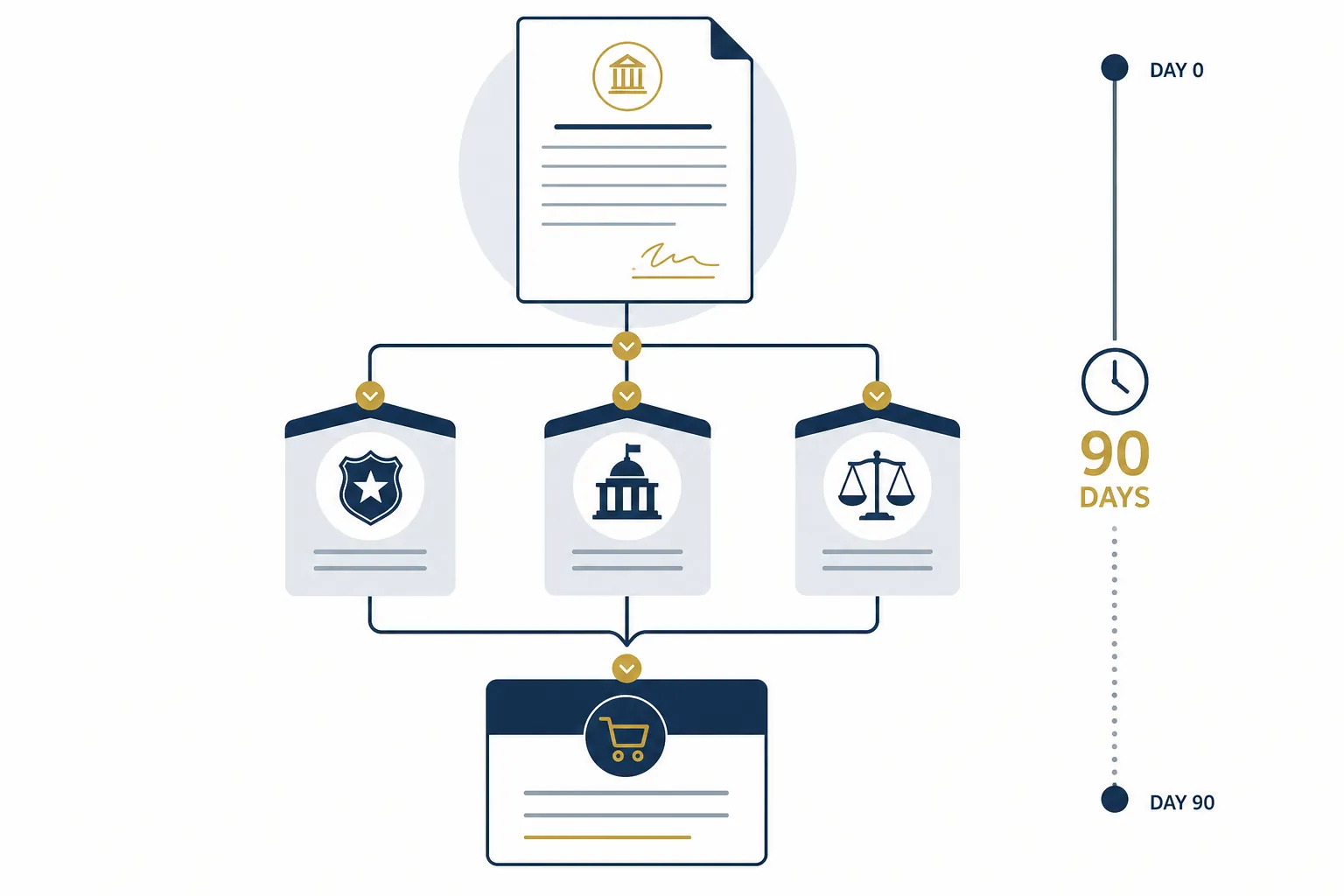
For litigation-risk purposes, the order is best read as a placeholder until DPS issues the actual standards. The 90-day period points to late October 2026, depending on how the city counts the effective date. A complaint filed before then may have to fight ripeness problems unless the plaintiff can show an immediate contractual or bidding injury. A complaint filed after the standards issue will have a clearer target: the text of the disclosure requirements, the scoring rubric, the disqualification triggers, and the process available to a vendor that disputes the city’s conclusion.
The most defensible version of the standards would keep the chain tight: identify the supplies being purchased, explain the safety and reliability interests attached to those supplies, define the required disclosures, distinguish mandatory disqualification from discretionary weighting, and provide a record-based path for vendors to contest errors. The least defensible version would use elastic phrases such as “flouting gun laws” without identifying which violations matter, how old they may be, whether a corrective action cures them, and who decides.
Existing contracts are the open file. If the order is applied only to future solicitations, Chicago’s position is cleaner. If the city attempts to add new eligibility conditions to current contracts, suspend purchase orders, terminate for reasons not already covered by contract language, or demand certifications not bargained for, the dispute becomes much less like a policy challenge and much more like a contract case.
The strongest challenge theories are ordinary ones
Procurement authority and bid fairness
A disappointed bidder’s first workable theory would likely sound in procurement law: DPS exceeded its delegated authority, used criteria not authorized by the solicitation, failed to apply standards uniformly, or relied on factors too remote from the city’s actual purchasing needs. That sort of claim is not flashy, but it is administrable. Courts know how to review whether a public buyer followed its own rules.
The city’s answer would also be conventional. Chapter 2-92 gives the procurement apparatus room to evaluate responsibility, compliance, and contractual risk.[3] A firearms supplier with repeated licensing violations, poor inventory controls, or documented noncooperation in investigations presents obvious performance and public-safety concerns for a municipal buyer. The city does not have to buy from every lawful seller. The harder question is how precisely DPS links each criterion to the purchase at hand.
Contract impairment and retroactivity
A vendor already under contract would look first at the agreement, not the press release. Does the contract allow the city to add compliance certifications? Does it contain termination-for-convenience language? Are purchase quantities guaranteed or merely optional? Is there a default clause that reaches the alleged conduct? Those questions decide whether EO 2026-04 merely guides future city purchasing or impairs an existing bargain.
A Contracts Clause theory should not be overstated without the contract text. Governments can regulate and can manage their own purchases; not every new public-policy condition creates unconstitutional impairment. But a retroactive procurement standard that blocks payment, cuts off orders, or creates new default triggers under a preexisting agreement would be a more serious target than a standard applied prospectively to a new solicitation.
Administrative process, vagueness, and uneven application
The standards will need definitions that survive contact with real vendor histories. A disclosed violation may be minor, old, contested, corrected, imposed by another jurisdiction, or unrelated to the goods Chicago is buying. A theft-prevention practice may be adequate for one class of supplier and insufficient for another. A cooperation-with-law-enforcement criterion may be simple when it means responding to trace requests, and much harder when it invites subjective judgments about attitude or advocacy.
That is where due-process and equal-protection theories become plausible. The claim would not be that a vendor has a constitutional right to a city ammunition contract. It would be that the city used vague criteria, treated similarly situated suppliers differently, failed to give a meaningful opportunity to correct the record, or made a disqualification decision without evidence that matched the standard.
The materials reviewed identify the still-pending litigation over Illinois’s Firearm Dealer License Certification Act, 430 ILCS 68, as a useful analogy rather than a controlling precedent. That challenge involved fees, security requirements, a $10,000-per-violation fine, and claims framed around equal protection, due process, the right to bear arms, and administrative-law objections.[5] The Illinois State Rifle Association also lists related litigation, but the docket posture should be checked before the case is cited as current authority.[6]
Speech and unconstitutional conditions
A First Amendment claim is possible, but it depends on what DPS writes. If the city asks about licensing compliance, inventory security, diversion controls, and cooperation with investigations, the dispute is mostly about commercial conduct and procurement risk. If the standards penalize a vendor’s association with advocacy groups, public policy positions, or refusal to endorse the city’s gun-policy message, the unconstitutional-conditions issue becomes more serious.
This is also where the anti-boycott cases matter, but only as a caution. The Duke Center’s discussion of gun-industry anti-boycott laws notes litigation over whether refusal-to-deal policies are expressive conduct and how courts have treated certification requirements in public contracts.[7] EO 2026-04 sits in a mirror-image posture: Chicago is asking whether firearm vendors are responsible enough for city business, not requiring banks or contractors to certify that they do not boycott the gun industry.
Why the Second Amendment is not the center of gravity
A Second Amendment complaint would be politically intuitive and legally less direct. EO 2026-04 does not, on the reviewed record, prohibit private residents from possessing firearms, bar private dealers from selling to private customers, or create a citywide licensing regime. Chicago is deciding how it will spend city money. That purchaser posture does not eliminate constitutional scrutiny in every possible case, but it makes the usual right-to-keep-and-bear-arms framing a poor fit.
Illinois preemption also does not supply an obvious knock-out argument on the materials reviewed. Giffords describes Illinois as lacking broad state firearm preemption, while noting that 2013 FOID Act amendments preempt certain local handgun possession and registration rules for valid FOID holders and preserve room for local greater restrictions in specified areas.[8] NRA-ILA’s state-law summary likewise treats Illinois as a state with significant firearm regulation rather than a jurisdiction with a single blanket preemption rule wiping out all local action.[9]
The timing of Barnett v. Raoul and Bevis v. City of Naperville makes the Second Amendment route even less attractive as the lead theory. On July 9, 2026, the Seventh Circuit issued a 2-1 opinion upholding Illinois’s Protect Illinois Communities Act in litigation over semiautomatic weapons and related restrictions.[10] WTTW/AP reported the decision the next day and noted the continuing Supreme Court posture around semiautomatic-rifle litigation.[11] That does not decide EO 2026-04, and the National Shooting Sports Foundation’s planned petition should be tracked, but it shows that major Illinois gun regulation was still surviving appellate review days before the Chicago order.
The careful formulation is an absence-in-research finding: the reviewed materials did not identify a reported decision invalidating a municipal responsible-procurement rule on Second Amendment grounds. That should not be converted into a categorical conclusion. A docket search for new challenges is necessary, especially because EO 2026-04 was only days old as of this verification date.
The Texas comparison cuts the other way
Texas’s anti-boycott regime is useful because it shows how procurement can become the vehicle for firearm-policy fights. The Duke Center analysis describes Texas SB 19 and enforcement pressure involving major financial institutions, including Citigroup and Bank of America.[7] But Illinois has no equivalent SB 19-style anti-boycott statute in the materials reviewed. That absence matters. A vendor challenging Chicago cannot simply import the Texas framework and claim that Illinois has already forbidden the city from considering firearm-industry responsibility in procurement.
The better use of the Texas comparison is narrower: it reminds counsel to ask whether a procurement certification is regulating conduct, compelling speech, or conditioning access to public contracts on a policy pledge. EO 2026-04 may raise that problem if DPS drafts ideology-based certifications. It is less likely to do so if the standards stay anchored to licensing, violations, theft prevention, diversion controls, training, security, and investigation cooperation.
What to verify before the risk map hardens
The current legal map stops short of the most important facts. Before advising that EO 2026-04 is either safe or vulnerable, counsel should verify the following items:
- The full signed EO 2026-04 text against the City Clerk source PDF, not only the press release or local coverage.
- The DPS standards issued under the 90-day directive, including definitions, scoring rules, mandatory exclusions, cure rights, and appeal or protest procedures.
- Whether Chicago has existing firearm, accessory, or ammunition contracts that the city intends to amend, suspend, terminate, or allow to expire.
- The city’s actual annual spend and current vendor identities, which were not established in the reviewed same-week reporting.
- Any filed bid protest, declaratory-judgment action, state-court contract claim, or federal constitutional complaint after the standards issue.
- The Supreme Court posture of Barnett / Bevis and related semiautomatic-rifle litigation, including any NSSF petition.
- The current docket posture of the Illinois firearm-dealer licensing litigation before using it as more than an analogy.
Until those documents are available, the best prediction is modest: EO 2026-04 is more likely to be tested through procurement authority, contract rights, and administrative regularity than through a pure Second Amendment challenge. The order’s fate will be written less in the mayoral announcement than in the DPS standards that follow it.
References
- Mayor Brandon Johnson Signs Executive Order Establishing Firearm Procurement Standards, City of Chicago, July 29, 2026.
- Executive Orders, Chicago City Clerk.
- Chapter 2-92 Department of Procurement Services, Municipal Code of Chicago.
- Mayor Johnson Signs Executive Order Designed to Ban Purchases From Gun Dealers Who Flout Laws, WTTW, July 29, 2026.
- Firearms dealers, state rifle association challenge new licensing law, Capitol News Illinois.
- Litigation, Illinois State Rifle Association.
- The Gun Industry and the New Anti-Boycott Laws, Duke Center for Firearms Law, August 2023.
- Preemption of Local Laws in Illinois, Giffords Law Center.
- Illinois Gun Laws, NRA-ILA.
- Barnett v. Raoul / Bevis v. City of Naperville, No. 24-3063, U.S. Court of Appeals for the Seventh Circuit, July 9, 2026.
- Federal Appeals Court Upholds Illinois Ban on Semiautomatic Weapons, Overturning Lower Court, WTTW/AP, July 10, 2026.
Operationalizing workflow
No workflow has been explicitly linked to this obligation yet. See Workflows generally.
Illustrative cases
No illustrative case is currently tracked for this obligation. See Risk Digest for documented incidents generally.
← Back to RegulationReport a correction or tip
Spotted an outdated figure, a misstated fact, or a ruling this regulation entry should reflect? Public comments are disabled for this content given the professional cost of a misreported case outcome, penalty amount, or rule text — use the structured correction channel instead.
Report a correction or tip for this record →