
Cislunar Space Debris Regulation Has a Legal Vacuum
- Authority
- United Nations Office for Outer Space Affairs (UNOOSA)
- Rule type
- treaty
- Jurisdiction scope
- International
- Source text
- Read primary rule text ↗
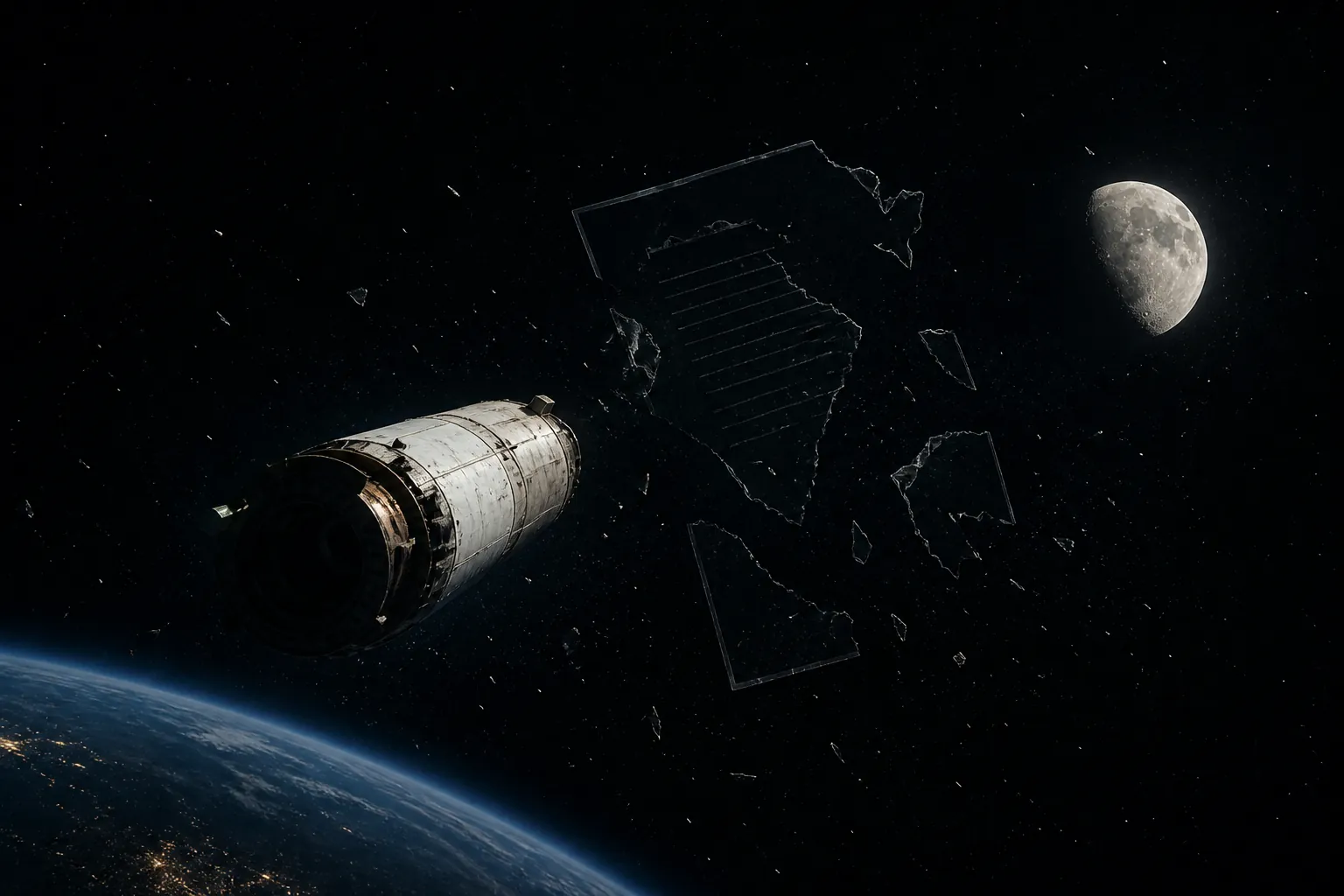
A derelict Falcon 9 upper stage, cataloged as 2025-010D, is expected to strike the Moon on August 5, 2026. As of July 31, the legal record is already being assembled, while the factual record is necessarily unfinished: no post-impact crater confirmation exists yet, and any imagery that could verify the result remains a future step. What can be assessed now is narrower and more useful for counsel: if the impact creates cislunar debris, the available legal tools do not yet provide a reliable way to make a state or operator pay for it.
The working answer is uncomfortable because it is not the same as saying space law is silent. The Liability Convention contains a fault route for damage outside Earth’s surface. U.S. regulators have licensing authority over launches and communications. Debris mitigation rules exist for familiar orbital regions. The problem is that each system fails at the point where a claimant would need it most: proof, attribution, and an enforceable disposal duty for the object that is actually headed toward the Moon.
This is a regulation-and-ethics analysis, not legal advice. It also treats the August 5 impact as an imminent event, not as an already confirmed debris incident.
The Falcon 9 Impact Is a Liability Test, Not Just a Disposal Failure
The upper stage’s legal significance begins with a technical fact: after trans-lunar injection, there may be little practical propellant margin left for a meaningful disposal maneuver. TechTimes reported that 2025-010D lacked propellant for disposal because the outgoing burn consumed nearly all available fuel, and that controlled disposal would require delta-v comparable to the trans-lunar injection burn itself.[1]
That fact matters because it separates two questions that are often blurred. One question is whether a mission designer can, in some cases, reserve propellant for post-injection disposal. Another is whether a regulator has required that reserve as a condition of launch or licensing. The first question is technical and economic. The second is legal. In this incident, the legal gap is the more durable one.
The same TechTimes report noted that SpaceX voluntarily demonstrated a solar-orbit disposal approach on the EscaPADE mission in November 2025 by carrying additional propellant, at a payload-capacity cost.[1] That does not prove every lunar or cislunar mission can absorb the same tradeoff. It does show why a blanket claim that disposal is impossible should not end the conversation. Where a capacity-for-propellant trade exists, someone has to decide whether the cost belongs to the operator, the customer, the insurer, or the future mission that inherits the debris field.
Article III Looks Like a Door Until Evidence Has to Walk Through It
The Liability Convention is the obvious first place to look, and it is also where overconfidence begins. The Convention imposes absolute liability for damage caused by a space object on the surface of Earth or to aircraft in flight, while Article III uses a fault standard for damage occurring elsewhere, including damage to another state’s space object.[2] A cislunar debris claim would therefore have to do more than show that an object was launched and that harm occurred. It would have to establish fault.
Fault is not an abstract inconvenience. A claimant would need to connect a particular harmful fragment or collision event to a particular launching state’s space object, then show conduct that meets whatever fault standard a tribunal or diplomatic process accepts. No state or operator has ever been held liable for in-space debris damage under the Liability Convention, and the Convention’s best-known successful invocation, the Cosmos 954 matter, involved radioactive debris from a Soviet satellite scattered over Canadian territory in 1978, not a contested in-space debris collision.[2][3]
Cosmos 954 is useful, but only within its limits. It shows that a state can invoke the Convention and obtain compensation after a space object causes damage on Earth. It does not answer the harder cislunar question: how to prove fault when the alleged harmful material is not on a recoverable surface under national control, not continuously tracked, and not necessarily identifiable after fragmentation.
The distinction is not academic. A burned crater on Canadian territory can be sampled, mapped, and tied to a known reentry event. A shard moving through cislunar space may be untracked from the start. If it later damages a spacecraft, the claimant may know the spacecraft failed, may know a collision is plausible, and may even know that an earlier lunar impact occurred. None of that necessarily proves that the damaging particle came from 2025-010D, or from any other identified object.
The Missing Layer Is Attribution
Earth-orbit debris numbers are sometimes used too loosely in cislunar debates, but they are still a useful warning. Völkerrechtsblog describes an orbital debris environment with more than 170 million debris pieces, about 37,000 tracked by U.S. Space Command, and only about 1 percent detectable.[3] Those figures are not cislunar-specific measurements. They do, however, illustrate the practical defect in a liability rule that depends on identifying fragments in a domain where tracking is even less mature.
Cislunar tracking is not the same enterprise as cataloging active satellites in low Earth orbit. Active spacecraft can transmit, maneuver, and supply ephemeris data. A derelict upper stage may do none of those things. Once it is no longer transmitting and no longer controlled, the evidentiary burden shifts toward external observation. If that observation is sparse, delayed, or unable to characterize fragments, Article III becomes a paper remedy.
The relevant question is not simply whether a treaty exists. The sharper question is whether the treaty can be used by a claimant who must prove origin, causation, and fault in a region where the evidentiary infrastructure is still forming. On the present record, the answer is no reliable mechanism.
The Familiar Debris Boundary Stops Far Short of the Moon
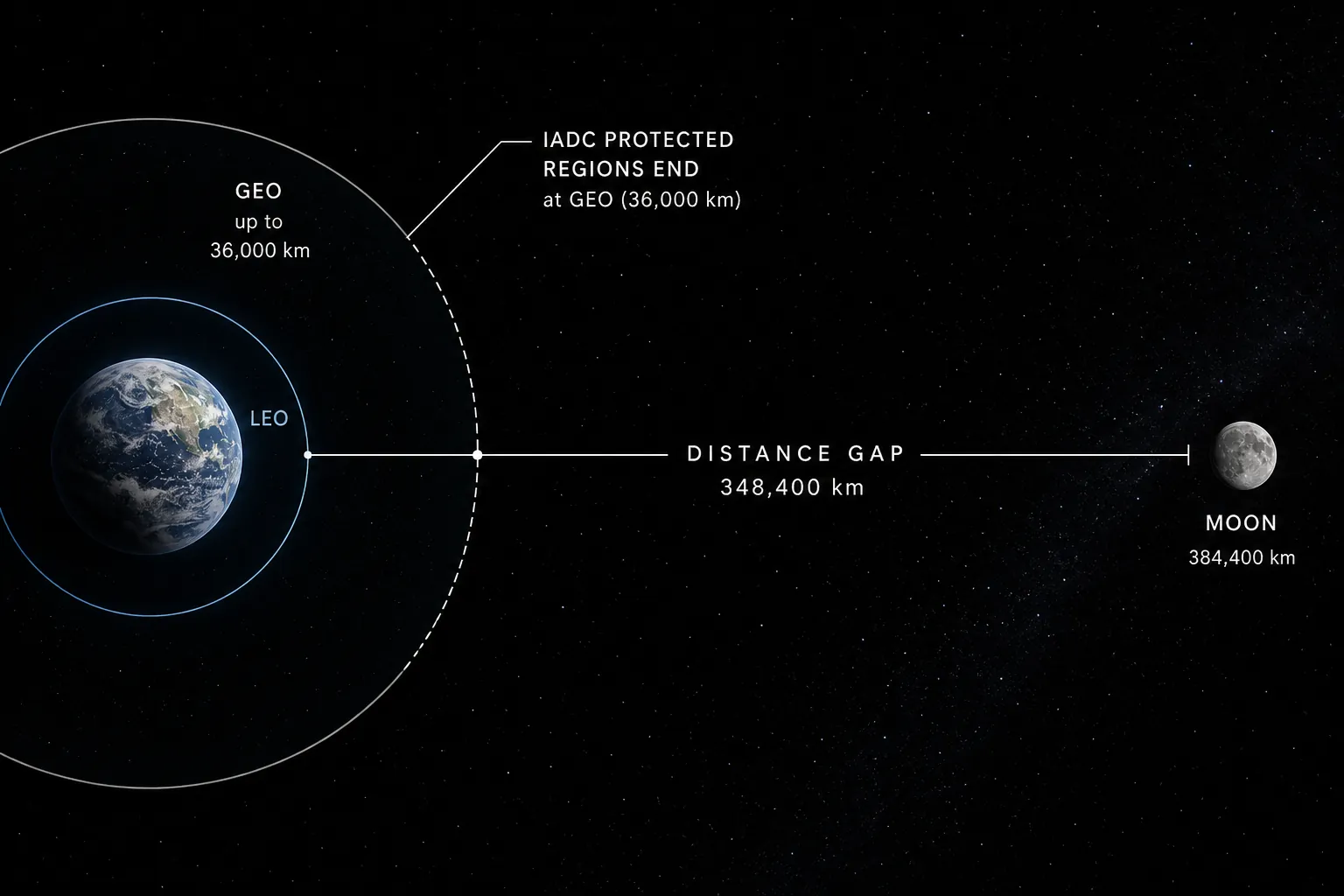
The protected-region problem is a useful corrective to casual assumptions about debris governance. The Inter-Agency Space Debris Coordination Committee’s protected regions extend to geosynchronous altitude, roughly 36,000 kilometers. Cislunar space reaches the Moon’s average distance of about 384,400 kilometers.[3] A rule set built around Earth-orbit protected regions does not automatically become a lunar-traffic rule just because both involve spacecraft.
| Legal or technical layer | What it can address | Where it fails for 2025-010D-style cislunar debris |
|---|---|---|
| Liability Convention Article III | Fault-based claims for damage outside Earth’s surface | Requires attribution, causation, and fault proof that cislunar tracking may not supply |
| Cosmos 954 precedent | Surface-damage compensation after recoverable debris on Earth | Does not establish an adjudicated standard for in-space debris claims |
| IADC protected regions | Debris mitigation assumptions through GEO-scale regions | Stops far inside the Earth-Moon distance |
| FCC Part 100 VTSS licensing | Licensing for commercial lunar spacecraft and active RF systems | Does not impose disposal duties on trans-lunar injection upper stages |
| FAA launch rulemaking | Potential authority to set upper-stage disposal obligations | The proposed 25-year disposal rule was withdrawn with no replacement |
The practical consequence is that a familiar compliance file may look complete while leaving the cislunar risk untouched. A launch authorization, a communications license, and ordinary debris-mitigation analysis can coexist with a derelict object that no one is required to dispose of after trans-lunar injection.
U.S. Rules Do Not Fill the Gap
The domestic regulatory stack is not empty. It is worse, from a risk-advice standpoint: it is active in adjacent places and quiet at the point of failure. TechTimes reported that the FAA formally withdrew its proposed 25-year upper-stage disposal rule on January 15, 2026, after 40 industry comments raised cost concerns and the agency cited a need for further study. No replacement had been proposed in the materials reviewed.[1]
That withdrawal matters because upper-stage disposal cannot be backfilled after launch. If a trans-lunar injection stage is not required to carry the propellant, hardware, planning margin, or mission design needed for disposal before departure, the later legal file is mostly an exercise in explaining why no one can do much once the object is derelict.
The FCC’s new Part 100 rules do not solve that problem. Part 100, effective July 22, 2026, created a Variable Trajectory Space Station licensing category for commercial lunar spacecraft. But the reported rule contains no disposal requirement for trans-lunar injection upper stages, and its mandatory space situational awareness data-sharing applies to active, transmitting RF systems rather than derelict, non-transmitting objects such as 2025-010D.[1]
That distinction should not be treated as regulatory fine print. A spacecraft that transmits can participate in a licensing and data-sharing system. A dead upper stage cannot. If the object is outside the class of systems that must share data and outside a rule that requires disposal, the regulator may have visibility into the mission without having a tool that prevents the debris-generating outcome.
Disclosure Is Not Disposal
For counsel, the distinction between disclosure and disposal is central. A license condition that improves space situational awareness may help operators avoid known active objects. It may also improve the record if a spacecraft is being tracked and communicating. It does not necessarily reduce the number of uncontrolled objects created by mission architecture, and it does not create a compensation path for later damage.
This is where a board memo can go wrong. It is tempting to say the company is operating in a regulated environment, has obtained the required authorizations, and has complied with available communications rules. All of that may be true. It does not establish that the company faced an enforceable cislunar upper-stage disposal obligation, nor that a third party would have a workable damages claim if debris later caused harm.
The Hazard Is Long-Lived, Even If the Claim Is Weak
The absence of a reliable liability mechanism does not mean the operational risk is trivial. TechTimes, citing Aerospace Corporation analysis, reported that a single cislunar collision could create hazard fields persisting for thousands of years because debris in that region does not decay through atmospheric drag.[1] Because the underlying Aerospace page was not available in the research materials, that point should be used cautiously and as a secondary-source assessment, not as an independently reviewed finding here.
Even in cautious form, the point changes the insurance and procurement conversation. Low Earth orbit debris may eventually decay depending on altitude and conditions. Cislunar debris can remain a mission-planning consideration for far longer. That persistence makes weak legal accountability more troubling, not less: the party least able to prove causation may still bear the operational cost of avoidance, shielding, redundancy, or mission redesign.
There is also a fragmentation risk in governance. Norms and policy proposals can influence behavior, but they do not bind all major space actors in the same way. If cislunar debris practice develops through voluntary measures, national licensing choices, and coalition-based commitments, counsel should assume uneven duties across counterparties rather than a single global compliance baseline.
What Exposure Looks Like When Liability Is Unlikely
The phrase “liability vacuum” should not be misread as “risk-free.” It means a claimant lacks a dependable path to legal recovery under existing international and U.S. mechanisms for this kind of cislunar debris creation. It does not mean a launch provider, mission sponsor, or customer can ignore the issue in contracts, disclosures, insurance submissions, or environmental and mission-assurance reviews.
The exposure is likely to appear first in documents that do not look like litigation pleadings. A customer may ask whether the mission reserves propellant for disposal. An insurer may ask whether a derelict stage will remain on an impact trajectory. A counterparty may seek indemnity for debris-related mission effects. A securities or financing reviewer may ask whether the company’s public sustainability language matches its disposal practices. None of those questions requires an adjudicated Liability Convention claim to become expensive.
- For launch providers, the immediate pressure point is whether disposal capability is priced, offered, declined, or technically unavailable for a specific mission.
- For payload customers, the issue is whether contract documents allocate the consequences of a non-disposed upper stage rather than assuming regulation has already done so.
- For insurers, the concern is not only third-party liability but the evidentiary difficulty of proving what object caused a later anomaly.
- For boards and risk committees, the question is whether “lawful launch” is being treated as equivalent to “controlled end-of-life outcome.”
A hypothetical illustrates the proof problem without pretending there is a decided case. Suppose a lunar-orbiting spacecraft later suffers damage consistent with a high-velocity particle strike. If the operator cannot identify the particle, cannot tie it to a cataloged fragment, and cannot show that the fragment originated from a specific prior upper-stage impact, the legal theory may never get past causation and attribution. The business loss may be real while the legal claim remains unusable.
The Narrow Q3 2026 Judgment
As of Q3 2026, no existing international or U.S. mechanism reliably holds a state or operator liable for cislunar debris created by a derelict trans-lunar injection upper stage striking the Moon. The Liability Convention offers a nominal fault route, but the evidence layer is not mature enough to make attribution and proof dependable. U.S. regulators have created adjacent licensing and data-sharing obligations, but they have not imposed a disposal mandate on the relevant upper stages.
For counsel, the operational implication is plain. The absence of enforceable liability today does not remove procurement, insurance, mission-design, or disclosure risk tomorrow.
References
- Dead Rocket Hits Moon Aug. 5: New FCC Cislunar Category Has No Disposal Mandate, TechTimes, July 30, 2026.
- Liability Convention text, UNOOSA.
- The Limits of Liability: How Millions of Untraced Pieces of Space Debris Challenge Attribution and Requirements for Evidence under the Liability Convention, Völkerrechtsblog.
Operationalizing workflow
No workflow has been explicitly linked to this obligation yet. See Workflows generally.
Illustrative cases
No illustrative case is currently tracked for this obligation. See Risk Digest for documented incidents generally.
← Back to RegulationReport a correction or tip
Spotted an outdated figure, a misstated fact, or a ruling this regulation entry should reflect? Public comments are disabled for this content given the professional cost of a misreported case outcome, penalty amount, or rule text — use the structured correction channel instead.
Report a correction or tip for this record →