
Where the CLARITY Act stands and what changes for XRP
- Authority
- U.S. Congress
- Rule type
- pending legislation
- Jurisdiction scope
- US federal
- Source text
- Read primary rule text ↗
No operative CLARITY Act obligations until the bill is enacted and effective.
Status record — last verified Aug. 2, 2026
Pending-legislation flag: H.R. 3633, the Digital Asset Market Clarity Act of 2025, is the bill being tracked here; it is not an operative statute as of Aug. 2, 2026, and no CLARITY Act change can yet be treated as in force for XRP, exchanges, custodians, funds, or institutional holders. The primary bill record is the Congress.gov page for H.R. 3633.[1]
The current status chain is narrow and date-sensitive. The House passed the bill on July 17, 2025, by a 294-134 vote; Galaxy Research reported that the vote included all 216 voting Republicans and 78 Democrats.[2] The Senate Banking Committee advanced the bill on May 14, 2026, by a 15-9 vote, with 13 Republicans and 2 Democrats in favor, according to contemporaneous policy tracking.[3] On July 22, 2026, the Senate released an updated 616-page text that merged Banking and Agriculture Committee work and added a government-ethics title.[3][4] On July 23, 2026, CoinDesk reported Majority Leader John Thune’s timing remarks and the leadership-reported problem of clearing a 60-vote Senate floor test before the Aug. 10 recess, after an Aug. 7 target window.[5]
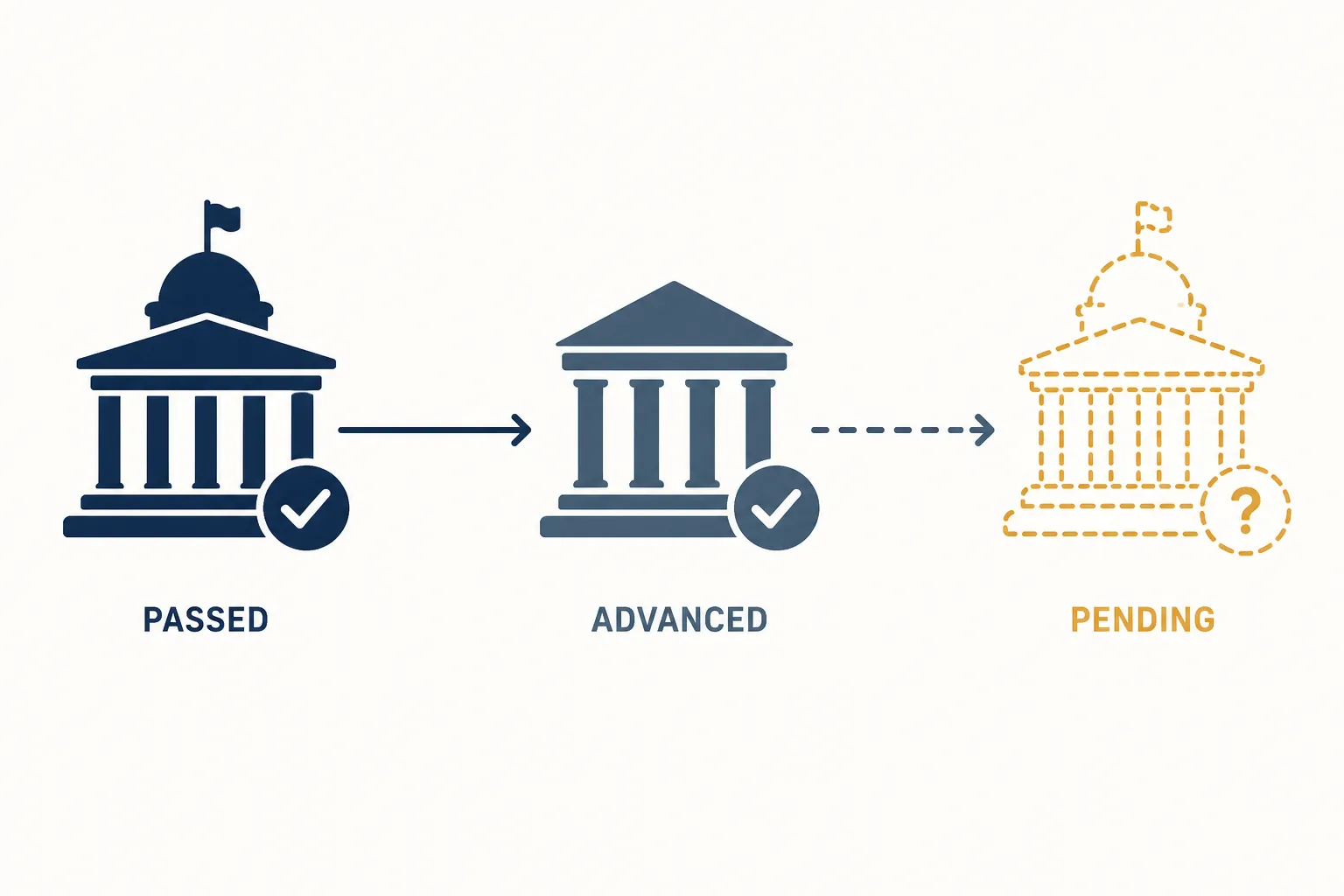
Those procedural facts do most of the work. A House vote, a committee advance, and a released Senate text are not the same instrument as enacted law. For an XRP-touching compliance memo, the CLARITY Act is therefore a conditional planning document, not a current authority. The Aug. 7 and Aug. 10 dates are political timing windows, not statutory deadlines.
For the underlying agency taxonomy that currently supports much of the market’s XRP analysis, this record should be read alongside the SEC/CFTC digital-asset taxonomy record. The important distinction is that the March 2026 taxonomy is an agency interpretation; the CLARITY Act would be a statute only if Congress enacts it.
What is actually in force for XRP now
XRP’s current digital-commodity treatment rests on two non-statutory layers. The first is Judge Analisa Torres’s July 13, 2023 summary-judgment order in SEC v. Ripple, which distinguished Ripple’s programmatic exchange sales from institutional sales; the court held that the programmatic sales did not constitute securities transactions, while institutional sales did.[6] That is a litigation ruling, not a market-structure statute.
The second layer is the SEC/CFTC joint interpretation released on March 17, 2026. The agencies described how federal securities and commodities laws apply to crypto assets, and the interpretive release names XRP within a futures-linked digital-commodity classification.[7][8] That is useful authority for operational analysis, but it remains sub-statutory. A later agency interpretation can move; a statute is harder to move.
The Ripple litigation still matters because it marks the boundary of what should not be smuggled into the CLARITY Act. The bill does not erase the court’s institutional-sales holding. Commissioner Caroline Crenshaw’s May 8, 2025 statement criticized the Ripple settlement and treated the institutional-sales portion as effectively left without meaningful enforcement consequences, but that enforceability criticism is not the same as statutory validation of every Ripple position.[9]
What CLARITY would change for XRP if enacted
The operative word is “would.” No source in the record says the CLARITY Act names XRP. The bill works through asset and transaction categories. For XRP, the practical question is whether current commodity-treatment support would become statutory and what new obligations would attach to intermediaries that list, custody, broker, deal in, or provide institutional exposure to XRP.
| Issue for XRP analysis | What the CLARITY Act would do if enacted | Operational consequence |
|---|---|---|
| Asset classification | Create an “investment contract asset” concept: a digital commodity sold as part of an investment contract would not itself become an investment contract, and certain secondary distributions by unrelated parties would not be securities transactions.[10][11] | This is the statutory move closest to the Torres programmatic-sales logic. It would help separate XRP as an asset from particular fundraising or distribution transactions involving XRP. |
| SEC/CFTC jurisdiction | Give the CFTC jurisdiction over digital commodities while narrowing SEC jurisdiction over covered digital-asset transactions, with SEC anti-fraud authority retained.[10][12] | An XRP venue would not simply exit federal oversight. The regulator map would shift, but anti-fraud exposure and transaction-specific securities analysis would remain relevant. |
| Mature blockchain status | Use a mature-blockchain certification process with an SEC notice-and-object mechanism.[10][12] | A market participant would need to track certification status and objections rather than rely only on the March 2026 agency interpretation. |
| Primary transactions | Provide an exemption for up to $75 million in digital-commodity primary transactions over a 12-month period, modeled in part on Regulation A+ Tier 2 concepts.[10][11] | This would matter most to issuers and affiliated distributors. It would not automatically bless earlier institutional-sales conduct or ordinary secondary-market holding. |
| Exchange, broker, and dealer registration | Create CFTC registration regimes for digital commodity brokers, digital commodity dealers, and digital commodity exchanges.[10] | An XRP listing decision would become less about proving the asset is outside securities law and more about satisfying the relevant CFTC market-intermediary regime. |
| Custody by futures commission merchants | Permit futures commission merchants to use qualified digital asset custodians, or QDACs, for digital-commodity custody.[4] | Custody policies for XRP would need to map to the QDAC framework if the participant is operating through an FCM structure. |
| Timing | Use a 360-day post-enactment effective date in the July 2026 Senate text.[4] | Even after enactment, implementation would not be instantaneous. Compliance calendars should start from enactment, not from committee approval or press coverage. |
The “investment contract asset” provision is the most XRP-relevant drafting move because it addresses a recurring confusion in token litigation: whether the thing sold and the legal relationship around the sale must be treated as the same object. In the Ripple order, that distinction drove the different treatment of programmatic and institutional sales.[6] In the CLARITY Act framework, the distinction would become a market-structure rule rather than a case-specific holding, but only within the bill’s statutory terms.[10][11]
That matters for compliance because a venue listing XRP, or a fund holding XRP, does not need a narrative of token-holder vindication. It needs a source that can be cited in a risk memo. Today, the strongest sources are the Torres order and the March 2026 SEC/CFTC interpretation. If enacted, CLARITY would add a statutory layer above them.
The bill’s category is not identical to the March 2026 agency category
The March 2026 interpretation is important because it expressly names XRP, but it should not be treated as a preview table for the bill. The interpretation uses a futures-linked digital-commodity classification, while the CLARITY Act’s summaries describe a statutory digital-commodity framework tied to assets intrinsically linked to a blockchain system and, for some purposes, a mature-blockchain process.[8][10] Those are related ideas. They are not interchangeable legal tests.
The count also needs care. The SEC/CFTC interpretive materials identify 16 futures-linked digital commodities, including XRP; Jenner & Block’s analysis also discusses two additional examples in its read of the interpretation, which should not be converted into a different official list count.[8][13]

Consequences for exchanges, custodians, and institutional holders
For an exchange, the immediate answer remains unchanged: CLARITY is not yet a listing authority. The current record for XRP still starts with the Torres programmatic-sales holding and the March 2026 interpretation.[6][8] If the bill becomes law, the exchange analysis would shift toward whether XRP fits the statutory digital-commodity category, whether any mature-blockchain certification or objection process affects the asset, and which CFTC registration route applies to the venue.
For a custodian, the bill would not merely answer “commodity or security.” It would create custody-specific questions, especially for firms operating around futures commission merchant structures and QDAC custody. A custodian holding XRP for institutional clients would need to identify whether its role is pure custody, exchange-adjacent custody, FCM-related custody, or another arrangement touched by the new CFTC intermediary categories.[4][10]
For a fund or institutional investor, the cleaner statutory classification would be useful but not self-executing. Investment guidelines, counterparty questionnaires, and custody agreements would still need to distinguish spot XRP exposure from participation in a primary distribution, structured product, lending arrangement, or other transaction that may introduce separate securities, commodities, banking, or anti-fraud issues. The CLARITY Act’s retained SEC anti-fraud authority is one reason the classification answer should not be treated as the end of the review.[10][12]
For Ripple or any other issuer-like participant, the $75 million over 12 months exemption would be a forward-looking transactional tool if enacted, not a retroactive cure. It would matter when designing future primary distributions. It would not rewrite the institutional-sales portion of the Ripple order.[6][10][11]
The Senate risk is procedural, but it affects reliance
The July 2026 Senate text added issues that matter because they can change the vote count. The updated draft added a government-ethics title that would bar covered federal officials and spouses from issuing or sponsoring digital assets, assign enforcement to the Attorney General, and sunset on Jan. 20, 2029, according to Paul Hastings and Davis Wright Tremaine summaries of the July 22 text.[3][4] That title is not an XRP classification provision, but it is part of the package the Senate would have to move.
The stablecoin-yield dispute belongs in the same category for this record: not because it changes XRP’s classification analysis directly, but because it affects whether the broader market-structure bill can assemble the votes needed for floor passage. CoinDesk’s July 23 report placed the timing problem in the context of leadership’s effort to move the bill before the summer recess and the difficulty of reaching the Senate’s 60-vote threshold.[5]
That is the practical reason to keep the pending flag visible. A firm may prepare systems, policies, and board materials against the July 2026 text. It should not sign a compliance position stating that the CLARITY Act has changed XRP’s legal treatment unless the bill has passed both chambers, been enacted, and reached the relevant effective date.
As-of-Aug. 2 position for XRP
As of Aug. 2, 2026, XRP already has meaningful support for digital-commodity treatment through the Torres programmatic-sales ruling and the SEC/CFTC’s March 2026 interpretation. That support is real enough to matter in exchange, custody, and institutional-holder analysis. It is not the same as statutory durability. The CLARITY Act would be the instrument that turns that support into a federal market-structure rule, but it remains pending until the Senate floor, final bicameral passage, enactment, and the bill’s own effective-date mechanics are satisfied.
References
- H.R.3633 - Digital Asset Market Clarity Act of 2025 — Congress.gov
- CLARITY Act Update: Final Push — Galaxy Research
- Senate Releases Updated CLARITY Act Text; SEC Commissioner Addresses Crypto Vaults; and SEC and CFTC Advance 24-Hour Trading — Paul Hastings
- Senate Updates Crypto Market Bill — Davis Wright Tremaine, July 2026
- CLARITY Act Expected to Miss Its Window Before Congress’ Summer Break, Leadership Says — CoinDesk, July 23, 2026
- SEC v. Ripple Labs, Inc. — U.S. District Court for the Southern District of New York, July 13, 2023
- SEC Clarifies Application of Federal Securities Laws to Crypto Assets — U.S. Securities and Exchange Commission, March 17, 2026
- Release No. 33-11412; Joint Interpretation Regarding Crypto Assets — U.S. Securities and Exchange Commission, 2026
- Crenshaw Statement on Ripple — U.S. Securities and Exchange Commission, May 8, 2025
- IN12584 — Congressional Research Service
- Congress Set to Bring CLARITY to Digital Asset Market Structure — WilmerHale, July 14, 2025
- The Facts: The CLARITY Act — U.S. Senate Committee on Banking, Housing, and Urban Affairs
- SEC and CFTC Issue Landmark Joint Interpretation on Crypto Asset Classification — Jenner & Block
Operationalizing workflow
No workflow has been explicitly linked to this obligation yet. See Workflows generally.
Illustrative cases
No illustrative case is currently tracked for this obligation. See Risk Digest for documented incidents generally.
← Back to RegulationReport a correction or tip
Spotted an outdated figure, a misstated fact, or a ruling this regulation entry should reflect? Public comments are disabled for this content given the professional cost of a misreported case outcome, penalty amount, or rule text — use the structured correction channel instead.
Report a correction or tip for this record →