
Is CMS's Part D Subsidy Cut Arbitrary and Capricious?
- Authority
- Centers for Medicare & Medicaid Services
- Rule type
- regulation
- Jurisdiction scope
- US federal
- Effective date
- Jul 28, 2026
- Source text
- Read primary rule text ↗
Provide reasoned explanation for policy change addressing reliance interests
The legal risk in CMS’s Part D move is not that a new administration changed course. Agencies do that. The risk is that CMS announced the Medicare Part D Premium Stabilization Demonstration in July 2024 as a program lasting “at least 3 years,” covering 2025 through 2027, and then, on July 28, 2026, ended it after two years on a public rationale reported as little more than the view that insurers now had “sufficient experience” to price Part D plans without the subsidy.[1][2] For lawyers assessing the legal implications of the Trump administration’s Medicare Part D subsidy change, that is the pressure point: the agency’s new explanation has to deal with the agency’s old explanation.
This is a pre-litigation assessment. No lawsuit had been filed as of the July 28, 2026 announcement, and the termination fact sheet itself was behind an authentication wall; the operative termination rationale is therefore being treated here as reconstructed from secondary reporting, not quoted as a verified CMS record.[2] The more reliable anchor documents are the July 2024 CMS memorandum, GAO’s May 2025 legal decision, GAO’s February 2026 performance audit, CRS’s January 2025 statutory background, KFF’s October 2025 market snapshot, and Avalere’s account of CMS’s 2025 modifications to the demonstration.[1][3][4][5][6][7]
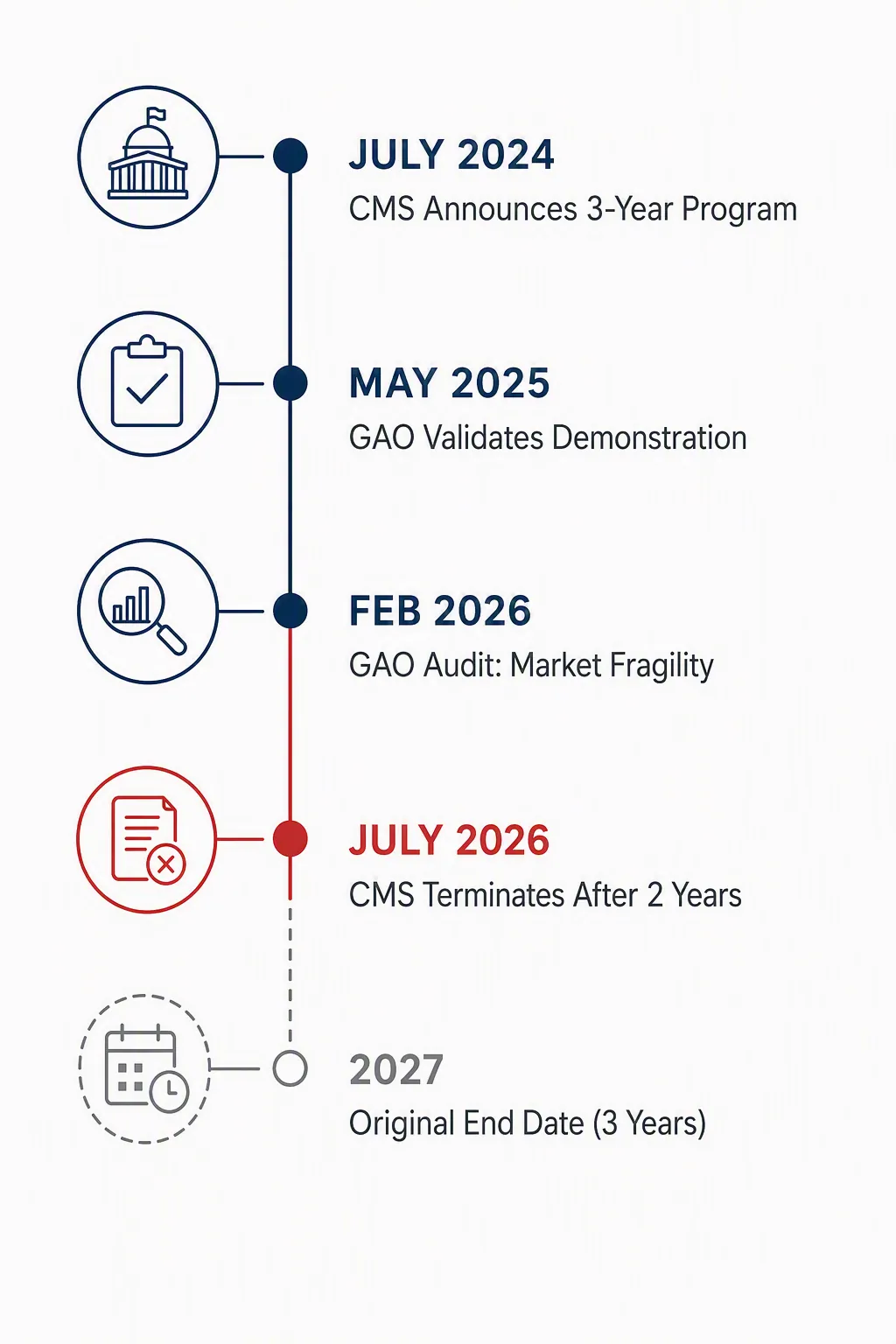
The vulnerable part is the gap between the 2024 record and the 2026 explanation
The July 2024 memorandum did more than announce a temporary payment experiment. CMS described the demonstration as lasting for a minimum of three years, framed it as a response to disruption risk in the stand-alone Prescription Drug Plan market, and connected the subsidy to preventing “widespread changes in enrollment” and disruption to access to medications.[1] Those statements matter because they are not just predictions floating outside the administrative record. They are the agency’s own account of why the demonstration needed a multi-year runway.
The participation design sharpened the reliance problem. CMS did not allow a sponsor to opt only selected PDPs into the demonstration, and it did not leave later entry open for sponsors that initially stayed out.[1] That structure asked sponsors to make an up-front, market-wide participation choice. When 96% of PDPs participated, the practical consequence was a broad market adjustment around the assumption that the demonstration would operate on the announced time horizon.[3]
That does not turn a demonstration into a permanent entitlement. It does make the agency’s explanation more demanding. A sponsor deciding whether to participate was not merely guessing at future politics; it was responding to a CMS framework that said partial participation was unavailable, late entry was unavailable, and the program would run for at least three years. If CMS later decided that the third year was unnecessary, it needed to explain why the earlier disruption findings no longer carried the same force.
The reported 2026 rationale does not yet appear to do that. Public accounts describe CMS as saying that, after two years, insurers had sufficient experience to price Part D plans without the subsidy.[2] That may be a defensible conclusion if backed by analysis. Standing alone, it is closer to a label than a reasoned answer to the 2024 memorandum. Experience with pricing is not the same thing as a finding that the market-stabilization concerns identified in 2024 have dissipated, that sponsors would remain in the PDP market without the third year, or that beneficiary disruption would remain within acceptable bounds.
GAO made the silence harder to defend
The May 2025 GAO legal decision is especially awkward for CMS if the termination record is as thin as reported. GAO concluded that the demonstration was consistent with Section 402 and observed that it created incentives for sponsors to remain in the PDP market.[3] A challenger would use that decision for a narrow but important point: the incentive structure was not incidental. It was the feature that made the demonstration legally intelligible.
GAO’s February 2026 audit then put numbers on the market fragility CMS had previously invoked. GAO reported that the five largest sponsors controlled 91% of stand-alone PDP enrollment, that the number of PDPs declined 22% from 2025 to 2026, and that without the demonstration roughly 37% of non-LIS stand-alone PDP enrollees would have faced premium increases exceeding $40 per month.[4] GAO also reported that premiums would have nearly doubled without the demonstration.[4]
Those figures do not prove that ending the demonstration in 2027 would actually cause the same projected harm. They were published before the termination announcement, and projections can be overtaken by later bid data, sponsor strategy, or market conditions. But they do identify the subjects CMS would be expected to confront: premium shock, sponsor concentration, PDP exits, and the demonstration’s apparent role in cushioning non-LIS enrollees. A termination explanation that says “sufficient experience” without grappling with those subjects invites a record-review problem.
KFF’s October 2025 snapshot points in the same direction without carrying the same legal weight as GAO. KFF reported that benchmark PDPs would fall to 88 in 2026, the lowest number since Part D began.[6] Again, that is not an injunction by spreadsheet. It is market context that makes a bare assurance of insurer pricing experience look underdeveloped.
What arbitrary-and-capricious review would ask
Under APA arbitrary-and-capricious review, the question is not whether the court would have kept the subsidy. The question is whether CMS examined the relevant data and articulated a rational connection between the facts found and the choice made. When an agency changes policy, FCC v. Fox Television Stations permits the change, but requires the agency to display awareness that it is changing position. And when the prior policy has engendered serious reliance interests, the agency must provide a more detailed justification than would be required for a blank-slate choice.[8]
That is where the three-year language becomes legally important. “At least 3 years” is not simply a political promise if the agency used it as part of a participation architecture that barred partial entry and later entry.[1] Sponsors had to decide how to bid, whether to remain in the PDP market, and whether to accept a demonstration that applied across their PDP offerings. Beneficiaries and beneficiary advocates, meanwhile, were told that the subsidy was designed to prevent widespread enrollment changes and access disruption.[1]
A court would not have to find that CMS was irrevocably bound through 2027. The more plausible plaintiff theory is narrower: CMS could terminate early only after acknowledging the prior three-year position, explaining why the disruption findings no longer justified the third year, and addressing the reliance created by the participation rules. If the final record contains only a short fact sheet and a generalized statement that insurers learned enough from two years of experience, the agency will have left the most important parts of its own file unanswered.
Avalere’s July 2025 account of CMS modifications reinforces that point in a modest way. CMS had previously adjusted the demonstration rather than abandoning it, which supports the inference that the agency treated the program as an ongoing mechanism capable of calibration.[7] That history would not prevent termination. It would, however, make a sudden cutoff more in need of explanation, particularly if CMS did not identify what changed between modification and abandonment.
The government has defenses, but they work best with a better record
CMS would not enter litigation empty-handed. Demonstrations are temporary by design. Section 402 gives CMS room to test payment approaches, evaluate them, and adjust course. The agency can argue that a demonstration announced as a test does not create a vested right to every projected year, and that the public interest does not require continuing a subsidy once the agency concludes the market can price without it.[3][5]
The government would also emphasize timing and uncertainty. GAO’s premium and enrollment figures were not final 2027 outcomes; they were projections and observations from an evolving market.[4] If CMS possesses later bid data showing that sponsors can price 2027 plans without serious disruption, that evidence could materially improve the agency’s litigation posture. Courts are often reluctant to transform an earlier policy memorandum into a freeze on later agency judgment, especially in a payment demonstration.
Those defenses depend on the record actually containing the work. An agency can change its mind after new experience. It cannot usually win arbitrary-and-capricious review by invoking “experience” as a substitute for explaining what the experience showed, how it relates to the earlier findings, and why the reliance interests are outweighed or no longer serious.
Standing may decide whether the merits are ever reached
The merits theory is easier to state than the plaintiff lineup. The parties with the cleanest economic injury may be PDP sponsors, but they are also regulated entities with ongoing business before CMS. That makes them plausible plaintiffs on paper and less predictable plaintiffs in practice.
| Potential plaintiff | Standing theory | Main difficulty |
|---|---|---|
| PDP sponsors | Economic injury from early loss of subsidy and disruption to bids or market participation decisions made under the three-year framework. | Sponsors may be reluctant to sue their primary regulator, and some may prefer commercial adjustment over litigation. |
| Beneficiary organizations | Diversion of resources, member premium injury, or member access disruption tied to the early cutoff. | They must connect injury to the termination rather than to general Part D market changes, sponsor decisions, or broader statutory redesign. |
| State attorneys general | State fiscal or quasi-sovereign injuries tied to premium increases, beneficiary disruption, or administrative burdens affecting residents. | They still need concrete injury and traceability, but they are the most practical lead plaintiffs under the available facts. |
Beneficiary organizations should not be dismissed, but they would need careful declarations. A generalized allegation that older adults dislike premium increases is not enough. The stronger version would identify members exposed to higher premiums or plan disruption because the third year of the demonstration was removed, and would explain how the organization had to divert resources to respond.
State attorneys general may be the most practical lead plaintiffs because they can absorb the institutional cost of suing CMS and may be able to frame injury around residents, state programs, and administrative burdens. That does not make standing automatic. It does make the litigation posture more realistic than waiting for a sponsor that participated in the demonstration to volunteer for a direct fight with the agency.
Likely strength of an APA challenge
On the materials currently available, an arbitrary-and-capricious challenge would be stronger than the ordinary objection to a subsidy cutoff. The claim would not be that CMS lacked all authority to end a temporary demonstration. It would be that CMS created a three-year participation structure, justified it by reference to disruption and PDP market stability, received intervening GAO analysis that validated and quantified those concerns, and then apparently ended the program one year early without addressing the relevant pieces of that record.
The claim is not guaranteed. The exact termination text needs verification. CMS may have additional analysis in the administrative record that public reporting has not captured. Courts may be cautious about ordering the continuation of a payment demonstration, particularly where the agency can argue that experience from 2025 and 2026 changed its predictive judgment for 2027.
Still, if the record resembles the public rationale, CMS has a Fox problem. The agency did not merely discontinue a discretionary benefit after a neutral expiration date. It cut off the announced third year of a demonstration whose own design induced broad sponsor participation and whose stated purpose was to prevent the very market disruption later documented by GAO. On that record, “sufficient experience” is not enough explanatory work.
References
- CMS July 2024 Memorandum, Centers for Medicare & Medicaid Services, July 2024.
- CMS July 28, 2026 Fact Sheet, Centers for Medicare & Medicaid Services, July 28, 2026.
- B-336645, Government Accountability Office, May 27, 2025.
- GAO-26-107935, Government Accountability Office, February 2026.
- IF12889, Congressional Research Service, January 30, 2025.
- KFF Snapshot, KFF, October 7, 2025.
- Avalere Health July 30, 2025 account of CMS modifications to the Part D Premium Stabilization Demonstration, Avalere Health, July 30, 2025.
- FCC v. Fox Television Stations, Inc., Supreme Court of the United States, June 29, 2009.
Operationalizing workflow
No workflow has been explicitly linked to this obligation yet. See Workflows generally.
Illustrative cases
No illustrative case is currently tracked for this obligation. See Risk Digest for documented incidents generally.
← Back to RegulationReport a correction or tip
Spotted an outdated figure, a misstated fact, or a ruling this regulation entry should reflect? Public comments are disabled for this content given the professional cost of a misreported case outcome, penalty amount, or rule text — use the structured correction channel instead.
Report a correction or tip for this record →