
What Coinbase Stock Drops Reveal About SEC Crypto Enforcement Risk
- Authority
- U.S. Securities and Exchange Commission
- Rule type
- regulation
- Jurisdiction scope
- US federal
- Source text
- Read primary rule text ↗
Coinbase stock made SEC crypto enforcement legible on June 6, 2023. The agency charged Coinbase with operating as an unregistered securities exchange, broker, and clearing agency, and the market translated that legal theory into an immediate roughly 12% single-day decline in the company’s shares.[1] That move is the cleanest entry point into the question behind the stock drop: not whether Coinbase was fairly priced that day, but what kind of regulatory risk investors and compliance teams were suddenly forced to recognize.
This is regulation-and-compliance analysis, not investment advice. The relevant trail starts with the SEC’s 2023 complaint release, runs through the February 27, 2025 dismissal with prejudice, and then keeps going because the dismissal did not answer every question a legal team would need answered before treating a crypto workflow as institutionally cleared.[1][2]

The 2023 Shock Was About Platform Structure
The SEC’s 2023 case was not a narrow disclosure dispute. It challenged Coinbase’s operating model by alleging that the company had made crypto asset securities available for trading while performing exchange, broker, and clearing-agency functions without registration.[1] For a public company whose business depends on matching buyers and sellers, custody-adjacent workflows, retail and institutional access, and confidence in platform continuity, that is a categorical threat.
A categorical threat is different from a bad quarter, a contested product claim, or a one-off enforcement inquiry. It asks whether the platform’s core structure is lawful under the regulator’s theory. That is why the June 2023 stock reaction mattered as a compliance signal. The roughly 12% drop did not prove the SEC was right on the law. It showed that public-market participants understood the case as a threat to the operating architecture, not merely to a line item.[1]
For legal-tech buyers and law-firm risk teams, the lesson from that first drop is procedural before it is directional. A stock chart can flag that a risk has become visible, but it cannot decide whether the risk has been adjudicated, settled, abandoned, or merely reprioritized. The docket posture still has to be read.
The 2025 Dismissal Removed the Overhang, Not the Theory
On February 27, 2025, the SEC dismissed its civil enforcement action against Coinbase with prejudice and without penalties.[2] That mattered. A dismissal with prejudice ended that case. It also freed Coinbase from defending the central lawsuit that had framed the company as an unregistered exchange, broker, and clearing agency. Coinbase estimated that the dismissal freed more than $50 million in annual legal costs, a practical number because it describes resources the company could stop spending on that fight and redirect elsewhere.[3]
But the key sentence in the SEC release was not the word “dismissed.” It was the caveat: the decision “is not based on any assessment of the merits” and did not state the Commission’s position on any other case.[2] That language does a great deal of work. It prevents the dismissal from becoming a merits ruling. It also prevents Coinbase’s outcome from becoming a reliable shortcut for other platforms, tokens, custody models, staking programs, or trading interfaces.
There is a real business difference between a case that has been dismissed and a legal theory that has been invalidated. Coinbase received the former. It did not receive the latter. The distinction is not academic for compliance teams that must document why an institutional crypto workflow is permissible, what assumptions support that conclusion, and which assumptions would need review under a different SEC chair, a different enforcement director, or a materially different fact pattern.
| Question | What changed in 2025 | What did not change |
|---|---|---|
| Is Coinbase still defending the main 2023 SEC platform-structure case? | No. The case was dismissed with prejudice and without penalties. | The dismissal did not decide whether the SEC’s 2023 legal theory was correct. |
| Can other crypto matters cite the dismissal as binding merits precedent? | No practical precedent was created by the dismissal itself. | The SEC said the dismissal did not reflect its position on any other case. |
| Did the company’s operating room improve? | Yes. Coinbase estimated more than $50 million in annual legal cost savings. | Cost relief is not the same as immunity from future enforcement, disclosure, fraud, or custody issues. |
This is the hinge in the Coinbase record. The existential case was gone. The archived theory remained readable.
The SEC Posture Shift Is Real, With Methodological Limits
The dismissal did not happen in isolation. By the time the SEC’s 2026 examination priorities were published in November 2025 for the fiscal year running October 1, 2025 through September 30, 2026, crypto no longer appeared as a named priority. That was a sharp break from 2024 and 2025, when crypto had dedicated treatment in the exam-priority materials.[4]
Enforcement counts tell the same story in broad outline, though not with the precision some commentary assigns to them. Cornerstone Research counted 33 SEC cryptocurrency enforcement actions in calendar 2024 and 13 in calendar 2025, a 60% decline. It also reported cryptocurrency-related monetary penalties of $142 million in 2025, compared with more than $4.7 billion in 2024.[5] Those figures support a posture shift, but they are calendar-year crypto-specific counts. They should not be blended casually with the SEC’s fiscal-year enforcement totals, which use a different reporting frame and include categories such as follow-on administrative proceedings.
The SEC reported 456 total enforcement actions for fiscal year 2025 and $808 million in financial remedies, the lowest monetary total since 2012.[6] That agency-wide figure says something about enforcement output under that fiscal-year methodology. It does not, by itself, answer how much crypto-specific risk remains for a particular trading platform, broker-dealer affiliate, token issuer, custodian, or data product.
The disciplined reading is narrower and more useful: the SEC moved away from broad crypto-platform confrontation during this period, but the materials do not support a conclusion that crypto enforcement risk disappeared.
The Remaining Risk Is Smaller and More Fact-Specific
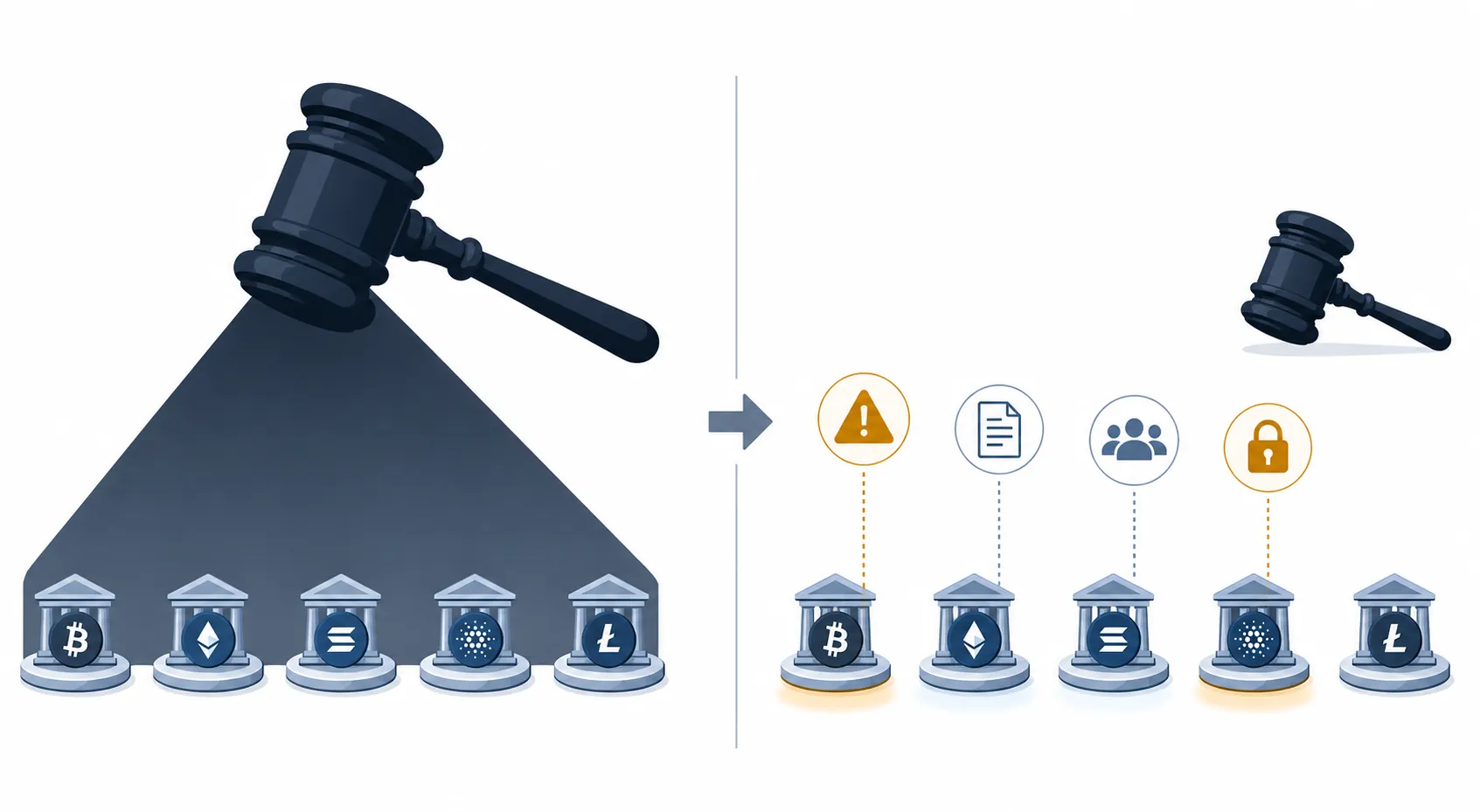
Once the main platform-structure case was dismissed, the compliance question changed. It became less useful to ask, “Has Coinbase beaten the SEC?” and more useful to ask, “Which fact patterns still invite SEC attention?” The answer is not one category. It is a cluster of triggers: user metrics, fraud representations, custody controls, disclosures, conflicts, token-specific facts, and future enforcement priorities.
The clearest example is the separate SEC investigation into Coinbase’s “verified user” metric. On May 15, 2025, secondary reporting described a New York Times report that the SEC was investigating whether Coinbase had misrepresented that user-count metric. Coinbase stock fell roughly 7% that day.[7] That move should not be treated as a clean user-metric investigation reaction. The same news window included Coinbase’s disclosure of a cyberattack with estimated costs of $180 million to $400 million, so the price move is confounded.[7]
The user-metric matter matters anyway because it is a different kind of risk. It does not require the SEC to revive the full 2023 exchange-broker-clearing-agency theory. A metrics investigation can proceed through ordinary disclosure and misrepresentation concepts. If a platform tells investors, counterparties, or customers something material about users, assets, controls, volumes, custody, or security, the legal exposure may turn on the accuracy and context of that statement rather than on the platform’s entire regulatory classification.
Antifraud authority also survived the posture shift. In the SEC’s fiscal 2025 enforcement results, the agency highlighted December 2025 charges against three purported crypto trading platforms accused of defrauding retail investors of more than $14 million.[6] That case does not prove that Coinbase faces comparable allegations. It proves the narrower, more durable point: when the alleged conduct fits traditional fraud theories, crypto-specific retrenchment does not disable the SEC.
How a Compliance Team Should Translate the Coinbase Record
A legal team evaluating a crypto-trading workflow in Q3 2026 should not copy the market’s emotional arc from panic to relief. It should separate the Coinbase record into different risk files. One file contains the dismissed categorical platform-structure case. Another contains preserved legal theories that were not tested on the merits. A third contains live or potentially live scenario-specific triggers. A fourth contains non-regulatory shocks that can still affect business continuity, revenue, and counterparty confidence.
- Platform-structure risk: document whether the workflow depends on exchange, broker, clearing, custody, staking, or settlement functions that could be reclassified under a future enforcement posture.
- Disclosure and metric risk: inventory user counts, volume figures, assets-under-custody statements, security claims, liquidity descriptions, and institutional-client representations.
- Fraud and misrepresentation risk: treat ordinary antifraud controls as active even when crypto-specific examination priorities are quiet.
- Custody and control risk: map who holds assets, who can move them, how incidents are disclosed, and who reviews exceptions.
- Administration-change risk: preserve a dated record of the assumptions tied to the current SEC posture, because the 2025 dismissal did not foreclose future theories on the merits.
That framework is less tidy than saying the SEC got out of crypto. It is also closer to the documents. The SEC’s own dismissal language tells compliance teams not to overread Coinbase’s result.[2] The exam-priority silence tells them the current supervisory emphasis changed.[4] The enforcement statistics tell them crypto actions declined under the relevant counting methods.[5] The antifraud case tells them ordinary fraud theories still move.[6]
Market Moves Are Evidence, Not Legal Conclusions
Coinbase’s market record after the dismissal is useful precisely because it refuses to stay inside a simple regulatory narrative. The company’s S&P 500 inclusion, announced for May 19, 2025, sent the stock up roughly 24%, showing that index-fund mechanics and benchmark demand can overwhelm regulatory sentiment as a near-term price driver.[3] That move did not make the SEC’s 2023 theory weaker. It made Coinbase newly important to a different class of buyers.
The 2026 earnings record points in the other direction. Coinbase reported a GAAP net loss of $394 million in Q1 2026, with revenue down 31% year over year, and a GAAP net loss of $359.5 million in Q2 2026, with revenue down 18.5% year over year.[8][9] Those losses were tied to a crypto market downturn and weaker transaction revenue, not to a new SEC platform lawsuit. As of a July 30, 2026 market snapshot, Coinbase traded near $155 after the Q2 earnings miss, while a separate analysis put the stock’s 52-week range at $139 to $445.[8][10]
That volatility matters for compliance procurement in a different way than enforcement risk. A vendor or platform can be less exposed to one regulator’s active campaign and still be exposed to transaction-volume compression, asset-price cycles, cybersecurity costs, liquidity conditions, and investor expectations. Regulatory relief can improve the operating environment without stabilizing the business model.
What Actually Changed Hands
From 2023 through Q3 2026, Coinbase moved from facing a live SEC case against its platform architecture to operating after a dismissal with prejudice. That is a material reduction in enforcement overhang. It released legal spend, removed the central case from the docket, and coincided with a broader SEC retreat from crypto-specific enforcement emphasis.[2][3][4][5]
What did not change hands was a merits ruling. The SEC did not concede that Coinbase’s structure was lawful under the 2023 theory. It did not bind itself in other cases. It did not abandon antifraud authority. It did not eliminate the possibility that a later Commission could treat archived theories as usable pleadings rather than historical artifacts.[2][6]
So the practical judgment is limited but firm: as of Q3 2026, Coinbase no longer faces the same categorical SEC threat that drove the 2023 shock. Legal teams can update their risk files to reflect that change. They should not close them. The risk has narrowed into preserved theories, open or unresolved fact-specific inquiries, ordinary antifraud exposure, administration-change risk, and non-regulatory revenue shocks.
References
- SEC Charges Coinbase for Operating as an Unregistered Securities Exchange, Broker, and Clearing Agency, U.S. Securities and Exchange Commission, June 6, 2023.
- SEC Dismisses Civil Enforcement Action Against Coinbase, U.S. Securities and Exchange Commission, February 27, 2025.
- From SEC Crypto Lawsuit to S&P 500, Yahoo Finance.
- SEC is done with crypto, removes all mention from its agenda for 2026, CryptoSlate.
- SEC Cryptocurrency Enforcement: 2025 Update, Cornerstone Research.
- SEC Announces Enforcement Results for Fiscal Year 2025, U.S. Securities and Exchange Commission.
- Coinbase stock drops after cyberattack and news of a SEC investigation, Yahoo Finance, May 15, 2025.
- Coinbase earnings Q2 2026, CNBC, July 30, 2026.
- Coinbase Q2 earnings miss Wall Street estimates, TheStreet.
- Is Coinbase Stock Undervalued in 2026? Two Straight Losses and a $232 Street Target Say Look Closer, TIKR.
Operationalizing workflow
No workflow has been explicitly linked to this obligation yet. See Workflows generally.
Illustrative cases
No illustrative case is currently tracked for this obligation. See Risk Digest for documented incidents generally.
← Back to RegulationReport a correction or tip
Spotted an outdated figure, a misstated fact, or a ruling this regulation entry should reflect? Public comments are disabled for this content given the professional cost of a misreported case outcome, penalty amount, or rule text — use the structured correction channel instead.
Report a correction or tip for this record →