
Water Reform Threatens Mexicali's Colorado River Rights
- Authority
- Mexican Congress
- Rule type
- statute
- Jurisdiction scope
- Mexico (federal)
- Effective date
- Dec 1, 2025
- Source text
- Read primary rule text ↗
Bans private water sales; unused agricultural water reverts to the federal government.
For Mexicali farmers, the Colorado River water-rights dispute now turns on a domestic Mexican-law change, not only on the familiar treaty architecture at the U.S.–Mexico border. Mexico’s Congress approved a water-law reform in December 2025 that prohibits private sales of water and provides that unused agricultural water reverts to the federal government; the immediate affected group is Irrigation District 14 in the Mexicali Valley, reported to include roughly 17,000 concession holders.[1] That is the same valley where U.S.-funded conservation under the IBWC minute system has relied on paid fallowing and related reductions in use.
The timing is not academic. Minute 323 was signed on September 21, 2017, and runs through December 31, 2026.[2] The United States has committed about $96.5 million for conservation under Minutes 323 and 330, and U.S. officials confirmed that about $41.6 million had been paid as of late February 2026.[3] The legal risk is therefore not simply whether Mexico will continue cooperating on Colorado River conservation after 2026. It is whether the domestic concession interests that made the existing conservation bargain administratively workable are being changed before the bargain expires.
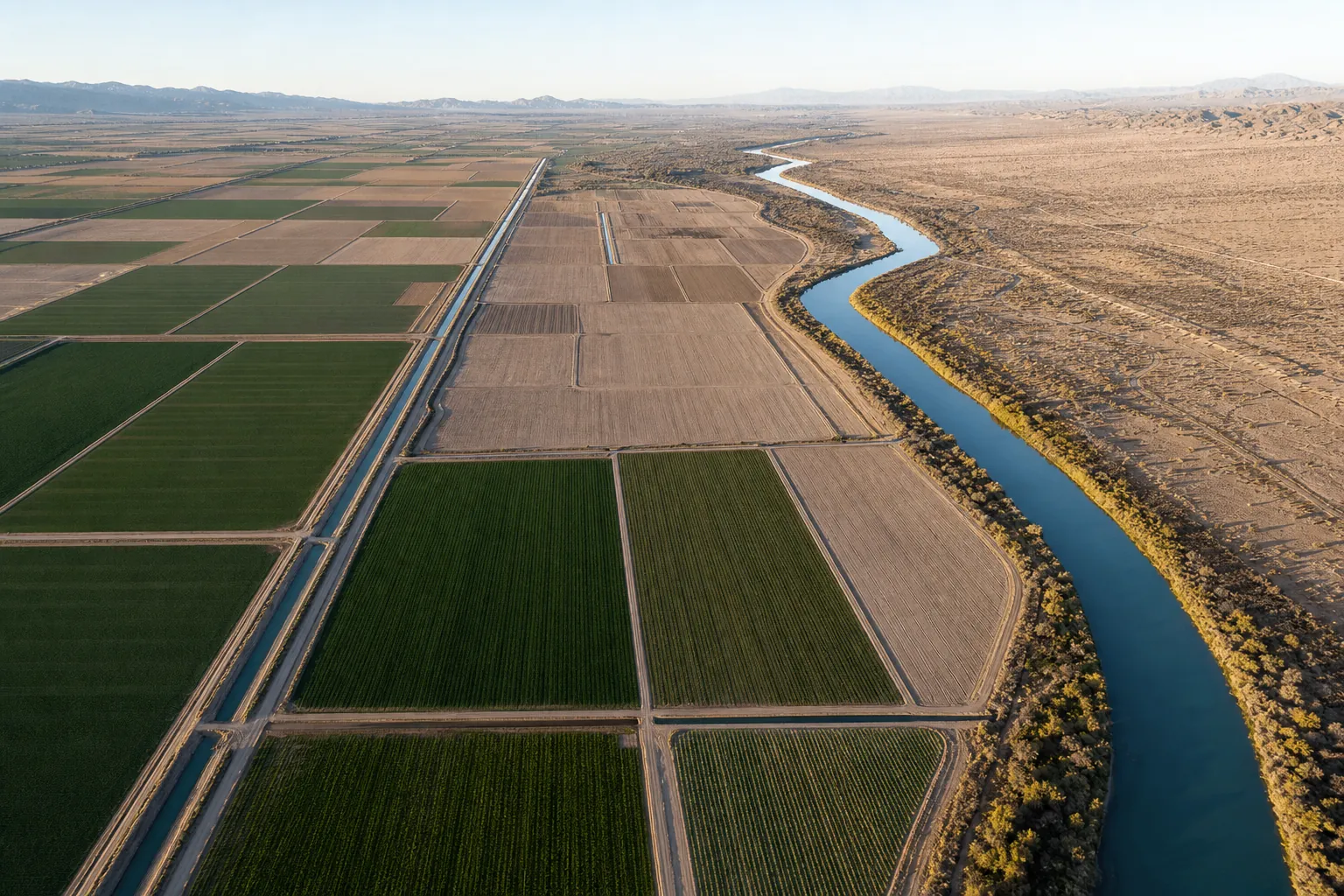
The December 2025 reform changes the value of unused water
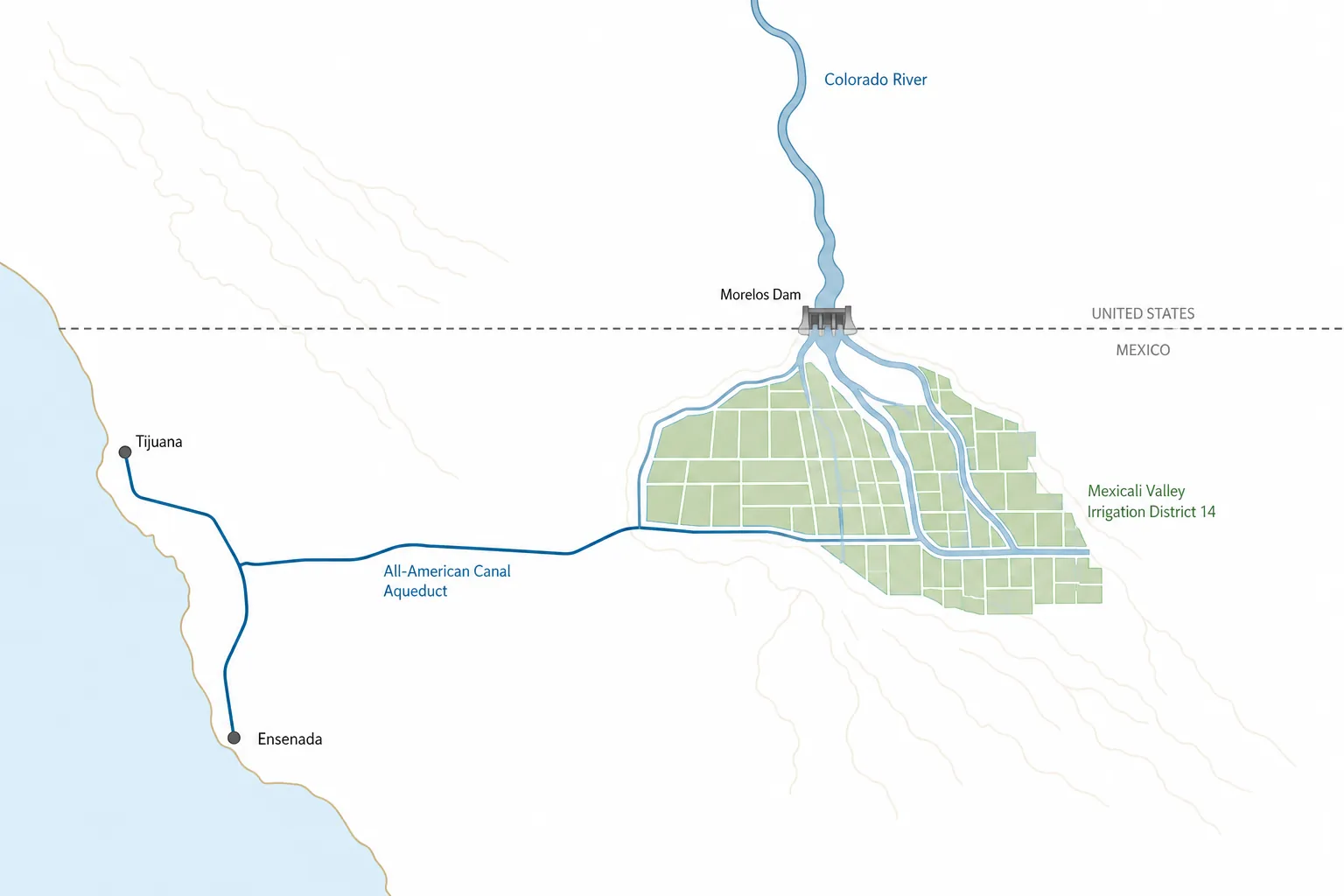
For a farmer holding a concession in Irrigation District 14, unused water was not merely absence of use. It could be the basis for a payment stream: private sales to urban demand centers such as Tijuana and Ensenada, or compensation through conservation programs that paid agricultural users to leave water in the system. Voice of San Diego reported that many district concession holders no longer farm and depend either on selling water through the aqueduct system to Tijuana and Ensenada or on conservation payments.[1]
The December 2025 reform strikes at that reliance in two distinct ways. First, it prohibits private water sales.[1] Second, it treats unused agricultural water as reverting to the federal government.[1] Those two changes should not be collapsed into a general statement that Mexico “took” Colorado River water from farmers. The narrower and more useful point is that a concession holder’s ability to monetize nonuse, transfer value, or participate in a paid conservation arrangement is being redefined under Mexican domestic law.
That distinction matters because the U.S.-funded fallowing program did not need to resolve every theory of Mexican public ownership of water. It needed identifiable local participants who could be paid for measurable conservation behavior. If domestic law now says unused agricultural water returns to the federal government rather than remaining an economic interest that the concession holder can bargain around, then the program’s next legal question is no longer only “what did the IBWC minutes authorize?” It is also “what, exactly, did the individual concession holder still have authority to conserve, transfer, or be paid for?”
The reform can be defended as a sovereignty measure without answering that payment-chain question. Mexico’s Constitution and national water regime already frame water as public property; the dispute is over the practical treatment of concessions that, in local agricultural practice, had become economically significant. Counsel should be cautious about substituting slogans on either side for the operative documents: a constitutional-public-ownership premise does not by itself settle compensation expectations, and farmer protest statements do not by themselves prove a vested private right immune from statutory change.
Who is exposed in Irrigation District 14
The affected class is unusually concrete for a binational water dispute: roughly 17,000 concession holders in Irrigation District 14.[1] Their interests are not all identical. Some continue to farm. Some, according to the reporting, no longer farm and rely on the economic value of water through sales or conservation compensation.[1] That difference matters in any legal-risk review because a reform that primarily regulates unused agricultural water will not fall with equal weight on a producer planting crops, a landholder relying on transfer income, and a participant expecting payment for fallowing.
The December 2025 reform also collides with the geography of demand. Mexicali Valley irrigation water sits within a system that can serve agricultural land near the border and, through aqueduct infrastructure, urban users westward in Baja California. Voice of San Diego described concession holders selling water to Tijuana and Ensenada via a 100-mile aqueduct.[1] A ban on private sales therefore does more than regulate a local farm transaction; it changes the legal assumptions behind a cross-regional supply practice.
Reported farmer threats to resume use, “spill” water, or otherwise disrupt allocations should be kept in their evidentiary lane: they are reported statements, not adjudicated legal consequences. The documented events are more useful. Voice of San Diego reported December 2025 border blockades at Calexico and a February 2026 sit-in at CONAGUA offices.[1][3] Those events show political pressure on the legal framework. They do not establish the validity of any concession-holder claim.
The treaty and minute system made fallowing payable
The 1944 Treaty allocates Mexico 1.5 million acre-feet of Colorado River water annually, and implementation has long depended on the International Boundary and Water Commission and its minute process.[4] Minute 323 is the relevant operating instrument for the current cycle: it extended cooperative shortage-sharing, storage, environmental, and conservation arrangements through December 31, 2026.[2][4]
The minute structure is important because it allowed binational conservation to be translated into administrable local acts. A law-firm summary issued when Minute 323 was released described the agreement as including Mexican water savings projects, U.S. funding participation, and conservation measures that would generate water for system benefit and for participating funders.[5] That is the hinge: a treaty allocation and IBWC minute do not themselves plant, irrigate, or fallow fields. Local concession holders and irrigation institutions do.
Minute 330, reported in 2024, added to this conservation-payment chain. Voice of San Diego reported that the United States committed a total of about $96.5 million under Minutes 323 and 330, with about $41.6 million paid as of late February 2026.[3] The published correction to that February 2026 article matters: the corrected paid figure is about $41.6 million, not the lower figure that continues to appear in some reposted or derivative accounts.[3]
| Instrument or legal layer | What it does for this dispute | Why counsel should separate it |
|---|---|---|
| 1944 Treaty | Allocates Mexico 1.5 million acre-feet of Colorado River water annually. | It is the binational allocation baseline, not the source of each farmer’s domestic concession rights. |
| Minute 323 | Creates the current cooperative framework and remains in force through December 31, 2026. | It supplies the expiring binational conservation architecture. |
| Minute 330 | Reported as part of the later U.S.-funded conservation commitment. | It belongs in the payment chain, but its farmer-level implementation still depends on domestic administration. |
| December 2025 Mexican water-law reform | Bans private water sales and provides for federal reversion of unused agricultural water. | It changes the domestic-law treatment of the concession interests that made paid fallowing valuable. |
The payment question is narrower than the politics
The clean number to use for U.S. payments, as of the corrected late-February reporting, is about $41.6 million paid under Minutes 323 and 330 against an approximately $96.5 million commitment.[3] That does not answer which individual farmers were paid, which projects were completed, or which amounts remain disputed. It establishes the scale of U.S. exposure and the fact that the program was not merely aspirational.
Farmers told Voice of San Diego that money remained due under the international agreement.[3] That claim should be treated as a claim, not as an accounting finding. A separate CILA breakdown circulated in a reposted version reportedly described about $18 million to District 14 farmers and about $2 million for infrastructure as of February 6, 2026, but that breakdown should not be blended into the corrected $41.6 million paid figure unless the underlying accounting records are being reviewed directly.
The same discipline applies to allegations of diverted money. A reported $4.5 million diversion allegation appears in secondary circulation, but the directly reviewable record for this article did not establish it. It may be a lead for document requests or local reporting review; it should not be used as a premise for legal advice.
The enforceability problem is sharper than an ordinary payment delay. A fallowing payment buys a conservation result by relying on a participant’s legally recognized ability to refrain from use and accept compensation for that restraint. If the state later characterizes unused agricultural water as reverting to federal control, the participant’s side of the bargain becomes harder to describe. Was the farmer conserving an interest still held under the concession? Was the district administering a federally reclaimable volume? Was the United States funding conservation value that domestic law no longer lets the local holder monetize?
Those are not rhetorical objections. They affect due diligence on releases, assignments, proof of performance, audit rights, and future contracting language. A U.S. district or agency-side participant may be satisfied that an IBWC minute authorizes funding. That does not eliminate the need to identify who, under Mexican law after the reform, can receive money for nonuse of agricultural water and give an enforceable assurance that the corresponding water will remain conserved.
What the reform does not prove
The reform does not, on the materials reviewed here, prove that Mexico has breached the 1944 Treaty. It does not prove that every Irrigation District 14 concession holder has an enforceable compensation claim. It does not prove that Tijuana or Ensenada will lose a defined volume of supply. It also does not prove that U.S. conservation funds were wasted. Each of those conclusions would require a different record.
What it does show is a legal mismatch. The IBWC minute regime can authorize binational conservation funding, but the economic holder of the conservation act may be determined by Mexican concession law. When that domestic law changes during the life of the minute, the payment structure inherits the uncertainty.
Renegotiation pressure beyond Mexicali
The Mexicali concession issue is unfolding while the broader Colorado River system remains under negotiation pressure. As of the February 2026 reporting, renegotiation of Mexico’s post-2026 conservation role had not begun.[3] Minute 323 still expires on December 31, 2026.[2] That leaves little room for treating the domestic reform as a side issue to be cleaned up after the basin states and federal governments finish their larger talks.
Other developments raise the stakes but should not be confused with proof on the Mexicali property-law question. The USDA announced on December 12, 2025, that Mexico had agreed to a 202,000 acre-foot water release in a separate treaty-obligation and tariff-threat context involving farmers in the American Southwest.[6] That release belongs in a watch file for cross-border water leverage; it does not decide how Mexican law treats Irrigation District 14 concessions.
Likewise, Arizona’s reported August 2026 litigation threat over the federal Colorado River plan reflects the increasingly adversarial posture among U.S. basin parties. The Los Angeles Times reported on August 18, 2026, that Arizona warned it could sue as reservoirs shrink, in the context of a federal planning process and a seven-state impasse.[7] That is relevant to negotiation leverage. It is not a holding on the 1922 Compact, and it is not evidence that the Mexican reform has any particular legal effect on farmer concessions.
Counsel’s working risk frame as of August 25, 2026
As last verified on August 25, 2026, the practical risk frame is this: Minute 323 expires December 31, 2026; U.S. conservation commitments under Minutes 323 and 330 total about $96.5 million; about $41.6 million had been paid as of late February 2026; and the domestic concession rights held through Irrigation District 14 have been placed under a reform that bans private water sales and provides that unused agricultural water reverts to the federal government.[1][2][3]
A useful diligence file should therefore separate at least four records: the IBWC minute authority, the funding and payment documentation, the Mexican domestic-law status of the concession, and proof of actual conservation performance. Treating those records as one “Colorado River cooperation” file is how the legal risk gets missed.
For post-2026 planning, the important conclusion is limited but consequential. The next Colorado River conservation bargain with Mexico cannot be assessed only through the 1944 Treaty and IBWC minutes. It also has to account for Mexican domestic water-law treatment of the concessions that made paid fallowing in the Mexicali Valley work. This article is a regulatory-risk analysis, not legal advice; the renegotiation and any domestic challenges may have moved after the reporting cited here.
References
- Mexicali Farmers Threaten to Use Their Colorado River Water, Putting Tijuana’s Supply in Jeopardy, Voice of San Diego, December 16, 2025.
- Management of the Colorado River: Water Allocations, Drought, and the Federal Role, Congressional Research Service.
- Mexicali Farmers Say They Are Still Owed Money from International Agreement, Voice of San Diego, February 27, 2026.
- Minute No. 323, International Boundary and Water Commission.
- Minute 323: Federal Officials Release Summary of New Agreement with Mexico Regarding the 1944 Colorado River Treaty, Somach Simmons & Dunn.
- Mexico Agrees to Meet Water Treaty Obligations to Farmers in the American Southwest, U.S. Department of Agriculture, December 12, 2025.
- As Colorado River reservoirs shrink, Arizona warns it could sue, Los Angeles Times, August 18, 2026.
Operationalizing workflow
No workflow has been explicitly linked to this obligation yet. See Workflows generally.
Illustrative cases
No illustrative case is currently tracked for this obligation. See Risk Digest for documented incidents generally.
← Back to RegulationReport a correction or tip
Spotted an outdated figure, a misstated fact, or a ruling this regulation entry should reflect? Public comments are disabled for this content given the professional cost of a misreported case outcome, penalty amount, or rule text — use the structured correction channel instead.
Report a correction or tip for this record →