
How Congressional Absences Undermine Farm Bill Legislation
- Authority
- U.S. Congress
- Rule type
- statute
- Jurisdiction scope
- US federal
- Source text
- Read primary rule text ↗
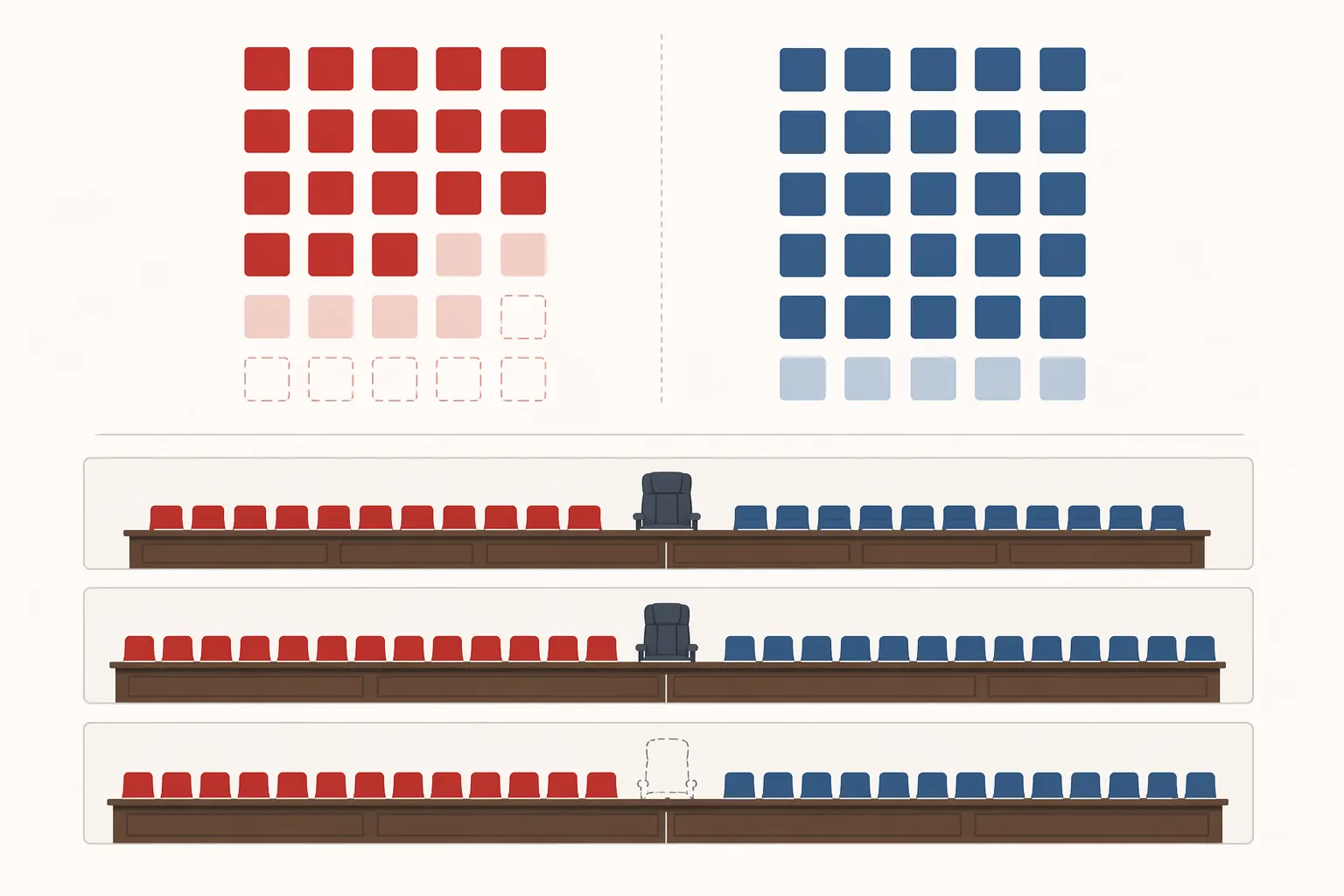
As of July 26, 2026, the farm bill problem begins with a missing vote. The Senate Republican majority is 53-47 on paper, but with Sen. Mitch McConnell hospitalized and absent since June 14, and with Sen. Lindsey Graham’s seat vacant after his death, that working margin has narrowed to 51-47. McConnell had not voted since June 11, and the practical result is that Republicans cannot lose a single member on a party-line floor vote while those conditions persist.[1][2]
That caveat matters because this is a live situation. If McConnell returns, if a farm bill markup is scheduled, or if Congress moves a short-term extension before publication, the immediate count changes. The larger risk does not disappear. In Q3 2026, the impact of congressional absences on farm bill legislation is not a staffing footnote; it is a procedural constraint that can disable the path from draft text to committee action even when a statutory deadline is visible to everyone in the room.
The arithmetic is doing the damage
The farm bill is not stalled only because agriculture, nutrition, and fiscal policy are hard. They are hard. But the immediate bottleneck is more mechanical: the Senate Agriculture Committee is split 11-11 without McConnell, which prevents Chair John Boozman from advancing a markup under the present conditions.[3]
For a legal or compliance team, that distinction is not cosmetic. A policy dispute can be modeled as a negotiation risk. A committee that cannot produce a working majority is a capacity risk. It means the forecast does not turn only on whether negotiators compromise; it also turns on whether enough bodies are available in the correct procedural location at the correct time.
The Agriculture Committee’s deadlock is especially consequential because the farm bill is already carrying more than one deadline. Its current extension expires September 30, 2026, the same date government funding runs into the shutdown deadline.[6] Congress also has only 10 scheduled legislative weeks remaining in 2026 before the midterm elections.[7] A client slide that treats September 30 as a forcing mechanism may be directionally right and still operationally unsafe.
| Procedural pressure point | Current constraint as reported | Why it matters for forecasting |
|---|---|---|
| Senate floor | 53-47 majority functioning as 51-47 while McConnell is absent and Graham’s seat is vacant | No margin for a party-line defection under those conditions |
| Senate Agriculture Committee | 11-11 split without McConnell | Farm bill markup path is blocked unless attendance or agreement changes |
| Senate Appropriations Committee | 14-14 split without McConnell | Funding negotiations face the same absence-driven capacity problem |
| Senate Budget Committee | Chair remains vacant after Graham’s death | Reconciliation planning lacks a normal committee lead |
Why the farm bill turns a committee absence into a compliance problem
The farm bill is the cleanest example because the downstream consequences are not abstract. Counties, states, food assistance administrators, lenders, producers, and rural development offices do not experience “no markup” as a parliamentary condition. They experience it as uncertainty about which program rules, funding assumptions, and state obligations will govern after the current extension runs out.
The highest-profile dispute around Boozman’s draft concerns SNAP cost sharing. Democrats have demanded a two-year delay in a state SNAP cost-sharing mechanism; per CBPP, as cited by Agri-Pulse on June 26, 2026, the mechanism would cost states about $9 billion.[4] That figure should be treated carefully: it is reported through Agri-Pulse’s account of CBPP’s estimate, not introduced here as an independently reviewed calculation. Still, for state budget lawyers and benefits administrators, the relevant planning problem is immediate. A delayed effective date, a modified cost-sharing formula, or no enacted farm bill produce different state exposure profiles.
The error-rate data explain why the dispute has teeth. Holland & Knight’s summary of the Senate Agriculture Committee draft reported that only 9 states achieved the under-6 percent SNAP error-rate threshold for full compliance in FY2025, while the national average error rate was 10.62 percent.[5] Those numbers do not prove how any final bill would perform. They do show why state compliance exposure cannot be assessed by reading “farm bill expected this year” as if it were an effective-date guarantee.
SNAP is only one part of the deadline. NACo’s county-focused explainer on the current extension warns that, after expiration, dairy pricing would revert to 1949 permanent-law authority, commodity support programs would expire after the 2025 crop year, and rural development authorizations would lapse.[6] Those are not identical risks. Dairy permanent law is a price-support cliff; commodity program expiration is a producer-support problem; rural development lapses affect local planning and authorization continuity. The common feature is that each depends on Congress turning a known deadline into enacted text.
The word “must-pass” is doing too much work
Legal forecasting often sorts federal legislation into rough buckets: messaging bills, plausible vehicles, and must-pass measures. The farm bill usually belongs closer to the last category because the cost of lapse is real and widely understood. But “must-pass” describes the pressure to act, not the ability to act by a particular date.
That difference matters most when a forecast is used outside Washington. A government-affairs memo can tolerate procedural ambiguity if its purpose is to describe negotiations. A compliance calendar cannot. A state agency deciding whether to reserve funds for SNAP cost-sharing exposure, a county lawyer tracking rural development authorizations, or an agricultural lender watching commodity-support assumptions needs to know whether a deadline is reliable enough to build around.
In the current posture, the safer answer is that the September 30 farm bill date is a legal and operational trigger, not a reliable enactment forecast. The date increases pressure; it does not supply votes.
Agriculture is not the only committee showing the same failure mode
The Agriculture Committee would be easier to treat as a one-off if other committees were moving normally. They are not. NOTUS reported on July 23 that the Senate Appropriations Committee is also deadlocked 14-14 without McConnell, stalling government funding negotiations ahead of the September 30 shutdown deadline.[1] The farm bill expiration and the government funding deadline are therefore not merely sharing a date. They are also exposed to the same missing-member bottleneck.
The Budget Committee adds a different version of the same fragility. After Graham’s death, the committee chair remained vacant, complicating reconciliation planning.[2] That is not an 11-11 tie, but it is still a procedural-capacity problem: a chamber with a thin majority loses not just one vote, but committee leadership, sequencing, and the ability to coordinate time-sensitive legislative vehicles.
The House adds background rather than the central mechanism. In 2025, it produced 362 roll-call votes, the second-lowest total since 2001, and enacted 64 public laws; four successful discharge petitions bypassed Speaker Mike Johnson, a historic high according to The New York Times.[8] Those figures do not explain the Senate Agriculture tie. They do support the narrower institutional point: the 119th Congress entered 2026 with little slack in its legislative machinery.
How legal teams should read congressional dates in Q3 2026
The practical lesson is not that Congress will fail to pass a farm bill. It may pass a full bill, adopt a short-term extension, fold pieces into another vehicle, or change the committee math if attendance changes. The point is narrower and more useful: in the current Congress, a statutory cliff plus bipartisan awareness of consequences is not enough to make timing dependable.
A July 2026 legislative-risk memo should separate at least four questions that are often blended together:
- What expires by law, such as the current farm bill extension on September 30.
- What committee must act before the chamber can move cleanly.
- Whether the majority has enough present members to control that committee or floor vote.
- Which fallback vehicle or extension would preserve current obligations without resolving the underlying policy dispute.
That framework is less elegant than a single expected effective date, but it is more honest. It also prevents one of the more common mistakes in regulatory tracking: converting a political necessity into a calendar assumption.
For the farm bill, the live questions are therefore not only whether lawmakers resolve SNAP cost-sharing, dairy, commodity, and rural development issues. They are whether the Agriculture Committee can move, whether the Senate can protect a floor margin with no room for defections, and whether September 30 becomes an enactment date, an extension date, or another missed deadline managed after the fact.
That is the compliance consequence of congressional absence. It turns “likely timing” into a conditional chain. If the missing vote returns, one bottleneck may clear. If the seat is filled, another margin may widen. If neither happens in time, the farm bill’s policy disputes remain important, but the first obstacle is simpler: the institution may not be able to put enough votes in the right committee seats to move the bill on schedule.
References
- McConnell's Absence is Grinding Some Senate Business to a Halt, NOTUS, July 23, 2026
- How Graham's Death and McConnell's Absence Complicates Senate Republicans' Agenda, TIME, July 13, 2026
- McConnell's absence creates new farm bill roadblock, E&E News/POLITICO, July 15, 2026
- Boozman signals openness to delaying state SNAP cost-share, Agri-Pulse, June 26, 2026
- Senate Agriculture Committee Releases Draft Text for 2026 Farm Bill, Holland & Knight, June 26, 2026
- Farm Bill expiration: What counties need to know, NACo, October 1, 2025
- Senate Farm Bill Negotiations Are Stuck During McConnell's Absence, NOTUS, July 22, 2026
- How the House Slumped to Historic Lows of Productivity in 2025, The New York Times, January 17, 2026
Operationalizing workflow
No workflow has been explicitly linked to this obligation yet. See Workflows generally.
Illustrative cases
No illustrative case is currently tracked for this obligation. See Risk Digest for documented incidents generally.
← Back to RegulationReport a correction or tip
Spotted an outdated figure, a misstated fact, or a ruling this regulation entry should reflect? Public comments are disabled for this content given the professional cost of a misreported case outcome, penalty amount, or rule text — use the structured correction channel instead.
Report a correction or tip for this record →