
Contempt Hearing Tests Executive Order on Trans Inmate Transfers
- Authority
- U.S. District Court for the District of Columbia
- Rule type
- standing order
- Jurisdiction scope
- US federal
- Effective date
- Jun 7, 2026
- Source text
- Read primary rule text ↗
BOP prohibited from transferring transgender women to men's prisons
The July 29 hearing put the workaround, not the executive order, on trial
Judge Royce Lamberth’s most important question at the July 29 hearing was not about the general legality of the administration’s transgender inmate transfer executive order. It was narrower and sharper: “You’re violating my order, aren’t you?” he reportedly asked the government as he considered whether the Bureau of Prisons had complied with his June 7 injunction blocking transfers of transgender women to men’s prisons.[1]
That question arose because the BOP’s post-injunction move did not look like direct defiance. The affected women were not simply transferred to men’s prisons in the face of the order. Instead, they were moved into a segregated unit in Fort Worth where, according to the plaintiffs’ account reported by AP, they had little recreation, work, or programming.[2] For a court enforcing an injunction, that distinction matters. It is also the whole problem.
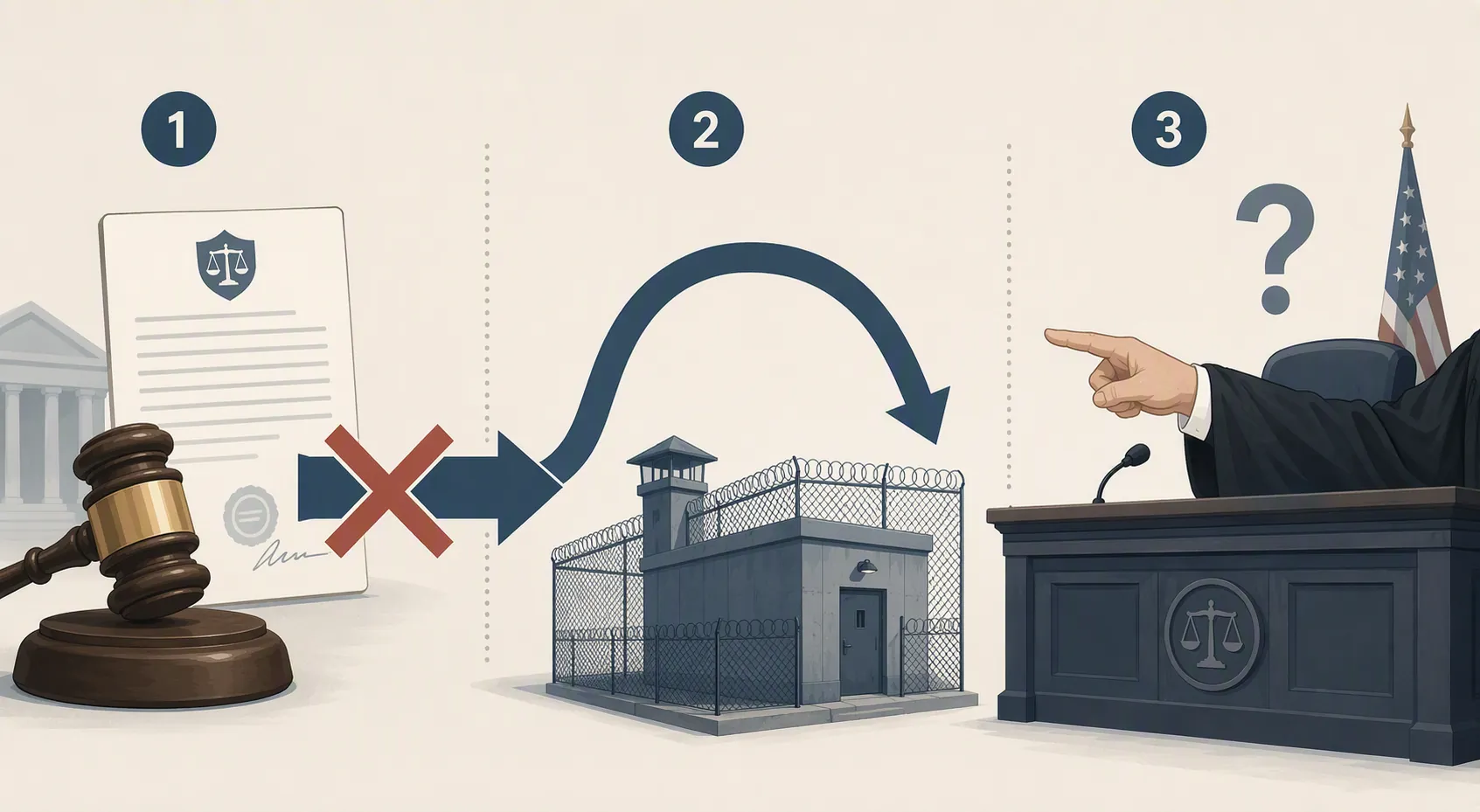
The legal issue is not simply whether segregation is harsh, or whether the plaintiffs would have preferred ordinary general-population housing. The immediate question is whether the government can comply with the literal boundary of an order barring transfers to men’s prisons while imposing a replacement placement that the plaintiffs say preserves the practical harm the order was meant to prevent. That is why the July 29 hearing sits at the center of the dispute: the claimed violation is administrative relabeling.
The injunction was narrower than the policy fight
Executive Order 14168, issued on January 20, 2025, directed federal officials to “ensure that males are not detained in women’s prisons.”[3] Judge Lamberth’s June 7, 2026 preliminary injunction did not purport to resolve every future application of that directive across the federal prison system. It blocked the BOP from transferring 14 transgender women to men’s prisons and found, in that individualized posture, that the agency had acted with deliberate indifference by following the executive order.[4]
That individualized posture is not incidental. PREA Standard § 115.42 requires placement and programming assignments for transgender and intersex prisoners to be assessed individually, with safety considered rather than resolved by a categorical rule.[5] The collision in Doe v. McHenry therefore was not only between an executive order and judicial authority. It was also between a categorical placement command and an existing regulatory framework that requires individualized assessment.
| Date | Procedural event | Why it matters now |
|---|---|---|
| Jan. 20, 2025 | Executive Order 14168 directs officials to ensure that “males are not detained in women’s prisons.”[3] | Creates the categorical federal policy the BOP later applied. |
| Feb. 4, 2025 | A temporary restraining order is entered in the litigation, according to the plaintiffs’ case timeline.[6] | Begins the court-supervised placement dispute. |
| Apr. 17, 2026 | The D.C. Circuit remands the case, according to the same procedural timeline.[6] | Returns the placement challenge to the district court. |
| June 7, 2026 | Judge Lamberth enters a preliminary injunction blocking transfers of 14 transgender women to men’s prisons.[4] | Creates the order the plaintiffs now seek to enforce. |
| July 29, 2026 | Judge Lamberth hears argument over the BOP’s segregated-unit placement and asks whether the government is violating his order.[1][2] | Turns implementation into a possible enforcement or contempt issue. |
The sequence matters because the government’s strongest framing depends on the June 7 injunction being read at a high level of specificity: no transfers to men’s prisons. If the women remained within a women’s facility or were placed in a segregated unit rather than transferred into men’s prisons, the government can argue it obeyed the order’s formal command. The plaintiffs’ framing runs in the other direction: the injunction was entered to prevent the BOP from using the executive order to expose the women to unsafe or punitive placement consequences, and segregation with reduced privileges is a functional continuation of the same policy implementation.
Why the Fort Worth unit is the enforcement problem
The Fort Worth placement is legally significant because it gives each side a different answer to the same question: what did the order forbid? AP’s account described the segregated unit as one with reduced privileges, including little recreation, work, or programming, and reported the plaintiffs’ position that the move violated the spirit of Judge Lamberth’s injunction.[2] That is a conditions fact, but it is also an injunction fact. It supplies the practical difference between ordinary placement and a workaround.
A court need not treat every adverse prison-management decision after an injunction as contempt. The question is whether the later administrative act is sufficiently tied to the enjoined conduct that it defeats the order’s operative protection. Here, the timing and the population affected do much of the plaintiffs’ work: the segregated-unit placement followed an injunction protecting the same transgender women from transfers under the executive-order policy.
Still, “violates the spirit of the injunction” is not the same thing as a contempt finding. The court has to connect the segregated placement to the injunction’s terms. If the order is read as a plain prohibition on transfers to men’s prisons, the government’s position has a formal hook. If the order is read as barring implementation of the executive order against these plaintiffs through placement decisions that strip them of ordinary custody status, the Fort Worth move becomes much harder to defend.
That is why Judge Lamberth’s reported “on its face” skepticism matters.[1] It suggests he was not treating the Fort Worth unit as an unrelated custody adjustment. He appeared to be testing whether the BOP’s compliance theory elevated the label of the placement over its effect.
The contempt question is emerging, not resolved
The July 29 hearing should not be overstated. Bloomberg Law reported that Judge Lamberth suggested the Justice Department had violated his order, but the reporting does not establish that he entered a final contempt ruling that day.[1] For litigators, that difference is not cosmetic. A judge’s pointed question may forecast the direction of an enforcement order; it is not the order itself.
The plaintiffs’ route is an enforcement route. They can ask the court to enforce the June 7 injunction, clarify its reach, and order the BOP to undo the segregated placement. If the court concludes that the government knowingly took action inconsistent with the injunction, contempt becomes available as a theory. But the cleaner immediate remedy is practical: return the plaintiffs to a placement that does not carry the reduced privileges attached to the segregated Fort Worth unit.
That requested relief was part of the July 29 posture. The plaintiffs sought an order requiring the government to return the women to general population, while the court also had before it the government’s procedural arguments and a proposed schedule that could put trial in October or November 2026.[1] The existence of that proposed schedule is another reason to keep the posture precise: the case was still moving, and the enforcement dispute had not displaced the underlying merits track.
The PLRA defense is the procedural brake
The Justice Department’s most consequential argument may be procedural rather than substantive. At the July 29 hearing, DOJ raised a Prison Litigation Reform Act exhaustion defense, arguing that the plaintiffs had not exhausted administrative remedies before challenging the segregated-unit conditions.[1] Judge Lamberth had not resolved that issue as of the reported hearing posture.[1]
That defense can matter even where the equities look urgent. Prison placement, recreation, work, and programming are exactly the kinds of facts that can be characterized as prison-condition issues. If the court accepts the government’s exhaustion framing, the plaintiffs may have to overcome a threshold procedural objection before the judge reaches the full force of the workaround theory.
The plaintiffs’ better procedural answer is that they are not filing a freestanding new prison-conditions case; they are asking the same court to enforce an existing injunction against the same agency conduct in altered form. That distinction does not make the PLRA disappear. It does show why the exhaustion issue is more than a technicality. It determines whether the court treats the segregated unit as a new administrative grievance or as the next act in the enjoined transfer policy.
Risk evidence explains the injunction’s urgency, but not the enforcement answer by itself
The plaintiffs’ underlying safety case is substantial. NCLR and GLAD, describing the June 7 order, cited a statistic that transgender women housed in men’s prisons are sexually assaulted at more than ten times the rate of other incarcerated people.[7] Judge Lamberth’s June 7 ruling, as reported by Bloomberg Law, found deliberate indifference in the BOP’s adherence to Executive Order 14168 for the plaintiffs before him.[4]
Those facts explain why the original injunction mattered. They do not, standing alone, answer whether the Fort Worth segregation violated the order. The enforcement analysis still has to pass through the order’s language, the agency’s actual implementation, and any procedural limits on the court’s ability to consider the new placement facts.
That is the careful line in this dispute. The safety record supports close judicial scrutiny of BOP placement decisions affecting transgender women. Contempt, however, requires the court to do more than disapprove of the agency’s policy judgment. It requires a conclusion that the agency’s workaround is legally inconsistent with what the injunction required.
The executive order cannot do all the work for the agency
Executive Order 14168 gives the BOP an asserted policy directive, but it does not answer the enforcement question after a federal court has entered an individualized injunction. Once the court ordered protection for the 14 plaintiffs, the agency’s compliance obligation was not simply to find the narrowest placement that avoided the words “men’s prison.” It had to avoid conduct the court could reasonably view as the same prohibited transfer policy operating through another housing mechanism.
PREA’s individualized-assessment requirement sharpens the point. A categorical executive-order instruction can explain why the agency acted. It does not necessarily justify a placement decision for a particular prisoner when a court has already found that the agency’s categorical implementation created unconstitutional or unlawful risk in the plaintiffs’ circumstances.[4][5]
The agency’s strongest defense remains textual: if the injunction barred transfers to men’s prisons and the BOP did not complete that transfer, then the court should not convert dissatisfaction with segregation into contempt. The plaintiffs’ strongest answer is functional: if the BOP imposed segregated, reduced-privilege confinement on the same women because the enjoined policy could not be carried out directly, the court can treat the move as an attempted end run around the injunction.
Where the case stood on July 30, 2026
As of the July 30, 2026 verification point, the record described in the available reporting showed a live enforcement dispute, not a completed contempt adjudication. Judge Lamberth had signaled skepticism at the July 29 hearing; DOJ had raised PLRA exhaustion; the plaintiffs were seeking relief that would return the women to general population; and a proposed October or November 2026 trial schedule remained part of the developing case posture.[1]
The practical signal is narrower than the public controversy around the executive order, but important for agency litigators. A federal agency cannot assume that compliance survives because it has changed the label of the action a court enjoined. Whether this Fort Worth placement becomes contempt depends on the next enforcement ruling, especially the court’s treatment of the injunction’s scope and the unresolved PLRA exhaustion defense.
References
- Judge Suggests DOJ Violated Order Over Trans Inmate Transfers — Bloomberg Law, Jul. 29, 2026
- Judge Weighs Bid to Block or Reverse Transfers of Transgender Inmates — PBS NewsHour / AP, Jul. 29, 2026
- Defending Women From Gender Ideology Extremism And Restoring Biological Truth To The Federal Government — White House, Jan. 20, 2025
- Federal Court Halts Transgender Inmate Transfers to Male Prisons — Bloomberg Law, Jun. 8, 2026
- PREA Standard § 115.42 — PREA Resource Center
- Judge Grants Preliminary Injunction to Transgender Women — Rosen Bien Galvan & Grunfeld LLP
- Federal Court Stops Trump Policy that Deliberately Exposes Transgender Women in Prison to Extreme Risk of Sexual Assault — NCLR / GLAD, Jun. 8, 2026
Operationalizing workflow
No workflow has been explicitly linked to this obligation yet. See Workflows generally.
Illustrative cases
No illustrative case is currently tracked for this obligation. See Risk Digest for documented incidents generally.
← Back to RegulationReport a correction or tip
Spotted an outdated figure, a misstated fact, or a ruling this regulation entry should reflect? Public comments are disabled for this content given the professional cost of a misreported case outcome, penalty amount, or rule text — use the structured correction channel instead.
Report a correction or tip for this record →