
Data Center Moratoriums Hit Caterpillar from Two Legal Fronts
- Authority
- New York State Governor
- Rule type
- regulation
- Jurisdiction scope
- US state
- Effective date
- Jul 14, 2026
- Source text
- Read primary rule text ↗
One-year pause on new data centers of at least 50 megawatts pending environmental impact statement.
Baird’s July 2026 move on Caterpillar was not just another valuation call. The firm cut CAT to Neutral and reduced its price target from $1,200 to $900 after data center moratorium risk became visible enough to enter an industrial-stock model, according to accessible Seeking Alpha and Barron’s snippets.[1] That is the first tangible market crack in a story that had been treated mostly as a question of AI electricity demand, generator supply, and execution.
The data center moratorium impact on Caterpillar stock now needs a legal-regulatory analysis because the pressure is no longer abstract. Caterpillar’s Power & Energy revenue reached $7.03 billion in Q1 2026, up 22% year over year, while the company’s backlog stood at $62.7 billion.[2] Public reporting also tied Caterpillar’s power-generation outlook to AI data center demand, including a forecast that power-generation sales would triple.[3] At the same time, CAT was trading around 36 times trailing earnings, a multiple that leaves little room for a supposedly continuous buildout cycle to become intermittent.[4]
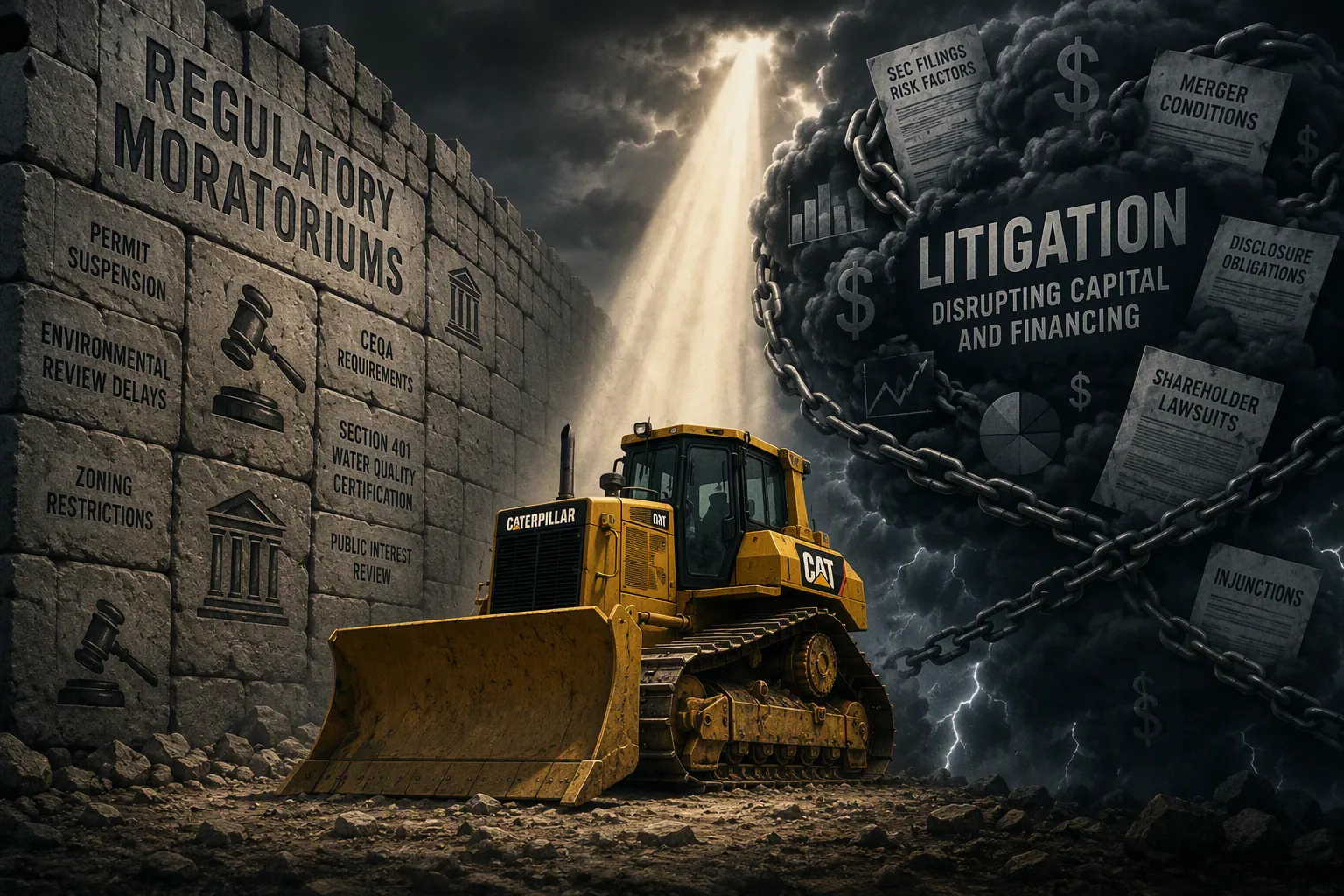
The legal map matters because the moratoriums are aimed at the very class of projects that made the power-generation story attractive: large, high-load data centers that can strain local grids, water systems, emissions controls, and land-use review. When those projects cannot wait for conventional interconnection timelines, natural-gas reciprocating generators become one way to keep construction and energization plans moving. That is where the law meets Caterpillar’s revenue assumptions.
The legal risk starts with thresholds, not headlines
A moratorium is not one thing. It can be enacted or proposed, statewide or local, time-limited or procedurally open-ended. For a stock exposed to hyperscale construction, the operative question is more concrete: which facilities cross the threshold, which permits stop moving, and whether the order contains a real review deadline that lenders and customers can underwrite.
New York is the hardest regulatory fact in the current record. On July 14, 2026, Governor Kathy Hochul issued Executive Order No. 62, described in press coverage as the first statewide data center ban and framed as a one-year pause on new data centers of at least 50 megawatts while the state studies environmental and energy impacts.[5] That 50 MW line is not cosmetic. It is a hyperscale threshold, not a small server-room threshold.
The more important securities-risk point is buried in the legal process. Phillips Lytle’s analysis of the order said that, although the press release referred to a one-year pause, the order text did not contain a firm deadline for completion of the Generic Environmental Impact Statement.[6] If that reading is right, the market is not looking merely at a calendar-year delay. It is looking at an administrative process whose endpoint may be less certain than the political description suggests.
| Jurisdiction or action | Status in available sources | Why it matters for Caterpillar exposure |
|---|---|---|
| New York Executive Order No. 62 | Issued July 14, 2026; described as first statewide ban; applies to data centers at or above 50 MW; press release described a one-year pause, while Phillips Lytle noted no firm GEIS deadline in the order text.[5][6] | Targets the size class most likely to require large power solutions and creates process uncertainty beyond the headline pause. |
| Maine bill | April 2026 bill vetoed.[7][8] | Shows political appetite for restriction even where the measure did not become law. |
| Oklahoma S.B. 1488 | Pending; described as applying to projects above 100 MW through 2029.[8][9] | A threshold above 100 MW would reach the largest load additions, the projects most relevant to backup and prime-power demand. |
| Vermont S.B. 205 | Pending; described as extending through July 2030.[8][9] | A multi-year moratorium would not be a harmless pause for projects whose financing, equipment procurement, and offtake commitments are sequenced. |
| Local moratoriums | Interconnected Capital tracks more than 100 local data center moratoriums in the United States.[10] | Local land-use freezes can delay projects even when no statewide ban exists. |
| Federal Sanders/Ocasio-Cortez bill | Federal proposal announced in 2026.[11] | Not current law, but it can shape investor expectations and state-level political cover. |
The table should not be read as if every item has the same legal weight. New York is operative. Maine is a vetoed signal. Oklahoma and Vermont are pending. Local moratoriums vary by ordinance and administrative practice. The federal proposal is not a federal ban. That hierarchy matters because a valuation model should not treat all legal developments as equal, but it also should not erase them because some are not yet final.
Law-firm surveys published in 2026 describe states experimenting with regulation of data center electricity use, environmental review, land use, and public-utility effects, while emphasizing that the measures raise legal and implementation questions.[7][8][9] Those summaries are not a substitute for reading each bill and ordinance, but they show a pattern: permitting risk is moving into the same time window as hyperscale AI construction demand.
That timing is what converts a planning dispute into a stock risk. A Caterpillar generator sale attached to a delayed hyperscale facility may not disappear immediately. It can be deferred, renegotiated, moved, or absorbed into a different project. But when a backlog and a high multiple rest on a fast data center cycle, delay is not neutral. It changes working-capital timing, customer purchasing behavior, and the confidence analysts place in segment growth.
Moratorium law is likely to be litigated, but litigation does not remove timing risk
Developers and property owners have arguments against some moratoriums. Vorys has identified likely challenges around state and local authority, preemption, takings, vested rights, and procedural defects.[12] Columbia Law School’s local-government discussion similarly treats moratoria as tools that require careful fit with planning needs, public process, and legal constraints.[13]
For Caterpillar, the existence of legal defenses is not enough. A successful challenge can still take time. A narrow injunction may help one developer and leave others waiting. A revised ordinance can replace a defective one. A state environmental review can proceed even while industry negotiates exemptions. The stock-market consequence is not determined only by who wins at final judgment; it is shaped by what happens to procurement schedules while the dispute is pending.
This is why the New York GEIS issue deserves more attention than the political framing of a one-year pause. If a moratorium has a firm statutory end date, counsel can price the risk differently. If the operative text depends on completion of a study without a fixed deadline, the risk migrates from calendar delay into administrative-law uncertainty. Equity models often compress that distinction into a single delay assumption, but project-finance lawyers do not.
The second front is financing litigation, not just AI circularity
The indirect legal front reaches Caterpillar through the capital stack that funds hyperscale construction. Quinn Emanuel’s client alert on AI data center financing litigation identified more than $120 billion in off-balance-sheet special-purpose-vehicle debt and highlighted circular capital flows tied to commitments including OpenAI’s $300 billion Oracle commitment, $38 billion with Amazon, and $22 billion with CoreWeave.[14] The point is not that every commitment is invalid or every SPV is defective. The point is that the same construction cycle that supports industrial demand is also being scrutinized through securities, disclosure, and financing-risk lenses.
Moody’s warned in February 2026 that hyperscaler lease commitments may understate actual liabilities.[15] That warning matters for an equipment supplier because understated or opaque obligations can become more expensive at exactly the wrong moment. If investors, lenders, or auditors demand more transparency, tighter consolidation analysis, or higher returns for financing data center SPVs, the effect can travel downstream into construction pacing and equipment orders.
The litigation record is already live. Quinn Emanuel’s alert discussed securities class actions including Ohio Carpenters’ Pension Plan v. Oracle Corp. and Masaitis v. CoreWeave, both filed in January 2026.[14] Pending cases do not prove liability. They do, however, create discovery risk, disclosure pressure, insurance and defense costs, and a public record that short sellers, ratings agencies, plaintiffs’ firms, and financing counterparties can mine.
That is where the financing issue becomes narrower and more serious than a general debate about whether AI spending is circular. Caterpillar does not need to be a defendant for its demand story to be affected. If a hyperscaler’s obligations are repriced, if an SPV sponsor must raise more equity, if a lease structure becomes harder to sell to credit investors, or if a customer delays a campus while disclosure questions are settled, the generator order attached to that campus becomes less certain.
The two fronts compound when permits freeze while financing is questioned
The direct and indirect fronts should not be modeled as separate discounts. A delayed project is not simply delayed revenue if the financing stack is also becoming litigated, repriced, or less credible while the permit clock is frozen. Time changes the parties’ leverage.
Consider a hypothetical large data center project above a state moratorium threshold. Before the moratorium, the developer may have treated generator procurement as part of a path around grid interconnection constraints. After the moratorium, environmental review stalls the project. During that stall, credit investors ask whether the tenant’s lease obligations are fully reflected, securities plaintiffs test statements about AI demand, and the SPV sponsor faces a higher cost of capital. By the time the legal pause lifts, the same customer may need a different capital structure, a smaller first phase, or a revised energization plan.
No precise loss estimate follows from the public record. The available materials do not establish how much of Caterpillar’s $62.7 billion backlog is tied to hyperscale data centers, how much depends on facilities over 50 MW or 100 MW, or which orders contain cancellation, deferral, or substitution rights.[2] Caterpillar’s SEC filings were not directly reviewed for this analysis, so no claim is made here that its current risk-factor or MD&A disclosure is legally deficient. The narrower point is that public events in 2026 have created a timing and legal-risk sequence that a clean demand narrative would miss.
That sequence is now visible enough for an analyst downgrade to reference moratorium risk, yet still underdeveloped in the way the market discusses Caterpillar. A single downgrade does not prove the correct price for CAT. It does show that the legal environment around data centers has crossed from policy commentary into industrial valuation.
What counsel and risk managers should be testing
The practical work is more granular than asking whether AI demand remains strong. Demand can be strong while individual projects become unfinanceable, unpermitted, or uneconomic at their original scale. The relevant diligence questions sit at the intersection of land-use law, environmental review, credit structure, and securities disclosure.
- Which Caterpillar Power & Energy assumptions depend on hyperscale data center projects above 50 MW, above 100 MW, or within jurisdictions with active local moratoriums?
- Do customer contracts or purchase orders permit deferral if a state order, local ordinance, environmental review, or utility proceeding delays construction?
- Are generator sales tied to projects financed through SPVs, long-term leases, or tenant commitments now under ratings-agency or securities-litigation scrutiny?
- Where management discusses backlog and power-generation demand, does the timing language distinguish supply-chain execution risk from permitting and financing risk?
- If a moratorium has a nominal end date, does the operative legal text actually require agency review to finish by that date?
Those questions are also useful for securities litigators on both sides. Plaintiffs will look for statements that treated data center demand as durable while omitting known legal impediments. Defendants will point to the uncertainty, uneven adoption, and still-developing nature of the regulatory record. The strongest analysis will not pretend that every moratorium kills a project or that every financing vehicle is suspect. It will map which project assumptions became legally contingent, when that contingency became knowable, and whether investors were told enough about the timing risk.
For Caterpillar, the current risk is not that the data center boom has ended. The risk is that the stock’s valuation still appears to reward a continuous buildout cycle while the legal system is interrupting both permission to build and money to build. That is a narrower claim, but it is the one a 36-times trailing-earnings industrial stock can least afford to have ignored.[4]
References
- Baird downgrade of Caterpillar to Neutral and price-target cut from $1,200 to $900 — Seeking Alpha / Barron’s, July 2026
- Caterpillar Q1 2026 earnings coverage — Reuters, April 30, 2026
- Caterpillar AI-driven power-generation demand coverage — Marketplace / PYMNTS
- Caterpillar valuation multiple coverage — Yahoo Finance / Insider Monkey
- New York data center moratorium coverage — Reuters, July 14, 2026
- Executive Order No. 62 legal analysis — Phillips Lytle
- State regulation trends and legal complexities for AI data centers — WilmerHale, February 23, 2026
- 2026 state-regulation landscape overview for data centers — AFS Law
- 2026 tracker of state and federal AI data center policy — MultiState
- US data center moratorium tracker — Interconnected Capital
- Sanders and Ocasio-Cortez federal data center moratorium bill press release — Office of Senator Bernie Sanders / Office of Representative Alexandria Ocasio-Cortez, 2026
- Analysis of likely legal challenges to data center moratoriums — Vorys
- Local moratoria considerations for data centers — Columbia Law School
- AI data center financing litigation risk client alert — Quinn Emanuel
- Hyperscaler lease commitment liability warning — Moody’s, February 2026
Operationalizing workflow
No workflow has been explicitly linked to this obligation yet. See Workflows generally.
Illustrative cases
No illustrative case is currently tracked for this obligation. See Risk Digest for documented incidents generally.
← Back to RegulationReport a correction or tip
Spotted an outdated figure, a misstated fact, or a ruling this regulation entry should reflect? Public comments are disabled for this content given the professional cost of a misreported case outcome, penalty amount, or rule text — use the structured correction channel instead.
Report a correction or tip for this record →