
ITLOS Orders Reshape Deep Sea Mining Regulation in 2026
- Authority
- ITLOS Seabed Disputes Chamber
- Rule type
- provisional measures order
- Jurisdiction scope
- International
- Effective date
- Jul 18, 2026
- Source text
- Read primary rule text ↗
Contractors must continue engaging with ISA LTC inquiry process while merits are pending.
For anyone tracking deep-sea mining environmental regulation in 2026, the operative event is narrow and dated: on 18 July 2026, the Seabed Disputes Chamber of the International Tribunal for the Law of the Sea issued provisional-measures orders in Case No. 34, NORI v. ISA, and Case No. 35, TOML v. ISA. The orders preserved the interim position and expressly stated that they “in no way prejudice the Chamber’s jurisdiction to deal with the merits.”[1][2] The next day, the International Seabed Authority said the Legal and Technical Commission inquiry process “remains in effect.”[3] Four days after the orders, on 22 July 2026, NORI’s exploration contract reached its expiry date.[4] The Mining Code still has not been adopted.
The materials reviewed for this report contain no verified public update through 28 July 2026 resolving NORI’s post-expiry status. That gap should not be tidied away. It is the practical problem left on counsel’s desk: a provisional-measures order that does not decide the merits, an ISA statement preserving the inquiry process, and an exploration contract whose critical date has already passed.
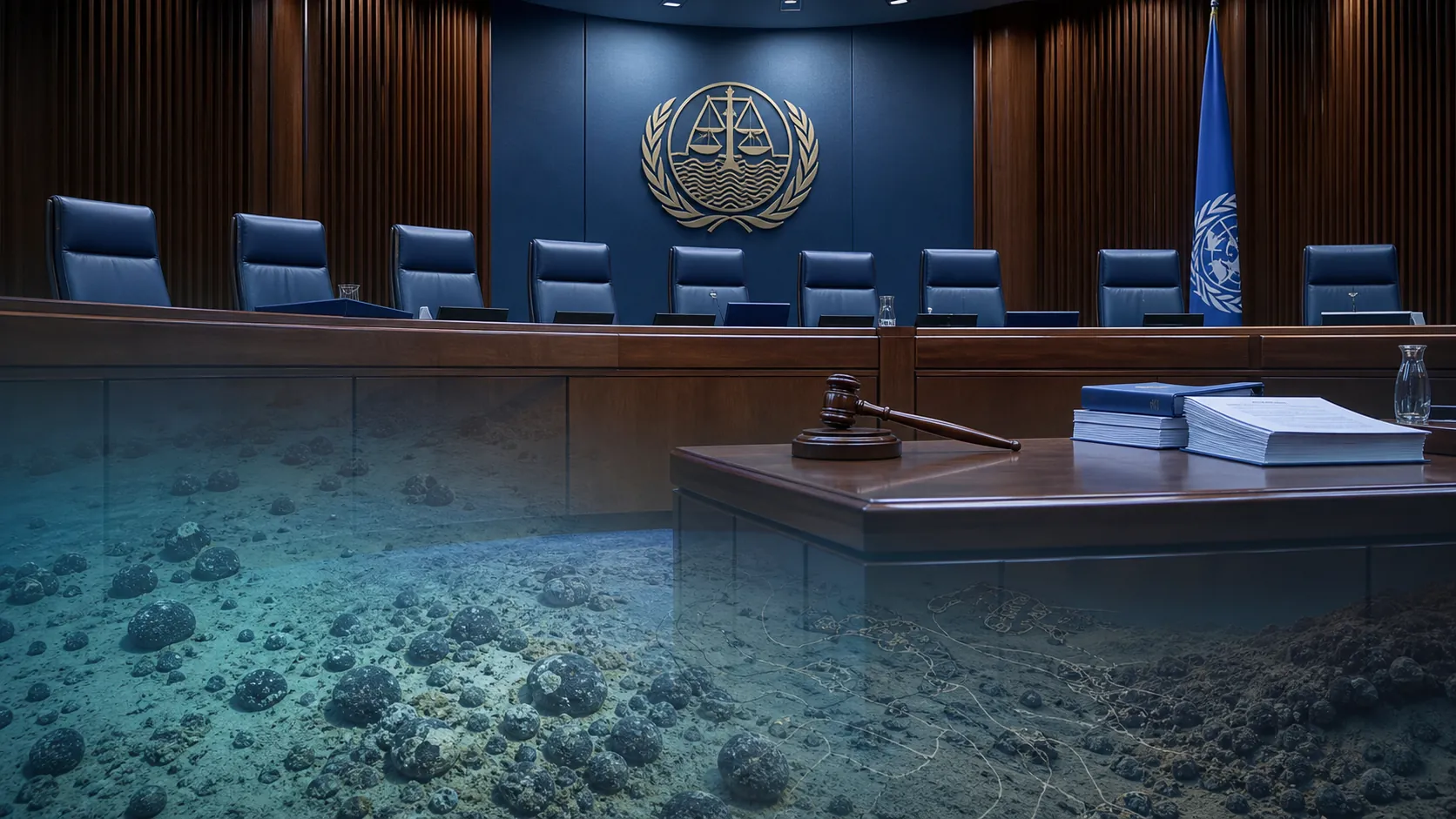
This is a special jurisdiction report, not a general ocean-policy primer. The environmental stakes of seabed exploitation explain why the regulatory system is under pressure, but the immediate legal question is more confined: what obligations can the ISA continue to press before final exploitation regulations exist, and what process must contractors receive before contract status changes in a way that may affect financing, insurance, sponsorship, and downstream operations?
What the July 18 orders did not do
The orders are easy to overstate. They did not halt deep-sea mining. They did not clear the ISA’s compliance inquiry on the merits. They did not decide jurisdiction. They did not resolve whether the LTC may identify compliance issues in the way the contractors challenge. The Chamber’s own reservation—“in no way prejudice”—is the controlling language for any cautious reading of the orders.[1][2]
Nor did the ISA treat the orders as disabling its internal process. Its 19 July statement said the LTC inquiry process “remains in effect,” which is the sentence that matters for contractors deciding whether to respond, reserve rights, or treat the inquiry as suspended.[3] A party may contest the legality of that process in the merits phase, but the provisional-measures posture did not give it a clean interim release from engagement.
The background to both disputes is Council Decision ISBA/30/C/19, adopted in July 2025, which triggered the compliance inquiry now being challenged.[1][2] That inquiry sits awkwardly beside the unfinished exploitation regime. It asks contractors to deal with compliance questions before the Mining Code has supplied the final regulatory architecture for commercial exploitation.
The four-day gap after the NORI order
NORI’s 22 July expiry date is not a background detail. It is the date that turns an interim tribunal order into an immediate contract-risk problem. The EJIL:Talk! analysis published before the orders identified NORI’s impending contract expiry as a central timing issue in the litigation.[4] The Chamber then issued provisional measures on 18 July without deciding the merits, and the contract date arrived four days later.
For a board or financing committee, the unanswered question is not abstract jurisdiction. It is whether the contractor’s legal position after 22 July is secure enough to support continued spending, disclosures, coverage positions, port arrangements, or sponsor-state assurances. If the compliance inquiry can affect extension consequences, then the contractor’s right to be heard before the expiry date becomes commercially material. If the inquiry cannot lawfully operate in that way, the contractor is still left proving that point later while managing present exposure.
The provisional-measures orders preserve the status quo only in the tribunal sense. They do not freeze the calendar. NORI’s contract date passed. The ISA’s statement maintained the inquiry process. The merits phase will decide the legal questions later, but insurers, sponsoring states, and counterparties do not get to wait in the same way a tribunal docket can.
Case 34 and Case 35 are not the same complaint
The two applications should not be collapsed into a single contractor grievance. Case No. 34, brought by NORI, focuses on the contract-extension implications of the compliance inquiry. Case No. 35, brought by TOML, tests whether the LTC can identify compliance issues before exploitation regulations are in place.[4] Those are related pressure points, but they are not interchangeable.

| Case | Procedural pressure point | Why it matters now |
|---|---|---|
| Case No. 34: NORI v. ISA | Whether the compliance inquiry can affect contract-extension consequences. | NORI’s exploration contract expired on 22 July 2026, four days after the provisional-measures order.[4] |
| Case No. 35: TOML v. ISA | Whether the LTC can identify compliance issues before final exploitation regulations exist. | The challenge goes to the ISA’s ability to run a compliance process in a still-incomplete regulatory regime.[4] |
NORI’s problem is calendar-driven. If a compliance inquiry influences extension consequences, the timing and procedural safeguards around that inquiry become decisive. A contractor facing expiry cannot treat later merits review as a full remedy if the contested process already affects contract status, investor confidence, or sponsor-state risk.
TOML’s problem is more structural. Its challenge asks whether the LTC has the regulatory footing to identify compliance issues before the exploitation rules are complete. That question matters beyond TOML because it tests how much operational pressure the ISA can place on contractors during the pre-code period.
The unfinished Mining Code is the condition that makes the inquiry contested
The Mining Code’s delay is not scenery. The ISA said in March 2026 that, after 12 years of negotiations, the Council had advanced 29 of 32 outstanding issues, but the Code had still not been adopted.[5] That is enough progress to show a functioning negotiation, but not enough to give contractors a final exploitation rulebook.
That distinction matters for environmental regulation. In a completed regime, a compliance inquiry can be measured against adopted standards, procedures, and consequences. In the present regime, the inquiry operates while the final exploitation regulations remain unfinished. The contractor’s objection is therefore not merely that regulation is burdensome; it is that process and consequence may be moving ahead of the rules that are supposed to organize exploitation.
For the ISA, the opposite risk is also real. If the LTC cannot ask compliance questions until every exploitation regulation is complete, the institution’s ability to manage contractor conduct during the transition period may be weakened. The merits cases will have to locate the boundary between necessary interim oversight and procedurally unfair pre-code enforcement.
The U.S. pathway changes leverage, not the legal answer
The U.S. Deep Seabed Hard Mineral Resources Act route cannot be dismissed as irrelevant to contractor behavior. A&O Shearman reported that TMC USA’s consolidated application was deemed in substantial compliance on 9 March 2026 and covered 65,000 square kilometers in the Clarion-Clipperton Zone, overlapping NORI and TOML ISA license areas.[6] That overlap is precisely why the ITLOS litigation and the U.S. pathway now sit in the same risk file.
It would still be too simple to treat DSHMRA as an escape hatch. A unilateral route may affect leverage, timing, and investor appetite, but it does not erase the questions attached to ISA contracts, sponsor-state duties, insurance exclusions, vessel services, port access, or reputational exposure. For many counterparties, the issue is not whether some legal pathway exists. It is whether the pathway is stable enough to underwrite.
That is why the provisional-measures posture matters commercially. If the ISA process is seen as procedurally uncertain and slow to clarify contract consequences, contractors and financiers will price alternatives more seriously. If the merits phase supplies clearer procedural safeguards, it may reduce the incentive to route projects through unilateral systems.
What can be said safely as of 28 July 2026
| Question | Safer answer |
|---|---|
| Did ITLOS decide the merits? | No. The orders expressly state that they do not prejudice jurisdiction or merits.[1][2] |
| Did the Chamber stop the LTC inquiry process? | The ISA’s 19 July statement says the LTC inquiry process remains in effect.[3] |
| Did the orders resolve NORI’s post-expiry contract status? | No verified public update resolving that status is available in the materials reviewed through 28 July 2026. |
| Has the Mining Code been adopted? | No. The Council advanced 29 of 32 outstanding issues in March 2026, but no Code was adopted.[5] |
| Does the U.S. pathway remove the ISA risk? | No. It complicates leverage and insurance assessment, particularly because TMC USA’s application overlaps NORI and TOML ISA license areas.[6] |
The answer to a client cannot be that ITLOS has blessed the ISA process. It has not. Nor can the answer be that the Chamber disabled the inquiry. The safer advice is narrower: the provisional-measures orders preserved the interim position without deciding the central legal questions, and the ISA has publicly maintained that the LTC inquiry remains operative.
That leaves the risk where interim litigation often leaves it: with the party that must act before the tribunal finishes. NORI’s expiry date has already passed. TOML’s challenge to pre-regulation compliance identification remains unresolved. The Mining Code negotiations have progressed but not produced final exploitation regulations. The U.S. route is now part of the contractor calculus, but not a clean answer to ISA-process risk.
The merits hearings will determine whether the ISA system supplies enough procedural safeguards to hold contractors inside that system. Until then, the July 2026 orders preserve the ISA process without curing its uncertainty.
References
- ITLOS Case No. 34 Order, International Tribunal for the Law of the Sea, 18 July 2026.
- ITLOS Case No. 35 Order, International Tribunal for the Law of the Sea, 18 July 2026.
- Statement on the orders delivered by the Seabed Disputes Chamber of the International Tribunal for the Law of the Sea, International Seabed Authority, 19 July 2026.
- Pre-Exploitation Litigation: Cases No. 34 and 35 and the Timing of Deep-Sea Mining Governance, EJIL:Talk!, 12 June 2026.
- The Council of the International Seabed Authority advanced negotiations on the Mining Code, International Seabed Authority, 19 March 2026.
- Deep sea mining in 2026: regulation, geopolitics and the race for critical minerals, A&O Shearman, 24 April 2026.
Operationalizing workflow
No workflow has been explicitly linked to this obligation yet. See Workflows generally.
Illustrative cases
No illustrative case is currently tracked for this obligation. See Risk Digest for documented incidents generally.
← Back to RegulationReport a correction or tip
Spotted an outdated figure, a misstated fact, or a ruling this regulation entry should reflect? Public comments are disabled for this content given the professional cost of a misreported case outcome, penalty amount, or rule text — use the structured correction channel instead.
Report a correction or tip for this record →