
Delaware's 2025 Measles Vaccine Law and the 2026 Outbreak
- Authority
- Delaware Department of Education
- Rule type
- regulation
- Jurisdiction scope
- Delaware
- Source text
- Read primary rule text ↗
Two MMR doses required for K-12 entry; religious and medical exemptions; outbreak exclusion possible.
Current Posture as of July 24, 2026
The 2025 framing points to the standing school-entry rule, not to a new 2025 Delaware measles-only statute. The operative rule is Delaware’s existing K-12 immunization framework: 14 Del. C. § 131, implemented through 14 Admin. Code § 804 and Delaware Department of Education materials. For measles, the school-file question is whether the student has the required MMR documentation or a valid exemption on the required pathway.[1][2]
The legally urgent change is the July 2026 outbreak. Delaware declared a measles outbreak on July 22, 2026, and the state reported five confirmed cases as of July 24, all unvaccinated adult males in Kent County. State and local reporting describe it as Delaware’s first measles outbreak in more than a decade.[3][4]
| Tracker field | Current Delaware posture |
|---|---|
| Jurisdiction | Delaware; K-12 school-entry immunization compliance |
| Primary authority | 14 Del. C. § 131 and 14 Admin. Code § 804, implemented through DOE and DPH materials [1][2] |
| Rule type | School-entry immunization requirement with religious and medical exemption pathways |
| MMR baseline | Two doses of MMR for school entry; first dose at 12-15 months and second dose at 4-6 years [1] |
| Exemptions | Religious exemption by notarized DOE affidavit; medical exemption by physician statement reviewed by DPH; no personal-belief exemption identified in the cited Delaware materials [2][5] |
| Outbreak posture | Students exempted or otherwise not adequately immunized may be temporarily excluded during a declared outbreak; DPH determines return; no academic penalty if assignments are completed [2] |
| Last verified | July 24, 2026, using the cited source set |
| Use limitation | Regulatory tracker, not legal advice or medical advice |

What Must Be on File for Ordinary K-12 Enrollment
For ordinary enrollment, the practical starting point is not the national vaccine schedule. It is the student’s Delaware school health record. DOE’s immunization materials state that students entering school must meet Delaware’s immunization requirements, including two MMR doses, with the first dose at 12 to 15 months and the second at 4 to 6 years.[1]
That matters because a district nurse or registrar is not being asked to resolve federal vaccine-policy disputes at the enrollment desk. The immediate administrative question is narrower: does the student file show the required vaccine record, an exemption that fits Delaware’s rule, or a temporary status allowed by the applicable school-health process?
The MMR line item is also where vague shorthand can mislead families. “Delaware requires vaccines” is too broad to be useful. “Delaware requires two MMR doses for school entry unless a valid religious or medical exemption applies” is the administratively usable version, because it points to the document that has to be accepted, rejected, or sent for review.
Religious Exemption
Delaware recognizes a religious exemption, but it is form-driven. The regulation refers to an affidavit of religious belief, and Delaware reporting describes the required document as a notarized Affidavit of Religious Belief on the DOE form.[2][5]
For compliance purposes, the notarization is not decorative. It is the feature that distinguishes a regulated affidavit from an informal parent note, email, or general statement of objection. A district that accepts something less than the prescribed form may have created the kind of record problem that only becomes visible later, when exclusion authority or litigation review is in play.
Medical Exemption
The medical exemption is a different pathway. Delaware materials describe a physician statement that is reviewed by the Division of Public Health.[5] The important distinction is who is making which determination: a physician supplies the medical basis, while DPH review is part of the state process.
That division of roles affects how a school should treat incomplete paperwork. A medical concern mentioned by a parent is not the same thing as a physician statement in the review channel. The district’s defensible position depends on keeping those categories separate rather than collapsing every health-related objection into a medical exemption.
No Personal-Belief Exemption in the Cited Delaware Rule Set
The cited Delaware materials support religious and medical exemptions; they do not identify a personal-belief exemption for school vaccine requirements.[5] That is a narrower statement than saying no family can object for personal reasons. Families can object. The school-entry file, however, still has to fit one of the recognized legal pathways.
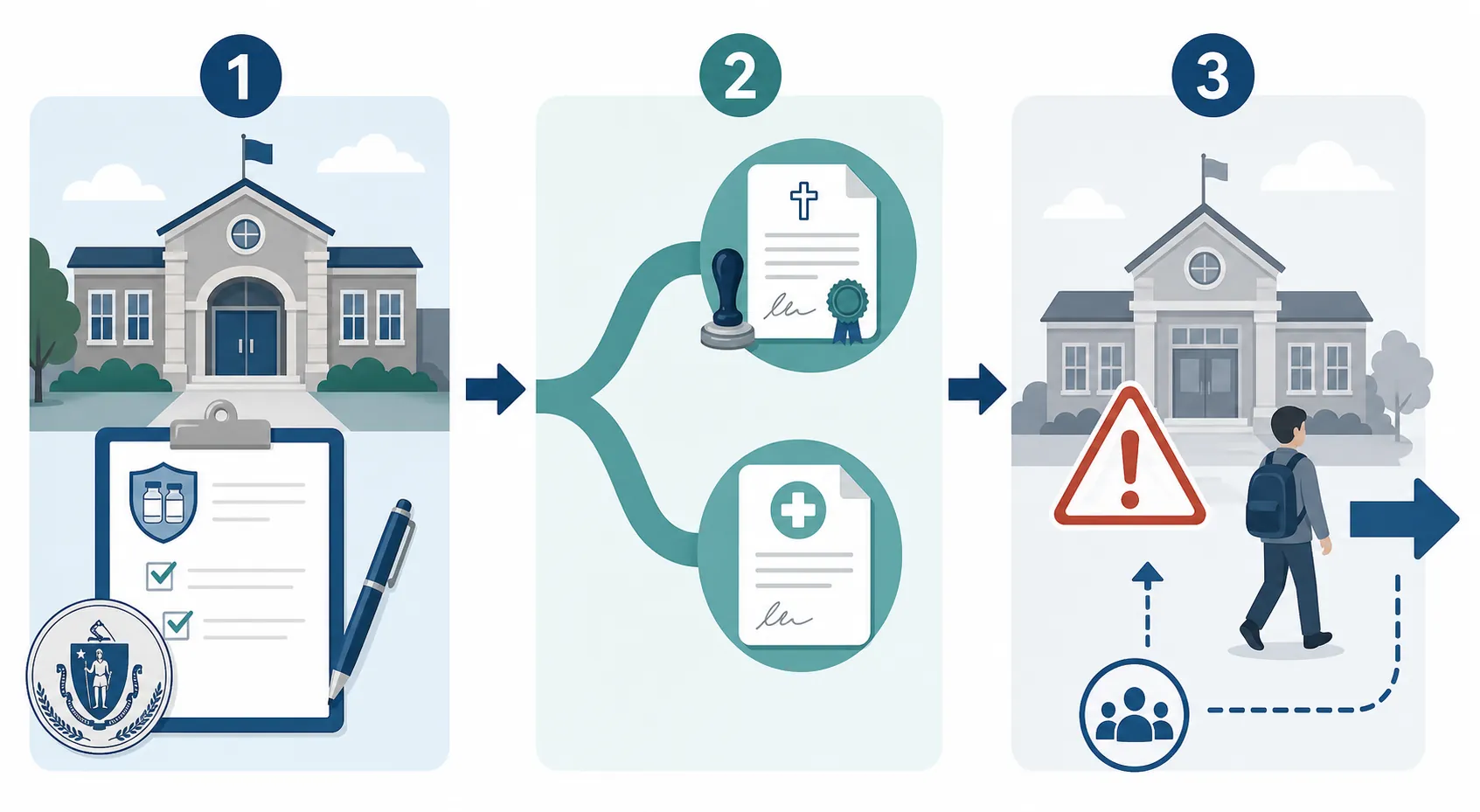
What Changes During a Declared Outbreak
Section 804’s outbreak language is the part that tends to sit quietly in the background until it does not. Under § 804-7.1.3, students who are exempted from immunization may be temporarily excluded from school during a declared outbreak. The regulation also assigns return-to-school control to the Division of Public Health and protects the student from academic penalty if assignments are completed.[2]
The July 2026 declaration gives that text operational force. It does not erase the exemption. It changes what the exemption can do while an outbreak exists. A religious affidavit or approved medical exemption may explain why the student lacks MMR vaccination documentation, but it does not guarantee physical attendance during an outbreak if the exclusion provision applies.
The same is true for under-immunized students without a completed exemption file. Once the outbreak clause is in view, the school’s risk is no longer limited to whether it enrolled the student correctly in September. The question becomes whether the district followed the state exclusion and return process when the public-health condition changed.
- Confirm whether DPH has declared an outbreak affecting the school population or relevant jurisdiction.
- Identify students without complete MMR documentation, including students with religious or medical exemptions.
- Apply exclusion decisions consistently with § 804 and DPH direction, not ad hoc school preference.
- Document who communicated the exclusion, the authority cited, and the condition for return.
- Preserve the academic-access record showing assignments were made available and completed work was not penalized.
Return Is a Public-Health Determination
The return provision is easy to underread. Section 804-7.1.3 does not leave return timing to a building administrator’s comfort level, nor to a parent’s assurance that the student feels well. It places return under DPH determination.[2]
That allocation protects both sides if the record is kept clean. The family knows the return condition is not being invented by the school. The school can show it acted under the state process rather than making a discretionary exclusion untethered from the regulation.
Academic Penalty Is a Separate Issue
The regulation’s academic-protection language should not be treated as a courtesy note. If a student is temporarily excluded during an outbreak, § 804-7.1.3 says the student may not be penalized academically if assignments are completed.[2]
That means the exclusion file and the instructional file have to talk to each other. A district may have a defensible public-health exclusion and still create a separate problem if the student is marked down for the absence rather than evaluated on completed assignments under the regulation’s terms.
Where Federal Vaccine Disruption Fits, and Where It Does Not
The federal context explains why readers are asking the question in 2026. Georgetown’s Center for Children and Families reported a January 5, 2026 CDC schedule change reducing listed diseases from 17 to 11, ACIP-related disruption, and a March 16, 2026 preliminary injunction in AAP v. HHS that paused the new committee and changes to the childhood vaccination schedule.[6]
That reporting is relevant background, not the source of Delaware’s school-entry rule. Delaware’s K-12 MMR requirement rests on state law and state regulation. A federal advisory schedule dispute does not, by itself, repeal 14 Del. C. § 131, amend 14 Admin. Code § 804, change DOE forms, or remove DPH’s outbreak-return role.
Delaware lawmakers also moved on a related but distinct access issue. A Delaware Legislative Black Caucus release said House Bill 338 advanced from committee on April 24, 2026, and would freeze Delaware insurance coverage requirements to ACIP recommendations as of January 1, 2025.[7] That bill speaks to insurance coverage and vaccine access. It should not be mistaken for the current school-entry mandate unless and until enacted provisions directly amend the school immunization framework.
Why the Outbreak Clause Is No Longer Theoretical
Delaware’s July 2026 outbreak involves adults, not a reported school cluster in the cited materials. That distinction should stay in the record. The legal point is not that Delaware schools have confirmed school-based spread; the point is that the state has declared an outbreak, and the school regulation contains an outbreak-exclusion mechanism that depends on that kind of public-health posture.[2][3]
National data give some reason why these clauses are receiving closer attention. Delaware reporting, citing CDC MMWR data, said kindergarten vaccine exemptions reached 3.6%, or about 138,000 students, in the 2024-25 school year.[5] That figure does not measure Delaware-specific school risk, and it does not prove that exemptions caused Delaware’s July 2026 outbreak. It does show why an exemption-and-exclusion workflow is now a live administrative subject rather than a back-page compliance detail.
Compliance Exposure for Districts and Families
For a district, the most likely failure points are ordinary ones: accepting the wrong exemption document, failing to route a medical exemption through the required review process, treating an exempt student as automatically attendance-eligible during an outbreak, or excluding a student without preserving the DPH basis and academic-access record.
For a family, the immediate access question is also documentary. A notarized religious affidavit has a different legal status from a personal objection. A physician statement in the DPH review pathway has a different status from a general health concern. During an outbreak, even a valid exemption may not answer the separate question of temporary exclusion and return.
For counsel reviewing a challenged decision later, the useful file will show the governing rule, the student’s MMR or exemption status, the outbreak authority relied on, DPH communication or determination, notice to the family, and the academic arrangement offered during the exclusion period. The absence of those items is where an otherwise lawful rule becomes harder to defend.
What Should Be Verified Next
Delaware’s MMR requirement remains a state-law school-entry obligation, and the July 2026 outbreak changes the compliance environment by making § 804’s exclusion procedure active rather than theoretical. The next defensible update should verify the current text of 14 Del. C. § 131 and 14 Admin. Code § 804, DOE immunization forms, DPH outbreak status and return guidance, and any enacted Delaware legislation affecting vaccine access or school-entry requirements.
References
- Immunizations, Delaware Department of Education.
- 14 Del. Admin. Code § 804-7.0, Cornell Legal Information Institute.
- Delaware Declares Measles Outbreak, Delaware News, July 22, 2026.
- Delaware declares measles outbreak days after first case, Spotlight Delaware, July 23, 2026.
- Can kids skip school vaccines for religious reasons in Delaware?, delawareonline, July 22, 2026.
- Court Order Presses Pause on New ACIP Committee and Changes to Childhood Vaccination Schedule, Georgetown University Center for Children and Families, March 31, 2026.
- House Committee Advances Bill Aimed at Protecting Vaccine Access in Delaware, Delaware Legislative Black Caucus, April 24, 2026.
Operationalizing workflow
No workflow has been explicitly linked to this obligation yet. See Workflows generally.
Illustrative cases
No illustrative case is currently tracked for this obligation. See Risk Digest for documented incidents generally.
← Back to RegulationReport a correction or tip
Spotted an outdated figure, a misstated fact, or a ruling this regulation entry should reflect? Public comments are disabled for this content given the professional cost of a misreported case outcome, penalty amount, or rule text — use the structured correction channel instead.
Report a correction or tip for this record →