
Denaturalization Criteria and Legal Implications Under Trump
- Authority
- U.S. Congress
- Rule type
- statute
- Jurisdiction scope
- US federal
- Source text
- Read primary rule text ↗
Citizenship may be revoked only if illegally procured or procured by material fraud.
Regulation & Ethics note
Last verified: July 27, 2026. This article is a legal-reference overview for risk, compliance, and immigration-practice readers. It is not legal advice, does not assess any individual case, and should not be used as a substitute for counsel’s review of the naturalization file, immigration history, criminal record, and any government pleadings.
The source hierarchy matters here. The binding law comes from INA §340, codified at 8 U.S.C. §1451, and from Supreme Court decisions interpreting the government’s power to revoke citizenship. Trump administration memoranda and agency targets can change referrals, investigations, pleadings, and the practical risk environment. They do not, by themselves, amend the denaturalization statute.
A separate verification caution applies to the June 2025 DOJ Civil Division denaturalization memo. The underlying PDF could not be fully verified directly for this article. Its priority categories are therefore treated as reconstructed from contemporaneous reporting and quoted excerpts by NPR, the Guardian, and the Migration Policy Institute, not as independently crawled primary text.

The criteria that can actually strip citizenship
The legal starting point is still INA §340(a). The statute authorizes revocation when citizenship was “illegally procured” or was “procured by concealment of a material fact or by willful misrepresentation.” Those are the two operative routes: illegality in procurement, and fraud-based procurement through concealment or willful misrepresentation of a material fact.[1]
USCIS’s own Policy Manual frames revocation around the same statutory grounds. The agency guidance is useful because it shows how USCIS describes the grounds internally, but it does not add a third ground for taking citizenship away.[2]
| Ground | What the government must connect it to | What it does not become |
|---|---|---|
| Illegal procurement | A defect in eligibility or compliance at the time citizenship was granted | A general power to revisit citizenship because the person later became undesirable |
| Concealment or willful misrepresentation | A willful falsehood or concealment that was material to the naturalization decision | A license to revoke citizenship for every inaccurate answer or omission |
That distinction is the first operational filter. A later criminal conviction, sanction, political controversy, employment dispute, or disciplinary issue may trigger attention. It may even generate a referral if an agency believes the later fact points backward to a concealed pre-naturalization problem. But post-naturalization conduct alone is not the statutory criterion. The government must tie the case back to procurement of citizenship.
Illegal procurement is about eligibility when citizenship was granted
Illegal procurement reaches cases where the person was not legally entitled to naturalize when the order of naturalization was entered. The defect may involve a statutory eligibility requirement rather than a lie: for example, if a required condition for naturalization was not satisfied. In that posture, the case is not necessarily about whether the person tricked the government. It is about whether citizenship was granted contrary to law.
For risk teams, this matters because the relevant factual period is not “everything the person has ever done.” The relevant question is whether the government can identify an eligibility defect connected to the grant of citizenship. That is why the naturalization application, interview record, immigration file, residence history, marital history where relevant, selective service history where relevant, criminal history, and good-moral-character period often matter more than the headline that triggered the inquiry.
Fraud-based denaturalization has a structured test
The Supreme Court’s decision in Kungys v. United States supplies the architecture for fraud-based civil denaturalization. The Court addressed the required relationship among misrepresentation or concealment, willfulness, materiality, and procurement of citizenship. The operative test can be stated as four connected elements: a misrepresentation or concealment, willfulness, materiality, and causation in the sense that naturalization resulted from the defective procurement.[3]
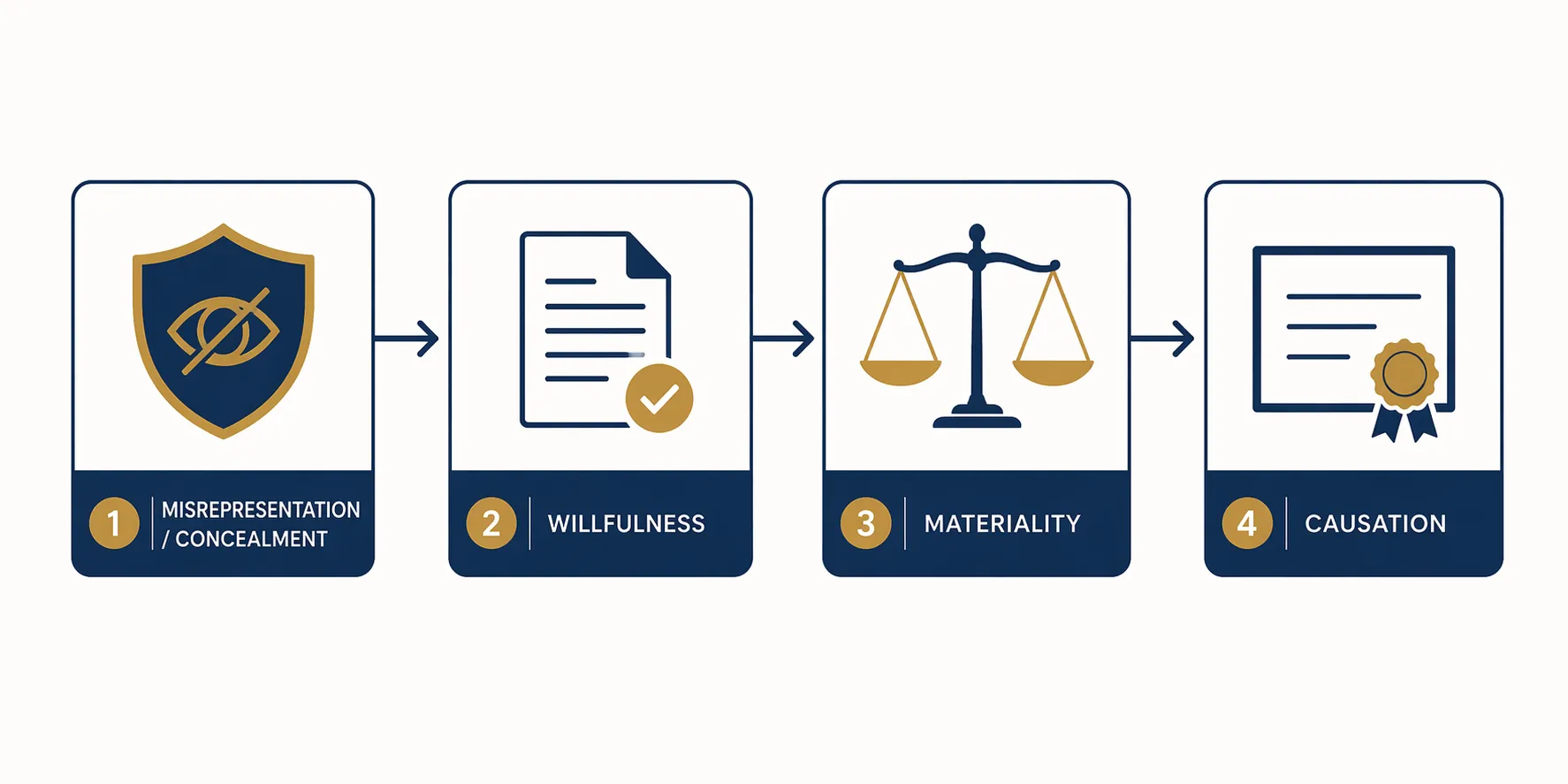
The materiality piece is not decorative. Kungys treated materiality as requiring more than an immaterial mistake; the falsehood or concealment must have a natural tendency to influence the naturalization decision or relate to a predictable naturalization consequence.[3] A misspelling, a stale address confusion, or an answer that had no real bearing on eligibility is not transformed into a denaturalization theory merely because it appears in a naturalization file.
Maslenjak v. United States tightened the same point in the criminal denaturalization setting. The Supreme Court rejected the idea that any false statement in the naturalization process could support criminal conviction and loss of citizenship. The government must prove a connection between the false statement and the acquisition of citizenship; the lie must be material to the naturalization decision.[4]
That is the legal reason a broad enforcement memo cannot do all the work. An agency may decide to look harder at a category of cases. A prosecutor may be instructed to prioritize certain files. But once the government is in court, it still needs a theory that fits the statute and the Supreme Court’s materiality requirement.
Afroyim blocks non-fraud revocation based on later conduct
Afroyim v. Rusk is the constitutional backstop often missing from fast denaturalization coverage. The Supreme Court held that Congress cannot involuntarily strip a person of U.S. citizenship once acquired, except within the narrow fraud-in-naturalization framework. The decision bars the government from treating citizenship as a status that can be withdrawn because of disfavored post-naturalization conduct alone.[5]
The practical consequence is straightforward but important. A naturalized citizen who commits a crime after naturalization may face prosecution, imprisonment, professional discipline, loss of security clearance, immigration consequences for relatives, or other collateral effects. Denaturalization requires a separate showing that citizenship itself was illegally procured or procured through material concealment or willful misrepresentation.
What the Trump administration changed
The Trump-era expansion is best understood as operational, not statutory. The administration did not need Congress to rewrite INA §340 in order to change what government lawyers are told to look for, what USCIS adjudicators are asked to refer, and which cases receive Civil Division resources. That is still a serious change. Resource allocation is not cosmetic when it increases investigations, referral pressure, and litigation exposure.
Contemporaneous reporting on the June 11, 2025 DOJ Civil Division memo describes 10 denaturalization priority categories, including sex offenses, drug distribution, terrorism, immigration fraud, wire or bank fraud, firearms offenses, violent crimes, human rights violations, national security threats, and a final category for “any other cases” determined to be sufficiently important.[6][7][8]
Those categories are priority signals. They do not replace the statutory test. A wire-fraud conviction, for instance, may be relevant if it reveals a concealed pre-naturalization offense, a false answer during the naturalization process, or an eligibility defect. It is not, standing alone, a new denaturalization criterion.
| Trump-era instrument | Legal status | Why it matters in practice |
|---|---|---|
| June 2025 DOJ Civil Division denaturalization priorities | Enforcement and litigation prioritization, reconstructed from reporting and quoted excerpts | Directs attention toward categories of cases DOJ lawyers may be expected to pursue |
| USCIS referral target reported in December 2025 | Operational target reported by NPR, not an amendment to INA §340 | Can increase file review, referrals, and pressure on adjudicators to identify denaturalization candidates |
| August 2025 USCIS good moral character policy memorandum | Agency policy guidance for naturalization adjudication | Can affect current applicants directly and may shape later theories about whether naturalization was lawfully procured |
The “sufficiently important” category is the pressure point
The most sensitive feature of the reported DOJ priority list is not the presence of categories such as terrorism, human rights violations, or immigration fraud. Those fit familiar enforcement instincts. The more legally and politically sensitive feature is the catch-all category for other cases deemed “sufficiently important,” as reported in accounts of the memo.[6][7][8]
A catch-all priority can be used narrowly, as a way to preserve discretion for unusual but serious cases that do not fit a named category. It can also create anxiety because it gives officials room to elevate cases that are prominent, controversial, or politically salient. The unresolved debate is not whether the catch-all changes the statute; it does not. The concern is whether it changes which naturalized citizens become the subject of investigation, subpoena activity, referral, or litigation.
Courts remain the limiting institution if the government files suit. The government still has to plead and prove illegal procurement or material fraud. But a person does not need to lose a case for the process to be consequential. A denaturalization investigation can require counsel, document reconstruction, employment disclosures, professional-risk analysis, and careful coordination if the person is a lawyer, executive, regulated employee, or government contractor.
The USCIS referral target changes the ground experience
NPR reported in December 2025 that the administration wanted USCIS adjudicators to meet a target of 100 to 200 denaturalization referrals per month.[9] The legal standard did not change when that target was reported. The institutional behavior can change anyway.
A referral target affects where attention goes inside the agency. It can encourage adjudicators and reviewers to search older files for discrepancies, compare naturalization answers against later criminal or civil records, and elevate cases that previously might have remained dormant. For immigration counsel, that means an unchanged statute can still produce more client calls, more FOIA work, more requests to reconstruct decades-old timelines, and more need to distinguish a real procurement defect from an alarming but legally insufficient inconsistency.
The good-moral-character memo is mainly front-end, but not irrelevant
On August 15, 2025, USCIS issued a policy memorandum titled “Restoring a Rigorous, Holistic, and Comprehensive Good Moral Character Evaluation Standard for Aliens Applying for Naturalization.” The memorandum broadened adjudicator discretion in naturalization cases, including consideration of factors such as tax compliance, educational attainment, and community involvement when evaluating good moral character.[10]
That memo directly affects people applying for naturalization, not citizens whose naturalization is already final. Its denaturalization relevance is more indirect: if USCIS applies a broader moral-character lens at the application stage, later government theories may focus on whether a person should have been found ineligible during the statutory period or whether a fact bearing on good moral character was concealed or misrepresented.
The distinction should not be blurred. A broader good-moral-character evaluation for applicants does not create a free-floating power to revoke citizenship years later. It may, however, enlarge the set of facts adjudicators treat as relevant when deciding whether to deny an application now or refer a past grant for further review.
What the case-count data can and cannot tell us
The available litigation data supports a scale signal, not a new legal rule. TRAC reported that civil denaturalization cases averaged about 11 per year from 1990 through 2017, and that 33 cases were filed in May and June 2026. TRAC also cautioned that denaturalization cases are difficult to count because PACER lacks a uniform Nature of Suit code for them, so its figures may undercount filings.[11]
That methodological caution should travel with the number. The May–June 2026 figure is meaningful because it suggests a concentrated increase in filings. It does not tell us how many investigations exist, how many referrals were declined, how strong the filed cases are, or how courts will apply Kungys, Maslenjak, and Afroyim to those complaints.
How to read a denaturalization risk signal
The safer review sequence is legal, not emotional: identify the alleged fact; place it in time; determine whether it existed before or during naturalization; compare it to the naturalization eligibility requirements and application answers; then ask whether the government can show illegal procurement or material, willful misrepresentation. Beginning with the person’s current notoriety or the administration’s priority category reverses the analysis.
| Signal | Question counsel should ask | Why it matters |
|---|---|---|
| A post-naturalization criminal conviction | Does the conduct reveal a pre-naturalization eligibility defect or a false naturalization answer? | Later conduct alone does not satisfy INA §340 |
| A mismatch between an old application and later records | Was the mismatch willful and material to the grant of citizenship? | Maslenjak and Kungys require more than a harmless inaccuracy |
| A DOJ priority-category label | Which statutory ground is the government actually relying on? | Priority categories guide enforcement; they do not create new grounds |
| A USCIS referral or inquiry | What file, form, interview answer, or eligibility requirement is being examined? | The referral may be serious even before a complaint is filed |
| Employer concern about a naturalized employee | Is there a filed proceeding, subpoena, government notice, or only media anxiety? | Overreaction can create employment, discrimination, confidentiality, and professional-responsibility problems |
For law firms and corporate legal departments, the employment-risk point deserves discipline. A naturalized lawyer or employee is not in a different citizenship class because a denaturalization initiative exists. Risk review should be tied to actual process: a government request, a filed complaint, a client conflict, a licensing obligation, a clearance issue, or a documented misstatement. Treating headlines as individualized risk facts can create its own legal and ethical exposure.
For immigration lawyers, the first file request is usually mundane and essential: the complete A-file if available, naturalization application and interview materials, prior immigration filings, criminal dispositions rather than docket summaries, tax and residence records where relevant, and any correspondence from USCIS, DOJ, or another agency. The issue is not whether the client is frightened. Many will be. The issue is whether the government can connect a legally material defect to procurement of citizenship.
What has not changed
The statutory criteria remain limited to illegal procurement and procurement through concealment or willful misrepresentation of a material fact. The Supreme Court’s guardrails continue to require materiality and a connection to naturalization. Afroyim continues to bar citizenship revocation based only on later conduct outside the fraud-or-illegality framework.
The Trump administration’s policy changes matter because they can increase enforcement exposure within those limits. They can change who is investigated, which files are reviewed, how many referrals are expected, and which cases DOJ lawyers are encouraged to bring. They cannot make denaturalization available simply because a naturalized citizen later becomes criminally convicted, professionally inconvenient, politically controversial, or publicly disfavored.
References
- 8 U.S.C. §1451 — Revocation of naturalization, U.S. Code, House Office of the Law Revision Counsel.
- Chapter 2 - Grounds for Revocation of Naturalization, USCIS Policy Manual.
- Kungys v. United States, 485 U.S. 759 (1988), Justia.
- Maslenjak v. United States, 582 U.S. ___ (2017), Supreme Court of the United States, 2017.
- Afroyim v. Rusk, 387 U.S. 253 (1967), Justia.
- Denaturalization and Trump immigration enforcement, NPR, June 30, 2025.
- US citizenship denaturalization Trump memo, The Guardian, July 1, 2025.
- A Last Resort or Intimidating Enforcement Tool? Denaturalization in the Trump Era, Migration Policy Institute.
- Trump administration wants to set quota for denaturalizing American citizens, NPR, December 24, 2025.
- Restoring a Rigorous, Holistic, and Comprehensive Good Moral Character Evaluation Standard for Aliens Applying for Naturalization, USCIS, August 15, 2025.
- TRAC report on denaturalization cases, TRAC, June 17, 2026.
Operationalizing workflow
No workflow has been explicitly linked to this obligation yet. See Workflows generally.
Illustrative cases
No illustrative case is currently tracked for this obligation. See Risk Digest for documented incidents generally.
← Back to RegulationReport a correction or tip
Spotted an outdated figure, a misstated fact, or a ruling this regulation entry should reflect? Public comments are disabled for this content given the professional cost of a misreported case outcome, penalty amount, or rule text — use the structured correction channel instead.
Report a correction or tip for this record →