
DOE emergency order power grid limits challenged in D.C. Circuit
- Authority
- U.S. Department of Energy
- Rule type
- standing order
- Jurisdiction scope
- US federal
- Effective date
- Jan 1, 2025
- Source text
- Read primary rule text ↗
Operators must continue operation of designated coal plants despite state-approved retirements, pending further order.
The D.C. Circuit is being asked to police the emergency line
For counsel tracking the legal implications of DOE emergency orders for the power grid, the important point in Q3 2026 is procedural as much as substantive: the consolidated Campbell and Eddystone challenges remain pending in the D.C. Circuit, and no merits ruling has issued. The contested move is DOE’s use of Section 202(c) of the Federal Power Act to delay planned coal-plant retirements that had proceeded through ordinary utility, state-regulatory, and grid-operator channels. In Campbell, the challengers include Michigan, Minnesota, Illinois, public-interest organizations, and amici such as the Institute for Policy Integrity and the Niskanen Center; the oral argument took place on May 15, 2026.[1]
DOE’s position is not merely that an operating unit may be dispatched during a storm, heat wave, or acute reliability event. The challenged theory is broader: a planned capacity exit can itself help create a “shortage of electric energy,” allowing the Secretary to order continued operation under Section 202(c). Utility Dive’s reporting describes the 2025–2026 orders as a first-time use of the authority to block retirements neither the utility nor the grid operator requested, with orders renewed in 90-day increments and no clear end condition identified.[1]
That is why Judge Cornelia Pillard’s questioning matters. At argument, she pressed DOE’s dependence on a NERC assessment and observed: “If you take out the elevated risk … you don’t have a basis for 202(c).”[1] That sentence should not be treated as a vote count. It does, however, isolate the vulnerability in DOE’s theory: if the agency’s four-factor framework depends on a reliability assessment that does not independently establish the kind of emergency Congress authorized, then the statutory hook may fail before the court ever reaches broader policy arguments.
The better reading is that Section 202(c) does not authorize DOE to transform planned, state-approved retirements into an emergency simply by labeling the resulting capacity concern a shortage. The D.C. Circuit is likely to reject that expansive interpretation, though it may do so through a narrower ruling tied to the factual predicate, renewal practice, or the particular orders before it rather than a sweeping opinion on every use of DOE emergency authority.

What Section 202(c) has usually been asked to do
Section 202(c) dates to 1935 and has historically functioned as an emergency reliability valve. The phrase doing the work here is “shortage of electric energy.” The historical record described in the available legal analysis is narrow: the authority has been used only several dozen times over roughly 90 years, typically in response to hurricanes, heat waves, winter storms, and other short-duration disruptions lasting hours to days.[2]
That history does not prove that every lawful Section 202(c) order must look exactly like a hurricane order. Emergency statutes have to be capable of responding to circumstances Congress could not list in advance. But historical usage is relevant when an agency asks a court to accept a categorical shift in function. Before the 2025–2026 retirement-blocking orders, the provision had not been used to countermand planned utility or state retirement decisions.[2]
The distinction is not semantic. A storm order deals with an abnormal interruption in supply, transmission, or operating conditions. A retirement-blocking order intervenes in a scheduled resource transition that has already passed through ordinary planning processes. If both situations are treated as the same “shortage,” the emergency trigger begins to resemble a standing federal veto over state-approved generation decisions.
That is where the word “shortage” becomes dangerous if left unbounded. In the narrow sense, a shortage is an immediate condition: demand cannot be served, or the system faces a concrete emergency requiring temporary direction. In DOE’s broader sense, a shortage can include a projected capacity concern associated with a planned retirement. Once that broader sense is accepted, the limiting principle becomes hard to find. Many ordinary resource-planning disputes involve some asserted risk margin, some competing reliability study, and some contested timing judgment.
DOE’s theory strains the ordinary regulatory sequence
The Campbell order is legally important because it enters after, not before, ordinary retirement review. State regulators, utilities, and grid operators had already been operating within overlapping planning processes. Michigan’s attorney general captured the federalism problem in a phrase that has more legal force than most press-release language: the order “interrupts and frustrates a finely calibrated system of overlapping regulatory processes.”[1]
That framing matters because Section 202(c) does not sit in a vacuum. The Federal Power Act preserves major areas of state authority over generation facilities and utility resource decisions, while federal and regional institutions address interstate transmission and reliability. DOE can have real emergency authority without having a general power to reopen every state-approved retirement that later becomes politically or operationally inconvenient.
The 90-day renewal pattern sharpens the issue. A short emergency order may be defensible even when the record is imperfect, because its premise is temporary stabilization. Serial renewals are different. If DOE can repeatedly reissue 90-day directives without identifying a concrete endpoint, mitigation condition, or changed emergency predicate, the statutory emergency valve begins to operate as a resource-planning instrument.
The cost evidence belongs in that compliance discussion, not at the center of the statutory analysis. Consumers Energy put Campbell-related costs through September 2025 at $80 million, while Sierra Club estimated $179.8 million; those figures are attributed estimates from interested or party-adjacent sources and may be disputed.[1] They still matter to counsel because emergency orders generate real cost-recovery, contracting, environmental-compliance, and customer-rate questions while the legality of the order remains unresolved.
Loper Bright leaves less room for an elastic agency gloss
The post-Loper Bright setting changes the reviewing posture. After the Supreme Court’s 2024 decision in Loper Bright Enterprises v. Raimondo, courts do not defer to an agency’s interpretation of statutory ambiguity under Chevron; they must exercise independent judgment about the best reading of the statute.[2]
That does not mean DOE loses because it is DOE. Loper Bright is not a rule that every agency interpretation is suspect, and Section 202(c) unquestionably gives the Secretary emergency authority in qualifying circumstances. The problem is more precise: DOE is asking the court to accept a reading of “shortage of electric energy” that would allow planned retirement decisions to become emergency predicates, even when the alleged shortage is filtered through a multi-factor reliability judgment rather than an immediate operational disruption.
That is why the NERC-assessment dependency drew attention at argument. If DOE’s four factors do independent statutory work, the agency can argue that it has translated a complex reliability record into an emergency finding. If the factors collapse once the “elevated risk” premise is removed, the court may view the order as an agency label attached to an ordinary planning disagreement. Judge Pillard’s question was aimed at that hinge.[1]
An administrable rule is available without disabling DOE in genuine emergencies. The court can hold that Section 202(c) reaches acute or concrete shortages requiring temporary operational direction, but does not authorize DOE to block a planned, state-approved retirement merely because the agency identifies elevated reliability risk associated with the capacity exit. That reading preserves emergency authority while preventing the emergency label from swallowing ordinary regulatory sequencing.
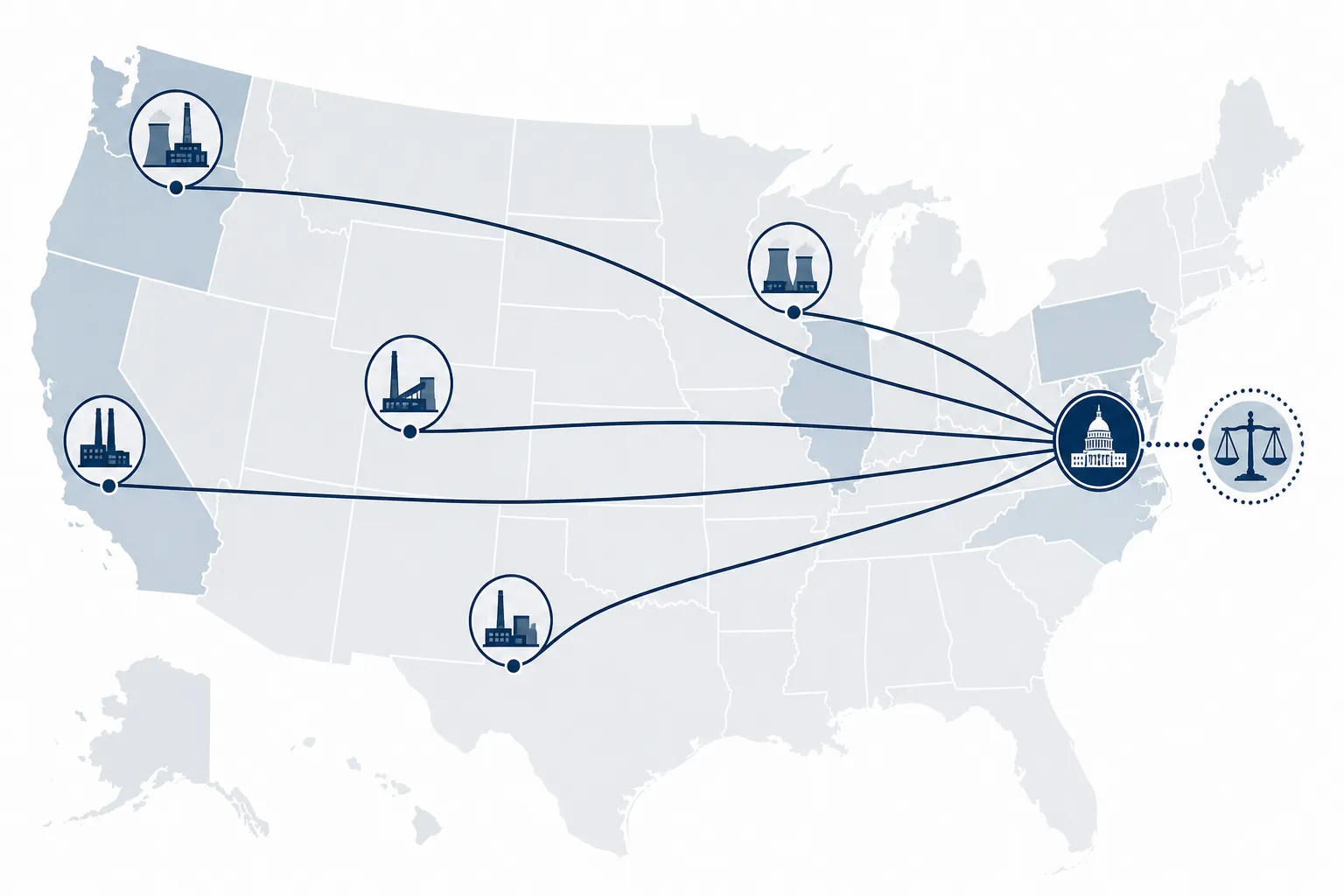
The litigation map is wider than Campbell
Campbell and Eddystone are the immediate D.C. Circuit focal points, but the Section 202(c) fight has spread across multiple retirement-blocking orders. The State Power Project tracker identifies Campbell in the D.C. Circuit, Eddystone in the D.C. Circuit, Centralia in the Ninth Circuit, Craig in the D.C. Circuit, and Schahfer/Culley in the D.C. Circuit.[3]
| Matter | Court | Why it matters here |
|---|---|---|
| Campbell, No. 25-1234 | D.C. Circuit | Lead vehicle for testing whether “shortage of electric energy” reaches planned capacity exits.[1][3] |
| Eddystone | D.C. Circuit | Consolidated posture keeps the D.C. Circuit focused on DOE’s Section 202(c) retirement-blocking theory.[3] |
| Centralia, No. 26-1252 | Ninth Circuit | Shows the issue is not confined to one regional planning dispute.[3] |
| Craig, No. 26-1059 | D.C. Circuit | Adds another D.C. Circuit challenge to the same broader DOE practice.[3] |
| Schahfer/Culley, No. 26-1057 | D.C. Circuit | Part of the same litigation spread over serial Section 202(c) orders.[3] |
Earthjustice announced the first court challenge to DOE’s coal-plant extension on December 22, 2025, framing the extension as illegal.[4] The date and party posture are useful; the rhetoric is less useful to the statutory question. The D.C. Circuit does not need to accept campaign-style illegality claims to reject DOE’s interpretation. It only needs to decide that the statute’s text, structure, and historical use do not support the agency’s claimed power.
Legal implications while the orders remain pending
The immediate legal implication is uncomfortable but ordinary: unless stayed or vacated, an emergency order must be treated as operative. Utilities and plant owners have to document compliance decisions, preserve objections, separate compelled operating costs where possible, and maintain a record that can support later cost-recovery or reimbursement disputes. State regulators have to decide how to account for federally compelled operations inside resource plans and rate proceedings that did not assume continued operation.
For grid operators, the risk is institutional. If DOE can invoke Section 202(c) without a request from the utility or grid operator and then keep renewing the order, regional planning judgments become provisional in a new way. A retirement approval no longer marks the end of the sequencing problem; it becomes a potential input into a later federal emergency finding.
For litigation teams, the record should be built around statutory predicates rather than generalized reliability disagreement. The useful questions are concrete: what condition existed when the order issued, what evidence showed an actual or imminent shortage, what alternatives were considered, what changed at renewal, and what condition would allow the order to terminate. Those questions expose whether DOE is responding to an emergency or managing a planning transition.
This analysis is limited to Section 202(c). DOE emergency activity under other authorities, including defense-related production tools, Part 205 procedures, or grid-security emergency orders, may raise different legal implications. The pending coal-retirement cases are important because they test one specific proposition: whether the 1935 Federal Power Act emergency provision can be stretched to hold retiring units in service as a reliability backstop.
The likely path of decision
The strongest route for the D.C. Circuit is not to write broadly about coal, decarbonization, or federal reliability policy. It is to decide the jurisdictional question cleanly: Section 202(c) authorizes emergency operational orders when the statutory predicate exists; it does not give DOE a continuing veto over planned retirements by recasting projected reliability risk as a “shortage of electric energy.”
A narrower opinion is possible. The court could reject the Campbell order because DOE’s record did not establish the required emergency, because the renewal practice lacked a lawful endpoint, or because the agency leaned too heavily on an assessment that did not supply the statutory predicate. Any of those routes would leave DOE room to act during genuine grid emergencies while denying the specific retirement-blocking theory advanced here.
On the materials available as of Q3 2026, the better reading is that Section 202(c) does not permit DOE to block planned, state-approved plant retirements by deeming them a shortage. The D.C. Circuit is likely to reject DOE’s expansive interpretation, even if it does so in a fact-bound way rather than by announcing a comprehensive limit on every future emergency order.
References
- DOE exceeded its authority with coal retirement delay, states tell appeals court, Utility Dive, May 18, 2026.
- Federal Power Act 202: Shaping Grid, Balch & Bingham / Public Utilities Fortnightly, March 2026.
- Challenges to DOE 202(c) Orders, State Power Project.
- DOE's Illegal Extension of Coal Plant Challenged in Court for the First Time, Earthjustice, December 22, 2025.
Operationalizing workflow
No workflow has been explicitly linked to this obligation yet. See Workflows generally.
Illustrative cases
No illustrative case is currently tracked for this obligation. See Risk Digest for documented incidents generally.
← Back to RegulationReport a correction or tip
Spotted an outdated figure, a misstated fact, or a ruling this regulation entry should reflect? Public comments are disabled for this content given the professional cost of a misreported case outcome, penalty amount, or rule text — use the structured correction channel instead.
Report a correction or tip for this record →