
DOJ Asks Supreme Court to Reinstate Trump Mail Voting Order
- Authority
- President of the United States (Executive Order 14399)
- Rule type
- regulation
- Jurisdiction scope
- US federal
- Source text
- Read primary rule text ↗
Mail ballot envelope redesign, SAVE citizenship verification, USPS ballot transmission compliance, and criminal exposure avoidance
DOJ’s request to restore Trump’s mail-voting order is not waiting for the ordinary pace of election litigation. The emergency application in docket 26A124 is already before the Court, with responses due August 3, 2026. DOJ says implementation must begin as soon as early to mid-August if the federal government is to restore Executive Order 14399 in time for the November 2026 midterms.[1]
That is the operative fact for election lawyers, county clerks, state board counsel, ballot vendors, postal liaisons, and UOCAVA advisers. The Supreme Court has not ruled. Justice Jackson could enter an administrative stay, refer the application to the full Court, deny relief, or the Court could issue a narrower order than either side wants. But if the injunction is lifted, the question changes immediately from who has the better Article II theory to which offices must redesign envelopes, alter verification queues, align with USPS ballot-transmission rules, and decide whether a routine ballot issuance could be characterized as criminal exposure.
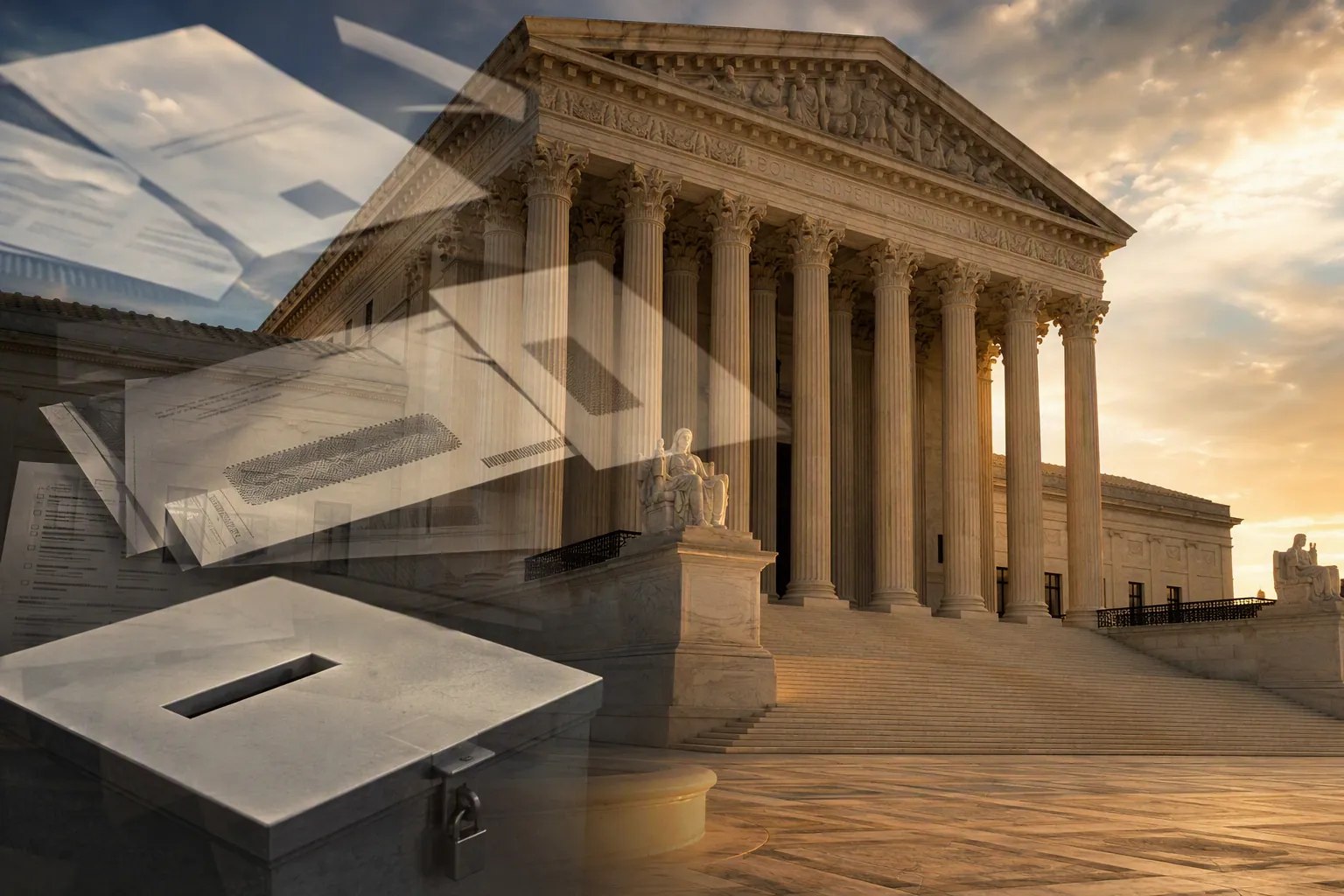
What Would Become Active If The Injunction Is Lifted
The emergency application concerns the injunction entered in the 23-state plus District of Columbia challenge. That matters. A Supreme Court order in this posture would not automatically settle every parallel challenge to EO 14399, including the ACLU/Brennan Center and DSCC tracks. Other restraints may remain in place, and the practical effect of any Supreme Court order will turn on its scope, not on the headline that the order was “restored.” For a broader map of the parallel Postal Service-related litigation, see Postal Service Ballot Rule Faces Multiple Legal Challenges.
For the states and offices within the affected injunction, the operational map is more concrete than the constitutional briefing suggests. EO 14399 would press election officials toward four immediate workstreams: mail-ballot envelope redesign, DHS SAVE citizenship verification, USPS ballot-transmission compliance, and prosecution-sensitive decision-making when DHS records do not confirm citizenship.
| Workstream | Operational Issue | Why Timing Matters |
|---|---|---|
| Mail-ballot envelopes | Mandated Intelligent Mail barcodes and Official Election Mail logos | Some jurisdictions have already purchased 2026 envelopes and would need reprinting or supplemental vendor work |
| SAVE verification | Citizenship cross-checks through DHS records | False positives require human review, voter contact, cure procedures, or exception handling before ballots are issued or counted |
| USPS protocols | Alignment with Postal Service ballot handling and transmission requirements | USPS issued a proposed rule in May 2026, so state calendars would collide with federal postal implementation |
| Criminal exposure | Risk to officials who issue ballots to individuals not appearing on DHS citizenship lists | Local officials would need guidance before ordinary ballot issuance becomes a contested enforcement decision |
Those are not policy preferences dressed up as administrative concerns. The 1st Circuit rejected the government’s position that envelope-related costs were merely speculative, pointing to states that had already purchased 2026 mail-ballot envelopes and would face reprinting burdens if the order were restored. The same opinion found that the changes would “sow confusion and threaten disenfranchisement of many eligible voters.”[2]
Envelope Redesign Is A Legal Deadline Wearing A Procurement Mask
Election offices do not buy mail-ballot envelopes the way a federal agency edits a form. They lock in sizes, windows, return-address placement, secrecy-sleeve interaction, vendor print schedules, barcode placement, local postal approval, and instructions that must match voter-facing materials. If EO 14399 is restored in early or mid-August, the affected states and the District of Columbia would be doing that work against ballot-finalization and mailing calendars already under pressure.
The order’s envelope requirements are tied to Intelligent Mail barcodes and Official Election Mail logos. USPS has already issued a proposed rule implementing the order’s requirements, which makes this more than an abstract possibility.[1] Once a proposed postal regime is in the field, state officials need to know whether old envelopes will be accepted, whether transitional use is permitted, whether reprinted stock must be certified, and whether counties may exhaust existing inventory. Those questions are often answered through vendor calls and postal liaison emails before they ever appear in a court filing.
The hard part is that the federal compliance signal would not land evenly. One county may still be waiting on vendor proofs. Another may have pallets of return envelopes already delivered. A third may rely on a state print contract with no immediate production slot. Treating those costs as speculative misses the work that actually makes mail voting function: proofing, testing, rerouting, approving, printing, mailing, and explaining the change to voters before the first confused call comes into a clerk’s office.
SAVE Cross-Checks Are Where Eligibility And Liability Collide
The SAVE requirement deserves equal attention because it is the place where an eligible voter’s record mismatch can become an administrator’s legal problem. EO 14399 would require citizenship verification through DHS’s SAVE database. The central compliance risk is not simply that a database can be wrong. It is that the order would turn a known mismatch environment into a live eligibility filter on a compressed election calendar.
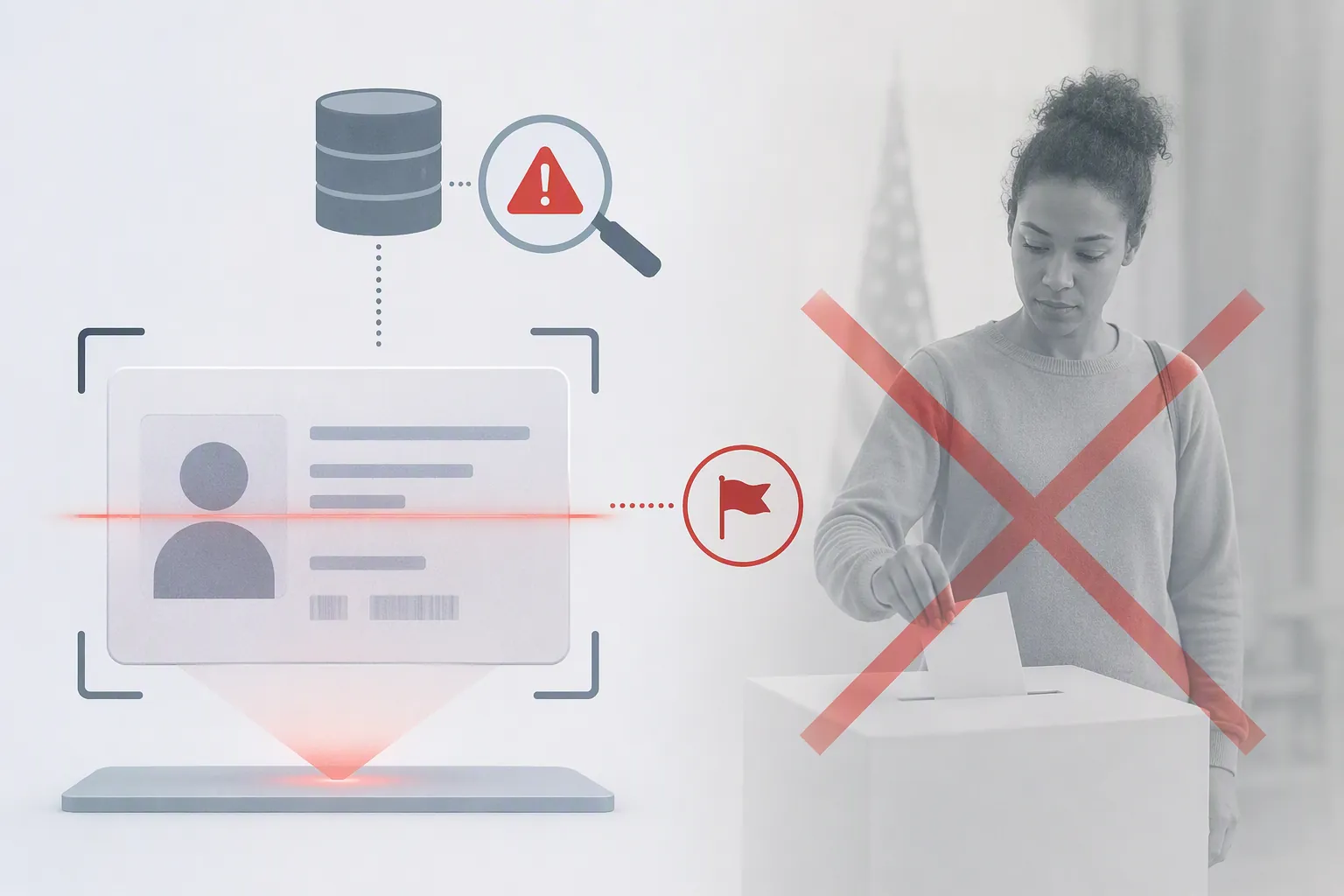
The most cited number should be used carefully. In St. Louis County, the Republican election director testified that roughly 35% of people flagged through SAVE were in fact U.S. citizens who had registered at naturalization ceremonies. That is a county data point, not a national SAVE error rate. It is still operationally serious because Texas and Louisiana reviews corroborate a pattern of false positives, and because even a narrower false-positive problem becomes dangerous when it is attached to ballot issuance, voter-list maintenance, and possible enforcement exposure.[2]
A false positive is not self-correcting. Someone has to notice it, document it, contact the voter or another agency, decide whether the voter remains eligible, preserve audit trails, and avoid treating similarly situated voters differently. In a normal list-maintenance setting, that work is already delicate. In an emergency implementation period, it becomes a queue-management problem with constitutional consequences.
Naturalized citizens are the obvious pressure point because citizenship records may not line up neatly across DHS, state motor vehicle files, voter registration systems, and county-level election management systems. A voter who lawfully registered after naturalization may still be absent from, mismatched in, or delayed within a database query. The legal question for the official at the counter is not whether the person is probably eligible in some general sense. It is whether the official has authority to issue the ballot when the federally mandated cross-check has not confirmed the voter.
The DOJ Non-Disclaimer Matters
The criminal-exposure issue is not a theoretical flourish. The order threatens criminal prosecution of election officials who issue ballots to individuals not on DHS citizenship lists, and DOJ refused to disclaim such prosecutions when Judge Talwani asked about that possibility at oral argument.[2]
That refusal changes the advice environment. State counsel can tell officials to comply with controlling law. They can build escalation protocols. They can create exception forms. What they cannot responsibly do is pretend that a local registrar facing a mismatched SAVE result has the same risk profile as she had before the order. If DOJ or the Court clarifies that ordinary good-faith ballot issuance will not be prosecuted, that would matter immediately. If no clarification comes, officials will be asked to administer an election while guessing where federal enforcement discretion begins.
Fraud Data Does Not Eliminate Compliance Duties, But It Does Frame Proportionality
Mail-ballot fraud exists, but the available figures do not support treating it as a high-frequency administrative baseline. A Brookings Institution study covering 2016 through 2022 general elections found about four cases of mail-ballot fraud per 10 million votes cast, or 0.000043%, using Heritage Foundation database methodology. Brookings noted that the Heritage database is not exhaustive. A News21 database cross-check produced a higher but still very low figure of about 2.5 cases per 1 million mail votes.[3]
Scale still matters. About 30% of all 2024 general-election ballots were cast by mail, and USPS processed 99.2 million ballots in that election cycle.[3] A rule change affecting mail-ballot design, ballot transmission, or eligibility verification therefore reaches a large operational system even if the fraud rate asserted to justify the change is small. That is the relevant compliance point: low-probability misconduct can still be addressed, but the remedy must be administered by real offices with finite staff, existing contracts, and voters who will not know which federal order changed which envelope.
The Litigation Signal Is Mixed, Not Predictive
Watson v. RNC is relevant because the Supreme Court recently upheld states’ authority to count mail ballots received after Election Day, a 5-4 ruling that suggests some skepticism toward aggressive federal preemption of state election administration.[4] It should not be overread. Watson does not decide EO 14399, does not answer the SAVE issue, and does not tell a county clerk what to do with a ballot application if an emergency stay arrives next week.
The better use of Watson is as a caution against assuming that every federal theory of presidential election control will automatically override state election procedures. The better use of the emergency docket is different: watch the exact words of the order. A stay “in full,” a partial stay limited to envelope provisions, an order preserving criminal-enforcement restraints, or a denial without prejudice would create different compliance obligations by Monday morning.
What Practitioners Should Watch Before Treating The Order As Restored
The immediate monitoring points are narrow but consequential. First, the Supreme Court docket in 26A124 controls the emergency posture, including any administrative stay, referral, or full-Court action after the August 3 response deadline.[1] Second, the scope of relief matters more than the label. A restored order may apply to all provisions, only some provisions, or only some parties.
- Whether the Court stays the entire 23-state plus DC injunction or only discrete provisions of it.
- Whether any order addresses already-purchased envelopes, barcode placement, Official Election Mail logo requirements, or transition periods.
- Whether DHS SAVE checks must be completed before ballot issuance, before ballot counting, or through some later reconciliation process.
- Whether DOJ or the Court clarifies criminal-enforcement exposure for officials acting in good faith on incomplete or mismatched citizenship data.
- Whether separate injunctions in parallel lawsuits continue to restrain implementation in some jurisdictions or for some plaintiffs.
This is also where military and overseas voter advisers need particular care. The research record provided here does not establish a distinct UOCAVA rule under EO 14399. The practical concern is instead calendar compression. Overseas and military ballot workflows depend on early transmission, clear instructions, and stable return channels. Any restored USPS, envelope, or eligibility-verification requirement that changes those channels late in the cycle can force advisers to answer voter questions before state guidance is settled.
The Conditional Compliance Judgment
If the Supreme Court grants DOJ’s emergency application broadly, the acute risk is not simply that EO 14399 returns. It is that 23 states and the District of Columbia may have to move into envelope redesign, SAVE cross-checking, USPS rule alignment, and prosecution-sensitive ballot decisions inside a roughly 60-day window before the November 2026 midterms. Some of those offices will already have envelopes on hand. Some will have voter-registration records that do not cleanly match federal citizenship data. Some will be operating under state-law duties that were not written for a midstream federal database filter.
The legal status will remain fragmented unless the Court speaks broadly enough to displace the parallel restraints. That is why the injunction’s scope, any administrative stay, the USPS implementation posture, and any criminal-enforcement clarification are the practical monitoring points. The 1st Circuit found that the changes would sow confusion and threaten eligible voters. Until the Supreme Court says otherwise, election practitioners should treat that finding as a live operational risk, not as a litigation slogan.[2]
References
- Trump v. New York, 26A124, Supreme Court of the United States.
- Analyzing the President's Executive Order on Mail Voting, Brennan Center for Justice.
- Mail voting in the US: Data points to very low fraud and significant benefits to voters, Brookings Institution.
- Watson v. RNC, SCOTUSblog, June 29, 2026.
Operationalizing workflow
No workflow has been explicitly linked to this obligation yet. See Workflows generally.
Illustrative cases
No illustrative case is currently tracked for this obligation. See Risk Digest for documented incidents generally.
← Back to RegulationReport a correction or tip
Spotted an outdated figure, a misstated fact, or a ruling this regulation entry should reflect? Public comments are disabled for this content given the professional cost of a misreported case outcome, penalty amount, or rule text — use the structured correction channel instead.
Report a correction or tip for this record →