
Which law applies to drone attacks on Suez shipping?
- Authority
- International Maritime Organization
- Rule type
- statute
- Jurisdiction scope
- International maritime law
- Source text
- Read primary rule text ↗
Establish jurisdiction and extradite or prosecute covered unlawful acts against ships; SUA does not provide at-sea enforcement measures.
Regulation & Ethics note
| Item | Record |
|---|---|
| Placement | Regulation & Ethics |
| Scope | This article concerns attacks affecting Suez-route shipping in the Red Sea, Bab el-Mandeb, and Gulf of Aden. It does not treat the documented incidents as attacks inside the Suez Canal unless a cited source says so. |
| Legal status | Informational analysis only; not legal advice, not a litigation opinion, and not a substitute for incident-specific counsel. |
| Last verified | 3 Aug 2026, UTC |
| Legal-background review | Named reviewer was not supplied in the publication materials; source review is limited to the cited legal and institutional materials below. |
The legal implications of Suez Canal drone attacks on shipping begin with a naming problem. Most of the documented Houthi-linked incidents that disrupted Suez-route trade were not in the Canal. They occurred in adjacent sea areas that matter legally: the Red Sea, Bab el-Mandeb, and Gulf of Aden. That distinction is not pedantry. Location can affect the available treaty route, the forum that can hear the case, the state entitled to act, and the way a naval response is justified.
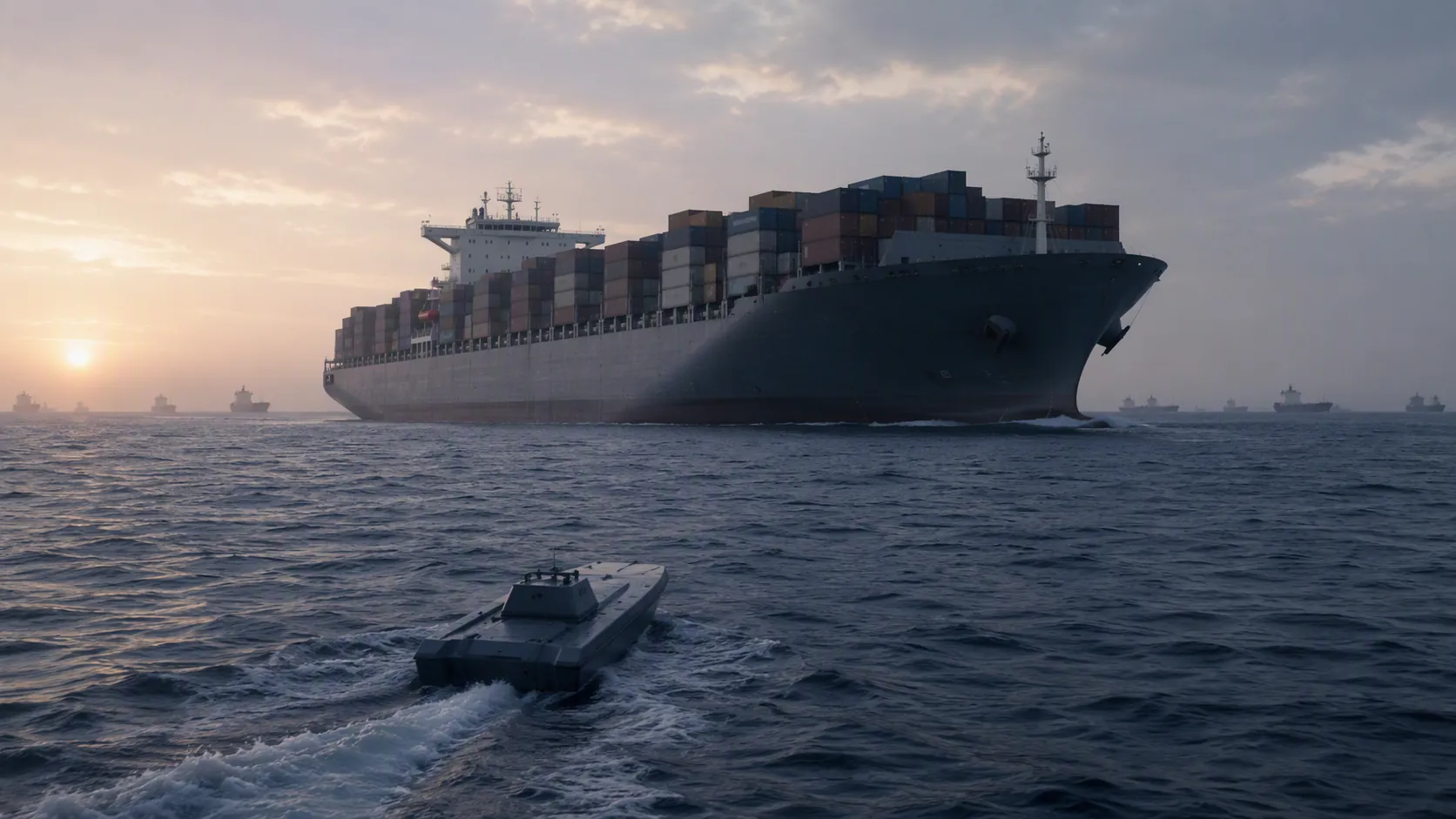
Before a carrier, charterer, P&I club, flag state, or naval lawyer can decide who may enforce, where jurisdiction lies, and who may be accountable, the act has to be classified. “Drone attack” is a factual description. It is not yet a legal category.
The first question is not danger; it is legal consequence
The instruments point in different directions. Piracy under UNCLOS Article 101 is attractive because it is familiar and carries a strong enforcement tradition, but the text was drafted around acts committed by the crew or passengers of a private ship. The 1988 SUA Convention is broader for violence against ships and may supply jurisdiction and extradite-or-prosecute obligations, but it does not itself give states a general power to board or seize at sea. Armed-conflict law may be the better frame for some Houthi drone and uncrewed surface vessel attacks, but then the hard questions move to target status, means of warfare, weapons review, attribution, and self-defense. Papastavridis treats the piracy/SUA choice as genuinely contested rather than a vocabulary preference, and that is the right starting point for counsel who has to classify before the facts are complete [1].
| Candidate framework | What it can establish | Where uncrewed attacks create pressure |
|---|---|---|
| UNCLOS Article 101 piracy | Universal-jurisdiction route and classic maritime-crime classification if the treaty elements are met | A drone or expendable USV may not satisfy the “crew or passengers of a private ship” element on a narrow reading; “private ends” is also disputed [1]. |
| 1988 SUA Convention | Jurisdiction and extradite-or-prosecute obligations for covered unlawful acts against ships | It is useful as a catch-all route, but it does not provide enforcement measures at sea [1]. |
| Armed-conflict / law-of-naval-warfare analysis | Rules for attacks, means and methods of warfare, weapons review, and responsibility in an armed-conflict setting | An unmanned sea drone does not comfortably meet the UNCLOS Article 29 warship test because that test requires a vessel manned by a crew under regular armed-forces discipline [2]. |
| UN Charter Article 51 self-defense | A justification for force by a state responding to attacks, including force against assets ashore if the self-defense test is met | It is a separate question from whether the original attack is piracy, a SUA offense, or an armed-conflict attack. |
The matrix is deliberately unsatisfying. It should be. The uncrewed feature does real legal work. A crewed seizure of a merchant ship and an explosive USV running into a hull may be part of the same operational campaign, but they do not necessarily travel through the same legal doorway.
A compact incident anchor, without letting the chronology take over
The incident record is useful only if it is kept legally sorted. The Galaxy Leader seizure on 19 Nov 2023 is the obvious early anchor, but it was a crewed seizure, not a drone case. Other incidents, including Central Park, Maersk Hangzhou, the 4 Jan 2024 uncrewed surface vessel attack, True Confidence, and MV Tutor, raise different classification questions because the method, target, location, flag, and consequences vary [3].
The IMO Maritime Safety Committee condemned attacks on international shipping in the Red Sea and Gulf of Aden as “illegal and unjustifiable” in a resolution adopted on 23 May 2024, and recorded roughly 50 attacks since the Galaxy Leader seizure [4]. The World Shipping Council has maintained a Red Sea security record that separately identifies events affecting merchant shipping and the surrounding maritime security environment [3]. Those records are enough to show the operational pattern. They do not, by themselves, settle the legal classification of each event.
Why piracy is tempting — and why it may fail for drones
Piracy is the label people reach for first because it sounds like the maritime law answer to violence against ships. UNCLOS Article 101, however, is not a general statute for every attack at sea. In the formulation discussed by Papastavridis, piracy requires illegal acts of violence, detention, or depredation committed for private ends by the crew or passengers of a private ship or aircraft and directed against another ship or aircraft, or against persons or property on board, in the relevant maritime spaces [1].
That “by the crew or passengers” language is where uncrewed systems do damage to the easy answer. If an explosive USV is remotely operated from shore, or if an aerial drone is launched from a platform and has no crew or passengers of its own, a narrow textual reading has trouble treating the drone itself as the private ship or aircraft whose crew committed the act. Counsel may still ask whether the act can be attributed to the people operating, launching, directing, or deploying the device. But that is an argument; it is not the same as simply saying that every drone strike on a merchant vessel is piracy.
The contest is not imaginary. Papastavridis notes the piracy route and its difficulties in the Red Sea setting, including the problem of political motives and the doctrine’s disputed boundaries [1]. The research literature has also left room for a purposive or evolutive reading associated with Petrig, under which a court or state might be asked to read the piracy rules in light of modern uncrewed operations. That broader reading competes with the narrower crew-element view, and with Guilfoyle/Papastavridis-type caution against stretching piracy doctrine past its text. The immediate advice consequence is simple: if a filing, detention decision, or diplomatic note turns on piracy, the theory of how the drone satisfies Article 101 has to be written out.
The “private ends” element adds another problem. Houthi attacks have been framed in political and military terms connected to the Gaza conflict and to pressure on Israel-linked or Western-linked shipping. Whether politically motivated violence can satisfy “private ends” has long been debated in piracy law. Some readings distinguish private from public or state-authorized ends; others treat non-state political violence differently. The Red Sea record does not remove that debate. It makes it operational.
SUA is broader, but it is not a boarding power
The 1988 SUA Convention is often the more practical criminal-law route for attacks on ships because it was designed for unlawful acts against the safety of maritime navigation rather than classic piracy alone. Papastavridis identifies the Convention as having 166 contracting parties as of Jan 2024, and emphasizes its value as a jurisdictional framework for Red Sea attacks [1].
For counsel, the distinction is not academic. SUA can help answer whether a state has jurisdiction over an offense and whether the extradite-or-prosecute obligation is triggered. It may support criminal accountability where the piracy route is uncertain. But it does not supply a free-standing enforcement measure at sea. If a naval vessel wants to board, seize, detain, or use force, the authority has to come from somewhere else: flag-state consent, another treaty power, Security Council authorization, self-defense, or an armed-conflict rule that actually applies.
That is the mistake to avoid in the Suez-route drone cases. SUA may be the best forum-and-accountability answer after the event. It is not necessarily the answer to what a warship may do in the water before the next drone reaches a merchant vessel.
The sea-drone problem: warship, vessel, or weapon?
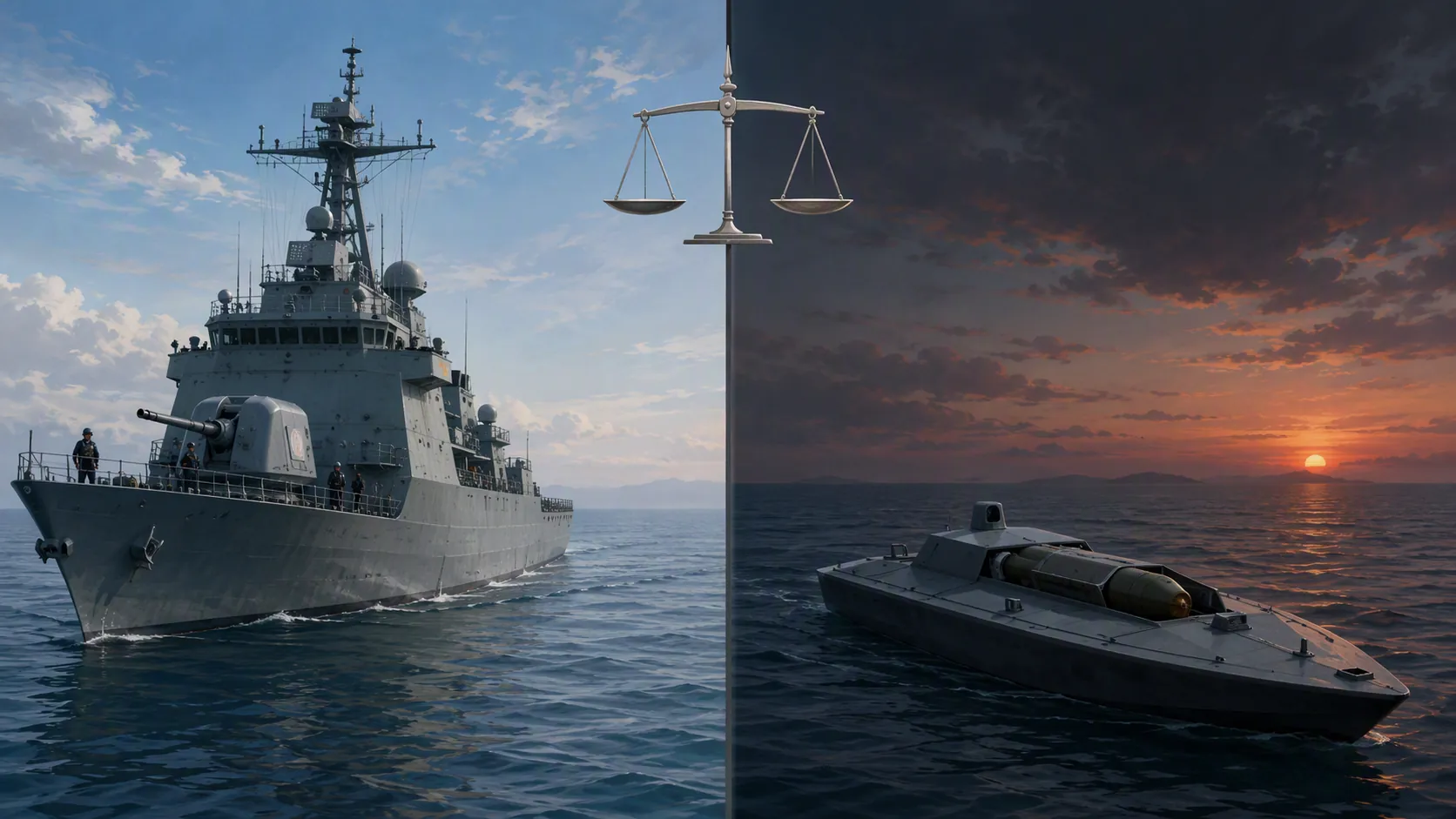
Uncrewed surface vessels also expose a different seam: status at sea. A crewed naval vessel can qualify as a warship if it meets the UNCLOS Article 29 requirements, including command by a commissioned officer, external marks, and a crew under regular armed-forces discipline. Stepien’s analysis of sea drones focuses on the difficulty created by that crew requirement. A fully unmanned sea drone does not comfortably satisfy the Article 29 warship test because it is not manned by such a crew [2].
That does not mean an unmanned maritime system is legally invisible. Stepien’s stronger classification is that many sea drones, especially expendable explosive systems, are better understood as means of warfare rather than warships. That moves the analysis toward weapons law, including analogies to naval mines and torpedoes and the obligation to conduct weapons review under Additional Protocol I Article 36 where applicable [2].
The disagreement is visible in contemporary sources. Stepien records a divergence between the U.S. Commander’s Handbook position, which permits remotely operated warships, and the 2025 Newport Manual’s treatment of expendable explosive unmanned maritime systems as weapons [2]. The distinction matters because a warship carries sovereign status, belligerent rights in armed conflict, and immunities that a weapon does not. A weapon can still be lawfully or unlawfully used, but it is not the actor in the same way.
For Houthi-linked explosive USVs, this cuts against casual phrasing such as “the drone attacked as a vessel” or “the sea drone was a hostile craft” if those words are then used to smuggle in legal conclusions. A low-profile explosive USV may be a target, a weapon, evidence, or the immediate means by which an attack is carried out. It is not automatically a warship, and it is not automatically the private ship whose crew commits piracy.
Security Council and IMO texts condemn the attacks, but do not answer every enforcement question
UN Security Council Resolution 2722, adopted on 10 Jan 2024 by 11 votes in favor with four abstentions including Russia and China, condemned Houthi attacks and affirmed navigational rights and freedoms. It also “took note” of member states’ right to defend their vessels from attacks. That language matters, but it is not the same as a clean Chapter VII authorization for every later naval or ashore response. Security Council Report’s July 2026 Monthly Forecast tracks the renewal chain through Resolution 2812 of 14 Jan 2026 [5].
The IMO resolution performs a different function. It records institutional condemnation by the maritime safety body and identifies the attacks as unlawful and unjustifiable in a shipping-safety frame [4]. Dominguez’s UN Chronicle account likewise places the protection of international shipping in a law-of-the-sea setting rather than treating the Red Sea situation as legally empty space [6]. These materials help defeat the lazy claim that there is no law here. They do not remove the need to choose the correct legal consequence for the particular act.
Classifying the Houthi attack is not the same as justifying force in response
A separate layer begins when a state uses force to protect ships, intercept missiles or drones, strike launch sites, or attack Houthi assets ashore. The law governing the original attack on shipping and the law justifying the response are related, but they are not identical tasks. A merchant-vessel strike might be analyzed under SUA, piracy, armed-conflict law, or all three in different respects. A U.S., U.K., or other naval response then requires its own justification, often framed through UN Charter Article 51 self-defense.
Pedrozo’s Lieber Institute analysis addressed the Red Sea maritime domain as a security and legal problem before the major January 2024 strike debates accelerated [7]. Buchan later treated the U.S. and U.K. strikes against the Houthis through the law of self-defense [8]. Brassat’s EJIL:Talk analysis examined the lawfulness of military strikes against the Houthis in Yemen and the Red Sea [9]. Kraska’s Lawfare treatment focused on attacks on U.S. warships as a basis for self-defense against Houthi forces ashore [10]. The common point for the present classification exercise is that self-defense is not a substitute piracy count and not a SUA jurisdictional clause.
That separation prevents two opposite errors. One error is to infer from condemnation of Houthi attacks that every military response is automatically authorized. The other is to infer from debate over self-defense that the original attacks lack a legal framework. Neither follows.
What has to be verified before counsel chooses a framework
The facts that matter are narrower than the news cycle suggests. A “Red Sea drone attack” headline usually does not tell counsel enough. The operative details are the location, the target, the flag, the actor, the system used, the command chain, the effect on the vessel and crew, and the legal consequence counsel is trying to establish.
- Identify the location. Do not call it a Suez Canal attack unless it occurred in the Canal. Separate the Red Sea, Bab el-Mandeb, Gulf of Aden, territorial sea, exclusive economic zone, and high seas issues.
- Identify the target vessel and flag. Flag-state rights, available forums, insurance consequences, and diplomatic posture may turn on this point.
- Identify the target’s status. A merchant ship, naval auxiliary, warship, and vessel under government service do not raise the same legal consequences.
- Identify the system used. Separate crewed boarding, missile attack, aerial drone, remotely operated USV, autonomous USV, expendable explosive system, and a system launched from another platform.
- Identify who operated or directed the system. A drone’s absence of crew does not end the inquiry, but the link between human operators and the legal elements must be proved rather than assumed.
- Test piracy elements one by one. Do not skip the “crew or passengers of a private ship or aircraft,” “two ships,” location, and “private ends” issues.
- Test SUA jurisdiction separately. Ask whether the conduct falls within the Convention route, which states have jurisdiction, and whether extradite-or-prosecute obligations are engaged.
- Do not treat SUA as an at-sea enforcement authority. If a boarding, seizure, interception, or use of force is contemplated, identify the independent source of authority.
- Test armed-conflict nexus and weapons classification. If an unmanned maritime system is better treated as a means of warfare, analyze the rules governing its use rather than forcing it into warship status.
- Separate responsibility for the attack from self-defense justification for the response. A state invoking Article 51 must still satisfy the self-defense analysis on its own terms.
- Check the current institutional record. As of the 3 Aug 2026 verification date, the situation remained fast-moving; source materials noted a pause after the October 2025 Gaza ceasefire, threatened resumption in June 2026, war-risk-premium movement after a July 2026 Saudi blockade announcement, and UN monthly reporting with no confirmed incidents from 9 May to 9 June 2026 [5].
The law is not absent from uncrewed attacks on Suez-route shipping. The problem is that the first label is often doing more work than it can bear. For drones and USVs, the governing framework has to be argued from the instrument text, the location, the target, and the system used. A confident classification made before those facts are verified is usually the most dangerous sentence in the brief.
References
- Red Sea Attacks and the International Response: An International Law Insight, ELIAMEP
- Sea drones: warships or weapons? Legal status and implications, International Review of the Red Cross, Vol. 108, 2026
- Red Sea Security, World Shipping Council
- IMO Maritime Safety Committee adopts resolution on security in the Red Sea and Gulf of Aden, International Maritime Organization, 23 May 2024
- The Red Sea, Security Council Report, July 2026 Monthly Forecast
- Applying the Law of the Sea to Protect International Shipping, UN Chronicle
- Securing the Maritime Domain in the Red Sea, Lieber Institute, 8 Dec 2023
- The Law of Self-Defense and the US-UK Strikes Against the Houthis, Lieber Institute, 31 Jan 2024
- The Lawfulness of Military Strikes Against the Houthis in Yemen and the Red Sea, EJIL:Talk!, 19 Mar 2024
- Attacks on U.S. Warships Justify Self-Defense Against Houthi Forces Ashore, Lawfare
Operationalizing workflow
No workflow has been explicitly linked to this obligation yet. See Workflows generally.
Illustrative cases
No illustrative case is currently tracked for this obligation. See Risk Digest for documented incidents generally.
← Back to RegulationReport a correction or tip
Spotted an outdated figure, a misstated fact, or a ruling this regulation entry should reflect? Public comments are disabled for this content given the professional cost of a misreported case outcome, penalty amount, or rule text — use the structured correction channel instead.
Report a correction or tip for this record →