
What Legal Risks Does the 2028 Drug Tariff Create?
- Authority
- White House
- Rule type
- proclamation
- Jurisdiction scope
- US federal
- Effective date
- Apr 2, 2026
- Source text
- Read primary rule text ↗
Adjust imports of pharmaceuticals and pharmaceutical ingredients
The legal implications of the Trump drug tariffs in 2028 start with a document problem. The reported schedule is now familiar: a zero-tariff period for imported generic drugs until July 2028, a 100% tariff beginning in August 2028, and a 200% tariff beginning in August 2029. CNBC and CBS News reported the plan on July 22, 2026, after a July 21-22 announcement on Truth Social.[1][2] As of July 25, 2026, however, no formal proclamation or executive order has been located that turns that schedule into operative legal text.
That distinction is not clerical. Procurement teams may already be revising forecasts, suppliers may already be asking for tariff pass-through language, and finance teams may already be modeling domestic-capacity investments. Counsel cannot treat the 0%/100%/200% schedule as settled law. Counsel also cannot ignore it until the government publishes the instrument. The contract calendar has started moving before the legal mechanism has arrived.
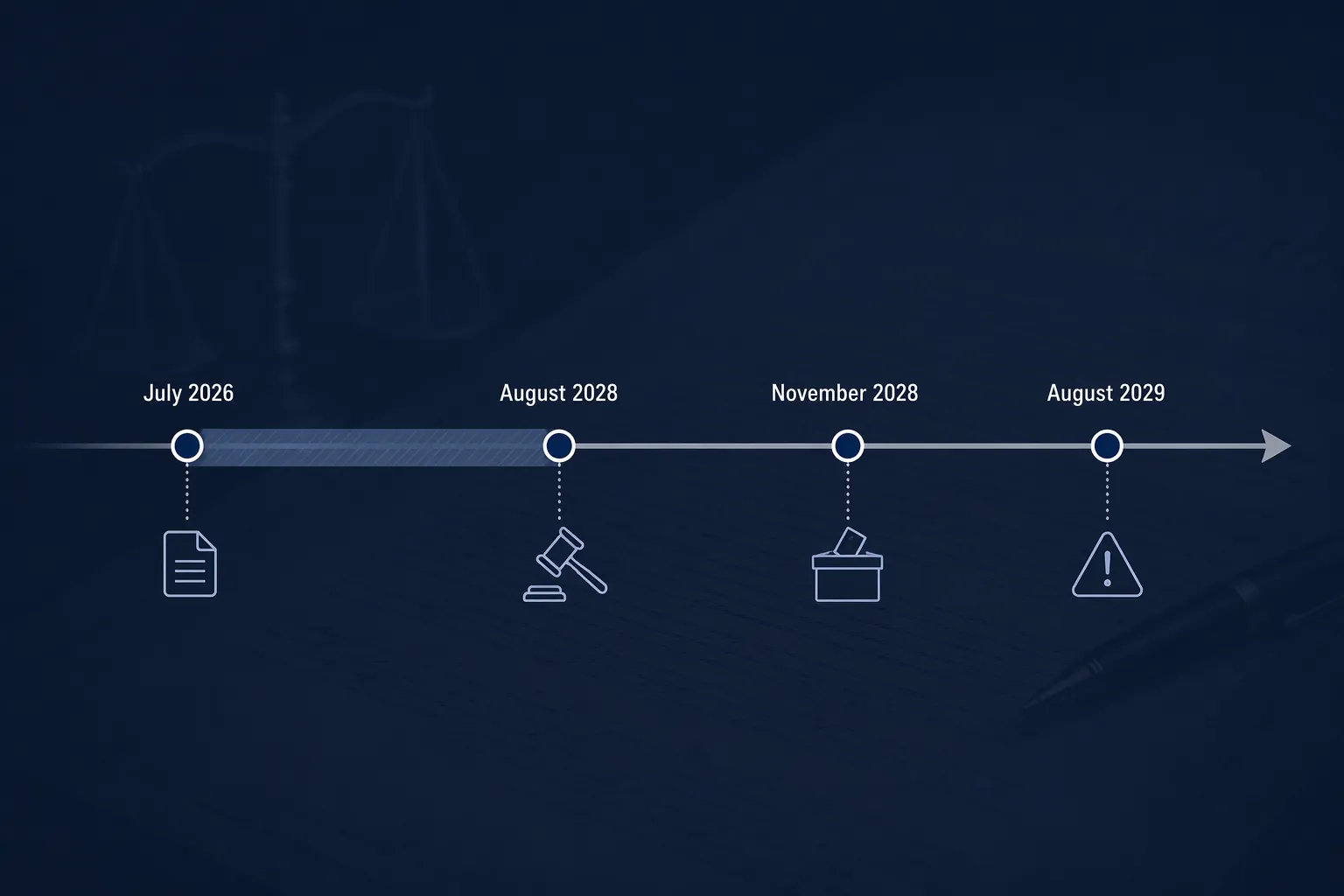
| Date or window | Reported tariff status | Legal exposure that starts now |
|---|---|---|
| July 2026 | Announcement reported; no formal instrument located as of July 25, 2026 | Source verification, authority analysis, board and counterparty caveats |
| July 2026-July 2028 | Reported zero-tariff window | Origin classification, API mapping, force majeure and hardship notice preservation |
| August 2028 | Reported 100% tariff trigger | Pass-through disputes, supply exits, shortage risk, litigation holds |
| November 2028 | Presidential election after the 100% trigger begins | Rescission, modification, or lock-in risk for irreversible compliance spending |
| August 2029 | Reported 200% tariff escalation | Allocation, termination, pricing, and continuity-of-supply disputes |
Start With What Has Actually Been Issued
The generic-drug proposal should be kept separate from the earlier pharmaceutical tariff machinery already in the public record. The White House issued an April 2, 2026 proclamation addressing imports of pharmaceuticals and pharmaceutical ingredients, but the reported generic-drug schedule described in July is not yet accompanied by equivalent public legal text.[3] That leaves counsel with a narrow but important task: preserve the business record without overstating the law.
A defensible internal memo should say, at minimum, which sources are confirmed, which primary instrument is missing, and which assumptions are being used for contract review. It should avoid language that says the tariff “will apply” to a product unless the product’s origin, classification, and covered status have been tested against the eventual instrument. The safer formulation is conditional: if the government implements the reported schedule in materially similar form, the following contracts, suppliers, SKUs, and notices are implicated.
This article is a risk map, not legal advice. The practical point is that legal uncertainty changes the wording of notices and approvals; it does not excuse waiting until August 2028 to begin the review.
The Zero-Tariff Window Is Already an Origin Problem
The most immediate work is not tariff payment. It is origin and classification. For many drug importers, the question is not simply where tablets are pressed or where final packaging occurs. Existing CBP substantial-transformation analysis can treat manufacture of the active pharmaceutical ingredient as the country-of-origin event for single-ingredient drugs, including in ruling N344024.[4] That is why the zero-rate window is not empty time.
A legal team should ask for the product map now: API source, intermediate processing, finished dosage location, packaging location, importer of record, HTS classification, supplier certifications, and any prior CBP advice. If the eventual proclamation uses country of origin, API origin, component content, import value, or a different coverage test, the answer may change. But companies that do not know their API exposure before the instrument is published will be negotiating from memory when the tariff becomes concrete.
This is also where smaller importers face asymmetric risk. Public reporting has described major drugmakers entering most-favored-nation pricing or onshoring arrangements, while the terms remain undisclosed. Lawfare cited an IQVIA tally of $600 billion in announced investments by at least 17 major drugmakers, but undisclosed agreement terms prevent outsiders from knowing what compliance commitments, exemptions, or sequencing assumptions those companies accepted.[5] That figure is useful context, not a safe benchmark for every importer.
The Contract Review Cannot Wait for the 100% Rate
The longest part of the legal work sits in ordinary commercial clauses that are easy to overlook because no duty is yet due. Force majeure, hardship, change-in-law, tax and tariff pass-through, price-adjustment, allocation, minimum-purchase, termination, and notice provisions all have clocks. Some require prompt notice after a party becomes aware of a potential impediment. Others require periodic mitigation updates. Jones Day warned in 2025 that pharmaceutical companies preparing for tariffs should review supply contracts, notice provisions, pricing mechanisms, and allocation rights before tariff implementation disrupts the chain.[6]
A buyer that waits until July 2028 to send the first hardship notice may inherit two bad arguments at once: the tariff was foreseeable for two years, and the counterparty was deprived of the contractually required opportunity to negotiate mitigation. A supplier that waits may face the mirror-image problem if it later claims that performance became uneconomic but never reserved rights when the risk became public.
The notice does not need to pretend the law is final. In many contracts, the better notice will be expressly conditional. It can identify the July 2026 announcement, state that no final instrument has been located, reserve rights if a tariff or equivalent import charge is implemented, request joint mitigation discussions, and object to any unilateral pass-through. The point is not to manufacture a dispute. It is to prevent silence from becoming waiver.
- Inventory contracts by governing law, notice address, cure period, and amendment mechanics.
- Separate contracts that allow automatic tariff pass-through from contracts requiring negotiation or proof of increased cost.
- Flag clauses that require notice of a threatened event, not only an actual legal change.
- Preserve supplier communications about allocation, price increases, country-of-origin assumptions, and substitution.
- Tie board approvals for mitigation spending to stated legal assumptions and election contingencies.
That last item matters because the evidentiary record will not be reconstructed cleanly in 2028. If a generic product becomes commercially impossible to supply at the reported 100% rate, the later dispute will ask what the parties knew in 2026, what alternatives were explored, who rejected them, and whether the claimant preserved remedies when the trigger first became foreseeable.
Pass-Through Language Deserves Its Own Review
Tariff pass-through clauses are often drafted as if the only question is arithmetic. For this proposal, the harder questions are legal and temporal. Does the clause cover duties imposed after the contract date but announced before a purchase order? Does it cover tariffs on ingredients, finished products, or both? Does the supplier need to prove payment to CBP before invoicing the buyer? Can the buyer audit origin certifications and entry documents? Does a change in administration unwind the adjustment?
A clause that says “all tariffs shall be borne by buyer” may not answer whether a 100% charge on a generic drug imported through an affiliate can be passed through without margin disclosure. A clause that says “seller shall absorb taxes and duties” may not answer whether the seller can suspend supply if the duty destroys the economics of performance. Those are the fights that begin in drafting rooms long before they appear in pleadings.
A 100% Duty Can Become a Shortage and Liability Event
The reported August 2028 trigger is not just a customs-cost event. Brookings has warned that generic-drug economics are vulnerable to pharmaceutical tariffs because generic manufacturers often operate on thin margins and may exit products rather than absorb added costs.[7] The narrower legal consequence is that a tariff dispute can become a continuity-of-supply dispute.
If a supplier withdraws a product, rations supply, or seeks emergency price relief, the downstream issues can move quickly: breach claims, allocation disputes, GPO contract fights, FDA shortage communications, citizen petitions, state-law claims, and reputational risk for distributors and labelers. None of those outcomes proves that the tariff is lawful. They can arise while the tariff is being challenged, stayed in part, modified, or replaced.
The litigation file should therefore be broader than customs entries. It should include product-margin analysis, alternative-source diligence, supplier capacity representations, communications with hospitals or group purchasing organizations, regulatory correspondence, and mitigation decisions. The party that later says it had no feasible alternative will need more than a spreadsheet showing the duty rate.
The Authority Question Matters, but Only After the Instrument Exists
The legal-authority analysis should be kept disciplined. If the government implements the generic-drug schedule through Section 232 or a future proclamation tied to national security findings, challengers will focus on statutory fit, administrative record, timing, product coverage, and the relationship between the stated security rationale and the rates imposed. Lawfare has already described the administration’s tariff program as expanding the boundaries of Section 232.[5]
If the government tries a fallback theory, the risk profile changes. PIIE has argued that Section 122 balance-of-payments tariffs would be vulnerable on the merits because the factual predicate is weak for the United States under a floating exchange rate.[8] That does not predict the fate of the generic-drug tariff. It does tell counsel not to draft contracts as if every tariff theory carries the same litigation risk or refund posture.
Recent tariff litigation also affects the tone of board advice. Holland & Knight reported in February 2026 on the Supreme Court striking down IEEPA tariffs and advised importers to assess refunds, protests, liquidation status, and alternative tariff authorities.[9] For pharmaceutical importers, that history supports a practical distinction: pay attention to the government’s fallback options, but do not treat a social-media announcement as if it already answers liquidation, protest, refund, or injunction strategy.
The 2028 Election Belongs in the Compliance Budget
The August 2028 trigger lands before the November 2028 presidential election. That timing makes the tariff different from a policy with a stable implementation horizon. A company may commit capital in 2026 or 2027 to domestic capacity, supplier relocation, dual sourcing, or inventory strategy, only to find that a new administration rescinds, narrows, delays, or replaces the tariff before the 100% rate has a full commercial life.
That does not mean companies should refuse to invest. It means approval papers should state what assumption justifies the spend. Is the investment needed even without the tariff because of supply resilience? Is it economical only if the 100% rate applies? Does it depend on the 200% escalation in August 2029? Can the company exit the commitment if the tariff is enjoined, rescinded, or materially modified? Who bears stranded-cost risk if a supplier builds domestic capacity at the buyer’s request?
Election contingency also belongs in contract language. A long-term supply amendment signed during the zero-rate window should not simply say that the parties are adjusting for “the tariff.” It should address what happens if the tariff is delayed, narrowed, invalidated, refunded, or replaced with quotas, licensing, exclusion procedures, or a different country-of-origin test. Without that language, a rescission may produce the next dispute: one party will say the commercial basis disappeared, and the other will say the amendment allocated that risk permanently.

What Counsel Should Have in the File Before August 2028
By the time the 100% rate is scheduled to begin, the file should show a sequence of decisions rather than a scramble. The first layer is verification: copies or links to the announcement, any later proclamation, Federal Register notice, agency guidance, CBP instructions, exclusion process, and litigation orders. The second is product exposure: classification, origin, API source, supplier certificates, and contrary evidence. The third is contract preservation: notices served, rights reserved, objections made, and amendment requests exchanged.
The fourth layer is mitigation. If a supplier was told to continue performance despite warning that a tariff would make the product uneconomic, that instruction should be documented. If a buyer rejected an alternate source because of quality, FDA, timing, or cost constraints, the reason should be preserved. If inventory was accelerated, the legal and regulatory assumptions behind that decision should be recorded. A later judge, arbitrator, agency reviewer, or counterparty will not give much weight to a vague claim that everyone knew the tariff was coming.
The last layer is restraint. Public statements, supplier letters, and board materials should not represent certainty that counsel does not have. Until the operative instrument is published and tested against the company’s products, the legally accurate posture is conditional. That may be less satisfying than a clean instruction to reshore, pass through, or wait. It is also the posture most likely to survive a later record review.
The 200% Phase Raises the Cost of Ambiguity
The reported August 2029 escalation to 200% is too remote to justify confident product-by-product predictions today. It is not too remote for drafting. A 200% rate would make ambiguous allocation rights, open-ended pass-through clauses, and weak termination language much more dangerous. It would also magnify disputes over whether a substitute source is commercially reasonable, whether a supplier must prioritize one buyer over another, and whether a buyer can reject a domestic alternative that does not meet the same price or timing terms.
The escalation phase should therefore be used as a stress test. If the contract cannot answer who pays, who allocates, who substitutes, who notifies regulators, and who bears stranded inventory at 100%, it will not become clearer at 200%.
The Practical Legal Position Today
The absence of final legal text does not eliminate present obligations. It changes their form. Counsel should be verifying sources, mapping origin, preserving contract notices, resisting unsupported pass-through demands, and documenting investment assumptions. Counsel should not be telling counterparties that the reported schedule is final law, approving irreversible spend without a rescission scenario, or waiting until August 2028 to discover that a notice period expired.
The hardest judgment is not whether the tariff will survive. It is how much commercial movement to permit before the legal record catches up. A new administration could rescind or modify the tariff before the 100% rate becomes fully embedded. The government could also publish a defensible mechanism that requires rapid compliance. The right file is built for both possibilities: conditional, dated, source-linked, and clear about which rights were preserved before the August 2028 trigger.
References
- Trump plans high generic-drug tariffs in 2028 to spur U.S. production, CNBC, July 22, 2026
- Trump plans 100% tariffs on imported generic drugs. Here's what experts say, CBS News, July 22, 2026
- Adjusting Imports of Pharmaceuticals and Pharmaceutical Ingredients, White House, April 2, 2026
- Section 232 pharmaceutical tariffs: What importers need to know, McDermott Will & Emery, April 20, 2026
- Trump's New Tariffs Expand the Boundaries of Section 232, Lawfare, April 2026
- Preparing for Pharmaceutical Tariffs: What Industry Can Do To Mitigate Supply Chain Risks, Jones Day, Sept 12, 2025
- Will pharmaceutical tariffs achieve their goals?, Brookings, March 27, 2025
- What the Supreme Court's tariff ruling changes, and what it doesn't, PIIE, Feb 23, 2026
- Supreme Court Strikes Down IEEPA Tariffs: What Importers Need to Know Now, Holland & Knight, Feb 20, 2026
Operationalizing workflow
No workflow has been explicitly linked to this obligation yet. See Workflows generally.
Illustrative cases
No illustrative case is currently tracked for this obligation. See Risk Digest for documented incidents generally.
← Back to RegulationReport a correction or tip
Spotted an outdated figure, a misstated fact, or a ruling this regulation entry should reflect? Public comments are disabled for this content given the professional cost of a misreported case outcome, penalty amount, or rule text — use the structured correction channel instead.
Report a correction or tip for this record →