
What Drummond's Farm-Equipment Escort Opinion Actually Holds
- Authority
- Oklahoma Attorney General
- Rule type
- attorney general opinion
- Jurisdiction scope
- US state (Oklahoma)
- Effective date
- Aug 24, 2026
- Source text
- Read primary rule text ↗
No escort required for farmer-hauled implements of husbandry and their trailers; separate lighting, width, interstate, dealer-distance, and for-hire duties remain.
The easy headline version of Attorney General Gentner Drummond’s farm-equipment escort law opinion is too large: it is not a general rule that farm equipment can ignore Oklahoma escort requirements. A.G. Opinion 2026-11 holds something narrower and more technical. For the farmer-hauled implements of husbandry described in the opinion, the 12-foot escort trigger in Title 47 never attaches because the equipment, and the trailers used to haul it, fall outside the relevant statutory definition of “vehicle.” The opinion was issued August 24, 2026, in response to a request from Rep. Dick Lowe. [1]
Last verified: August 26, 2026. This is a legal-analysis record, not legal advice for a particular route, load, carrier arrangement, or citation defense. The opinion PDF is the primary source; the Attorney General’s press release and news reports explain why the question reached the office, but they do not carry the legal reasoning.
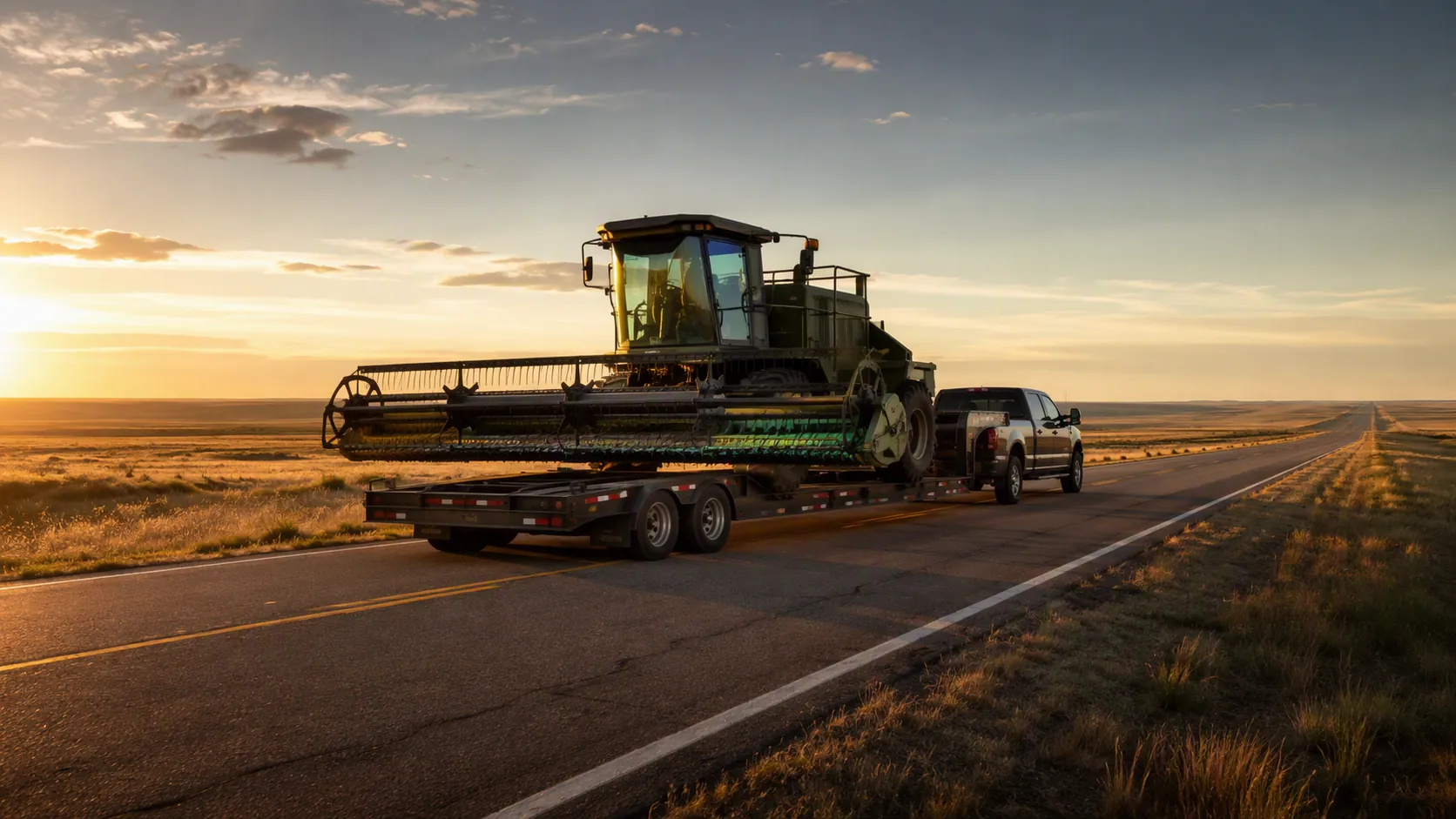
The citation explains the question, not the whole rule
The public controversy began with a practical enforcement problem. The Attorney General’s office described an Oklahoma Highway Patrol trooper citing a driver who was hauling a swather on a trailer without an escort vehicle. That fact matters because it shows the situation the opinion was answering: not a parade of unusual agricultural movements, not every oversized load carrying farm-related equipment, and not a commercial carrier’s interstate shipment. It was a farmer-hauling scenario that forced a classification question under Title 47. [2]
That classification question is the hinge. If the equipment and trailer are “vehicles” or a “combination of vehicles” for the escort statute, the width threshold matters. If they are outside that statutory category, the escort statute has nothing to fasten onto. The opinion answers the second way for the farmer-hauled equipment it addresses.
The statutory path: implement, vehicle, combination, escort
The cleanest way to read A.G. 2026-11 is as a short statutory syllogism. Title 47 has a category for an “implement of husbandry,” and that category is not casual farm slang. Section 1-125 defines the term by reference to equipment designed, adapted, and used for agricultural, horticultural, or livestock-raising operations, rather than ordinary passenger or freight transportation. [3]
From there, the opinion turns to the separate Title 47 definition of “vehicle.” The opinion’s conclusion is that implements of husbandry, and trailers used to transport them in the described farmer-hauled setting, are excluded from that “vehicle” definition. That is why the result does not depend on whether a swather is wide, inconvenient, or capable of surprising an approaching driver. Width alone is not enough; the escort statute must first apply to the thing being moved. [1]
Section 14-120.1(A), the escort provision at issue, is framed around “any vehicle or combination of vehicles” exceeding 12 feet in width. If the implement and the trailer fall outside the relevant “vehicle” category, then the load does not become a covered “vehicle or combination of vehicles” simply because it is wider than 12 feet. [4]
- The escort statute reaches a “vehicle or combination of vehicles” over the stated width threshold. [4]
- The opinion treats the farmer-hauled implement of husbandry, and the trailer used to haul it, as outside Title 47’s relevant “vehicle” definition. [1]
- Because the statutory noun is missing, the 12-foot escort trigger does not attach to that category of movement.
That is a stronger legal answer than a discretionary enforcement preference, but it is also narrower than the political shorthand. The opinion is not saying that an officer should forgive an agricultural move because farming is important. It is saying that the escort statute, as written, does not reach the described farmer-hauled implements of husbandry in the first place.
| Question | What A.G. 2026-11 answers | What still has to be checked |
|---|---|---|
| Does the 12-foot escort trigger apply to the farmer-hauled implement-and-trailer category addressed in the opinion? | No. The opinion treats the equipment and hauling trailer as outside the relevant Title 47 “vehicle” definition. [1] | Confirm the move fits the farmer-hauled implement-of-husbandry category. |
| Does the opinion eliminate all obligations for wide farm equipment? | No. It resolves the escort-trigger question for the covered category. | Lighting, width, interstate, dealer, carrier, and route-specific duties remain separate. |
| Does a press release headline control the analysis? | No. The opinion PDF is the controlling instrument. | Use the press release only for the triggering citation and public explanation. [2] |
Why the trailer point matters
The trailer is not a side issue. In ordinary speech, a pickup, trailer, and oversized machine look like a “combination.” In the escort statute, however, the operative phrase is “vehicle or combination of vehicles.” If the legal definition excludes the particular trailer arrangement used to haul the implement of husbandry, the state cannot get to the escort requirement by pointing only to the physical combination on the road.
That is where many summaries go wrong. Saying “farm equipment is exempt” hides the reasoning and can mislead the next person making a decision: the farmer deciding whether to move before harvest weather changes, the trooper deciding whether to write the next citation, the prosecutor deciding whether to defend the old one, or counsel advising an agribusiness transport plan. The better shorthand is: for the farmer-hauled implement-of-husbandry category addressed in A.G. 2026-11, the escort statute’s vehicle-based trigger does not attach.
Where the opinion stops
The difficult work after A.G. 2026-11 is not deciding whether the covered farmer-hauled swather-type move is protected. It is resisting the instinct to carry that answer into other transport settings with different statutory words.
Retail implement dealer deliveries
Retail implement dealers have their own line to watch. The current escort statute includes a retail-implement-dealer provision tied to deliveries within 150 air miles from the point of distribution, and the 2022 legislative materials are important because older crawlable versions of Section 14-120.1 may not show that amendment. [4][5]
A dealer delivery beyond that 150-air-mile boundary is not the same legal problem as a farmer hauling an implement of husbandry between fields or farm-related locations. The opinion itself flags the dealer line rather than converting the farmer-hauled holding into a dealer-wide rule. [1]
Commercial or for-hire carriers
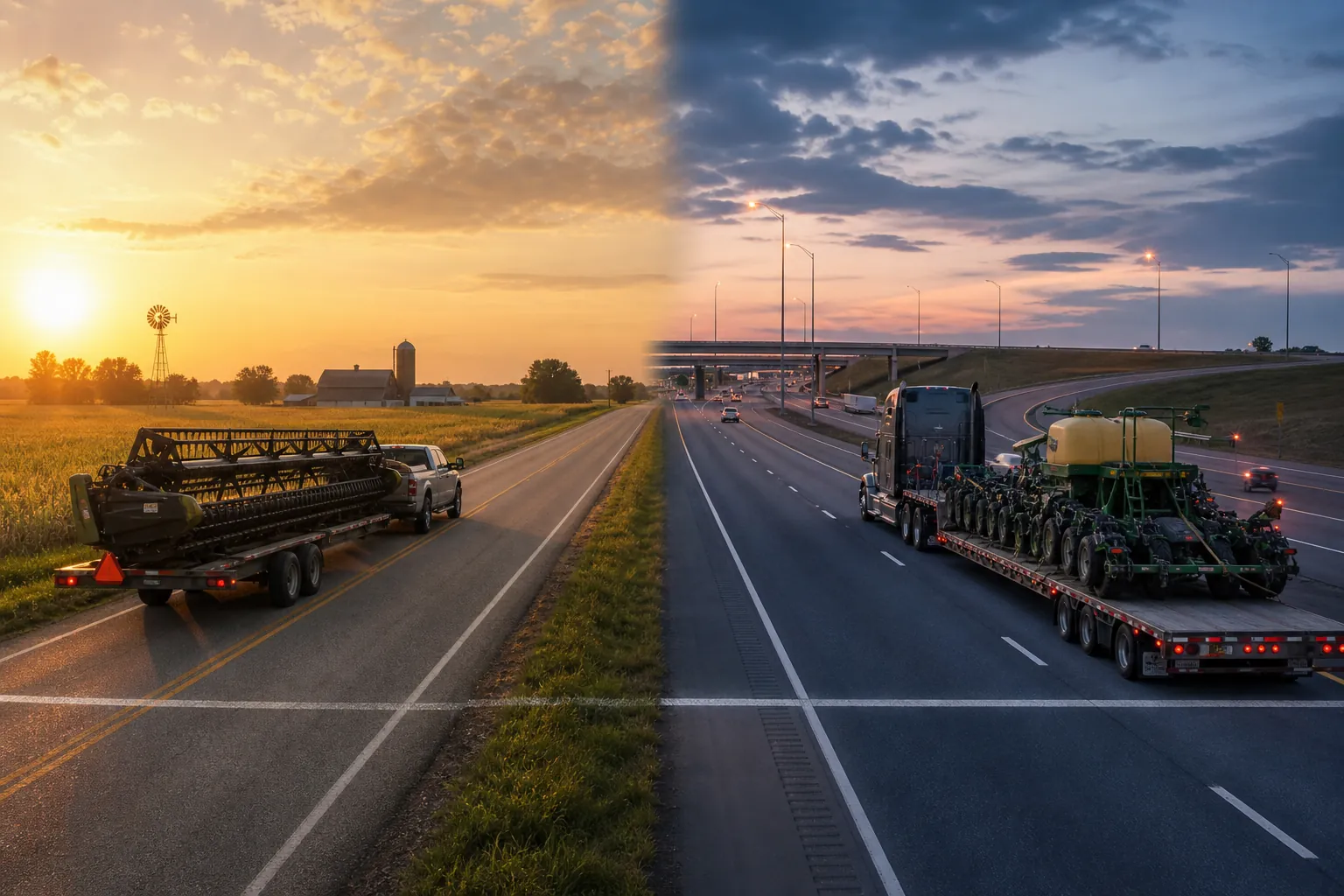
A for-hire carrier also changes the analysis. The opinion’s protection is built around the statutory classification of farmer-hauled implements of husbandry and the trailers used for that hauling. A commercial carrier moving farm machinery as freight should not assume that the same exclusion follows the cargo. At that point, the relevant object may be the carrier’s vehicle, its trailer, and its regulated transport operation, not merely the agricultural identity of the machine on the deck.
Interstate movement
Interstate movement is another separate bucket. Section 11-406(A) addresses implements of husbandry on Oklahoma roads and bars movement on the National System of Interstate and Defense Highways without permission from the Department of Public Safety. The same section also contains operational duties for certain wide equipment movements, including due-regard and yielding concepts that do not disappear merely because the escort statute is unavailable. [6]
That distinction is easy to miss because “escort,” “permit,” “interstate,” and “wide load” are often treated as one practical problem. They are not one statutory problem. A.G. 2026-11 removes the Section 14-120.1 escort trigger for the covered farmer-hauled category; it does not grant DPS permission for interstate movement.
Lighting and width duties
The opinion also should not be read as a lighting waiver. Section 14-118(G) is important because it deals with size-permit treatment for implements of husbandry and separately incorporates lighting obligations. The incorporated lighting rule includes a duty for tractors pulling machinery over 13 feet wide to use two amber lamps mounted at least 39 inches high. [7]
That is the practical reason to keep permit, escort, lighting, and width analysis in separate columns. A movement can be outside the escort trigger and still present a lighting violation. It can be exempt from one size-permit requirement and still be restricted on an interstate route. It can involve agricultural equipment and still fall outside the farmer-hauled fact pattern that made the opinion work.
The binding effect is real, but not limitless
Oklahoma attorney general opinions are not blog posts with seals on them. The Attorney General’s office states that official opinions are binding on the state officials affected by them unless a court sets them aside, with a separate caveat that opinions declaring statutes unconstitutional are advisory only. [8]
That matters for OHP and DPS. If the described equipment move fits A.G. 2026-11, the opinion gives public officials a statutory answer they must take seriously. It also gives defense counsel a better argument than fairness or custom: the cited escort duty did not attach because the statutory classification was wrong.
It does not mean every private actor can stop reading Title 47 after the word “farm.” A court could later disagree with the opinion. A route could involve interstate movement. A dealer could be outside the 150-air-mile provision. A carrier could be hauling for hire. A lighting requirement could remain enforceable. Those are not footnotes to the real rule; they are the boundaries of the rule.
The practical reading
For the specific category A.G. 2026-11 addresses, the opinion is strong protection. A farmer hauling an implement of husbandry on a trailer has a direct statutory answer to a Section 14-120.1 escort citation: the escort law is written for a “vehicle or combination of vehicles,” and the opinion concludes this equipment-and-trailer category is not within that vehicle definition.
The practical legal analysis is therefore narrow. Ask who is hauling, what is being hauled, whether the machine is an implement of husbandry, whether the trailer exclusion applies, whether the move is interstate, whether a dealer-distance rule is involved, whether the carrier is for hire, and whether lighting or other width-related duties remain. Drummond’s opinion answers the escort-trigger question for farmer-hauled implements of husbandry. It is not a universal clearance pass for every farm-equipment movement on Oklahoma roads.
References
- Attorney General Opinion 2026-11 — Oklahoma Office of the Attorney General, August 24, 2026
- New AG opinion from Drummond: Farmers don’t need highway escort to haul equipment — Oklahoma Office of the Attorney General
- 47 O.S. § 1-125 — Oklahoma Statutes
- 47 O.S. § 14-120.1 — Westlaw
- Oklahoma-2022-HB2325-Engrossed — LegiScan
- 47 O.S. § 11-406 — Oklahoma Statutes
- 47 O.S. § 14-118 — Oklahoma Statutes
- Opinions — Oklahoma Office of the Attorney General
Operationalizing workflow
No workflow has been explicitly linked to this obligation yet. See Workflows generally.
Illustrative cases
No illustrative case is currently tracked for this obligation. See Risk Digest for documented incidents generally.
← Back to RegulationReport a correction or tip
Spotted an outdated figure, a misstated fact, or a ruling this regulation entry should reflect? Public comments are disabled for this content given the professional cost of a misreported case outcome, penalty amount, or rule text — use the structured correction channel instead.
Report a correction or tip for this record →