
What the DSA's 'abolish borders' plank legally requires
- Authority
- U.S. Congress
- Rule type
- statute
- Jurisdiction scope
- US federal
- Source text
- Read primary rule text ↗
If enacted, the DSA plank would require Congress to abolish ICE, end detention/deportation, grant amnesty, and amend INA visa caps; deeper border abolition collides with plenary-power doctrine.
The late-July and early-August 2026 version of the “abolish borders” fight compressed three different things into one headline: the DSA platform released in July, Fox News’s report that DSA co-chair Megan Romer confirmed border abolition as a long-term goal, and NOTUS’s report that Senate Democrats it contacted rejected that position.[1][2][3] That compression is politically useful and legally messy. For a Regulation & Ethics analysis, the useful question is narrower: what legal acts would the immigration plank actually require?
This is a feasibility map, not legal advice and not another pass through Senate abolition mechanics. The Senate side of the dispute belongs with the sibling record What the Constitution Requires to Abolish the Senate and ICE. Here, the question is the immigration half: what happens when a platform plank, a reported interview answer, and the phrase “abolish borders” are treated as legal text rather than as a cable-news yes-or-no test.

Start with the platform text, not the viral shorthand
The platform language that does the work is the DSA’s “Abolish ICE” plank. It says: “End ICE detention and deportations and punish federal agents’ brutality. Legalize migration, grant amnesty for all immigrants regardless of status, provide a path to citizenship for all permanent residents, and end visa caps and quotas.”[4]
That matters because the literal phrase “abolish borders” is not the plank’s text. It is a later political framing around “legalize migration” and related platform commitments, amplified by the reported Romer exchange and by opponents asking whether Democrats would endorse the same formulation. Treating the phrase as if it were itself statutory language produces bad analysis in both directions: it lets critics pretend the entire plank is one legally impossible act, and it lets defenders pretend the phrase has no legal content at all.
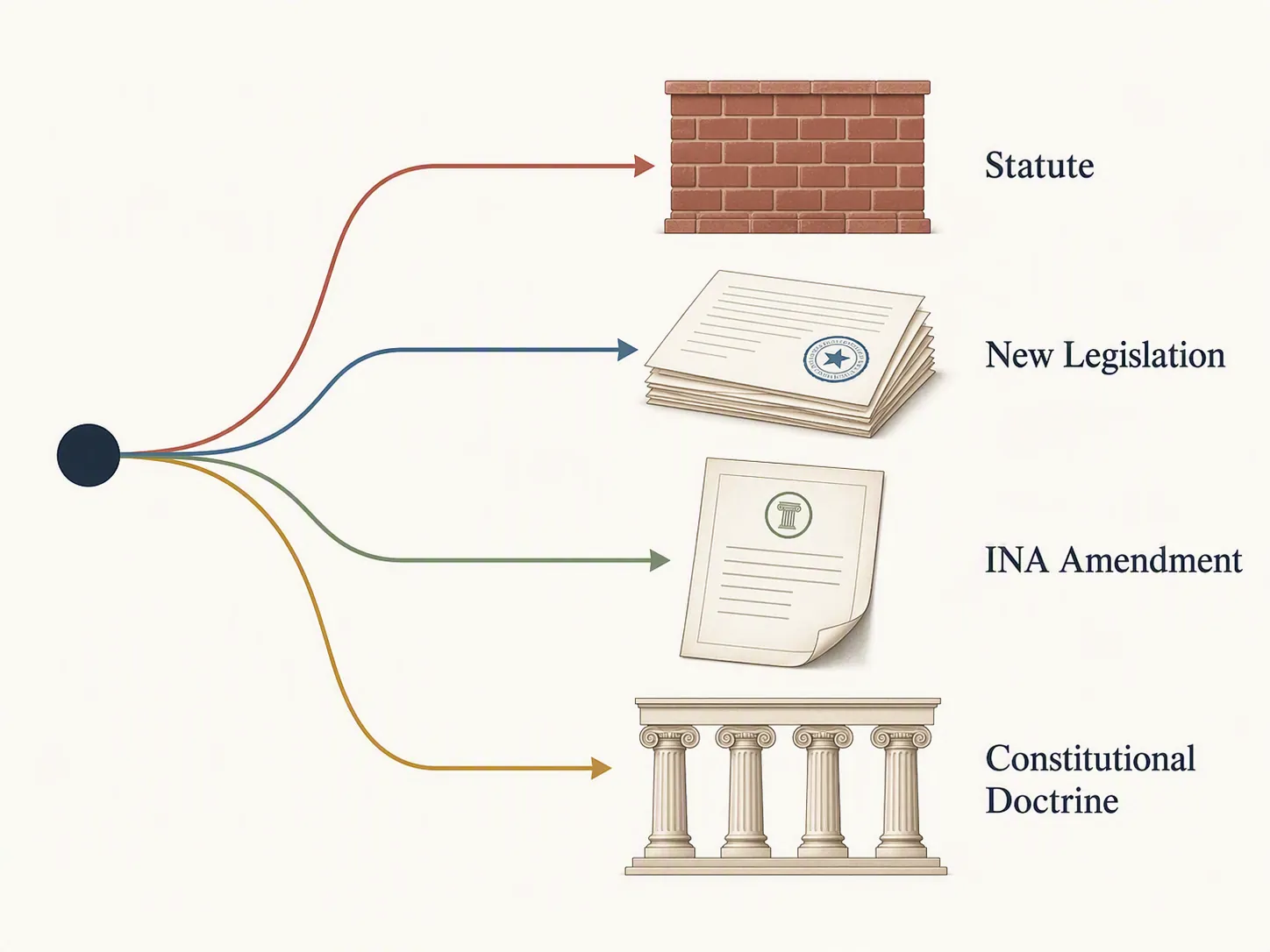
Read as legal work, the plank separates into several assignments. They do not use the same instrument, and they would not face the same objections.
| Platform component | Legal mechanism it would require | Main legal difficulty |
|---|---|---|
| Abolish ICE | Ordinary federal statute reallocating, dissolving, or redesigning agency functions | Institutional and political difficulty, not Article V difficulty |
| End ICE detention and deportations | New legislation changing detention authority, removal machinery, appropriations, and enforcement mandates | Statutory design plus due-process floors |
| Grant amnesty regardless of status | New legislation creating eligibility, exclusions, procedures, and status consequences | Congressional enactment and implementation design |
| Path to citizenship for permanent residents | Amendments to naturalization and related immigration statutes | Eligibility, timing, and administrative capacity |
| End visa caps and quotas | Amendment to the Immigration and Nationality Act’s numerical limits and allocation rules | Statutory rewrite of admissions categories |
| A deeper “abolish borders” theory | Constitutional and doctrinal challenge to the border as a legal gatekeeping device | Collision with plenary-power doctrine and existing admission/removal law |
ICE abolition is the cleanest statutory question
Abolishing ICE is not constitutionally exotic. ICE is a statutory and administrative creation of the post-9/11 reorganization. The Brennan Center’s account of the abolish-ICE movement traces ICE’s origin to the Homeland Security Act of 2002, which abolished the old Immigration and Naturalization Service and moved immigration functions into the newly created Department of Homeland Security structure.[5]
That statutory origin is the important fact. Congress can create an agency, divide its functions, fund it, restrict it, transfer parts of it, or abolish it. The legal question is not whether Article V is required; it is what Congress would do with the authorities, personnel, pending cases, records, contracts, appropriations, and enforcement responsibilities now housed in or routed through ICE.
There is also a legislative template, even if it did not become law. In 2018, Rep. Mark Pocan introduced an abolish-ICE bill that would have created a commission to recommend how to transfer ICE’s essential functions and terminate the agency within a set statutory process.[5] That sort of bill does not answer whether abolition is wise, but it answers a narrower legal point: Congress already has the drafting vocabulary for agency dissolution.
The demand also did not emerge in a vacuum. The Yale Law Journal’s 2019 essay “Abolish ICE . . . and Then What?” describes the growth of the immigration enforcement apparatus after ICE’s creation: ICE funding rising from $3.3 billion in 2003 to $7.5 billion in 2018, approximately 130% growth; immigration enforcement spending exceeding all other federal criminal-law enforcement combined; the undocumented population rising from about 7 million in 2000 to about 12 million by DHS estimates; and deportations averaging more than 300,000 per year so far in the twenty-first century, compared with fewer than 25,000 per year in the twentieth century.[6]
Those are historical figures from a 2019 essay, not 2026 operational numbers. Their value here is not to prove current enforcement scale to the dollar or case. Their value is to explain why “abolish ICE” became an institutional reform demand rather than merely a complaint about one administration’s enforcement priorities.
Detention, deportation, and amnesty are not solved by renaming the agency
The platform’s next moves are legally heavier. “End ICE detention and deportations” is not the same act as abolishing ICE. If Congress abolished ICE but left the detention statutes, removal grounds, appropriations, and executive enforcement mandates largely intact, those functions could be reassigned. The letterhead would change faster than the client’s risk.
A serious detention-and-deportation bill would have to decide what it means by “end.” It could bar civil immigration detention except in defined circumstances. It could repeal or narrow detention mandates. It could restrict appropriations for detention beds. It could change removal grounds, cancellation rules, administrative procedures, and judicial review. It could also leave removal formally available while making detention rare. Those are different bills.
The same is true of “grant amnesty for all immigrants regardless of status.” Amnesty is not a wand counsel can wave over the Immigration and Nationality Act. A statute would have to define who qualifies, whether there are criminal or security exclusions, what proof is required, what happens to pending removal cases, whether prior orders are reopened or vacated, how employment authorization works during processing, whether unlawful-presence bars are waived, and what status the person receives before any path to citizenship.
That implementation layer is where slogans become client advice. A person in removal proceedings, a person with an old order, a person who entered without inspection, a person who overstayed, and a lawful permanent resident seeking naturalization do not all occupy the same legal position. A platform can group them politically. A statute cannot avoid sorting them administratively.
Visa caps and quotas point to the INA, not to the Constitution
“End visa caps and quotas” is another discrete legal claim. It does not require pretending that borders have already disappeared. It requires amending the Immigration and Nationality Act’s numerical limits and allocation rules. Congress could remove caps in selected categories, increase them, change country-allocation rules, create uncapped routes, or abolish numerical limits more broadly.
Each version has different consequences. Ending a cap in one family category is not the same as eliminating employment-based numerical limits. Removing country caps is not the same as abolishing worldwide ceilings. A bill that “legalizes migration” by expanding lawful channels would still need inspection rules, admissibility rules, work authorization rules, benefit-eligibility rules, and enforcement rules for fraud or disqualifying conduct.
This is the same kind of source-by-source duty map that matters in other Regulation & Ethics contexts: a political commitment becomes legally meaningful only after the drafter identifies the binding instrument. That is why analyses such as How binding is US-Japan-Philippines maritime cooperation? and Legal requirements vary by affordable housing funding source are useful analogues: the obligation depends on the instrument that actually binds someone.
Where ordinary statutory reform meets plenary power
The harder question begins when “legalize migration” is read not as an expansive admissions statute but as a theory that the border should stop functioning as a legal gate. That is where ordinary statutory feasibility gives way to constitutional doctrine.

Under the plenary-power line, immigration regulation is treated as an area in which Congress has dominant national authority and courts have historically given substantial deference to the political branches on admission and exclusion.[7] That doctrine does not mean Congress must choose restriction. It means Congress has unusually broad room to decide the terms of admission, removal, and status.
That distinction is central. A statute opening many more lawful channels, legalizing large numbers of people already present, reducing detention, narrowing removal, or abolishing ICE as an agency would generally be an exercise of congressional immigration power. It would be controversial, but controversy is not a constitutional category. Congress can use broad power to liberalize as well as to restrict.
A claim that Congress lacks power to abolish ICE, grant immigration relief, or remove visa caps would need an identified constitutional prohibition. The more plausible constitutional boundary runs the other way: current doctrine assumes that the national government may maintain a legal border regime, classify noncitizens for admission and removal purposes, and attach consequences to entry, presence, and status. A program that says the border should have no legal gatekeeping function is therefore not merely an INA amendment. It is a challenge to the assumptions under which modern immigration doctrine operates.
Due process still sets floors
Plenary power is not the same as a constitutional blank check. Due-process protections still set floors for persons, including noncitizens, even though the scope of protection varies by context, location, status, and the nature of the government action.[7] That floor matters whether Congress is expanding enforcement or dismantling it.
For example, if Congress created a mass regularization program, it would still have to design procedures for notice, evidence, adjudication, review, fraud findings, and adverse action. If it sharply limited detention, it would have to say what happens to people with pending proceedings and what process applies to any remaining custody decisions. If it eliminated some removal grounds, it would have to address pending cases and final orders. Reform does not eliminate procedure; it changes what procedure is for.
The border-as-construct argument is serious but not self-executing
Open-borders scholarship presses deeper than ordinary reform. Kevin Johnson’s “Open Borders?” argues against treating the border as a natural constitutional inevitability and instead treats it as a legal and policy construct that can be questioned, justified, narrowed, or rejected.[8] That kind of scholarship matters because it exposes how much of immigration law depends on premises that are often described as if they were unavoidable.
But scholarship does not repeal doctrine. The argument that borders are legally constructed can support a political program and can influence future doctrine, statutory drafting, or judicial critique. It does not, by itself, erase the existing plenary-power framework, the INA, inspection rules, admissibility rules, or the legal distinction between admission, presence, removal, and citizenship.
That is why the phrase “abolish borders” is least useful when treated as one legal event. At the statutory end, much of the platform is draftable: abolish ICE, reassign functions, change detention authority, legalize status, amend visa caps. At the doctrinal end, a fuller theory that the border should cease to operate as a legal gate collides with the very structure courts have used to describe national immigration power.
The legal bottom line
The DSA plank is not one impossible act, and it is not one easy act. ICE abolition is ordinary statutory redesign. Amnesty, detention limits, deportation changes, and citizenship pathways require new legislation with careful transition rules. Ending visa caps and quotas requires amending the INA. A deeper “abolish borders” theory moves beyond agency and statute into the contested terrain of plenary power, due process, and the border as a legal construct.
For counsel, that decomposition is the point. The operative question is not whether a slogan sounds radical or whether a senator wants to endorse it. The operative question is which legal instrument would bind whom, which authority it would amend or repeal, and where existing constitutional doctrine stops treating the issue as ordinary immigration legislation.
References
- Democratic Socialists of America platform calls for abolishing ICE, amnesty for illegal immigrants, The Washington Times, July 15, 2026.
- DSA co-chair confirms Democratic Socialists want to abolish borders, Fox News, July 2026.
- Senate Democrats reject Democratic Socialists’ call to abolish borders, NOTUS, August 2, 2026.
- Abolish ICE, Democratic Socialists of America National Political Platform.
- The Abolish ICE Movement Explained, Brennan Center for Justice.
- Abolish ICE . . . and Then What?, Yale Law Journal, 2019.
- ArtI.S8.C18.8.1 Overview of Congress’s Immigration Powers, Constitution Annotated.
- Open Borders?, UCLA Law Review.
Operationalizing workflow
No workflow has been explicitly linked to this obligation yet. See Workflows generally.
Illustrative cases
No illustrative case is currently tracked for this obligation. See Risk Digest for documented incidents generally.
← Back to RegulationReport a correction or tip
Spotted an outdated figure, a misstated fact, or a ruling this regulation entry should reflect? Public comments are disabled for this content given the professional cost of a misreported case outcome, penalty amount, or rule text — use the structured correction channel instead.
Report a correction or tip for this record →