
EEOC Antisemitism Probe at UPenn: AI Compliance Lessons
- Effective date
- Mar 31, 2026
The July 23 update in the EEOC’s antisemitism investigation at the University of Pennsylvania is narrower than the headline suggests: the agency withdrew its pending subpoena-enforcement bid, but the investigation did not end. The withdrawal agreement left each side to bear its own costs and fees, and the EEOC reserved its ability to pursue further legal action in the matter.[1] The Hill likewise reported that the underlying investigation continues.[2]
That distinction matters for any employer reading the UPenn fight as a proxy for its own subpoena risk. A withdrawn application does not tell the records team that the request was unlawful, over, or impossible to reframe. It tells them that the live procedural vehicle changed. If the agency returns with a narrower demand, a cleaner demand, or a demand pointed at a different data set, the employer still has to know what exists, where it sits, who controls it, and what can be withheld without overclaiming.
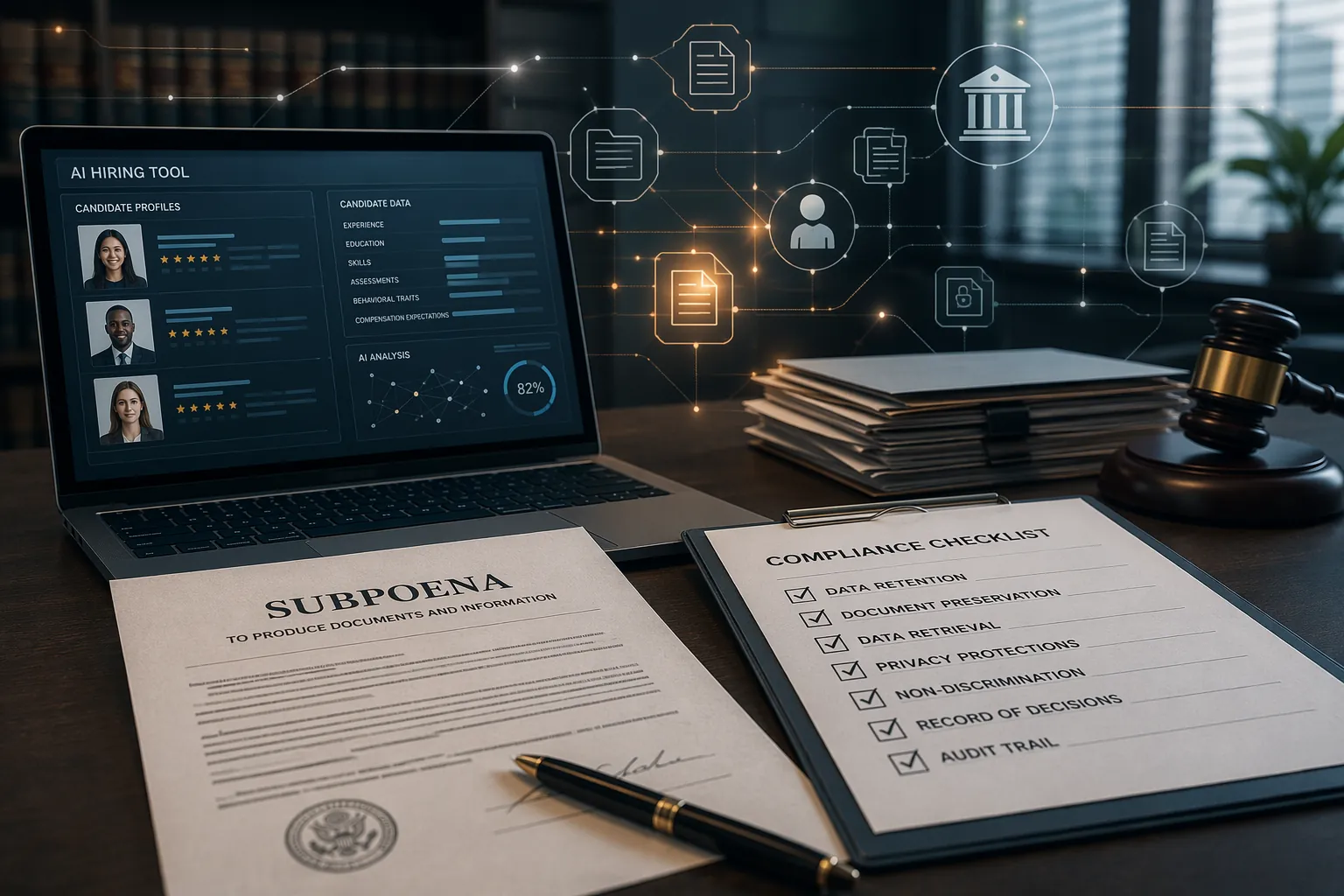
The original enforcement action came from an EEOC subpoena issued in an investigation of an alleged antisemitic work environment at the University of Pennsylvania. In its November 2025 announcement, the agency said it filed a subpoena-enforcement action after seeking information connected to that investigation.[3] The later withdrawal changed the posture of the court fight; it did not erase the March ruling that explains why subpoena objections remain a hard place to win.
What Pappert Actually Left on the Table
Judge Gerald Pappert’s March 31 ruling is the part of the UPenn matter that should stay on a compliance desk. As analyzed by Bond, Schoeneck & King, the court enforced the EEOC subpoena under a relevance standard that was described as a constitutionally “low bar.”[4] That is not a throwaway phrase. In subpoena practice, relevance is often the hinge between a burdensome request the employer dislikes and a request the court will still require the employer to answer.

The court did not require the EEOC to prove its underlying discrimination theory before obtaining records. It required the agency to show that the requested material had a sufficient connection to the charge under investigation. That is the ordinary but often uncomfortable point of administrative subpoena enforcement: the document demand arrives before the merits are resolved, and the response obligation can be real even when the employer believes the agency’s theory is weak.
UPenn’s broader constitutional objections largely failed. The university raised First Amendment association and privacy arguments, but the court did not accept those defenses as a reason to block the subpoena wholesale.[4] For employers, that is the first operational lesson: constitutional language may matter, but it does not automatically convert a records dispute into a categorical shield. If the agency can tie the requested information to the investigation, the employer needs a more precise objection than generalized discomfort with disclosure.
The part that did work was narrow. The court barred disclosure of employees’ specific organizational affiliations, while still requiring names and contact information to be produced.[4] That carveout is more useful than a sweeping victory would have been, because it shows the line-drawing a court may actually do. Identity and contact data may be compelled; sensitive affiliation data may receive more protection when the privacy or associational burden is concrete enough.
| Records issue | What the UPenn ruling suggests |
|---|---|
| Names and contact information | May still be compelled when tied to the investigation. |
| Specific organizational affiliations | May receive protection when the disclosure burden is particularized. |
| Broad First Amendment or privacy objections | Unlikely to defeat a subpoena without a narrower records-specific showing. |
| Merits disputes | Do not usually eliminate the duty to respond at the investigatory stage. |
That distinction should shape the first review memo after any EEOC subpoena. The useful question is not whether the employer can object in the abstract. It is which fields are responsive, which fields are sensitive for a legally articulable reason, which custodians and systems contain them, and whether a narrower production can satisfy the agency without disclosing protected associations, privileged communications, or unrelated personal data.
The NEP Did Not Make Subpoena Enforcement Less Important
The June 4 National Enforcement Plan belongs in this discussion because it changes the enforcement environment around the subpoena, not because it answers the UPenn facts. Mayer Brown’s June 30 analysis reads the new NEP as reorienting the EEOC away from disparate-impact theories and toward priorities associated with the current Commission leadership, including DEI-related discrimination, anti-American bias, single-sex spaces, and religious liberty.[5] That is secondary interpretation, not an independent court holding, but it is still useful for planning.
The same analysis notes that the NEP expressly places subpoena enforcement within the integrity of the enforcement process.[5] That placement should prevent an overly tidy reading of the policy shift. Even if the agency brings fewer cases under one theory, it still needs records to investigate the theories it does choose to pursue. A narrower enforcement agenda can increase the importance of targeted requests because the agency has to build intent, knowledge, comparator, accommodation, or hostile-environment evidence from employer-controlled files.
In practice, that means a subpoena response is not just a litigation event. It is a test of whether the employer’s HR, legal, IT, and records functions can reconstruct decisions made months or years earlier. Who received a complaint. Who was interviewed. Which search terms were used. Which candidate screens were applied. Which accommodation request was escalated. Which messages are duplicative, privileged, or outside scope. The NEP may affect which questions the EEOC asks first; it does not remove the need to answer the questions with defensible records.
The EEO-1 Rescission Narrows One Reporting Channel
The July 21 EEO-1 development is easy to overread. PBS and the Associated Press reported that the EEOC voted 2–1 to stop requiring covered employers to submit demographic workforce data through a reporting requirement that had existed for 60 years and covered about 73,000 employers.[6] That is a significant change to a reporting channel. It is not a repeal of Title VII recordkeeping duties, and it is not a promise that the agency will stop asking targeted questions in individual investigations.
The religion-data issue is the practical bridge between the EEO-1 rescission and the UPenn subpoena fight. EEO-1 reporting historically focused on demographic categories such as race and sex, not a standing employer inventory of religious affiliation. In a religious-discrimination or antisemitic-work-environment investigation, the EEOC may not be able to rely on a routine reporting pipeline to understand who was affected, who complained, who witnessed relevant conduct, or how the employer responded. Targeted subpoenas fill that gap.
That does not mean employers should start building unnecessary religion files. It means they should know which lawful records may become relevant: complaints, accommodation requests, investigation notes, interview rosters, remedial measures, training records, communications about protected activity, and decision records for discipline, hiring, promotion, or termination. The safer posture is not indiscriminate collection. It is disciplined retention and retrievability for records the employer already has a legitimate reason to maintain.
Where AI-Assisted Systems Create the Response Problem
None of the cited UPenn materials says the case was about AI records management or AI hiring tools. The compliance consequence is still hard to avoid. Employers increasingly use search layers, document-management tools, chat platforms, applicant-tracking systems, and vendor-supported screening tools that can make retrieval look instantaneous until a subpoena asks for a legally bounded production.
AI-assisted search is not a substitute for a document map. A tool may surface likely responsive material, but someone still has to explain the systems searched, the date ranges used, the custodians included, the fields exported, the deduplication logic applied, and the exclusions made for privilege, privacy, or nonresponsiveness. If the employer cannot describe that process, the production may look less like a reasonable response and more like improvisation with software.
Hiring tools add a second layer. If an EEOC subpoena asks about applicants, screens, interview selection, ranking, rejection reasons, accommodation requests, or communications with vendors, the employer needs more than a final hiring decision. It needs the decision trail: inputs used by the tool, human review points, override authority, job-related criteria, audit logs if they exist, and records showing how sensitive fields were excluded, masked, or protected. If those records live partly with a vendor, the response plan has to account for contract access before the subpoena arrives.
The Pappert carveout is especially relevant here. Many systems commingle ordinary contact fields with sensitive information, inferred traits, affinity-group participation, accommodation narratives, complaint histories, or free-text notes. A subpoena may reach the former while a court limits the latter. The employer that can separate fields cleanly has options. The employer that stores everything in unstructured notes has a review problem, a redaction problem, and a negotiation problem.
The records posture that survives a narrowed subpoena
A defensible response posture starts before the agency letter. Legal should know which HR systems hold structured fields, which repositories hold investigation files, which chat or email systems preserve informal decision-making, and which vendors control logs or scoring information. HR should know what was retained because policy required it and what was never collected because collection would have been unnecessary or risky. IT should know how to preserve without overwriting metadata or expanding access to sensitive material.
- Retention: preserve complaints, investigation files, accommodation records, decision records, and relevant communications for the periods required by policy and law.
- Retrieval: maintain a system map that identifies custodians, repositories, vendors, fields, date ranges, and export limits.
- Review: separate responsive records from privileged, unrelated, or sensitive material before production.
- Redaction: document why specific fields are withheld or masked, especially where associational, religious, medical, or privacy interests are implicated.
- Explanation: be able to describe AI-assisted search, screening, ranking, or records workflows in ordinary language that counsel can defend.
The temptation after the July 23 withdrawal is to score the docket. That is not where the useful lesson is. UPenn avoided the immediate fight over that subpoena, on terms that left each side paying its own way, while the EEOC preserved its legal options and the investigation continued.[1][2] The March ruling remains the more durable warning: relevance is a low bar, broad objections may fail, and narrow privacy or association arguments work best when the employer can identify the exact data at issue.[4]
For employers using AI-assisted hiring or records systems, the next subpoena may be narrower rather than softer. It may ask for names but not affiliations, candidate records but not every applicant file, complaint communications but not privileged advice, or vendor logs for a defined time window. The organization that can preserve, retrieve, review, redact, and explain those records has a response. The organization that has to discover its own data architecture after service has a litigation-support problem before it has a merits defense.
References
- US agency drops bid to force Penn to provide names in antisemitism probe, Reuters, July 23, 2026.
- EEOC drops subpoena for Jewish employees at Penn, The Hill, July 23, 2026.
- EEOC Files Subpoena Enforcement Action Against University of Pennsylvania Over Antisemitic Work Environment, U.S. Equal Employment Opportunity Commission, November 2025.
- Federal Court Enforces EEOC Subpoena to UPenn in Antisemitism Probe, Bond, Schoeneck & King, March 31, 2026.
- EEOC Releases New National Enforcement Plan, Reorienting Agency Priorities, Mayer Brown, June 30, 2026.
- Federal civil rights agency moves to stop requiring demographic data collection after 60 years, PBS/AP, July 21, 2026.
Operationalizing workflow
No workflow has been explicitly linked to this obligation yet. See Workflows generally.
Illustrative cases
No illustrative case is currently tracked for this obligation. See Risk Digest for documented incidents generally.
← Back to RegulationReport a correction or tip
Spotted an outdated figure, a misstated fact, or a ruling this regulation entry should reflect? Public comments are disabled for this content given the professional cost of a misreported case outcome, penalty amount, or rule text — use the structured correction channel instead.
Report a correction or tip for this record →