
Four Guardrails Against Election Interference Removed Before Midterms
- Authority
- U.S. Department of Justice
- Rule type
- regulation
- Jurisdiction scope
- US federal
- Source text
- Read primary rule text ↗
As of late July 2026, the meaningful question in assessing potential federal election interference before the 2026 midterms is not whether any one prosecution has been filed. It is whether the internal machinery that used to slow election-sensitive federal action is still operating. On the present record, four guardrails that previously limited, reviewed, or coordinated federal election-crime activity have reportedly been removed or disabled: the DOJ election-offenses manual, the Public Integrity Section’s election-crimes capacity, the regular election-crime training program, and the Election Day command center model.
That conclusion is time-bound and source-bound. The manual removal, Public Integrity Section reduction, training cancellations, and command-center cancellation have been reported by Spotlight PA and NOTUS and described in Senate oversight letters; they are not, on the materials available here, first-party DOJ admissions accompanied by a complete replacement policy. DOJ could restore or revise any of these structures before Election Day. This article is a regulation-and-ethics analysis, not legal advice.
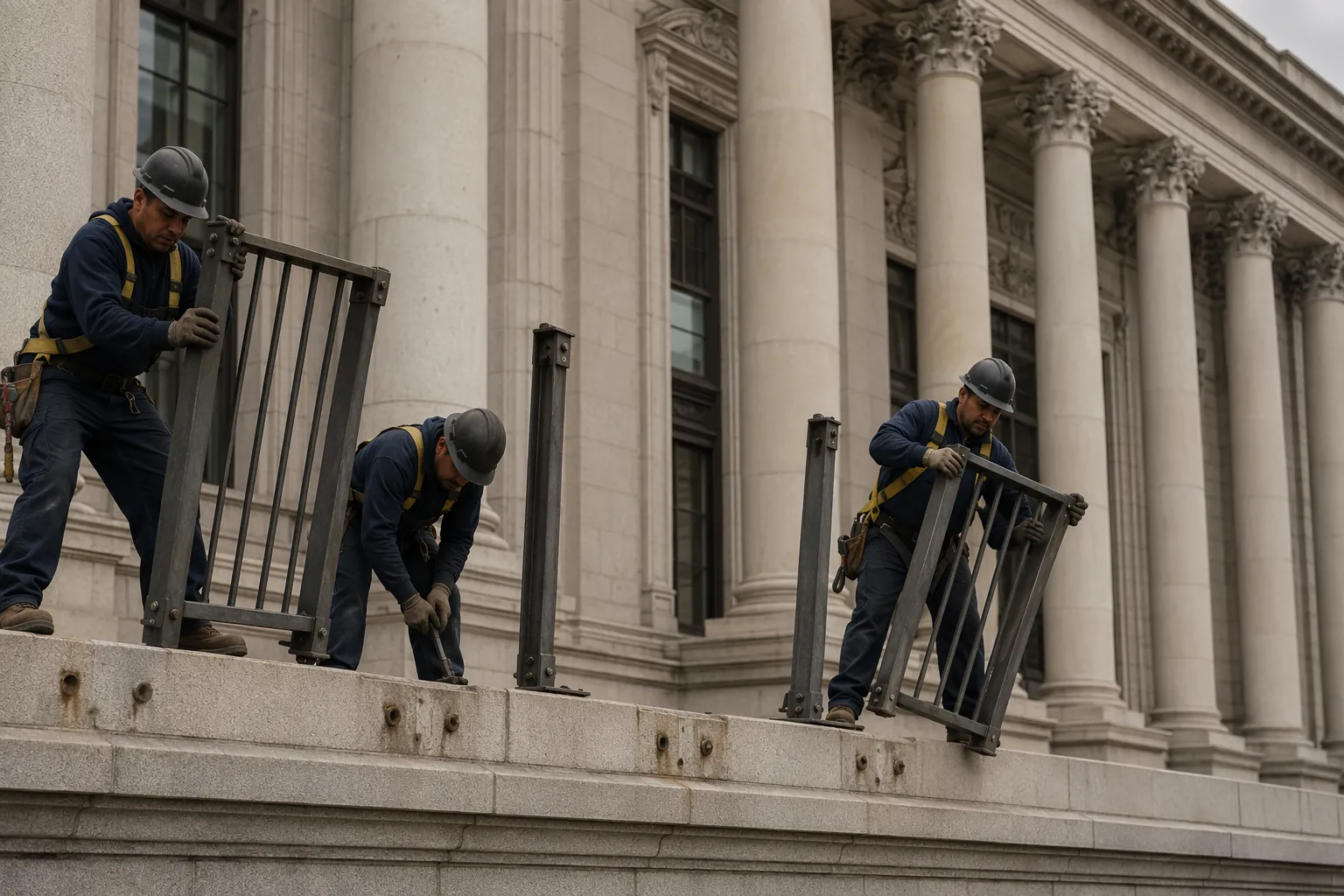
The four missing frictions
| Guardrail | Reported change | Why it mattered in practice |
|---|---|---|
| Federal Prosecution of Election Offenses manual | The 8th edition was reportedly removed from DOJ’s website without a replacement available as of early 2026. | It gave prosecutors, supervisors, defense counsel, and courts a shared reference point for election-sensitive timing and conduct. |
| Public Integrity Section election-crimes capacity | Senate oversight letters described a reduction from 36 attorneys to approximately 2. | Specialized review capacity is what makes consultation more than a box-checking exercise. |
| Election-crime training | March and July 2026 sessions at the National Advocacy Center were reportedly canceled. | Training is where line prosecutors learn the norms before a contested election cycle, not after one begins. |
| Election Day command center | Spotlight PA reported that the FBI headquarters command center would not be stood up for 2026, citing three sources with knowledge. | A central intake-and-coordination point reduces inconsistent field responses to election-day allegations. |
The point is not that an internal manual or a training calendar has the force of a statute. It does not. The point is that election prosecutions are unusually vulnerable to timing abuse, and the old DOJ apparatus treated timing, routing, and supervision as legal-risk controls rather than administrative decoration.
The vanished manual removed a common professional baseline
The most consequential reported change is the removal of the Federal Prosecution of Election Offenses manual. Spotlight PA and NOTUS reported in June 2026 that DOJ had taken down the 8th edition and had not posted a replacement; Senate letters likewise flagged the manual’s removal as part of a broader concern about election-crimes enforcement before the midterms.[1][2]
The sentence that matters most was not subtle. The removed manual stated that prosecutors “may never select the timing of public statements, investigative steps, criminal charges, or any other action for the purpose of affecting any election.” Executive Functions highlighted that language in February 2026, before the later June reporting on the broader guardrail collapse.[3]
That sentence did several kinds of work at once. For a line prosecutor, it gave a bright professional command. For a supervisor, it supplied a basis to stop or delay a proposed investigative step. For defense counsel, it created language to quote in a letter, motion, or meeting. For a judge, it showed that DOJ itself had historically recognized election timing as a special danger.
It was never self-enforcing. A prosecutor determined to misuse federal power could still evade or ignore it. But written norms matter in election law because many damaging steps occur before adjudication: a subpoena issued to a campaign vendor, an interview request to county personnel, a public filing that becomes a news event, a criminal process served close enough to voting to alter behavior even if no charge is ever sustained.
The manual’s removal also intersects with a separate Justice Manual change. Justice Manual § 9-85.210, the election-crimes consultation provision, has been suspended with a boldfaced note stating that “Department leadership is currently revising this section.”[3] A suspended consultation rule is not merely a housekeeping edit. It changes who must be brought into the room before an election-sensitive step is taken.
For practitioners, this is the first memo point: do not assume the older DOJ election-offenses manual or consultation architecture will operate as a practical restraint unless you can identify a currently effective replacement. If the client is a campaign, county official, registration vendor, nonprofit, platform, corporate PAC, or data processor, the relevant question is no longer simply whether DOJ historically would have routed the matter through specialized review. The question is whether any operative rule now requires that routing.
The Public Integrity Section reduction turns policy risk into capacity risk
The staffing number is the part that turns an abstract institutional concern into an operational one. Senate oversight letters from June 8, 2026 described the Public Integrity Section as having been reduced from 36 attorneys to approximately 2.[2][4] Spotlight PA and NOTUS also reported the collapse in Public Integrity Section election-crimes capacity.[1]
A consultation requirement only has practical value if there are experienced lawyers available to consult. Election-crime review is not interchangeable with generic criminal review. It requires familiarity with voting procedures, recount periods, ballot-handling disputes, campaign operations, voter-registration workflows, and the legal difference between ordinary administrative error and criminally provable conduct.
The risk created by a 36-to-approximately-2 reduction is not only that meritorious cases may be missed. It is also that weak or politically timed matters may receive less resistance before investigative machinery begins moving. A small residual staff cannot review the same volume of field-office questions, train new prosecutors at the same scale, maintain institutional memory with the same redundancy, or impose the same consistency across districts.
This matters most in the gray zone before an indictment. A subpoena to a voter-registration vendor can impose immediate compliance burdens and confidentiality questions. A request to a county office can divert election administrators during statutory deadlines. A public investigative step near voting can become a campaign event even if the legal theory later proves thin. PIN’s historic value was that it inserted specialized friction before those consequences attached.
The staffing change also changes how outside counsel should read silence. In prior cycles, the absence of a visible PIN objection might have suggested that specialized review had occurred. With the reported capacity reduction, silence should not be treated as evidence of ordinary internal vetting.
Canceled trainings are not a sideshow
NOTUS sources reported that DOJ canceled election-crime training sessions scheduled for March and July 2026 at the National Advocacy Center.[1] That may sound less dramatic than a manual disappearing from a website or a specialist unit being reduced to a skeleton staff. It is not less relevant to risk.
Training is how institutional memory reaches newer prosecutors before they receive an urgent call from a field office, a political complainant, or a local election official under pressure. It is where lawyers learn why some seemingly intuitive steps—publicly confirming investigative activity, moving visibly near a voting deadline, demanding broad voter data without careful tailoring—can carry election effects independent of the merits.
Canceled training does not prove that any future prosecutor will act improperly. It does mean practitioners should expect less uniform familiarity with election-crime norms across offices. In a fast-moving pre-election dispute, that variance can matter as much as the formal legal standard.
The missing command center weakens Election Day coordination
Spotlight PA reported that DOJ would not stand up the Election Day command center at FBI headquarters for 2026, citing three sources with knowledge.[1] The old model gave federal actors a centralized place to receive, triage, and coordinate election-day allegations. That function is easy to undervalue until separate offices start receiving time-sensitive claims in parallel.
A command center does not decide an election, and it does not immunize bad judgment. But it can reduce inconsistent responses to similar complaints, preserve lines of authority, and slow premature escalation. Without it, outside counsel should assume that election-day contacts from federal actors may be less centrally coordinated unless the government identifies a substitute structure.
Personnel signals belong in the file, but not at the expense of the machinery
The enforcement-posture context includes personnel decisions. Dan Bishop has been appointed to a nationwide election-fraud role, and Joe DiGenova and Kurt Olsen have also been appointed to election-related DOJ positions, according to the reporting and oversight materials cited above.[1][2][4] Those appointments are relevant because they indicate who may shape priorities, routing, and interpretation inside the department.
Still, personnel should not swallow the analysis. A named official can attract more attention than a suspended consultation rule, but the consultation rule may do more day-to-day work. The same is true of a training calendar or a command-center protocol. In election litigation, the decisive move is often not the speech at the podium; it is the email authorizing process, the supervisor who was not consulted, or the specialist who no longer has capacity to review the demand.
What still constrains federal actors
The weakening of internal DOJ safeguards does not leave federal actors unconstrained. It shifts more work onto external law: statutes, constitutional structure, jurisdictional limits, standing doctrine, remedial timing, and the willingness of affected parties to seek relief before the election consequences become irreversible.
Polling-place force and intimidation statutes
Two criminal statutes remain central to any analysis involving federal presence or coercive conduct around voting. 18 U.S.C. § 592 bars armed federal troops at polling places except where necessary to repel armed enemies of the United States. 18 U.S.C. § 593 addresses intimidation, threats, coercion, and attempts to interfere with voting through military or federal force. These statutes do not recreate the removed DOJ manual, but they provide hard legal limits in scenarios involving armed federal actors or coercive presence at the polls.
They are also narrow. A subpoena to an election vendor, a document demand to a county office, or a public investigative step near Election Day may raise serious timing and abuse-of-power concerns without fitting neatly into a polling-place-force theory. That gap is why the internal DOJ norms mattered.
Congressional election judgments and Roudebush
Article I, Section 5 provides that each house of Congress judges the elections, returns, and qualifications of its own members. Roudebush v. Hartke recognized that a state recount could proceed in a Senate election without preventing the Senate from making its own final judgment. Edward Foley has argued, drawing also on work by Derek Muller, that this structure may limit executive-branch intrusion into congressional election outcomes, including possible federal seizure or control of ballots in a disputed congressional race.[5]
That is a serious constitutional argument, not settled doctrine for every future ballot-seizure dispute. Counsel should treat it as a theory to preserve and develop where the facts implicate federal interference with the materials or processes by which Congress would later judge a House or Senate election. It should not be oversold as a ready-made injunction in every election-crime contact.
Pre-election standing after Bost
Bost v. Illinois State Board of Elections also belongs in the practitioner’s standing analysis. On January 14, 2026, the Supreme Court decided the case 7–2 in an opinion by Chief Justice Roberts, recognizing a pathway for candidates and voters to challenge certain election rules before an election rather than waiting until after votes are cast.
The practical significance is timing. If a federal investigative demand, data request, seizure threat, or enforcement posture plausibly changes the rules or burdens under which an election will proceed, counsel should evaluate whether a pre-election challenge is available. The harder question will usually be remedy: what order can a court enter that prevents interference without improperly managing an investigation or intruding into ordinary law enforcement?
How counsel should recalibrate risk now
The old assumption was that election-sensitive federal action would pass through a recognizable internal discipline system before becoming visible to clients. That assumption is no longer safe on the current public record. A legal-risk review should now begin with five practical questions.
- Source: Is the contact from a field office, Main Justice, the FBI, a U.S. Attorney’s Office, a task-force channel, or an informal government intermediary?
- Jurisdiction: Which district is acting, which election is affected, and which state or local election officials have authority over the records or process?
- Timing: How close is the requested action to registration deadlines, early voting, ballot curing, canvassing, certification, recounts, or congressional seating?
- Client exposure: Is the client a direct target, a third-party recordholder, a regulated entity, a political actor, a nonprofit, an election vendor, or a public official with statutory duties?
- Injunctive posture: Is there a plausible pre-election claim, an identifiable irreparable harm, a proper plaintiff, and a remedy that a court can administer before the election clock runs out?
That review should include a request, where appropriate, for the government to identify the operative authority, supervisory approvals, and any election-sensitive review process used. The answer may be incomplete. The refusal to answer may itself be relevant. Either way, counsel should create a record early enough that a court can understand the timing problem before it becomes a post-election grievance.
For clients holding voter data, ballot-related records, campaign communications, or vendor logs, preservation and response protocols should be separated from merits assessment. A client can preserve records, prevent spoliation, and maintain privilege without conceding the legitimacy, scope, timing, or purpose of a demand. That distinction becomes more important when the usual DOJ election-review channels cannot be assumed.
For public officials, the exposure analysis has an additional layer: statutory duties to administer elections do not disappear because a federal actor asks for speed. County and state officials should identify who has custody, who has authority to release records, whether state law imposes notice or confidentiality limits, and whether compliance would interfere with ongoing election administration.
For campaigns and political organizations, the question is not only whether the government can compel information. It is whether the compelled act, the timing of service, or the public visibility of the demand alters campaign activity, donor behavior, voter contact, or media coverage. Those facts belong in contemporaneous declarations if litigation becomes necessary.
The same structural instinct appears in adjacent 2026 election-law disputes. Redistricting and separation-of-powers fights, including the litigation context discussed in Lex Machina Review’s analysis of Louisiana v. Callais and the Speech or Debate Clause issues raised in the Jack Smith subpoena analysis, are not the same problem. But they ask a related threshold question: which institution is allowed to act, at what moment, and with what procedural check?
The narrower conclusion
The available record supports a narrow but important conclusion. Internal DOJ safeguards that previously helped restrain election-sensitive federal action have reportedly weakened before the 2026 midterms. The removed manual matters because it contained direct professional language against timing prosecutorial acts to affect an election. The Public Integrity Section reduction matters because review capacity is what makes that norm operational. The canceled trainings and missing command center matter because they are how a department transmits and coordinates restraint under pressure.
External legal constraints remain. Statutes still limit armed federal presence and intimidation at polling places. Article I, Section 5 and Roudebush support constitutional arguments against executive intrusion into congressional election judgments, though the ballot-seizure theory is not settled for future disputes. Bost may help certain plaintiffs get into court before election harm is complete.
What should not remain is reliance on DOJ’s former institutional self-restraint as a risk-control assumption. Counsel should assess source, jurisdiction, timing, client exposure, and injunctive posture directly, with the record built before the election clock makes ordinary remedies too late.
References
- Midterms command center, Public Integrity Section, Trump federal government, Spotlight PA, June 2026
- Cantwell, Colleagues Sound Alarm on Trump Administration Opening the Door to Midterm Election Interference, U.S. Senator Maria Cantwell, June 8, 2026
- Yet Another Sign That the Trump Administration, Executive Functions, February 5, 2026
- Padilla, Durbin, Whitehouse, Colleagues Sound Alarm on Trump Administration Use of Election Crimes Prosecutions to Interfere in Midterm Elections, U.S. Senator Alex Padilla, June 8, 2026
- How can the Supreme Court protect electoral integrity?, SCOTUSblog, February 2026
Operationalizing workflow
No workflow has been explicitly linked to this obligation yet. See Workflows generally.
Illustrative cases
No illustrative case is currently tracked for this obligation. See Risk Digest for documented incidents generally.
← Back to RegulationReport a correction or tip
Spotted an outdated figure, a misstated fact, or a ruling this regulation entry should reflect? Public comments are disabled for this content given the professional cost of a misreported case outcome, penalty amount, or rule text — use the structured correction channel instead.
Report a correction or tip for this record →