
The Elections Clause Blocks Trump's Mail-in Voting Executive Order
- Authority
- Supreme Court of the United States
- Rule type
- executive order
- Jurisdiction scope
- US federal
- Source text
- Read primary rule text ↗
Directs mail-in voting restrictions and citizenship verification for federal elections
Executive Order 14399 is now in the Supreme Court as Trump v. California, No. 26A124, on an emergency application filed July 27, 2026, with the state respondents’ response due August 3, 2026. The question is not whether mail-in voting restrictions are sound policy. It is whether the President may direct changes in the administration of federal elections when the Elections Clause assigns the “Times, Places and Manner” of those elections to state legislatures, subject to alteration by Congress. EO 14399 is the operative presidential text at issue. [1][2]
Last verified: July 30, 2026, UTC. This analysis is for regulatory, ethics, and public-law information only and is not legal advice. Because the application is on an emergency track, the Court may act before ordinary merits briefing would clarify which objections are constitutional, statutory, procedural, or prudential.
| Source discipline | Use in this analysis |
|---|---|
| Executive Order 14399 text | Identifies the presidential command being challenged, rather than treating the dispute as a generalized referendum on mail voting. [1] |
| CRS Legal Sidebar LSB11368 | Frames the Elections Clause, Youngstown, NVRA, HAVA, and parallel litigation arguments without collapsing them into one election-policy dispute. [3] |
| SCOTUSblog emergency-application analysis | Tracks the July 27 emergency application, the August 3 response deadline, and the posture in Trump v. California, 26A124. [2] |
| Judge Talwani’s D. Mass. ruling | Supplies the lower-court merits conclusion that the challenged order is “legally void.” [2] |
| 1st Circuit 2-1 affirmance | Gives the Supreme Court an appealed merits record focused on institutional power rather than voting-administration preferences. [2] |
| D.C. Circuit July 28 ripeness ruling in DSCC v. Trump | Creates the procedural alternative: a parallel challenge may be premature if the order is not self-executing. |
| DOJ general-policy-guidance defense | Tests whether the order is merely advisory or whether it asserts legal effect in a field assigned elsewhere. |
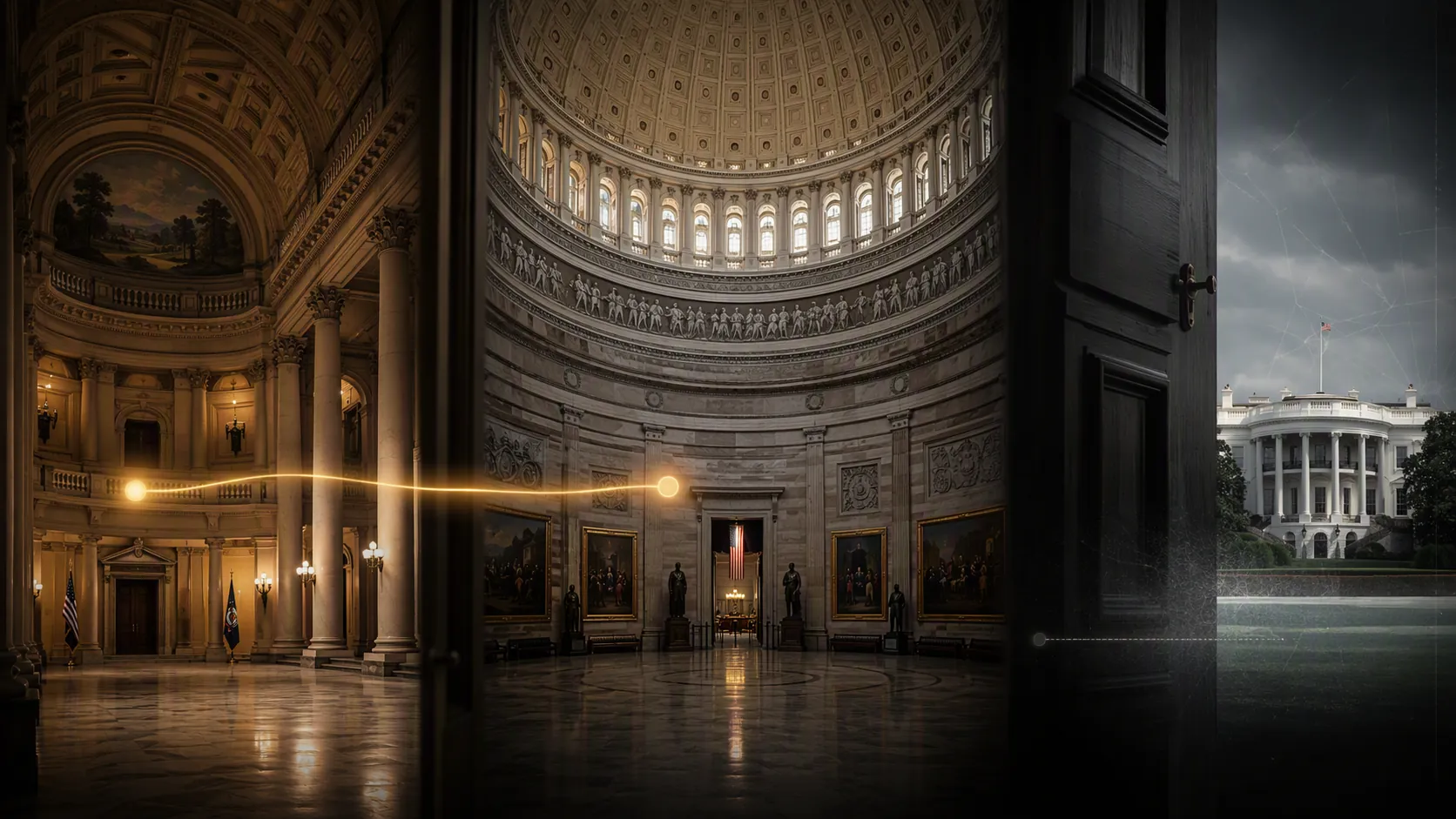
The Elections Clause problem is structural, not administrative
Article I, Section 4, Clause 1 supplies an unusually clean allocation: “The Times, Places and Manner of holding Elections for Senators and Representatives, shall be prescribed in each State by the Legislature thereof,” while “the Congress may at any time by Law make or alter such Regulations.” The clause names two actors for federal election regulation: state legislatures first, Congress second. It does not name the President. CRS’s legal analysis treats that omission as central to the constitutional challenge to executive election directives. [3]
That is why the lower-court rejection of EO 14399 is best understood as a separation-of-powers ruling before it is understood as a voting-rights ruling. A President may have views about mail ballots, citizenship verification, ballot deadlines, or federal election integrity. The Elections Clause question is whether those views can become legally operative commands in the administration of congressional elections without either state legislative action or congressional legislation.
Judge Talwani’s District of Massachusetts ruling, as described in the emergency-application coverage, held the challenged order “legally void.” [2] That phrase matters. It does not merely say the order is unwise, underdeveloped, or difficult to administer. It says the order has no legal force because the constitutional actor issuing it lacks assigned authority in the field.
The 1st Circuit’s 2-1 affirmance gives the Supreme Court a live merits record on that same institutional premise. [2] The dissent matters for emergency posture, but the majority’s core point is the one the justices must either confront or avoid: if the Elections Clause is exclusive as to federal election administration, presidential direction cannot be saved by recasting the order as election-integrity management.
Why “general policy guidance” does not end the inquiry
The Department of Justice’s most administrable defense is that EO 14399 is general policy guidance rather than a self-executing rule. Taken seriously, that argument has force. Courts do not ordinarily decide abstract disagreements over a President’s policy preferences before an agency has taken a concrete step, imposed a duty, denied funds, changed a form, or threatened enforcement.
But the guidance label cannot do all the work. A presidential document can be non-self-executing in one sense and still exert legal pressure in another. Election administrators do not wait in a vacuum. They must set forms, instructions, ballot-processing rules, certification practices, procurement calendars, training manuals, and litigation positions before an election. If an executive order purports to tell federal agencies how to condition election-related interactions with states, the practical pressure can arrive before the final enforcement memo.
The Youngstown frame sharpens the problem. If Congress has expressly or implicitly foreclosed presidential action through statutes such as the National Voter Registration Act and the Help America Vote Act, the President is not merely acting without a clear congressional invitation; he is acting at what Youngstown calls the “lowest ebb” of executive power. CRS identifies the NVRA and HAVA as part of the statutory background against which the executive-order challenges are being evaluated. [3]
That inquiry is not identical to the Elections Clause inquiry. A court could say Congress has occupied enough of the field to make the order unlawful under Youngstown without deciding that the President can never have a role in election administration. Or it could say the Elections Clause itself is decisive because the President is absent from the constitutional allocation. The lower-court merits theory against EO 14399 is strongest when it keeps those arguments distinct rather than blending them into a single objection to federal influence over elections.
The emergency posture changes the Court’s available answers
The administration has not arrived at the Supreme Court through full merits review. It is asking for emergency relief from lower-court orders that block the mail-in voting restrictions from going forward while the litigation continues. SCOTUSblog reported the July 27, 2026 application in Trump v. California and the August 3 response deadline for the states. [2]
That posture matters because an emergency order can turn on likelihood of success, irreparable injury, administrative disruption, or the public interest without producing a final constitutional holding. A stay grant would not necessarily mean the Court believes the President has Elections Clause authority. A stay denial would not necessarily mean the Court has permanently adopted Judge Talwani’s structural conclusion. The shadow docket often produces legal consequences faster than it produces doctrine.
Still, the merits question is hard to avoid if the Court treats the lower-court injunctions as ripe and operative. The administration needs to show more than inconvenience. It must explain why a presidential order in a field textually assigned to state legislatures and Congress has a lawful source of authority. The states, in turn, can defend the injunction by emphasizing institutional injury: they are being asked to administer elections under pressure from a federal actor who is not assigned a regulatory role by the Elections Clause.
Ripeness is the narrow exit
The D.C. Circuit’s July 28, 2026 decision in DSCC v. Trump gives the Supreme Court an off-ramp. In that parallel litigation, the court held the challenge unripe because the executive order “is not self-executing.” That is not a merits endorsement of EO 14399. It is a timing judgment: until agencies take concrete implementing action, the dispute may be too contingent for judicial resolution.
The ripeness theory has an evident institutional attraction. It lets the Court avoid deciding, on an emergency application, whether the Elections Clause categorically excludes presidential direction. It also lets the Court avoid deciding how the NVRA and HAVA interact with the order under Youngstown before agencies have identified the exact steps they intend to take.
But ripeness is not a cost-free answer. If a presidential order is facially beyond the issuing officer’s constitutional authority, waiting for agency implementation can shift the burden onto states and election officials who must plan around a legally uncertain command. The lower courts that reached the merits were not simply impatient; they treated the order’s claimed effect as already significant enough to justify judicial intervention.
The choice, then, is not between election policy and judicial restraint. It is between two forms of institutional restraint: refusing to let a President move first in a constitutionally assigned field, or refusing to decide the scope of that field until the executive branch has acted with more specificity.
The 2025 order is an analogy, not the case
The litigation over the 2025 executive order, EO 14248, belongs in the background only as a pattern. CRS discusses challenges such as LULAC v. Executive Office of the President and California v. Trump as part of the broader litigation history over executive election-administration directives. [3] Those cases are useful because they show recurring structural objections when presidents try to influence election administration through executive instruments.
They do not decide EO 14399. Different text, different implementing mechanisms, different procedural posture, and different relief can change the analysis. Treating the 2025 litigation as if it mechanically resolves Trump v. California would flatten the very distinctions that matter in emergency litigation.
What the Court can do without deciding everything
If the Supreme Court reaches the Elections Clause merits, EO 14399 is vulnerable for a simple reason: the constitutional text gives regulatory authority over federal-election time, place, and manner rules to state legislatures and Congress, and it does not supply a presidential substitute. That is a structural defect, not a defect in drafting style.
The more likely narrow path is procedural. The justices can treat the D.C. Circuit’s ripeness reasoning as a reason to pause before resolving a categorical separation-of-powers question on the shadow docket. That would leave the administration to identify concrete agency implementation and leave the states to challenge those steps if and when they become legally operative.
That narrower ruling would not rehabilitate the order. It would only postpone the moment when a court must decide whether a President can command what Article I assigns elsewhere. On the record now described by the lower courts, the merits vulnerability is substantial; the uncertainty is whether the Supreme Court will say so now.
References
- Ensuring Citizenship Verification and Integrity in Federal Elections, The White House, March 2026
- Trump administration asks Supreme Court to clear the way for new mail-in voting restrictions, SCOTUSblog, July 2026
- CRS Legal Sidebar LSB11368, EveryCRSReport
Operationalizing workflow
No workflow has been explicitly linked to this obligation yet. See Workflows generally.
Illustrative cases
No illustrative case is currently tracked for this obligation. See Risk Digest for documented incidents generally.
← Back to RegulationReport a correction or tip
Spotted an outdated figure, a misstated fact, or a ruling this regulation entry should reflect? Public comments are disabled for this content given the professional cost of a misreported case outcome, penalty amount, or rule text — use the structured correction channel instead.
Report a correction or tip for this record →