
Is 2026's Employment-Based Green Card Backlog a Record High?
- Authority
- U.S. Department of State
- Rule type
- regulation
- Jurisdiction scope
- US federal
- Effective date
- May 22, 2026
- Source text
- Read primary rule text ↗
Verify category- and country-specific visa availability in the current Visa Bulletin before citing aggregate 2026 employment-based backlog figures.
Yes: 2026 can credibly be described as a record-high backlog environment for employment-based green cards. No: there is not one authoritative 2026 number that says “the employment-based green card backlog is X.” The defensible answer is a set of sourced components, each measuring a different part of the system at a different date.
| Component | Number or event | What it measures | As-of date and source |
|---|---|---|---|
| USCIS pending volume | 11.3 million pending cases; net backlog of 6.3 million | All USCIS pending cases and net backlog across form types, not employment-based green cards alone | End of FY2026 Q1; Niskanen Center June 30, 2026 update [1] |
| Employer-sponsored processing delay | 1,256 days, or 3.44 years, for employer-sponsored green cards; DOL+DHS employer-sponsored processing backlogs exceeding half a million pending cases | Agency processing time and inventory across DOL and DHS employer-sponsored steps; not the full statutory visa queue | End of FY2025 Q2; Cato Institute, August 11, 2025 [2] |
| Full employment-based queue estimate | 1.8 million people; 1.1 million from India, or 63%, and about 250,000 from China, or 14% | A full-queue estimate of people waiting for employment-based green cards, based on March 2023 data; still widely cited, but not a fresh 2026 count | March 2023 data; Cato Institute, August 2023 [3] |
| Category exhaustion | EB-2 India reached its FY2026 annual cap on May 22, 2026 and is unavailable through September 30, 2026 | A visa-availability event showing category pressure; not a backlog-size measure | State Department notice and Fragomen analysis, May 2026 [4][5] |
The record is real, but the label has to stay attached to the dataset
The 11.3 million figure is the cleanest record headline, and also the easiest one to misuse. Newsweek reported it as the highest USCIS pending volume ever recorded, and Niskanen’s underlying update identifies it as total USCIS pending cases at the end of FY2026 Q1, up 17% year over year. The same update reports completions down 41% year over year to 1.8 million, a 6.3 million net backlog, and a frontlog of 197,684 unopened cases compared with zero a year earlier.[1][6]
That is a serious USCIS operating signal. It is not an employment-based green card queue count. USCIS pending inventory includes many form types outside the employment-based immigrant visa process. If the 11.3 million number is moved into a sentence about “employment-based green card backlog size” without the all-USCIS qualifier, the sentence changes the evidence.
The 1,256-day figure is narrower and closer to the employer-sponsored problem, but it measures time and processing burden, not everyone waiting for a visa number. Cato described employer-sponsored green card processing as reaching an all-time high of 1,256 days, or 3.44 years, as of the end of FY2025 Q2, compared with 705 days in 2016. The same analysis put DOL+DHS employer-sponsored processing backlogs above half a million pending cases.[2]
The 1.8 million figure is the broader queue estimate people often want when they ask “how many are waiting?” It is also older. Cato’s August 2023 estimate used March 2023 data and remains a major reference point because it tried to capture the full employment-based green card queue, not merely one agency’s pending inventory. It has not been superseded by a single authoritative 2026 full-queue count.[3]
EB-2 India’s May 2026 cap exhaustion is different again. It shows that a high-demand category used its FY2026 annual allocation before the fiscal year ended. It does not tell the reader how many total people are in the employment-based queue, and it should not be dressed up as an unprecedented historical claim. The supported statement is narrower: EB-2 India reached its FY2026 annual cap on May 22, 2026 and is unavailable through September 30, 2026.[4][5]
Why these numbers cannot be added together
A tempting shortcut would be to place the 11.3 million USCIS pending figure, the half-million-plus employer-sponsored processing backlog, and the 1.8 million full-queue estimate in one paragraph and let the reader feel the scale. That is how a backlog number becomes unusable. The figures overlap conceptually in some places, exclude each other in others, and answer different questions.
- The 11.3 million USCIS pending figure answers: how much pending case volume was sitting across USCIS at the end of FY2026 Q1?
- The 6.3 million net backlog figure answers: how much of that all-USCIS pending volume Niskanen categorized as backlog after its own netting method?
- The half-million-plus DOL+DHS figure answers: how many employer-sponsored cases were pending in the processing pipeline Cato analyzed as of FY2025 Q2?
- The 1.8 million Cato estimate answers: how many people were estimated to be in the employment-based green card queue using March 2023 data?
- The EB-2 India cap exhaustion answers: whether visa numbers remained available in that category for the rest of FY2026.
Those are not interchangeable units. “Pending case,” “net backlog,” “processing backlog,” “person in the queue,” and “visa category unavailable” are different measurements. A sponsored employee may experience them as one delay, but counsel cannot cite them as one statistic.
Where the employer-sponsored queue actually forms
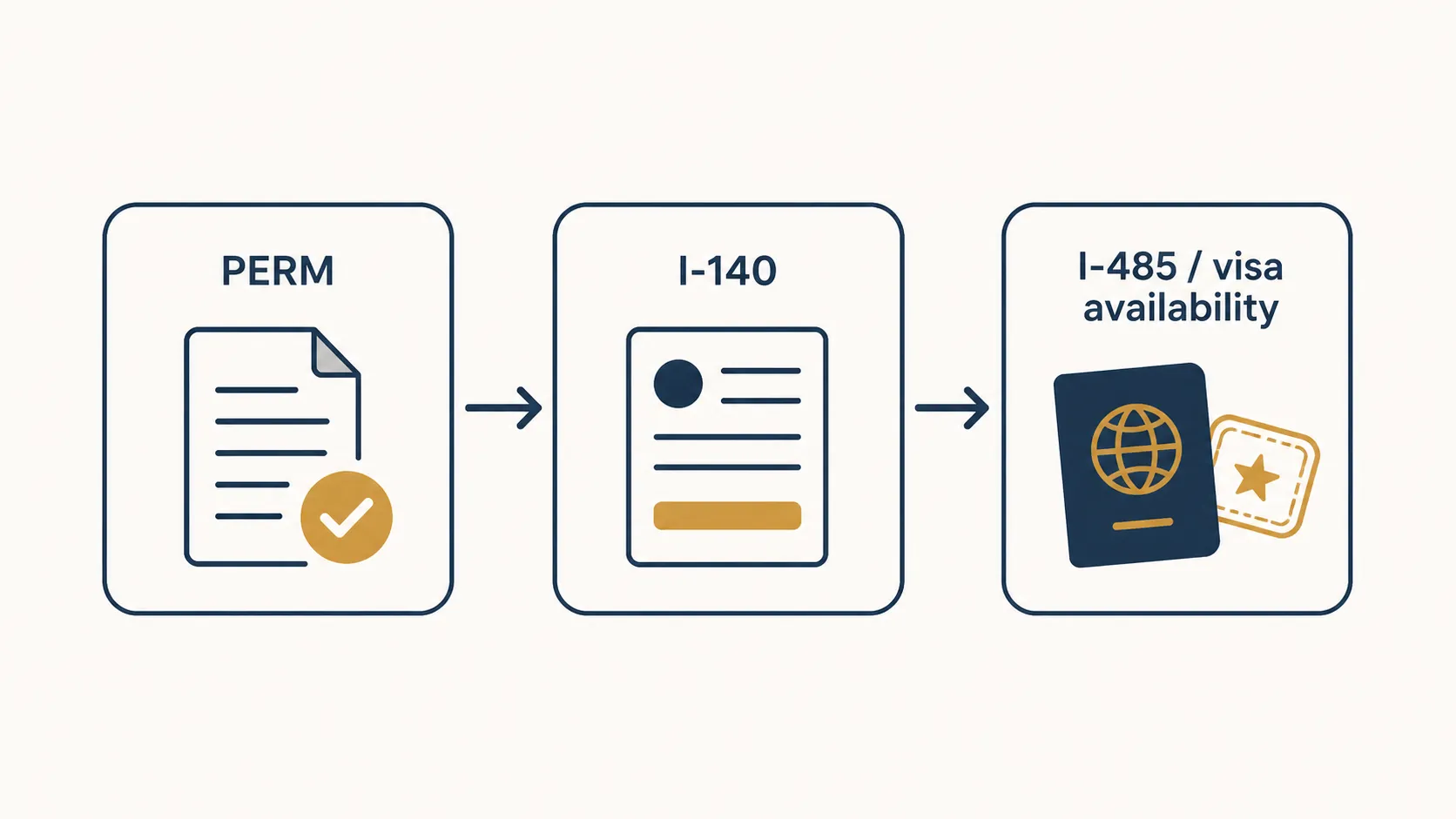
For most employer-sponsored green card matters, the delay is not located in one office or one statute. It accumulates through stages, and each stage creates a different kind of waiting.
PERM: the labor certification gate
PERM sits before the immigrant petition in many employer-sponsored cases. It is handled by the Department of Labor, so a delay here is not a USCIS pending case. It can still be the first major bottleneck in an employment-based green card matter. Niskanen’s 2026 update reports PERM processing at a record 501 to 512 days in 2026.[1]
That distinction matters in planning. A case delayed at PERM may not yet appear in the USCIS immigrant-petition inventory. If an employer tells a worker only that “USCIS is backlogged,” the explanation may already be wrong at the first step.
I-140: the employer petition
After the labor certification step, where required, the employer files the immigrant petition. This is where USCIS adjudication capacity becomes more directly relevant. A pending I-140 is a processing matter: the agency has to receive, open, review, and decide the petition.
Processing backlogs are operationally painful because they slow the moment when the employer and worker know whether the underlying classification has been approved. They are not the same as waiting for a visa number. A case can clear adjudication and still be unable to finish if the category or country is not current.
Visa availability and I-485: the cap becomes the bottleneck
The last stage is where processing delay and statutory scarcity are most often confused. Adjustment of status through Form I-485, or immigrant visa processing abroad, depends on visa availability. If the relevant employment-based category and country are not current, the worker may be waiting because the annual and per-country limits are binding, not because an officer has failed to adjudicate a ready case.
That is why EB-2 India’s unavailability in FY2026 is a pressure indicator rather than a backlog total. It means the category exhausted its annual allocation for the fiscal year. It does not measure how many PERMs are pending, how many I-140s are waiting, or how many people are in the entire employment-based queue.[4][5]
A larger annual cap does not automatically clear the queue
The FY2026 worldwide employment-based immigrant visa cap was 186,317, higher than 150,037 in FY2025 and 160,791 in FY2024.[7] That number is important because it prevents a second bad shortcut: assuming a higher annual cap means the backlog must be easing.
A larger worldwide cap can coexist with severe queue pressure when accumulated demand is already deep, when per-country limits constrain high-demand countries, and when specific categories consume their available numbers before the fiscal year closes. EB-2 India reaching its FY2026 annual cap on May 22 is exactly the kind of event that shows why aggregate annual supply and category-specific availability have to be read together.[4][5]
For an employer, this is not a semantic issue. A higher cap year may improve some filing or final-action possibilities while still leaving a particular employee unable to complete the case. The practical question is never just “what is the cap?” It is which category, which country, which priority date, which procedural stage, and which bulletin date.
How to cite the 2026 record without laundering the number
A responsible 2026 citation should name the component being used. These formulations are safer than a single blended backlog claim:
- For USCIS operating burden: “Total USCIS pending cases reached 11.3 million at the end of FY2026 Q1, with a 6.3 million net backlog, according to Niskanen.”
- For employer-sponsored processing delay: “Employer-sponsored green card processing reached 1,256 days, or 3.44 years, as of FY2025 Q2, according to Cato.”
- For full-queue scale: “The most recent widely cited full employment-based backlog estimate cited here is Cato’s 1.8 million estimate using March 2023 data.”
- For category pressure: “EB-2 India reached its FY2026 annual cap on May 22, 2026 and is unavailable through September 30, 2026.”
The unsafe version is the one that sounds cleaner: “The 2026 employment-based green card backlog is 11.3 million,” or “the employment-based backlog is 6.3 million.” Those figures come from an all-USCIS pending and net-backlog dataset, not an employment-based-only queue count. They may support a record USCIS workload claim; they do not support that sentence.
Verification note
Where a filing, client alert, or article relies on a primary government page that is being accessed through practitioner summaries, the citation trail should say so. Fragomen’s EB-2 India analysis is useful because it identifies the May 22, 2026 cap event and the September 30, 2026 unavailability period, but the State Department notice remains the primary item to verify for the government action itself.[4][5]
The same discipline applies to Visa Bulletin figures and annual-limit analysis. Fragomen reports the FY2026 worldwide employment-based cap as 186,317, compared with 150,037 in FY2025 and 160,791 in FY2024.[7] Before that number is copied into a legal memorandum as a primary government figure, the underlying State Department bulletin should be checked directly.
The narrow, usable conclusion is therefore this: 2026 is a documented record-high backlog environment for employment-based green cards, supported by record USCIS pending volume, record employer-sponsored processing times, an older but still central full-queue estimate, and mid-year EB-2 India cap exhaustion. Any citation that matters should identify the specific component, source, and as-of date.
References
- Immigration Data, Niskanen Center, June 30, 2026.
- Employer-Sponsored Green Card Processing Takes 3.4 Years, an All-Time High, Cato Institute, August 11, 2025.
- 1.8 Million Employment-Based Green Card Backlog, Cato Institute, August 2023.
- India Per-Country Limit Reached in the EB-2 Category, U.S. Department of State.
- United States: EB-2 India Immigrant Visa Category Unavailable Through September 30 After Reaching Annual Limit for FY 2026, Fragomen, May 26, 2026.
- US Immigration Backlog Hits All-Time High, Newsweek, July 2025.
- United States: September 2026 Visa Bulletin – Main Employment-Based Categories Hold Steady; Some Categories May Hit Annual Limits Before End of September; USCIS to Honor Final Action Dates, Fragomen.
Operationalizing workflow
No workflow has been explicitly linked to this obligation yet. See Workflows generally.
Illustrative cases
No illustrative case is currently tracked for this obligation. See Risk Digest for documented incidents generally.
← Back to RegulationReport a correction or tip
Spotted an outdated figure, a misstated fact, or a ruling this regulation entry should reflect? Public comments are disabled for this content given the professional cost of a misreported case outcome, penalty amount, or rule text — use the structured correction channel instead.
Report a correction or tip for this record →