
Epstein Survivors' Protest as a Stress Test for DOJ Ethics
- Authority
- U.S. Department of Justice
- Rule type
- ethics opinion
- Jurisdiction scope
- US federal
- Source text
- Read primary rule text ↗
As of July 31, 2026, Todd Blanche’s attorney general nomination is not simply awaiting a vote. The Senate Judiciary Committee vote was postponed on July 30 after Republican senators, including John Cornyn and Thom Tillis, demanded written guarantees tied to the IRS settlement controversy; President Trump publicly floated withdrawing the nomination; and Epstein survivors were actively urging senators not to confirm Blanche after a Justice Department meeting they described as performative and unresponsive to investigative leads.[1][2][3][4]
That status is already a legal-impact event for anyone assessing DOJ credibility. The question is not whether the nomination will ultimately fail or survive. The question is whether the stalemate itself is a usable signal that DOJ representations, commitments, and internal accountability pathways now require more discounting than they ordinarily would.
On the present record, the signal is not built from one dramatic allegation. It is built from several institutional facts that point in the same direction: a vacant internal discipline post, an effort to reduce external bar-discipline exposure, congressional concern over a non-functioning inspector general, and a judicial finding that prosecutorial power was used retaliatorily. The Epstein survivors’ protest matters because it shows what those defects look like to people asking DOJ to act, not because protest alone proves every ethics allegation.
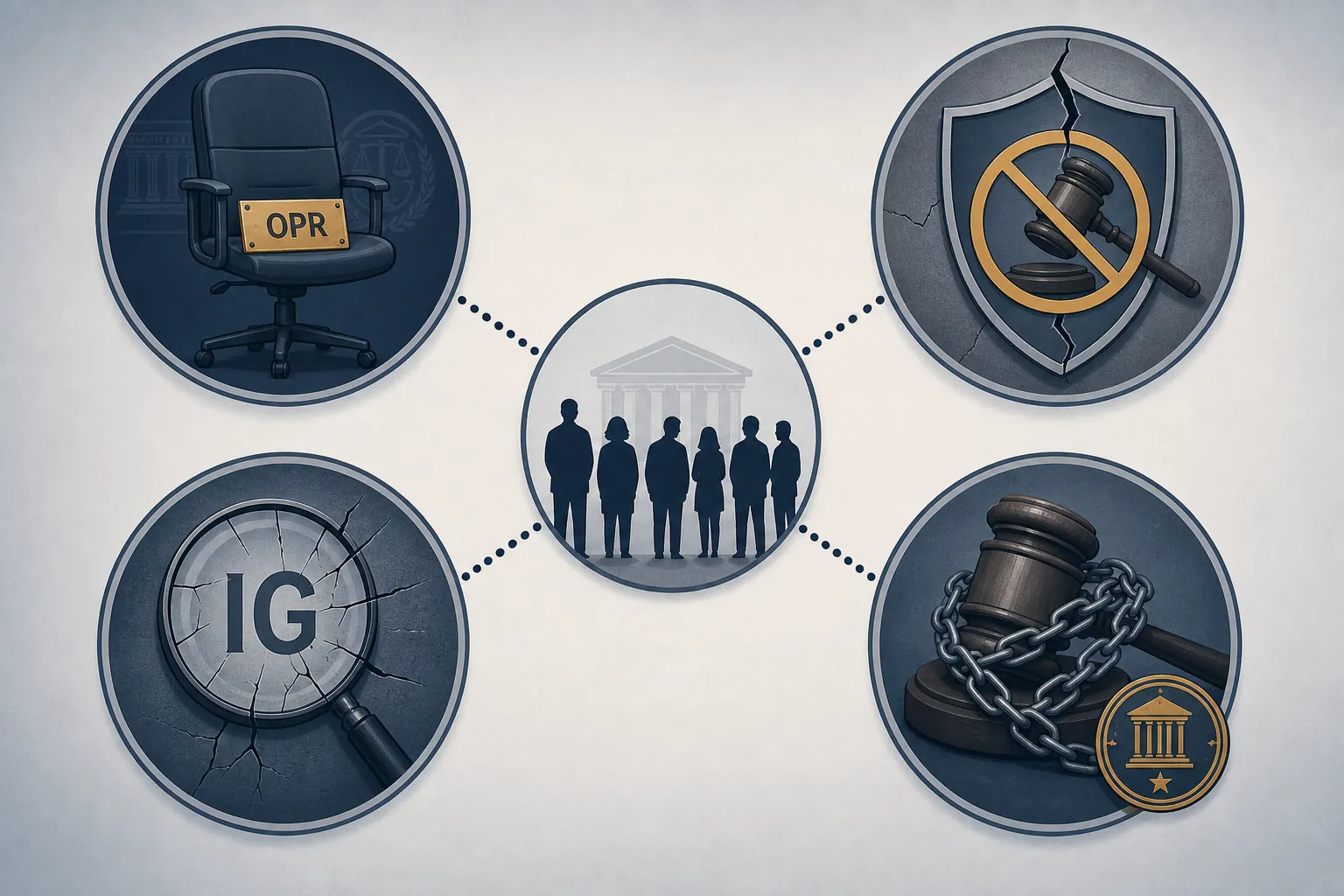
The nomination freeze-frame shows several watchdogs at once
Confirmation fights usually invite biographical sorting: prior clients, loyalty to the president, performance at hearing, vote count. Those details are not irrelevant, but they are not the center of gravity here. Blanche was already acting attorney general during the relevant period, and the sources now opposing his confirmation focus less on ordinary politics than on whether DOJ’s ethics machinery can still correct or expose abuse when senior leadership is implicated.[5][6]
The New York City Bar Association’s July 13 opposition letter framed its objection around five categories: politically motivated prosecutions, constitutional violations, misplaced loyalty, hollowing-out of DOJ, and professional ethics. The June 22 ethics complaint filed by more than 100 former judges supplied a separate procedural track, alleging conduct that should be examined through professional-discipline mechanisms rather than only through confirmation politics.[5][6]
For practitioners, the important distinction is between advocacy pressure and documented infrastructure risk. A bar association letter opposing a nominee is not itself proof that DOJ cannot be trusted. A survivor’s description of a meeting is not itself proof that every investigative decision was improper. But when those materials converge with vacancies, proposed rule changes, whistleblower claims, and a judicial finding, the question shifts from partisan temperament to institutional reliance.
Four safeguards, four different failure modes
The ethics record is easiest to misread if every item is treated as the same kind of accusation. It is not. Each safeguard performs a different function inside the accountability chain. Losing one may create delay or friction. Weakening several at once changes the reliability calculation.
| Safeguard | Documented concern | Why it matters for reliance |
|---|---|---|
| Office of Professional Responsibility | Director position vacant for more than 12 months | Internal discipline may lack stable leadership when senior DOJ conduct requires review |
| State bar discipline | Proposed rule would shield DOJ attorneys from state bar disciplinary complaints | External professional accountability could become harder to trigger |
| Inspector General | Whistleblower complaint described DOJ IG as not functioning properly | Congressional and internal oversight channels may be degraded at the same time |
| Judicial review of prosecution | Federal judge found Blanche started an investigation to implicate Abrego Garcia | Retaliatory-use risk is no longer merely hypothetical |
The OPR vacancy is an internal discipline gap
The DOJ Office of Professional Responsibility is the internal ethics mechanism most directly associated with attorney misconduct inside the department. The NYC Bar letter states that the OPR director position had been vacant for more than 12 months.[5] That fact is not theatrical. It is worse in a quieter way: it raises the odds that serious disputes over DOJ lawyer conduct are reviewed without the ordinary institutional leadership that gives an internal process weight.
A vacancy does not prove that no OPR work occurs. Nor does it prove any particular complaint will be ignored. The narrower, better-supported conclusion is that an internal discipline channel appears structurally weakened during the same period in which senior leadership conduct is under unusual scrutiny. For a regulated party, a court, or a company considering a criminal referral, that affects how much comfort to take from DOJ’s own assurance that it can police itself.
The bar-discipline proposal would reduce outside pressure
The June 22 ethics complaint describes a DOJ proposed rule that would insulate department attorneys from state bar disciplinary complaints.[6] That issue is distinct from OPR. State bars are external professional regulators. Their jurisdiction can be uneven and contested, but their existence matters because DOJ lawyers are not supposed to operate only inside DOJ’s internal hierarchy.
The legal-impact question is not whether every state bar complaint against a federal prosecutor is meritorious. Many are not. The issue is whether DOJ leadership is seeking to narrow a route of accountability at the same time that its internal ethics office is described as lacking permanent leadership. If internal discipline is thin and external discipline is being fenced off, the usual redundancy in professional accountability begins to disappear.
The inspector general concern is an oversight problem, not just an org-chart complaint
The ethics complaint and NYC Bar letter also reference a whistleblower complaint to Congress alleging that the DOJ inspector general was not functioning properly.[5][6] That is a different kind of alarm. OPR concerns lawyer discipline; bar regulators concern professional licensing; the inspector general concerns broader waste, abuse, and misconduct oversight. If congressional overseers cannot rely on the IG channel, the accountability gap widens beyond attorney ethics.
The record provided here does not establish the full merits of the whistleblower complaint. It does support a narrower institutional point: serious actors have put Congress on notice that an oversight channel may be impaired while the department is handling politically sensitive matters. For legal-risk analysis, that notice matters even before a final adjudication exists, because reliance decisions often must be made while oversight disputes are still pending.
The retaliatory-prosecution finding makes the risk concrete
The most consequential item is the judicial finding cited in the ethics complaint: a federal judge found that Blanche “started the investigation to implicate Abrego Garcia.”[6] That is not a pundit’s inference about motive. It is a court’s finding about the use of prosecutorial power in a specific matter.
A single case cannot prove general frequency. It does, however, defeat the safer assumption that retaliation concerns are purely speculative. When a court has already found retaliatory initiation in one matter, and when ethics channels around that leadership are simultaneously contested, institutional users have reason to treat DOJ credibility as a live litigation variable rather than as background noise.
The Epstein survivors’ protest is the stress test
The survivor meeting changes the analysis because it moves the issue from safeguard design to safeguard performance. Survivors and advocates told reporters that the meeting with Blanche was performative, that DOJ did not commit to pursuing investigative leads, and that leads were visible on “almost every page” of available material without follow-up.[3][4] NewsNation reported survivors using language including “deflection, interruption, gaslighting” to describe the encounter.[7]
Those accounts do not prove which leads are valid, whether prosecutors have already assessed them, or whether legal barriers prevent disclosure. A careful reader should not convert survivor frustration into a finding that DOJ unlawfully refused to investigate. The supported point is narrower and still serious: people seeking accountability from DOJ report that they could not obtain even a commitment on investigative leads while the department’s ethics and oversight safeguards were under documented strain.
That is why the protest should not be treated as decorative color at the top of a confirmation story. It is the working example. The survivors are not asking an outside commentator to validate their anger; they are asking the department that controls records, investigative sequencing, prosecutorial discretion, and public explanation to tell them whether specific leads will be pursued. When that system is also facing questions about internal discipline, external professional accountability, inspector general function, and retaliatory use of prosecution, the reliance problem becomes practical.
This is also where the legal impact differs from the political impact. A senator can oppose Blanche because the meeting was badly handled. A practitioner has to ask a more operational question: if DOJ will not give affected survivors a clear commitment on leads in a case of extraordinary public sensitivity, what weight should be assigned to DOJ’s assurances in less visible matters where the affected party has fewer public allies?
The Senate pressure corroborates the signal without defining it
The Senate dynamics matter, but they should not be overread. NPR reported that the committee vote was postponed after Republican senators sought written guarantees connected to the IRS settlement, and separately reported Trump’s threat to withdraw Blanche’s nomination.[1][2] Those facts show that concern is not confined to outside legal groups or survivor advocates.
They do not tell us the final confirmation outcome. They also should not be confused with Blanche’s prior deputy attorney general confirmation. The reported 52-46 vote belongs to that earlier DAG confirmation in March 2025, not to the pending attorney general nomination. Treating that earlier vote as if it decided the current nomination would flatten the very timing problem this controversy presents.
The same caution applies to reports about White House strategy sessions involving Epstein files. The NYC Bar letter references reporting that Blanche participated in a White House Situation Room discussion, but on the materials available here that claim is secondhand through the letter rather than independently verified from the underlying article.[5] It may be relevant; it should not carry more evidentiary weight than the primary documents and survivor accounts that are directly available.
What the legal impact actually is
The legal impact of the Blanche confirmation stalemate is not a new rule of law. It is not a prediction that a court will discredit DOJ in every matter. It is a credibility signal that can affect how lawyers frame risk, how institutions evaluate DOJ representations, and how courts may receive arguments about prosecutorial independence when specific facts support them.
For litigation-risk purposes, the signal has several parts. First, DOJ’s internal discipline apparatus is described as impaired at the leadership level. Second, DOJ is alleged to have pursued a rule that would reduce exposure to outside bar discipline. Third, the inspector general channel is under congressional whistleblower challenge. Fourth, a court has already made a finding that links Blanche to retaliatory prosecutorial initiation in a specific case.[5][6]
No one of those facts requires blanket distrust. Together, they justify more careful treatment of DOJ assurances about process, independence, recusal, follow-up, and investigative completeness. A company deciding whether to make a criminal referral, a defense team evaluating a cooperation posture, or an investor reading enforcement exposure should not treat the Blanche stalemate as ordinary nomination friction.
The stronger point is not that the survivors’ protest created the institutional problem. It exposed the consequence. When people with direct claims to DOJ attention reportedly left without a commitment on investigative leads, the abstract question of ethics infrastructure became a reliance question: who can make DOJ act, who can review DOJ’s refusal, and who can credibly explain the result?
That is enough to make the stalemate actionable as a risk signal even before the Senate resolves the nomination. The documented safeguards do not appear compromised in isolation. They appear compromised simultaneously, and the survivors’ reported experience shows why that is not merely an internal governance defect. It changes the terms on which outsiders can rely on the department when it speaks, declines, delays, or promises to investigate.
References
- Senate committee postpones vote on Todd Blanche nomination, NPR, July 30, 2026.
- Trump threatens to withdraw Todd Blanche nomination, NPR, July 30, 2026.
- Epstein survivors and experts warn of Todd Blanche DOJ risk, The Guardian, July 27, 2026.
- Epstein survivor criticizes Blanche, calls meeting a performative move, PBS NewsHour.
- Oppose Todd Blanche Attorney General Nomination, New York City Bar Association, July 13, 2026.
- Ethics Complaint by 100+ Former Judges, June 22, 2026.
- Epstein survivors accuse Blanche of gaslighting, NewsNation.
Operationalizing workflow
No workflow has been explicitly linked to this obligation yet. See Workflows generally.
Illustrative cases
No illustrative case is currently tracked for this obligation. See Risk Digest for documented incidents generally.
← Back to RegulationReport a correction or tip
Spotted an outdated figure, a misstated fact, or a ruling this regulation entry should reflect? Public comments are disabled for this content given the professional cost of a misreported case outcome, penalty amount, or rule text — use the structured correction channel instead.
Report a correction or tip for this record →