
How Ethiopia TPS Court Ruling Survives Mullin's APA Bar
- Authority
- U.S. District Court for the District of Massachusetts
- Rule type
- standing order
- Jurisdiction scope
- US federal
- Effective date
- Apr 8, 2026
- Source text
- Read primary rule text ↗
Postpones Ethiopia TPS termination pending resolution of constitutional claims
- Last verified: July 27, 2026. USCIS’s operative public language as of that date extended certain Ethiopia TPS-related EADs through July 30, 2026 and described the extension as “limited relief until the U.S. District Court … aligns with Mullin v. Doe.” [1]
- Docket posture: African Communities Together v. Mullin, No. 1:26-cv-10278-BEM, in the District of Massachusetts. Some materials still use the earlier caption, African Communities Together v. Noem, because the caption changed after DHS leadership changed. [2]
- Source note: the research set for this article did not include the full April 8 postponement order. Quotations attributed to Judge Murphy’s order are therefore taken from CBS News, The Hill, and Fragomen’s analysis of the order, not from a directly reviewed order PDF. [3][4][5]
- Mullin note: the research set likewise did not include the full Mullin v. Doe slip opinion. The APA-bar and constitutional-claim reservation discussed here rely on secondary reporting and legal updates, and should be read with that limitation in mind. [6][7][2]
- This is legal analysis for issue-spotting and knowledge-management use. It is not legal advice for any individual TPS holder, employer, or counsel of record.
The apparent contradiction is the whole story. Judge Murphy blocked the Ethiopia TPS termination on April 8, 2026. Then Mullin v. Doe arrived and, as reported, shut the door on APA-based challenges to DHS TPS termination decisions. Yet the postponement has not simply vanished. For readers tracking the legal impact of the Ethiopia TPS court ruling, the live question in 2026 is narrower: what part of Murphy’s order can still bear weight after Mullin removed APA review as the main path?
The answer is not that Murphy “defied” the Supreme Court, and not that Mullin “ended” the Ethiopia case. The useful distinction is between a statutory-process theory that now looks badly exposed and factual findings that may still matter in a constitutional equal-protection case. The postponement continues, but the beam under it has changed.

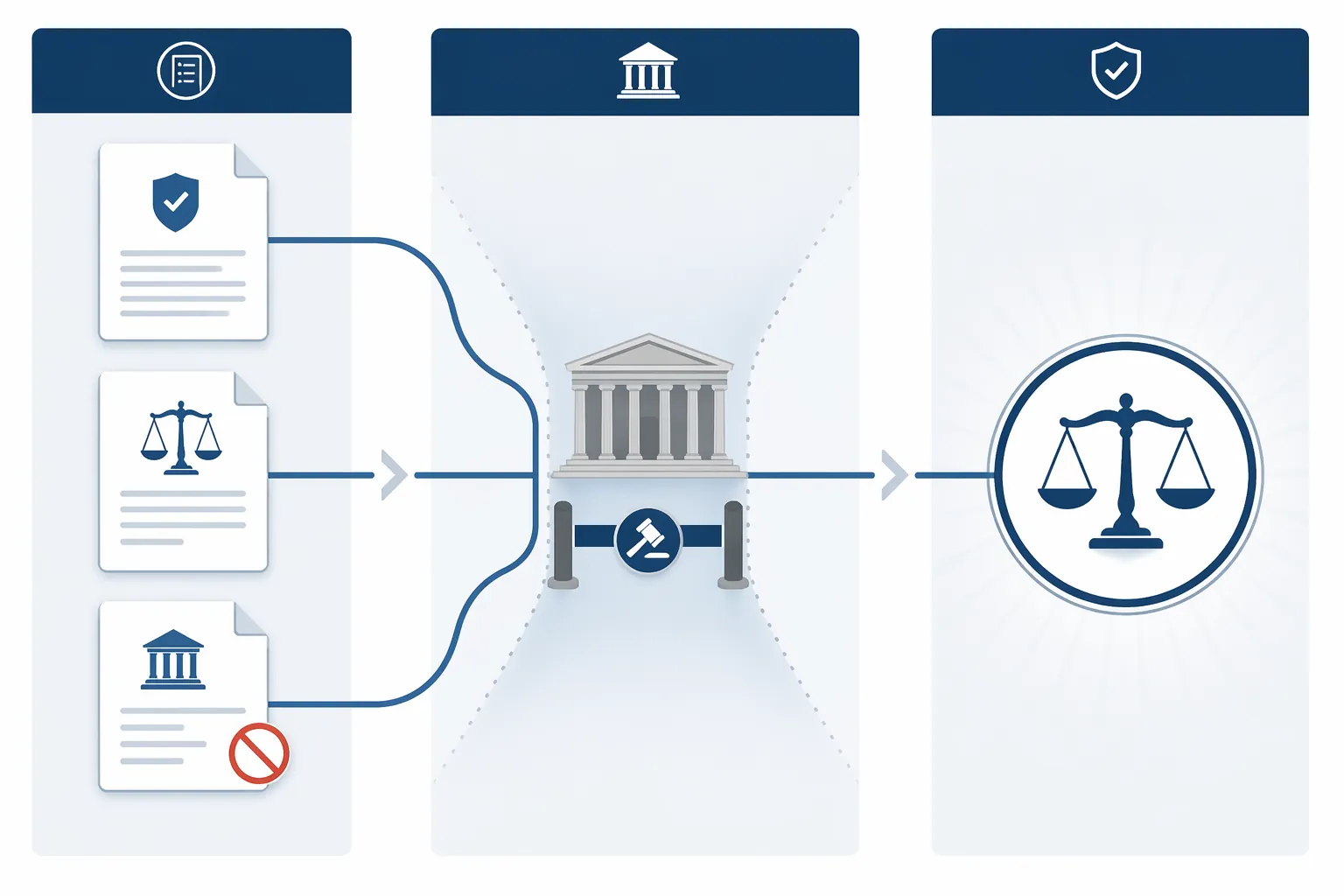
Murphy’s order has three parts, and Mullin does not hit them equally
The April 8 order matters because it did more than pause a deadline. As described by the available reporting and legal analysis, Murphy identified three defects in DHS’s Ethiopia TPS termination decision: a failure to consult appropriate agencies, a “preordained” decision, and “pretextual” stated reasons. Those findings now have very different legal lives.
| Murphy finding | What it did before Mullin | What it can still do after Mullin |
|---|---|---|
| DHS failed to consult with appropriate agencies as INA § 244(b)(1) requires. [5] | Supported a statutory and APA-style challenge to the termination process. | Likely becomes the most vulnerable part of the order because Mullin is reported to bar APA review of TPS termination decisions. [6][7][2] |
| The termination was a “preordained decision,” tied to timing and administration policy rather than a fresh country-conditions review. [3][4][5] | Helped show that DHS had not performed the decisionmaking Congress required. | Can remain evidence of motive, sequence, and decision architecture in an intentional-discrimination claim. |
| The stated justifications were “pretextual,” with Murphy reportedly writing: “Perhaps it has been a banner year for disaster recovery and geopolitical stability worldwide. The evidence, and common sense, suggests otherwise.” [3] | Supported vacatur or postponement by attacking the agency’s stated rationale. | Can become evidence that the official explanation was not the real reason, though pretext alone is not the same as proving unconstitutional intent. |
That separation is the legal impact. The first finding sounds in statutory compliance. The second and third sound in motive and explanation. Mullin, as reported, is aimed at the court’s power to hear APA challenges to TPS termination decisions; it did not, on the available accounts, decide whether Fifth Amendment equal-protection claims alleging intentional discrimination may proceed. [6][7][2]
The consultation finding is the easiest one to lose
Fragomen’s account of the April 8 order says Murphy found that DHS Secretary Noem “failed to consult with appropriate agencies as required by the TPS statute.” [5] Before Mullin, that was a clean administrative-law point. INA § 244(b)(1) requires a TPS termination decision to be made through a statutory process, including consultation with appropriate agencies. If DHS skipped or hollowed out that process, a court reviewing the termination under ordinary APA principles could treat the failure as unlawful agency action.
After Mullin, that same finding has a much harder time supporting relief on its own. If federal courts cannot hear APA-based challenges to TPS termination decisions, then a plaintiff cannot simply relabel a statutory consultation defect and ask for the same APA remedy. The evidence may still matter as background, but the cause of action has to come from somewhere else.
That is why treating the Ethiopia order as if it survived unchanged is misleading. The consultation issue may explain why Murphy originally intervened, and it may show irregularity in how DHS proceeded. But after Mullin, irregular statutory procedure is not enough unless it is connected to a claim the Supreme Court left available.
“Preordained” and “pretextual” do different work
The more durable parts of Murphy’s order are factual, not remedial. CBS News, The Hill, and Fragomen each describe the court as finding that the Ethiopia termination was “preordained,” meaning DHS’s result was effectively fixed before the agency completed the country-conditions process Congress contemplated. [3][4][5]
That finding is not automatically a constitutional holding. Agencies often act under presidential policy direction, and presidential immigration priorities are not unlawful merely because they are political. The problem Murphy identified, as reported, was sharper: the will of the President could not replace the statutory job assigned to the agency. CBS News and The Hill report Murphy’s separation-of-powers language this way: “the will of the President does not supersede that of Congress; Presidential whims do not and cannot supplant agencies’ statutory obligations.” [3][4]
Before Mullin, that language supported an APA-style objection to agency process. After Mullin, its value is more evidentiary. A “preordained” finding can help plaintiffs build a record that the stated agency process was not the real decision process. It can point counsel toward timing evidence, internal sequencing, comparative treatment of countries, and public statements that may bear on motive.
The “pretextual” finding operates in the same way. CBS News reports Murphy’s skepticism of DHS’s stated justification in unusually plain terms: “Perhaps it has been a banner year for disaster recovery and geopolitical stability worldwide. The evidence, and common sense, suggests otherwise.” [3] That sentence is powerful, but its legal force after Mullin depends on what it is used to prove. Pretext can support an inference that the official explanation was false or incomplete. It does not, by itself, prove that the real explanation was race, national origin, or another constitutionally forbidden purpose.
This is the point at which the case migrates from administrative law to constitutional litigation. The record does not become irrelevant. It becomes contested for a different reason.
Why the 17-country pattern matters now
The constitutional theory needs more than a bad process. It needs a plausible claim of intentional discrimination under the Fifth Amendment’s equal-protection component. That is where the reported pattern of TPS terminations becomes important.
CUSP’s litigation tracker describes the administration’s TPS termination pattern as affecting 17 of 17 non-white countries. [2] Standing alone, that is not a judgment of liability. A pattern can be overread, and courts do not usually treat disparate impact as a substitute for discriminatory purpose. But in a case where a district judge has already found preordination and pretext, the pattern gives those findings constitutional relevance.
The sequence matters. If plaintiffs merely alleged that Ethiopia TPS was terminated and Ethiopia is a non-white country, the claim would be thin. If they can pair the 17-of-17 pattern with evidence that DHS’s Ethiopia rationale was pretextual and that the result was fixed as part of a broader campaign, they have a more recognizable intentional-discrimination architecture. That still leaves hard questions of proof, causation, and permissible inference. It does not leave the case with nothing.
The human stakes are real but should not be inflated with loose numbers. The Hill reported that “upwards of 5,000” Ethiopians currently had TPS protections, while USCIS estimated that 26,700 people could qualify. [4] Those are different measures: one describes current protection, the other potential eligibility. For constitutional litigation, the numbers explain who is exposed to harm; they do not answer whether the termination was motivated by an impermissible purpose.
Mullin narrows the remedy path, not the factual record
Mullin’s reported holding is severe for APA claims: federal courts cannot hear APA-based challenges to DHS TPS termination decisions. [6][7][2] That matters because much of the April 8 Ethiopia order reads, on the available descriptions, like classic administrative-law review. Consultation, country-conditions assessment, reasoned explanation, and pretext are familiar APA terrain.
But the reported reservation of constitutional claims is just as important. Fox News, Morgan Lewis, and CUSP each describe Mullin as leaving open the possibility that constitutional claims, including equal-protection theories, could proceed. [6][7][2] That reservation does not mean the plaintiffs win. It means the door Mullin closed is not the only door in the courthouse.
For litigation teams, the distinction changes the pleadings and the record-building. The question is no longer simply whether DHS complied with INA § 244(b)(1) or gave a reasoned explanation. The question becomes whether the defects Murphy identified are evidence that DHS acted with discriminatory purpose. That is a higher and narrower burden.
This is also why the district court’s factual findings will be fought over carefully. DHS has every reason to argue that preordination and pretext, even if accepted for APA purposes, do not establish intentional discrimination. Plaintiffs have every reason to argue that those findings are exactly the kind of evidence courts examine when evaluating whether a facially neutral government action was driven by an impermissible motive.
Current posture: abeyance, amended claims, and a July 30 stopgap
The posture reflects that narrowing. CUSP and Fragomen report that the First Circuit held the appeal in abeyance on April 20, 2026 pending Mullin. [2][5] Once Mullin issued, the procedural fight could no longer proceed as if the APA theory were untouched.
Fox News reports that plaintiffs filed a post-Mullin amended complaint shifting toward constitutional claims. [6] That is the expected move if the APA route is blocked and the constitutional route remains open. It also means the case is not best understood as a district judge simply refusing to follow the Supreme Court. It is better understood as a case being forced onto the claim category the Supreme Court did not decide.
The interim work-authorization regime shows how fragile that posture is. USCIS’s July 17 SAVE alert extended certain Ethiopia TPS-related EADs through July 30, 2026, but described that extension as “limited relief until the U.S. District Court … aligns with Mullin v. Doe.” [1] That is not durable language. It is agency language for a bridge period, and it may be superseded after the July 27 verification date.
Employer compliance questions belong mainly in the companion work-authorization tracker, especially for I-9 annotation and reverification timing. Here, the July 30 date matters for a different reason: it shows that the legal postponement is operating under pressure from Mullin rather than under a settled merits ruling.
What practitioners should separate
The case now requires clean separation between four things that are easy to blur in public summaries.
- The injunction or postponement effect. The termination has been postponed for now, and USCIS has recognized a short EAD extension through July 30, 2026 as of the July 17 alert. [1]
- The APA theory. The consultation and statutory-process findings are the most vulnerable because Mullin is reported to bar APA review of TPS termination decisions. [6][7][2]
- The factual record. Murphy’s reported preordination and pretext findings remain potentially important as evidence, even if they no longer support APA relief in the same way. [3][4][5]
- The constitutional claim. The Fifth Amendment equal-protection theory still has to prove intentional discrimination; Mullin’s reported reservation of constitutional claims keeps the theory available, not proven. [6][7][2]
That separation is especially important for law-firm risk memos and client alerts. A client who hears only that the court “blocked termination” may assume work authorization is stable. A client who hears only that Mullin “barred APA review” may assume the Ethiopia litigation is over. Neither assumption matches the posture.
The more precise formulation is narrower and more useful: Murphy’s order survives only by changing legal character. It is no longer primarily an APA-review case about statutory process. It is becoming an intentional-discrimination case in which the district court’s findings of preordained and pretextual decisionmaking, together with the 17-country pattern, are the record everyone will fight over next.
References
- Update on Termination of Temporary Protected Status for Ethiopia (Release: July 17, 2026) — USCIS SAVE Alert, July 17, 2026.
- Ethiopia TPS — Litigation Update & What It Means for You — CUSP Litigation Tracker.
- Judge postpones termination of temporary protected status for Ethiopians in U.S. — CBS News.
- Judge halts Trump administration move to end protections for Ethiopians — The Hill.
- United States: Federal Court Continues to Postpone Ethiopia TPS Termination — Fragomen.
- Federal judge blocks Trump's move to end Ethiopia TPS protections — Fox News.
- TPS for Haiti and Syria after Mullin: What Employers Need to Know Now — Morgan Lewis, June 30, 2026.
Operationalizing workflow
No workflow has been explicitly linked to this obligation yet. See Workflows generally.
Illustrative cases
No illustrative case is currently tracked for this obligation. See Risk Digest for documented incidents generally.
← Back to RegulationReport a correction or tip
Spotted an outdated figure, a misstated fact, or a ruling this regulation entry should reflect? Public comments are disabled for this content given the professional cost of a misreported case outcome, penalty amount, or rule text — use the structured correction channel instead.
Report a correction or tip for this record →