
Ethiopia TPS Work Authorization Extended to July 30, 2026
- Authority
- U.S. District Court for the District of Massachusetts
- Rule type
- standing order
- Jurisdiction scope
- US federal
- Effective date
- Jul 17, 2026
- Source text
- Read primary rule text ↗
Use July 30, 2026 as work authorization expiration date; document court order citation; monitor weekly for supersessions.
As of July 27, 2026, employers documenting the Ethiopia TPS work authorization extension should use July 30, 2026 as the current expiration date. That date comes from the July 17, 2026 USCIS SAVE guidance implementing the stay in African Communities Together et al. v. Noem et al., No. 26-cv-10278-BEM (D. Mass.). This article is an obligations tracker and compliance reference, not individualized legal advice. [1]

The date is also reflected in the i9 Intelligence TPS Employer Guide, updated through July 24, 2026, which gives the employer-facing I-9 and E-Verify handling: Section 2 and E-Verify use July 30, 2026; the Additional Information box should identify the court order by case name and docket number. [2]
The part that matters in an audit is not that someone in HR remembers “there was an extension.” The file needs to show why the employer treated the employee as work-authorized through July 30, 2026, and it needs to preserve the source chain that supported that treatment on the day the I-9 was completed or corrected.
Use July 30, 2026 now, but document why
For an Ethiopian TPS beneficiary whose work authorization is being documented under the current court-order extension, the operative compliance answer is narrow: use July 30, 2026. Do not treat that date as a permanent endpoint. USCIS describes the current Ethiopia TPS extension as limited relief while lower courts address the effect of Mullin v. Doe, and the government has moved to dissolve the Ethiopia stay after Mullin. [1]
That distinction matters because a July 30 expiration date typed into Section 2 without a court-order notation can look arbitrary later. The employer file should be able to answer three questions without reconstructing the law from memory:
- Which source supplied the expiration date in effect on the I-9 action date?
- Which court order kept the Ethiopia TPS termination from taking effect for work-authorization purposes?
- Who checked for a superseding USCIS or E-Verify update before the employer relied on that date?
I-9 documentation workflow for Ethiopia TPS
For a new I-9, reverification, or remedial cleanup involving Ethiopian TPS work authorization, the employer should separate the document being presented from the legal reason its validity is extended. The document may show an earlier printed expiration date. The current compliance date comes from the court-order extension as reflected in USCIS guidance, not from improvising around the face of the card.
| I-9 or E-Verify field | Current Ethiopia TPS handling |
|---|---|
| Section 1 | Use the court-order basis reflected in the employer guide; the Section 1 notation should read “as per court order.” [2] |
| Section 2 | Enter July 30, 2026 as the expiration date for the TPS work authorization being documented under the current extension. [2] |
| Additional Information | Add the court-order citation: African Communities Together et al. v. Noem et al., No. 26-cv-10278-BEM (D. Mass.). [2] |
| E-Verify | Use July 30, 2026 as the expiration date when creating or updating the E-Verify case under the current Ethiopia TPS extension. [2] |
| Employer audit file | Retain the USCIS SAVE update, the employer guide or E-Verify instruction relied on, and the date the compliance team verified there was no later supersession. |
The Additional Information entry should not be reduced to “TPS extended” or “per USCIS.” The useful audit sentence is specific enough to explain the source of the exception: “Ethiopia TPS EAD/work authorization extended through July 30, 2026 per African Communities Together et al. v. Noem et al., No. 26-cv-10278-BEM (D. Mass.).” If the employer later updates the record because USCIS issues another supersession, the new entry should identify the later source and date of verification rather than overwriting the earlier compliance history.
For remedial I-9 cleanup, the same principle applies. Make the correction transparent. Date the correction, identify the person making it, preserve the prior entry, and add the court-order citation rather than quietly replacing the expiration date. A clean correction tells an auditor the employer recognized a superseding legal basis and documented it; a silent edit invites the wrong question.
What to keep with the I-9
An employer that retains supporting documentation should keep a compact source packet for the Ethiopia TPS entry: the July 17, 2026 USCIS SAVE update, the i9 Intelligence employer instruction used for the I-9 fields, any relevant E-Verify update available on the action date, and a note showing the date and person who performed the check. The source packet is not a substitute for legal review, but it is often what prevents a payroll suspension or a mistaken reverification demand when the printed EAD date no longer matches the operative work-authorization date.
Do not skip the receipt-date tier for automatic extensions
The Ethiopia TPS court-order extension does not erase the separate problem of EAD automatic-extension rules. If an employee is relying on an I-797C receipt notice, the employer should check the actual receipt date before accepting the extension period shown or assumed from the notice.
| I-797C receipt date | Automatic-extension treatment to verify |
|---|---|
| Before July 22, 2025 | May be eligible for up to a 540-day automatic extension. [2] |
| July 22, 2025 through October 29, 2025 | Capped at one year under the One Big Beautiful Bill Act. [2] |
| October 30, 2025 onward | No automatic extension under the DHS interim final rule described in the employer guidance. [2] |
This is not a universal shortcut for every Ethiopian TPS file. It is a checkpoint. Some receipt notices may appear to support a longer period than the employee can actually use under the later tiering rules. The compliance question is therefore not only “Is Ethiopia TPS extended?” It is also “What is this employee’s receipt date, and which automatic-extension tier applies to this employee’s document?”
When the receipt-date tier and the court-order extension point in different directions, do not solve that conflict by guessing. Escalate the file to counsel or the organization’s designated immigration-compliance reviewer, keep the employee working only where the documented authorization supports it, and record the source used for the decision.
Why the July 30 date is unstable
The underlying Ethiopia TPS termination was published in the Federal Register on December 15, 2025 at 90 FR 58028. DHS estimated 5,001 approved Ethiopia TPS beneficiaries and 263 pending applications as of November 10, 2025; that estimate is useful context, but it should not be treated as a current headcount for 2026 employer planning. [3]
The current work-authorization extension exists because of the stay in African Communities Together et al. v. Noem et al., No. 26-cv-10278-BEM, in the District of Massachusetts. The stay was granted on January 30, 2026 and extended on March 30, 2026. [4]
The pressure on that stay comes from Mullin v. Doe, decided by the Supreme Court on June 25, 2026. The Court held, 6-3, in an opinion by Justice Alito, that TPS termination decisions are statutorily unreviewable under INA § 244(b)(5)(A), and it rejected the equal-protection racial-animus claims in the case before it. Mullin directly addressed Haiti and Syria TPS terminations, not Ethiopia. [5]
That is as far as an employer compliance article should go. The government has moved to dissolve the Ethiopia stay after Mullin, and USCIS is treating the current Ethiopia extensions as limited relief while lower courts align with Mullin. But predicting whether the District of Massachusetts stay will remain in place, be narrowed, or be dissolved is a legal judgment for counsel, not a payroll-calendar assumption. [1][5]
A weekly monitoring workflow is safer than a static reminder
USCIS and related employer guidance have been moving in short increments. Available updates show Friday supersession activity on July 10, July 17, and July 24, 2026, including parallel TPS-related extensions for a seven-country cluster: Burma, Ethiopia, Haiti, Somalia, South Sudan, Syria, and Yemen. Fragomen reported a brief multi-country TPS employment-authorization extension on July 10, 2026; Littler reported additional TPS-related EAD expiration updates on July 13, 2026; i9 Intelligence then reflected the Ethiopia date in guidance updated through July 24, 2026. [2][6][7]
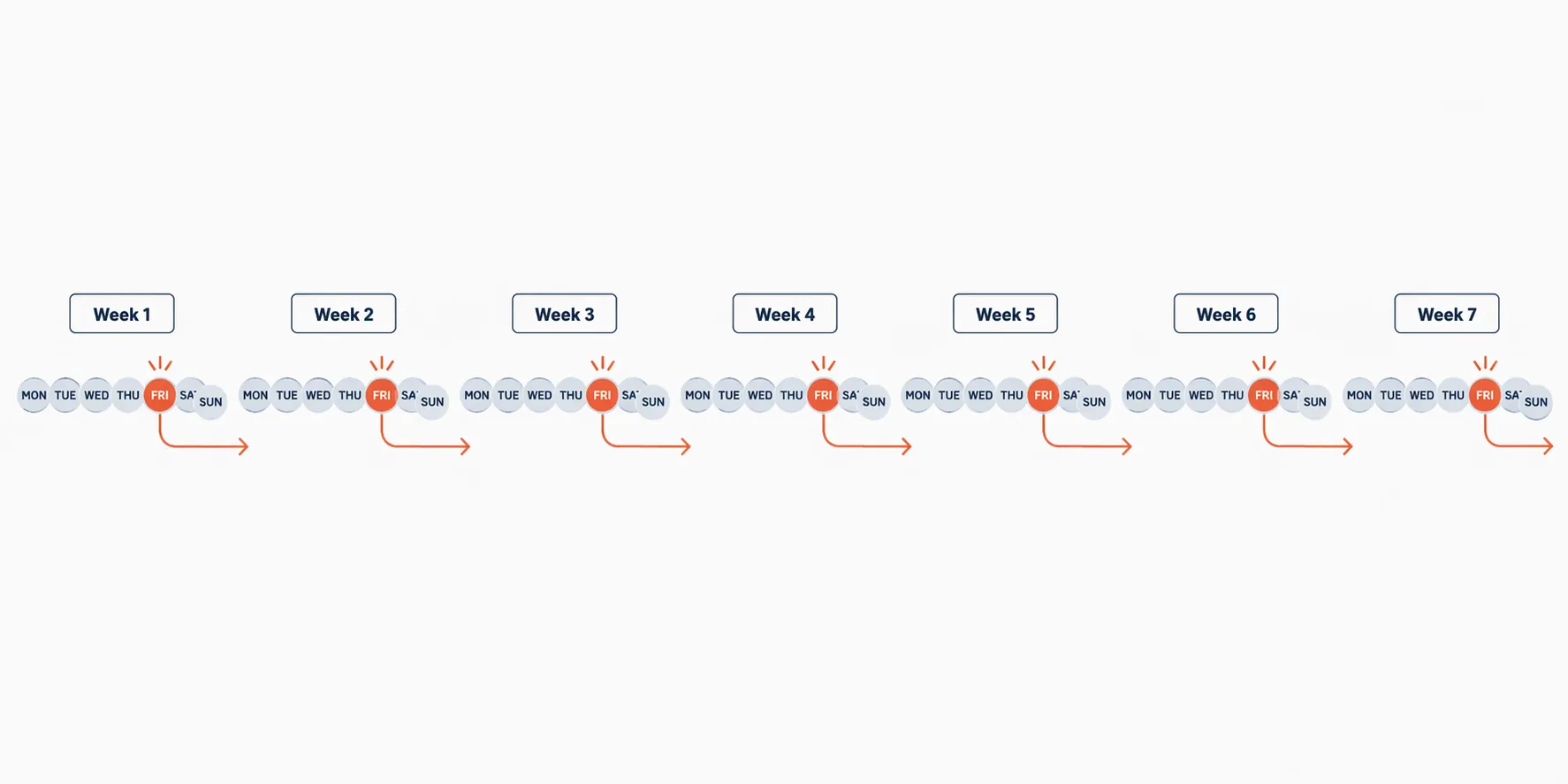
That Friday pattern is a monitoring signal, not an announced USCIS schedule. It should change employer behavior without becoming folklore. A compliance team should not tell managers that “USCIS updates every Friday.” It should tell them that, during this post-Mullin period, Ethiopia TPS work-authorization dates have been superseded in short Friday increments and must be checked weekly against primary or employer-facing official guidance.
A workable monitoring routine is simple enough to survive turnover:
- Assign one owner for TPS date verification and one backup. Do not leave the check to the person who happens to process the next reverification.
- Check USCIS SAVE alerts, E-Verify updates, the USCIS Ethiopia TPS page, and the employer I-9 guidance source at least weekly while the stay remains volatile.
- Perform the weekly check late Friday or early Monday, but treat the timing as an internal control, not a prediction that the government will act on that schedule.
- Save the source reviewed, the URL, the date and time of review, and the name of the reviewer.
- If the date changes, update the reverification calendar, affected I-9 Additional Information entries, E-Verify handling instructions, and any payroll hold list before contacting employees.
- If no new guidance appears, keep July 30, 2026 in place and record that no supersession was found.
The payroll risk runs in both directions. Suspending an employee who remains work-authorized is an operational failure with human consequences. Continuing to rely on an expired date after USCIS has superseded it is a compliance failure. The weekly check is the control that keeps those two risks from being managed by rumor.
What to do today
For Ethiopia TPS work authorization in 2026, the date to use today is July 30, 2026. Put that date in Section 2 and E-Verify where the current extension applies. Put “as per court order” in the Section 1 handling described by the employer guide. Add the case citation — African Communities Together et al. v. Noem et al., No. 26-cv-10278-BEM (D. Mass.) — in Additional Information. Then set the file to be checked again next week, because the compliance position is only as current as the last verified USCIS or E-Verify update.
References
- Update on Termination of Temporary Protected Status for Ethiopia — Release July 17, 2026, USCIS SAVE, July 17, 2026.
- TPS Employer Guide, i9 Intelligence, updated through July 24, 2026.
- Termination of Designation of Ethiopia for Temporary Protected Status, Federal Register, December 15, 2025.
- African Communities Together v. Noem, No. 26-cv-10278-BEM, CourtListener.
- Mullin v. Doe, 609 U.S. ___, Supreme Court of the United States, June 25, 2026.
- TPS Employment Authorization Again Extended Briefly for Several Countries, Fragomen, July 10, 2026.
- USCIS Issues Additional Updates to TPS-Related EAD Expirations, Littler, July 13, 2026.
Operationalizing workflow
No workflow has been explicitly linked to this obligation yet. See Workflows generally.
Illustrative cases
No illustrative case is currently tracked for this obligation. See Risk Digest for documented incidents generally.
← Back to RegulationReport a correction or tip
Spotted an outdated figure, a misstated fact, or a ruling this regulation entry should reflect? Public comments are disabled for this content given the professional cost of a misreported case outcome, penalty amount, or rule text — use the structured correction channel instead.
Report a correction or tip for this record →