
What the FAA’s Environmental Waiver Actually Waives for SpaceX and Blue Origin
- Authority
- Federal Aviation Administration
- Rule type
- regulation
- Jurisdiction scope
- US federal
- Source text
- Read primary rule text ↗
Waiver of environmental review requirements under 13 federal statutes for commercial launch licenses, but does not affect public health/safety protections or preempt independent enforcement by EPA and other agencies.
The FAA’s July 28, 2026 proposal is easy to overread. NPRM 2120-AM51 would let the agency waive certain environmental and natural-resource-law requirements when issuing commercial launch and reentry licenses, including licenses that matter to SpaceX, Blue Origin, and their contractors. It is still a proposed rule, with a 30-day comment period and no final effective date. It also does not waive requirements needed to protect public health and safety, national security, or U.S. foreign-policy interests.[1][2]
That last limitation is not decorative. A waiver inside the FAA launch-license process is not the same thing as a general environmental pardon. The legal question is not whether the FAA is trying to move faster; it plainly is. The question is which obligations move with the FAA license and which remain lodged in other agencies, permits, enforcement statutes, land actions, or citizen-suit provisions.

The Rule Event, Not the Headline Version
The proposed rule did not appear out of nowhere. The chain runs from Executive Order 14335, issued on August 13, 2025, through Department of Transportation direction, to the FAA’s July 2026 NPRM. The order directed agencies to accelerate commercial space transportation licensing and permitting, and the DOT then moved that policy into the FAA’s launch-licensing machinery.[1][3]
The reported list of laws is broad. Secondary coverage identifies 13 federal environmental and natural-resource statutes on the table, including NEPA, the Endangered Species Act, the Clean Water Act, the Clean Air Act, the National Historic Preservation Act, and the Marine Mammal Protection Act.[2] That is enough to make the rule significant. It is not enough to treat every statutory section, exception, consultation duty, permit duty, and enforcement path as resolved. The Federal Register PDF for the NPRM was not available in crawlable form in the materials reviewed here, so the exact regulatory text and statutory citations should be verified against Docket No. 2120-AM51 before anyone uses the list as a final compliance map.
The pressure behind the proposal is also real. The FAA authorized a record 205 commercial space operations in fiscal year 2025 and projects as many as 4,288 operations over the next decade. CNBC also reported that SpaceX President Gwynne Shotwell told FAA Administrator Bryan Bedford in mid-2026 that SpaceX aims for 10,000 launches annually within five years.[2] Those figures do not prove environmental harm, and they do not prove safety risk. They explain why a procedural waiver can become legally consequential: at high cadence, a mistaken compliance assumption repeats quickly.
What the FAA May Be Trying to Waive
At its core, the NPRM appears aimed at the FAA’s own environmental-review burden when it decides whether to issue a commercial launch or reentry license. That matters most for laws that enter the license record through agency review, consultation, or procedural findings. NEPA is the obvious example: if the FAA can waive an environmental assessment, environmental impact statement, or related review step for a qualifying launch-license decision, the licensing path shortens.
The same logic may matter for FAA-triggered consultation or analysis under other listed statutes, depending on the final text. A launch operator may care less about the label on the waived requirement than about the practical result: fewer studies before license issuance, fewer interagency review loops, fewer grounds for a licensing delay, and fewer procedural hooks for pre-launch litigation against the FAA.
| Issue | What the available materials support |
|---|---|
| FAA launch-license review | The NPRM would authorize waivers of requirements under 13 environmental and natural-resource laws for qualifying commercial launch and reentry licenses. |
| Public health and safety | The proposal does not waive requirements needed to protect public health and safety. |
| National security and foreign policy | The proposal does not waive requirements needed to protect national security or U.S. foreign-policy interests. |
| Independent enforcement | The available materials do not support treating the FAA waiver as preempting EPA, FWS, state, or citizen-suit enforcement automatically. |
| Final operative text | The NPRM remains proposed; counsel should verify the Federal Register notice and any final rule language before relying on secondary summaries. |
Blue Origin belongs in that analysis because it is a commercial launch operator likely to benefit from the same licensing reform. But the available record does not support treating Blue Origin as if it has the same documented environmental enforcement history as SpaceX. The waiver question is shared; the public enforcement record available here is not symmetrical.
What Survives Outside the FAA License Lane
The cleanest way to separate the waiver from the surviving obligations is to ask who is acting. If the FAA is deciding whether its own license record must include a particular environmental review step, the proposed waiver may matter directly. If EPA is enforcing the Clean Water Act, if FWS is defending a refuge-land action, if a state agency is enforcing state-law water obligations, or if plaintiffs bring a citizen-suit theory that does not depend solely on the FAA’s waived procedure, the analysis changes.
The SpaceX deluge-water record is the useful anchor because it is not abstract. EPA issued an administrative order on March 13, 2024, over unauthorized deluge-water discharges from Starbase. A later consent agreement included a $148,378 civil penalty in January 2025. The reported discharge range was 34,200 to 45,300 gallons per event across at least eight identified incidents from 2022 through 2024.[4] Texas regulators also entered an agreed order in August 2024 with an additional fine.[5]
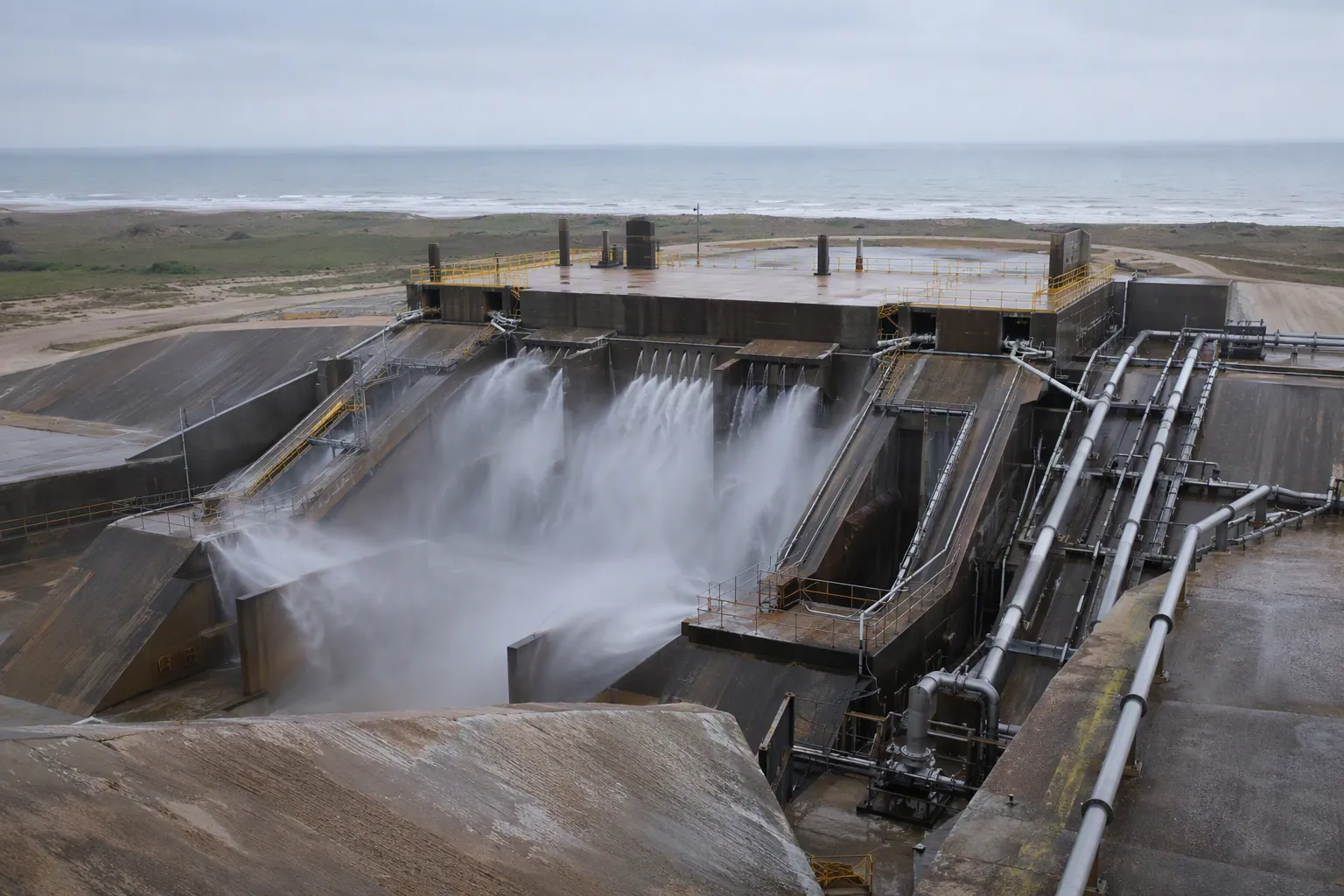
That record does not show that every launch site will create the same problem. It shows something narrower and more important for compliance purposes: a launch-license framework does not make a physical discharge disappear. Water leaves a system. It enters or threatens regulated waters. A regulator identifies incidents. An order issues. A penalty follows. None of those steps depends on whether a headline says the FAA can waive environmental review for licensing.
The same boundary applies to other agency duties. FWS does not become a component of the FAA merely because launch licensing is faster. If habitat consultation, refuge management, endangered-species determinations, or land-transfer decisions sit with FWS, the FAA’s waiver does not automatically answer what FWS must do under its own statutes. NASA, the Air Force, and other federal agencies conducting connected actions may also have independent NEPA duties if their own approvals, funding, property interests, or operational decisions are legally separate from the FAA license.
How a Licensing Shortcut Becomes a Liability Cascade
The risk event is not the waiver itself. The risk event is an operator, investor, contractor, or political office treating FAA approval as global environmental clearance. That mistake can sit quietly until something concrete happens: a discharge, a species impact, a construction dependency, a land transfer, a connected federal approval, or a lawsuit filed by a plaintiff with a statutory hook.
A simplified version looks like this. The FAA waives part of its environmental-review process and issues a launch license. The operator proceeds on an accelerated schedule. A launch-support system produces wastewater, stormwater, emissions, noise, debris, lighting, habitat disturbance, or construction impacts. Another regulator then asks a different question: not whether the FAA license was efficient, but whether the operator discharged without authorization, affected protected species, violated a permit condition, or relied on a land action that required its own administrative record.
That is why the pending and recent litigation matters. In Center for Biological Diversity v. FAA, No. 1:23-cv-01204 in the District of Columbia, the court entered partial summary judgment for the government and SpaceX in September 2025 on NEPA “hard look” and unlawful-delegation claims. The Climate Case Chart entry states that climate impacts were not briefed and remained unresolved in that entry.[6] That is a narrower result than “the launch program won every environmental issue,” and it should be cited that way unless PACER shows a later docket development.
The June 2026 land-swap litigation is a different kind of warning. The Center for Biological Diversity, Save RGV, and the South Texas Environmental Justice Network challenged a 715-acre land transfer to SpaceX, alleging violations of the National Wildlife Refuge System Improvement Act, the National Historic Preservation Act, and NEPA. The plaintiffs also challenged FWS’s use of “Biological Importance Scores,” which they said were unfounded.[7] That case is not merely another launch-license complaint. It targets a land transaction and the agency record supporting it.
For counsel, the practical distinction is decisive. A waived FAA review step may reduce one path of attack on the launch license. It does not necessarily cure defects alleged in a land swap, refuge action, historic-preservation process, discharge authorization, or biological analysis. If a launch site depends on those pieces, the operator’s legal exposure may move rather than vanish.
The Marin Audubon Complication
There is also a post-Marin Audubon problem that should not be flattened into a slogan. In November 2024, the D.C. Circuit invalidated CEQ’s binding NEPA regulations, complicating the legal foundation for categorical exclusions and other NEPA implementation structures.[8] That does not automatically invalidate the FAA’s proposed waiver. It does mean NEPA procedure is already in a legally unsettled posture while agencies design faster review paths.
The unresolved point is how courts will treat citizen-suit and agency-action challenges when a waiver framework, agency-specific NEPA practice, and post-Marin Audubon doctrine collide. Standing, final agency action, statutory waiver authority, and preemption may all matter. The available materials do not support a clean answer, and a clean answer would be suspicious at this stage.
What Counsel Should Not Assume
The proposed waiver is a real deregulatory tool if it survives the rulemaking process in materially similar form. It may materially narrow the FAA’s environmental-review burden for commercial launch and reentry licensing. It may also reduce the leverage of plaintiffs whose claims depend on procedural defects in the FAA license record. Those are meaningful changes, especially for companies trying to increase launch cadence.
But a launch operator should not build its compliance memo around the word “waiver” alone. The questions that still need separate signoff are more concrete:
- Does the operation require a Clean Water Act permit, discharge authorization, spill-control measure, or state water approval outside the FAA license?
- Is FWS taking a separate action involving habitat, refuge land, endangered species, biological opinions, or land exchange?
- Is another federal agency approving property use, funding, access, construction, range operations, or mission support?
- Does the site rely on a categorical exclusion, consultation record, mitigation commitment, or prior environmental document whose legal status has changed?
- Are citizen-suit plaintiffs likely to frame the dispute around a surviving statutory duty rather than the waived FAA review step?
SpaceX’s Starbase record supplies the clearest available example of why those questions cannot be skipped. Blue Origin and other operators should draw the compliance lesson without importing enforcement facts that are not in their own records. A waiver that shortens FAA licensing can still leave water, species, land, historic-preservation, and state-law obligations standing in adjacent lanes.
The safer working conclusion is narrow and citable: NPRM 2120-AM51 may materially narrow FAA environmental review for commercial launch approvals, including approvals relevant to SpaceX and Blue Origin, but it is not total environmental immunity. Treating it as total relief is the compliance failure most likely to create the next docket entry.
Before relying on the rule in a legal opinion, verify the final Federal Register text for Docket No. 2120-AM51, check PACER for the current status of CBD v. FAA, and treat citizen-suit and post-Marin Audubon interactions as open questions until courts or agencies supply firmer answers.
References
- DOT press release on FAA environmental waivers for commercial space launch licensing, U.S. Department of Transportation, July 28, 2026
- CNBC coverage of FAA NPRM 2120-AM51 and commercial launch cadence projections, CNBC, July 28, 2026
- Greenberg Traurig analysis of Executive Order 14335 and commercial space transportation permitting, Greenberg Traurig
- Mitchell Williams analysis of EPA consent agreement concerning SpaceX Starbase deluge-water discharges, Mitchell Williams
- NPR reporting on Texas regulatory action involving SpaceX Starbase deluge-water discharges, NPR
- Center for Biological Diversity v. Federal Aviation Administration, Climate Case Chart
- Environmental groups sue over Texas land swap for SpaceX expansion, The Texas Tribune, June 11, 2026
- Marin Audubon Society v. Federal Aviation Administration, Climate Case Chart
Operationalizing workflow
No workflow has been explicitly linked to this obligation yet. See Workflows generally.
Illustrative cases
No illustrative case is currently tracked for this obligation. See Risk Digest for documented incidents generally.
← Back to RegulationReport a correction or tip
Spotted an outdated figure, a misstated fact, or a ruling this regulation entry should reflect? Public comments are disabled for this content given the professional cost of a misreported case outcome, penalty amount, or rule text — use the structured correction channel instead.
Report a correction or tip for this record →