
Does the Fauci contempt vote create real legal exposure?
- Authority
- U.S. Congress
- Rule type
- statute
- Jurisdiction scope
- US federal
- Source text
- Read primary rule text ↗
Willful refusal to appear, answer, or produce documents is a misdemeanor under 2 U.S.C. §192, but a committee contempt vote alone has no punitive effect.
| Record field | Current status |
|---|---|
| Category | Regulation & Ethics / U.S. congressional oversight |
| Last verified | August 2, 2026, UTC |
| Live procedural status | Unresolved. The July 29, 2026 Senate Homeland Security and Governmental Affairs Committee hearing occurred, but the committee contempt vote was scheduled and had not yet been held; there is no committee vote count, no full-Senate action, no completed statutory referral, no DOJ decision, no grand jury, and no criminal case as of this verification date. [1] |
| Witness posture | Anthony Fauci appeared in person for a hearing that ran roughly three hours and invoked the Fifth Amendment on the record. That posture is materially different from a witness who ignores a subpoena or never appears. [1] |
| Practical answer | The scheduled contempt vote could create procedural and political pressure, but by itself it would not impose a penalty or establish guilt. |
The short answer to the legal-implications question is that a committee contempt vote would be a first gate, not a conviction. It would not fine Fauci, imprison him, or require the Department of Justice to prosecute him. The criminal route would still have to move through a full Senate step, a referral to federal prosecutors, DOJ charging discretion, grand-jury process, and trial. Reuters separately reported that a criminal referral from the Senate would likely face a 60-vote hurdle in the 100-member chamber, which is a substantial obstacle before DOJ discretion even comes into view. [2]

What the scheduled committee vote would actually do
A contempt-of-Congress vote is often described in the language of punishment, but the criminal-contempt statute does not let a committee punish a witness on its own. The relevant misdemeanor provision, 2 U.S.C. § 192, covers a summoned witness who willfully fails to appear, refuses to answer a question, or refuses to produce documents; the statutory penalty is a fine of $100 to $100,000 and imprisonment of one to twelve months. The referral mechanism is in 2 U.S.C. § 194. [3]
Those penalties matter, but they are not triggered by a committee press release, a hearing confrontation, or even committee approval of a contempt resolution. A committee vote would put the committee on record. It would not itself satisfy the later institutional steps that make a criminal case.
That distinction is especially important here because the factual posture is not nonappearance. Fauci sat for the hearing and asserted the Fifth Amendment. The Hill reported that he did so 111 times; other accounts have described the number as more than 100. The precise count is less important legally than the fact that the assertion occurred on the record after an appearance. [4]
The criminal path has several gates still closed
| Stage | What would have to happen | Status as of August 2, 2026 |
|---|---|---|
| Committee contempt vote | The committee would approve a contempt resolution or report. | Scheduled, not yet held. [1] |
| Full Senate action | The chamber would need to act on the contempt matter. For this Senate referral, Reuters reported that the path would likely require 60 votes. [2] | No floor action. |
| Certification or referral | Under the statutory contempt route, Congress transmits the matter to the appropriate U.S. attorney for presentation to a grand jury, though executive-branch practice leaves room for prosecutorial judgment. [3] | No completed statutory referral. |
| DOJ charging decision | Federal prosecutors would decide whether to pursue the matter. | No DOJ decision. |
| Grand jury | A grand jury would have to return an indictment. | No grand-jury action. |
| Trial and judgment | The government would have to prove the offense in court; only a conviction could produce criminal punishment. | No case. |
The full-Senate step is not a technicality. In a closely divided or procedurally contested Senate, the reported 60-vote hurdle is the first major practical filter. If that step does not happen, the ordinary statutory chain does not mature into the kind of referral that contempt headlines tend to imply.
Nor does Congress itself initiate a federal criminal prosecution. Even after a referral, the executive branch retains a role. The statutory language says the U.S. attorney’s duty is to bring the matter before the grand jury, but modern disputes over congressional contempt have repeatedly turned on DOJ’s view of prosecutorial discretion, constitutional defenses, and institutional interests. [3]
Sen. Rand Paul also floated a different route: sending a referral letter directly to DOJ without waiting for a full Senate contempt vote. That could create a record and invite DOJ review, but it would not be the same as a completed statutory contempt referral backed by chamber action, and it still would leave the charging decision with prosecutors. [4]
Why Fauci’s appearance changes the comparison set
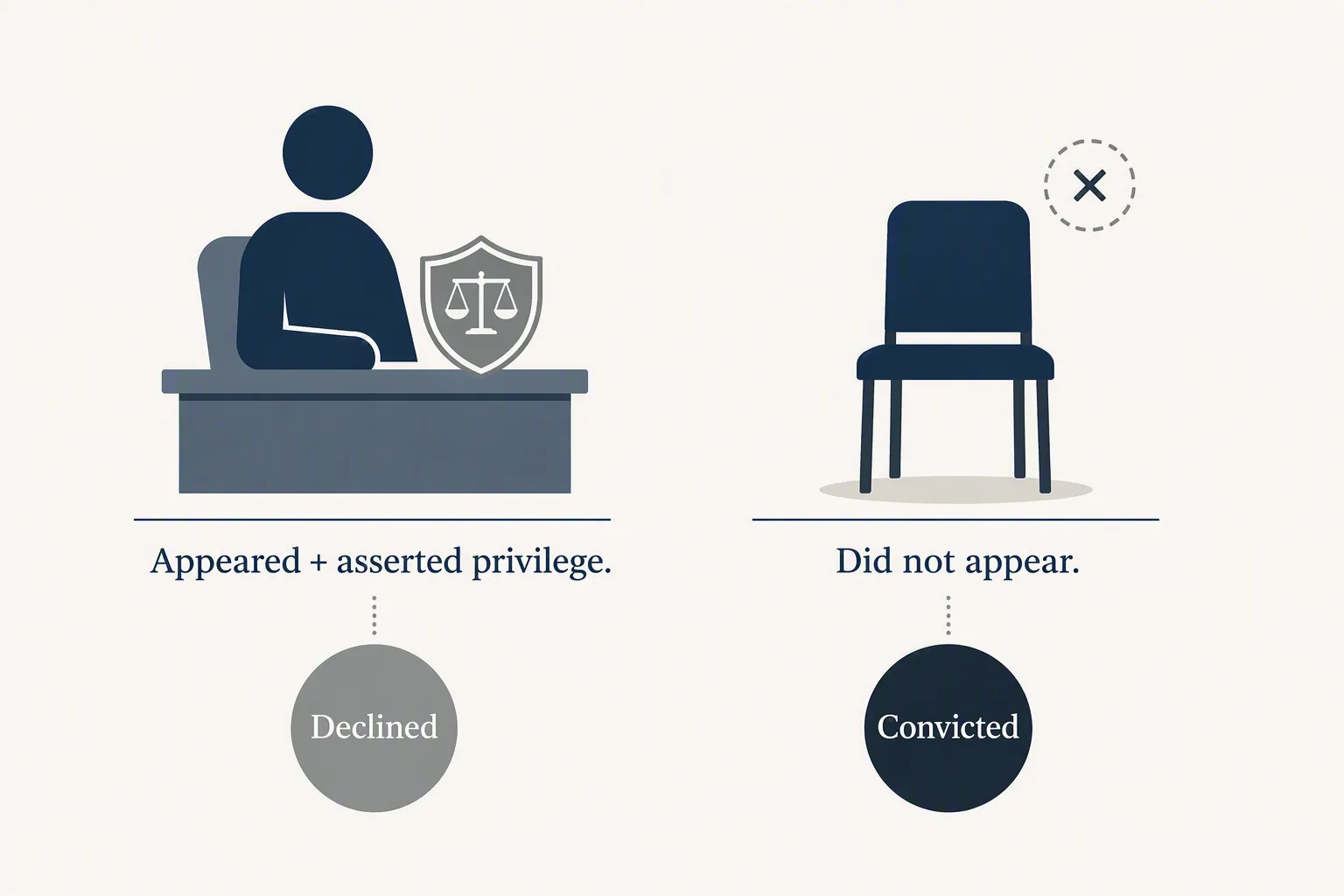
The legally useful comparison is not between politicians who are angry and politicians who are not. It is between witnesses who did not appear or did not respond at all, and witnesses who appeared or had institutional privilege defenses and then faced a referral.
The criminal convictions came from a different posture
Steve Bannon and Peter Navarro are the obvious modern examples because their contempt cases became real criminal cases. Bannon was indicted after he failed to appear for deposition testimony and failed to produce records to the House committee investigating January 6. [5] Navarro was indicted after he failed to appear for testimony and failed to produce documents in response to that committee’s subpoena. [6]
Those cases show that contempt can become a prosecution. They do not show that every refusal to answer at a hearing becomes one. The core conduct was different: the witnesses did not appear or did not comply with subpoena demands in the first place. Fauci’s current record, as described in the public reporting, is appearance plus assertion of the privilege.
The closer analogues are the declined referrals
Lois Lerner and Merrick Garland are more useful reference points for the current posture, though neither is a perfect match. Lerner appeared before Congress and invoked the Fifth Amendment in the IRS targeting investigation; DOJ declined to prosecute after the House contempt referral. Garland was referred by the House in 2024 over subpoenaed executive-branch materials, and DOJ also declined prosecution. [7][3]
That comparison does not create a rule that appearing witnesses can never be prosecuted. It does, however, identify the pattern that matters for a risk memo: the contempt cases that became convictions look much less like Fauci’s current record than the referrals that stopped inside the executive branch.
Other congressional tools exist, but they do not make prosecution automatic
Criminal contempt is not Congress’s only enforcement option. The Senate can pursue civil enforcement through Senate Legal Counsel under 28 U.S.C. § 1365, a route the Congressional Research Service describes as having been used roughly six times. Civil enforcement can produce a court order, but it is slower and does not itself create a criminal conviction. [3]
There is also inherent contempt, the old congressional power to detain or punish a contemnor directly. In modern practice it is largely dormant; CRS notes that the procedure was last used in 1934. The failed 2024 House effort concerning Garland, which did not pass, illustrates why inherent contempt is more a constitutional backdrop than the likely operating path in this dispute. [3]
If Congress wants testimony over a Fifth Amendment assertion, the more direct compulsion mechanism is immunity. The Hill noted 18 U.S.C. § 6005 as the route through which Congress may seek an immunity order for testimony. If properly conferred, immunity can change the privilege analysis because the witness’s testimony and its fruits may no longer be usable in a criminal case covered by the immunity. [4]
The pardon problem keeps the Fifth Amendment question open
The hard legal issue is not whether a committee vote punishes Fauci. It does not. The harder issue is whether Fauci had a valid Fifth Amendment basis after President Biden’s January 2025 preemptive pardon. The pardon document covers conduct “arising from or in any manner related to” Fauci’s government work from 2014 through January 19, 2025. [8]
The government-side argument starts with Brown v. Walker. In 1896, the Supreme Court held that a pardoned witness could not set up the Fifth Amendment privilege on the theory that the pardon had removed the risk of federal prosecution. [9]
But that does not end the analysis cleanly. CNN reported a split among legal commentators over whether Brown resolves Fauci’s congressional-hearing posture after a preemptive pardon. The unresolved points include how the old rule applies in this setting, whether all realistic exposure was eliminated, and what happens if answers would touch matters outside the pardon’s coverage. [10]
Several possible gaps matter. A federal pardon does not bar state prosecution; TIME reported that a Florida prosecutor had announced an investigation. The pardon also does not cover post-January 19, 2025 conduct, and it would not license a witness to commit perjury in later testimony. Those gaps do not prove that every Fifth Amendment assertion was valid, but they are enough to keep the privilege issue from being treated as frivolous on the public record. [11]
Where the record stops
As of August 2, 2026, the legal record stops before the first formal contempt gate has even closed. The committee vote was scheduled, not completed. There is no full-Senate vote, no formal statutory referral, no DOJ charging decision, and no criminal case.
If the committee later votes contempt, the legal implication will still be procedural rather than punitive. It may increase pressure, create a record for Senate action, and give DOJ something to evaluate if a referral reaches the department. On the present record, however, the path to criminal consequences remains incomplete and unlikely.
References
- Anthony Fauci invokes 5th Amendment during Senate hearing, faces contempt vote, NPR, July 29, 2026
- Could Fauci face criminal charges for refusing Senate COVID questions?, Reuters, July 30, 2026
- Congress’s Criminal Contempt Power and the Executive Branch, Congressional Research Service
- Fauci invokes Fifth at COVID hearing as GOP senators threaten contempt vote, The Hill
- Stephen K. Bannon Indicted for Contempt of Congress, U.S. Department of Justice
- Peter Navarro Indicted for Contempt of Congress, U.S. Attorney’s Office for the District of Columbia
- Contempt of Congress: Process and Penalties, FindLaw
- Grant of Pardon for Anthony S. Fauci, Office of the Pardon Attorney, U.S. Department of Justice, January 2025
- Brown v. Walker, 161 U.S. 591 (1896), Justia U.S. Supreme Court Center, 1896
- Fauci invokes the Fifth Amendment despite Biden pardon, CNN, July 29, 2026
- Why Anthony Fauci Took the Fifth Despite Biden’s Pardon, TIME, July 30, 2026
Operationalizing workflow
No workflow has been explicitly linked to this obligation yet. See Workflows generally.
Illustrative cases
No illustrative case is currently tracked for this obligation. See Risk Digest for documented incidents generally.
← Back to RegulationReport a correction or tip
Spotted an outdated figure, a misstated fact, or a ruling this regulation entry should reflect? Public comments are disabled for this content given the professional cost of a misreported case outcome, penalty amount, or rule text — use the structured correction channel instead.
Report a correction or tip for this record →