
Legal Architecture and Vulnerabilities of the FCC Robot Vacuum Ban
- Authority
- Federal Communications Commission
- Rule type
- regulation
- Jurisdiction scope
- US federal
- Effective date
- Jul 28, 2026
- Source text
- Read primary rule text ↗
New covered equipment requires Conditional Approval or waiver for authorization, import, marketing, or sale.
The legally important fact about the FCC robot vacuum ban is not that the agency suddenly took an interest in household appliances. It is that, on July 28, 2026, the FCC added foreign-produced advanced robotic devices, including robot vacuums, to the Covered List after receiving a qualifying National Security Determination, then routed the practical prohibition through its equipment-authorization system.[1][2]
That distinction changes the legal analysis. A challenge aimed only at the FCC as if it had independently invented a consumer-device ban would miss the hinge of the action. The FCC is implementing a statutory mechanism built under the Secure Networks Act and Secure Equipment Act; the operative national-security judgment comes from an interagency process, and the FCC’s role is closer to a gatekeeping implementation function than a free-standing product-safety or privacy rulemaking.[1][2]
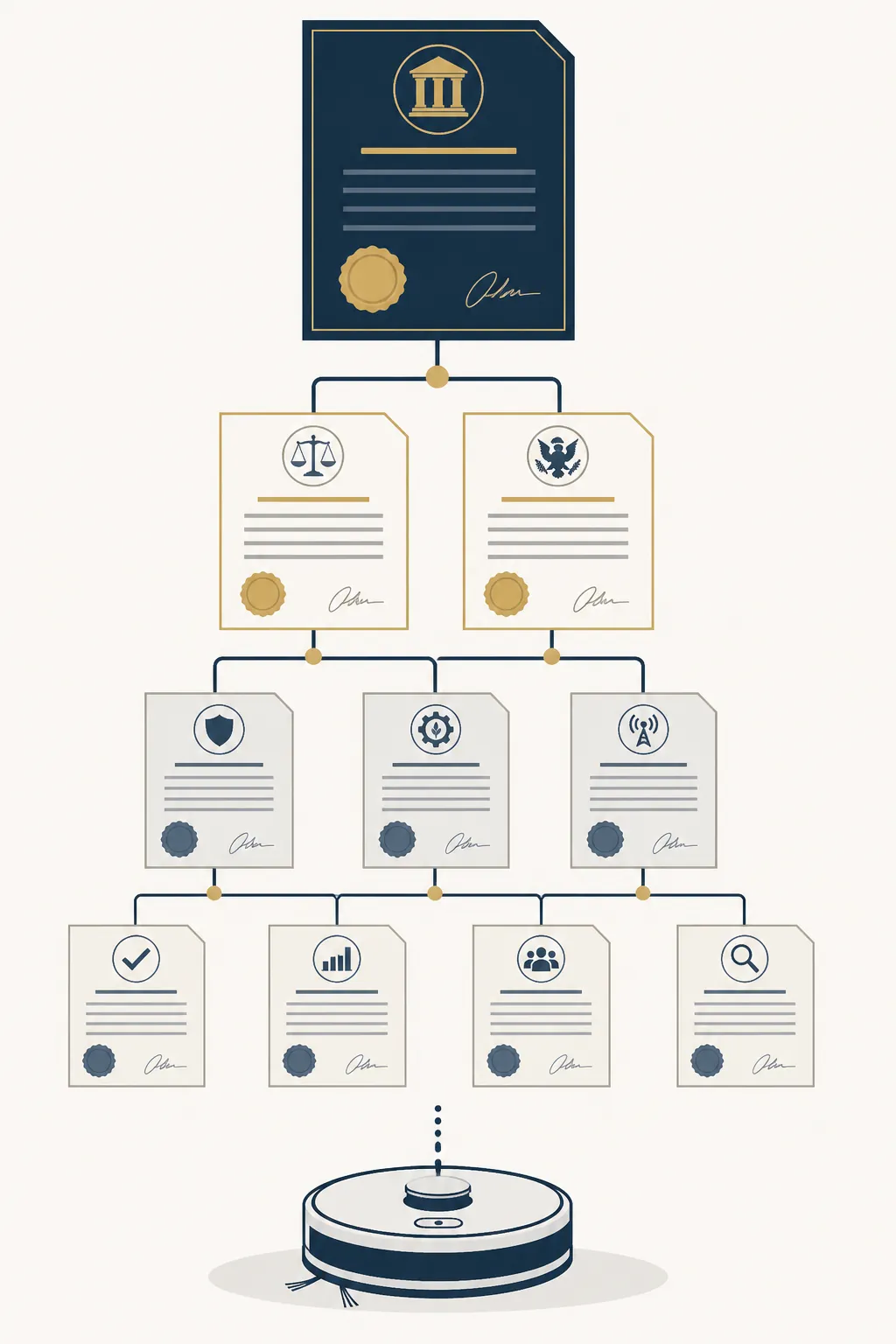
The ban runs through the Covered List, not ordinary product regulation
The FCC’s own FAQ is unusually important here because it states the mechanics that public shorthand tends to flatten. The agency says additions to the Covered List require a national-security determination from one of the bodies identified by statute; the FCC cannot initiate Covered List additions on its own.[1] Wiley’s reading of the same structure reaches the same point: the Commission is acting after receipt of a qualifying National Security Determination, not making the initial national-security finding itself.[2]
Once equipment is on the Covered List, the Secure Equipment Act matters because the FCC may no longer authorize covered communications equipment for importation, marketing, or sale through its equipment-authorization procedures.[2] For robot vacuums, that means the legal effect arrives at the authorization gate. The device category is not simply disfavored in procurement, and it is not merely the subject of a warning label. New covered equipment cannot move through the normal authorization pathway unless an exemption mechanism applies.
This architecture is more legally durable than a hypothetical FCC order that declared, on its own initiative, that robot vacuums are dangerous. Congress created a Covered List mechanism and tied equipment authorization to national-security determinations. But the same layering makes the challenge posture more awkward. The party burdened by the ban experiences the FCC’s denial or conditioning of authorization; the predicate judgment may sit with an interagency national-security determination that is less transparent, less familiar, and potentially harder to isolate for review.
| Legal step | Why it matters |
|---|---|
| Qualifying National Security Determination | Supplies the predicate national-security judgment; the FCC does not initiate the Covered List addition on its own. |
| Covered List addition | Identifies the covered equipment category and the scope of the restriction. |
| Equipment-authorization effect | Turns the listing into a practical barrier to new authorization, importation, marketing, and sale. |
| Conditional Approval or waiver | Creates the administrative channel through which some devices may remain or become eligible despite the listing. |
The product-level sweep is the new pressure point
Earlier Covered List controversies were easier to describe in entity or country terms. The July 2026 action is different because it reaches a product category: foreign-produced advanced robotic devices. The FCC FAQ identifies robot vacuums within that category, and Wiley emphasizes that the covered category is not limited to a named manufacturer.[1][2]
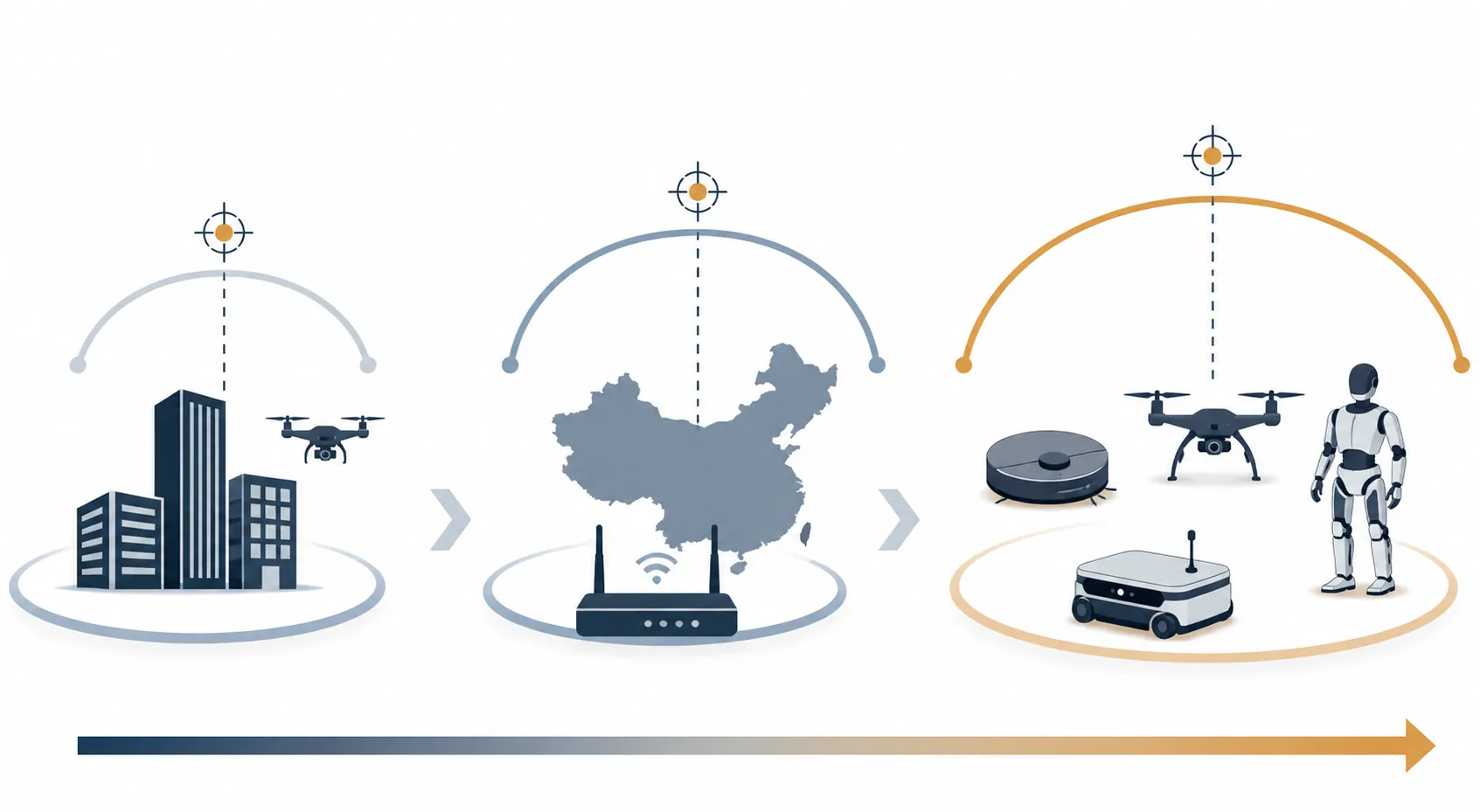
That matters because the fit between rationale and remedy becomes harder to defend as the category widens. The public materials connect the National Security Determination to concerns about advanced robotics, including reported incidents involving DJI Romo and Unitree devices, but those incidents concern different device categories from a conventional consumer robot vacuum.[4] The record may contain more than the public materials show; the underlying NSD documents were not available for direct review. On the public record available here, however, the government’s explanation appears to move from incidents involving drones or humanoid robots to a remedy that includes lower-functionality consumer cleaning devices.
That is not automatically fatal. Agencies and national-security bodies are not required to wait for each device subclass to fail in the same way before acting prophylactically. But an APA challenge would likely press on the fit: what feature of a robot vacuum makes it relevantly similar to the cited advanced robotics risks, and why does the chosen origin-based screen address that feature better than a narrower manufacturer, software, connectivity, data-transfer, or control-system criterion?
The answer may exist in classified or nonpublic national-security material. If so, a reviewing court’s posture could be deferential. Still, the visible structure gives challengers a recognizable arbitrary-and-capricious argument: the government identified a security problem in one technological neighborhood and selected a product-category remedy that may sweep in devices whose relevant functions, data flows, and control risks differ materially.
“Foreign-produced” does more work than the China-focused politics suggest
The most technically consequential definition is not “robot vacuum.” It is “foreign-produced.” The FCC FAQ and Wiley both describe the Covered List entry as using a foreign-production concept tied to the Buy American standard in 48 C.F.R. § 25.101(a), rather than a simple list of Chinese brands or a named-country prohibition.[1][2]
That cross-reference is doing unusual work. Buy American rules were designed for procurement-origin analysis, not as the obvious foundation for a communications-equipment security ban. Importing that definition into the Covered List context could make the ban turn on production-origin concepts that are administratively familiar in one setting but untested in this one. For supply chains that split design, firmware development, final assembly, component sourcing, and cloud services across jurisdictions, the question is not merely where the brand is headquartered.
The country-neutral framing also sits uneasily beside the public policy narrative. Reuters reported on July 28, 2026, that the administration was expected to exempt many non-Chinese suppliers, citing anonymous sources.[3] That report should not be treated as operative law; it is not an FCC order, and it does not establish which companies will receive relief. But if official exemptions later track a China-focused policy while the rule text remains formally country-neutral, the gap will become litigation material.
The legal issue is not hypocrisy in the abstract. It is reasoned decisionmaking. If the risk is foreign production as such, the agency must explain why the origin test is a rational proxy for the national-security problem. If the risk is concentrated in China-linked ownership, control, firmware, data access, or government-compulsion exposure, a facially broader foreign-production test may require an explanation for why it reaches beyond that narrower risk. The more the exemption practice narrows the ban in one direction, the more important the original explanation becomes.
Conditional Approval turns vulnerability into administrative design
The FCC FAQ says parties may seek Conditional Approval, and it also describes an Office of Engineering and Technology blanket waiver for certain equipment that had already been authorized before the new Covered List additions.[1] That waiver point is practically important: the legal shock is concentrated on new authorizations and future market access, not necessarily on every device already sitting in the stream of commerce.
The harder question is what Conditional Approval is supposed to test. The Verge reported that DHS is excluded from the waiver process and that the Department of War controls exemptions.[5] Gizmodo, focusing on the same approval structure, noted the apparent mismatch between a security rationale and a process that may not ask the security-practice questions one would expect.[6] Taken together, those reports do not prove that the process is unlawful. They do show why the exemption architecture may become the place where challengers translate general skepticism into reviewable administrative claims.
A rational exemption process can be narrow, even blunt. National-security screening often uses proxies. But if Conditional Approval is the safety valve for an otherwise broad product-category ban, its criteria matter. A process that asks mainly about origin or institutional eligibility, while declining to examine software-update practices, data handling, remote-access controls, vulnerability disclosure, cloud routing, or ownership control, may invite the argument that the agency has not connected the problem it identified to the relief it offers.
The Netgear example is a useful caution against assuming exemptions map neatly onto actual risk. The Verge reported that Netgear had been exempted in a related framework even though its routers had been implicated in Volt Typhoon activity.[5] That is not evidence that every exemption is suspect, nor is it a robot-vacuum case. It is evidence that exemption status and security posture may diverge, which is precisely the kind of divergence litigators look for when testing whether an agency’s line-drawing is reasoned.
The constitutional challenge is plausible, but not the cleanest first shot
The nondelegation argument is easy to state and hard to win. Congress has allowed an interagency national-security determination to trigger significant market consequences through FCC equipment authorization. A challenger could argue that the statutory pathway gives executive actors too much product-category power with too little intelligible limiting principle, particularly where the Covered List addition is not confined to named entities or a specific hostile state.
That argument should not be oversold. Courts have historically tolerated broad delegations in national-security and foreign-affairs-adjacent settings, and the Secure Networks Act/Secure Equipment Act structure does contain procedural predicates. The better use of the constitutional point may be as pressure on statutory interpretation: if the government reads the Covered List mechanism to permit sweeping product-category restrictions based on an interagency determination and a procurement-origin cross-reference, courts may look harder at whether Congress clearly authorized that breadth.
The APA path is more administratively concrete. It can focus on whether the agency explained the move from the NSD rationale to the covered product category, whether the foreign-production definition rationally tracks the identified risk, whether similarly situated devices or suppliers are treated consistently, and whether the Conditional Approval process actually mitigates the concerns that justified the listing. Those are not guaranteed winning arguments, but they attach to the machinery that will generate agency records, denials, conditions, and exemptions.
What the current record does not yet show
Several facts remain too unsettled to support a litigation forecast. No lawsuit had been filed in the days following the July 28, 2026 announcement. No Conditional Approvals had been granted. The FCC’s official National Security Determination document and the underlying NSD PDFs were not available for direct review, so any assessment of the government’s evidentiary basis must be limited to the FCC FAQ, Wiley’s legal alert, and public reporting.[1][2]
That limitation matters. The most damaging or most defensible material may sit in documents not available here, especially if the government relies on nonpublic national-security information. The public sources are enough to identify legal vulnerabilities, not enough to predict how a court would treat a completed administrative record.
On the present materials, the FCC robot vacuum ban is stronger than a stand-alone FCC product prohibition because it rests on a statutory Covered List mechanism triggered by a National Security Determination. It is also more vulnerable than many prior Covered List moves because it combines a broad product-category sweep, a new foreign-produced definition borrowed from Buy American procurement rules, and an exemption structure whose fit with the stated security rationale is not yet clear.
References
- Covered List FAQs: Robots and Inverters, Federal Communications Commission.
- FCC Adds Foreign-Produced Power Inverters and Advanced Robotic Devices to the Covered List, Wiley.
- Trump administration to ban new Chinese robots, inverters protecting US AI buildout, Reuters, July 28, 2026.
- United States Bans Chinese Humanoid & Quadruped Robots, Citing National Security, Forbes, July 28, 2026.
- US robot ban could sweep up Chinese vacuums, The Verge.
- Trump’s Robot Vacuum Ban Sucks for Everyone, Gizmodo.
Operationalizing workflow
No workflow has been explicitly linked to this obligation yet. See Workflows generally.
Illustrative cases
No illustrative case is currently tracked for this obligation. See Risk Digest for documented incidents generally.
← Back to RegulationReport a correction or tip
Spotted an outdated figure, a misstated fact, or a ruling this regulation entry should reflect? Public comments are disabled for this content given the professional cost of a misreported case outcome, penalty amount, or rule text — use the structured correction channel instead.
Report a correction or tip for this record →