
Federal Appeals Court Split on Bond Hearings in 2026
- Authority
- U.S. Courts of Appeals
- Rule type
- statute
- Jurisdiction scope
- US federal
- Source text
- Read primary rule text ↗
Bond hearing requirement varies by circuit for detainees under INA § 235(b)(2)(A).
As of July 26, 2026, access to an immigration bond hearing for a noncitizen detained under INA § 235(b)(2)(A) turns first on circuit geography. The Second, Sixth, and Eleventh Circuits require individual bond hearings; the Fifth and Eighth currently permit no-bond detention; the First, Third, Fourth, Seventh, Ninth, and Tenth have pending cases rather than settled circuit rules. The Supreme Court has also granted review in Genalo v. Black, but that grant has not yet displaced the working circuit map. This is a reference record for filing and risk review, not legal advice; counsel should verify the docket and any local stay posture before relying on a rule in an active case.[1][2][3]
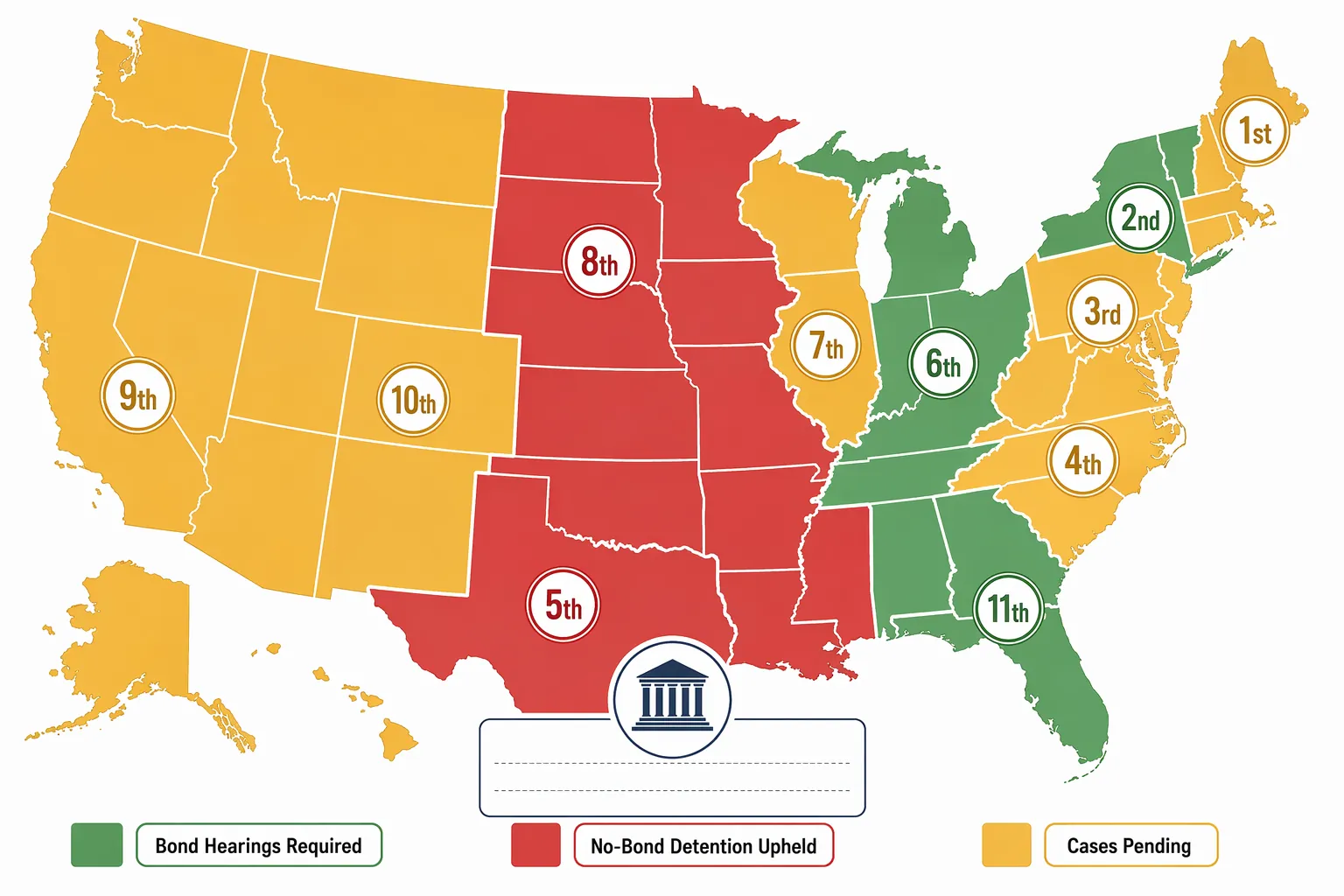
Circuit Tracker as of July 26, 2026
| Circuit | States covered | Current rule | Leading case or posture | Bond hearing required? | Status note |
|---|---|---|---|---|---|
| First | Maine, Massachusetts, New Hampshire, Rhode Island, Puerto Rico | No settled circuit rule verified in the supplied materials | Case pending, as tracked by CLINIC | Unresolved | Do not treat as a merits rule; verify district and appellate posture before filing.[1] |
| Second | Connecticut, New York, Vermont | Mandatory no-bond detention rejected for the tracked § 235(b)(2)(A) classification issue | April 2026 circuit ruling reported by Al Jazeera and the ACLU; also cataloged by CLINIC | Yes | Binding circuit posture favors a bond hearing unless later stayed, narrowed, or superseded.[1][4][5] |
| Third | Delaware, New Jersey, Pennsylvania, Virgin Islands | No settled merits rule verified in the supplied materials | Case pending; January 2026 § 1252(b)(9) opinion described second-hand in the research materials | Unresolved | The January 2026 jurisdictional description should be checked against the full opinion before reliance.[1] |
| Fourth | Maryland, North Carolina, South Carolina, Virginia, West Virginia | No settled circuit rule verified in the supplied materials | Case pending, as tracked by CLINIC | Unresolved | Current record supports only pending status, not a bond-required or no-bond merits rule.[1] |
| Fifth | Louisiana, Mississippi, Texas | No-bond detention currently operative after en banc vacatur of the panel ruling | Sosnava-Rodriguez v. Ortega; en banc vacatur reported July 14, 2026 | No, under current posture | Provisional. The en banc vacatur returned the circuit to no-bond detention while rehearing proceeds, with a September 2026 rehearing deadline reported by practitioner coverage.[6] |
| Sixth | Kentucky, Michigan, Ohio, Tennessee | Mandatory no-bond detention rejected for the tracked § 235(b)(2)(A) issue | Sixth Circuit ruling reported by Law Commentary and cataloged by CLINIC | Yes | Circuit posture favors individual bond hearings for covered detainees.[1][7] |
| Seventh | Illinois, Indiana, Wisconsin | No settled circuit rule verified in the supplied materials | Case pending, as tracked by CLINIC | Unresolved | Pending status should not be described as a merits split position.[1] |
| Eighth | Arkansas, Iowa, Minnesota, Missouri, Nebraska, North Dakota, South Dakota | No-bond detention upheld for the tracked issue | Eighth Circuit position cataloged by CLINIC | No | Current circuit posture places the Eighth on the no-bond side of the split.[1] |
| Ninth | Alaska, Arizona, California, Hawaii, Idaho, Montana, Nevada, Oregon, Washington, Guam, Northern Mariana Islands | No settled circuit rule verified in the supplied materials | Case pending, as tracked by CLINIC | Unresolved | A pending case is not a Ninth Circuit rule; confirm any district injunction, stay, or appeal status before filing.[1] |
| Tenth | Colorado, Kansas, New Mexico, Oklahoma, Utah, Wyoming | No settled circuit rule verified in the supplied materials | Case pending, as tracked by CLINIC | Unresolved | Current record supports pending status only.[1] |
| Eleventh | Alabama, Florida, Georgia | Mandatory no-bond detention rejected for the tracked § 235(b)(2)(A) classification issue | April 2026 circuit ruling reported by Al Jazeera and the ACLU; also cataloged by CLINIC | Yes | Circuit posture favors a bond hearing unless later stayed, narrowed, or superseded.[1][4][5] |
| D.C. | District of Columbia | No circuit position identified in the supplied circuit-split materials | Not included in the tracked split record supplied for this article | Not classified | Do not infer a D.C. Circuit rule from the regional-circuit tracker. |
The table deliberately separates three different filing consequences: a circuit rule requiring a hearing, a circuit rule allowing no-bond detention, and a pending case. Those categories are not interchangeable. In a detained client’s case, the difference is not academic; it determines whether counsel is asking a court to enforce controlling circuit law, preserve an issue against adverse precedent, or litigate into an unsettled field.
The Classification Question: § 235(b)(2)(A), Not § 1226(c)
The operative classification in this tracker is detention under INA § 235(b)(2)(A), the provision used for certain noncitizens treated as applicants for admission. CLINIC’s circuit-split resource frames the dispute around whether that provision mandates detention without an individualized bond hearing for people placed in that category.[1]
That matters because § 235(b)(2)(A) is not the same detention authority as INA § 1226(c). Section 1226(c) is the familiar mandatory-detention provision for certain noncitizens with specified criminal or terrorism-related grounds during removal proceedings. Section 235(b)(2)(A), by contrast, is being used in the current split through the government’s classification of people as applicants for admission. A filing that treats those provisions as interchangeable risks losing the statutory argument before the court reaches due process.
The practical problem is that a detained person may have been living inside the United States before arrest and still be classified by immigration officials as an applicant for admission for detention purposes. That classification is the hinge. If it holds, the government argues that detention is mandatory and bond is unavailable. If the circuit rejects that reading, the detained person can seek an individualized hearing where custody risk and flight risk can be tested.
For filing purposes, the first question is therefore not simply whether the person is detained by ICE. It is which detention statute DHS is invoking, whether the record identifies § 235(b)(2)(A), whether the government is relying on applicant-for-admission treatment, and whether controlling circuit law requires a hearing despite that classification.
Where Bond Hearings Are Required
The Second, Sixth, and Eleventh Circuits are the hearing-required side of the current split. The supplied materials identify April 2026 rulings in the Second and Eleventh Circuits rejecting the administration’s mandatory no-bond position, with CLINIC tracking those rulings as part of the § 235(b)(2)(A) split.[1][4][5]
The Sixth Circuit is also listed on the hearing-required side. Law Commentary reports that the Sixth Circuit rejected the policy denying bond hearings, and CLINIC includes the Sixth Circuit among the circuits that have rejected mandatory detention under the tracked theory.[1][7]
The point for counsel is narrow but important: in those circuits, the stronger filing posture is not a request for a court to create a new rule. It is a request to apply the existing circuit position to the client’s detention classification and hearing denial. The record still has to show custody authority, custody duration, hearing history, and any government argument for a stay or exception.
Where No-Bond Detention Currently Controls
The Eighth Circuit sits on the no-bond side of the split in the supplied tracker. CLINIC identifies the Eighth Circuit as upholding mandatory detention under the tracked § 235(b)(2)(A) theory.[1]
The Fifth Circuit requires more care because its July 2026 posture is easy to overstate. Practitioner coverage reports that the Fifth Circuit, sitting en banc, vacated the panel ruling in Sosnava-Rodriguez v. Ortega on July 14, 2026. The reported consequence is that Texas, Louisiana, and Mississippi returned to the no-bond rule while en banc proceedings continue, with rehearing tied to a September 2026 deadline.[6]
That is not the same as a final en banc merits decision blessing the government’s position. It is the current operating consequence after vacatur. For a detained person in the Fifth Circuit today, that distinction does not soften the immediate result: a bond hearing is not required under the current circuit posture. But for briefing, preservation, and risk assessment, the posture should be stated as provisional.
Pending Circuits Should Stay Pending in the Memo
The First, Third, Fourth, Seventh, Ninth, and Tenth Circuits are pending in the supplied circuit-split materials. That means the article, motion, or client memo should not say those circuits have joined either side unless a newer order has issued and been checked against the docket.[1]
| Pending circuit | Use in a filing today | Verification point |
|---|---|---|
| First | Argue from statutory text, persuasive circuit authority, and district posture | Check whether the pending appeal has produced an order, stay, or merits decision |
| Third | Treat merits status as unresolved | Verify the January 2026 § 1252(b)(9) opinion against the full opinion before relying on it |
| Fourth | Do not characterize the circuit as having adopted either side | Check current appellate docket and any district-level injunction |
| Seventh | Use persuasive authority only unless a new ruling has issued | Confirm appeal status and any stay |
| Ninth | Avoid importing older detention doctrines without matching the statutory classification | Confirm whether the pending case addresses § 235(b)(2)(A) classification directly |
| Tenth | Frame as unresolved unless newer authority exists | Check appellate docket before filing |
The Third Circuit deserves a specific caution because the research materials describe a January 2026 § 1252(b)(9) opinion second-hand, while noting that the PDF could not be directly reviewed. That may be important to jurisdiction, channeling, or reviewability, but it should not be cited as verified circuit authority without the opinion itself.
Why the Split Accelerated
The litigation wave followed a July 2025 ICE policy shift described in ForumTogether’s account of the reclassification of applicants for admission. That account reports that the administration used applicant-for-admission classification to reshape mandatory detention for people who otherwise might have sought bond under a different custody framework.[8]
That policy context explains why the same statutory phrase now matters in detention facilities across different regions. It does not answer the immediate filing question by itself. A person detained in New York, Michigan, or Florida stands in a different procedural position from a person detained in Texas or Missouri because the controlling circuit posture is different.
Advocacy and practitioner sources have reported high habeas success rates, large numbers of affected judges, and sharp increases in detention-related filings. Those figures are not used here as court statistics because the supplied research brief flags them as advocacy or law-firm analyses requiring verification against primary data. They may be useful for policy background; they should not be treated as the basis for a circuit rule.
The Supreme Court Grant Does Not Yet Flatten the Map
The Supreme Court granted certiorari in Genalo v. Black on June 15, 2026, with argument expected in the October 2026 term. The supplied materials identify the case as concerning prolonged immigrant detention without bond hearings, and SCOTUSblog separately reported the grant among the Court’s new cases.[2][3]
The grant matters because a Supreme Court decision could supersede circuit due-process rules on prolonged detention. But the research brief flags an important limit: Genalo is framed under § 1226(c), not § 235(b)(2)(A). That means the decision may not directly resolve the statutory-interpretation fight over applicant-for-admission detention, even if it changes the constitutional analysis around prolonged detention.
Until the Court decides the case, the circuit table remains the working map. A cert grant is not a merits ruling, and it does not erase existing circuit obligations unless a stay, injunction, or later order changes the applicable posture.
Filing Consequences to Check Before Relying on the Rule
- Identify the custody statute in the actual detention record; do not assume § 235(b)(2)(A) from custody alone.
- Confirm whether DHS is treating the person as an applicant for admission and whether that classification is being used to deny bond.
- Match the detention location to the governing regional circuit, not to counsel’s office or the client’s prior residence.
- In the Fifth Circuit, describe the July 2026 en banc vacatur as the current operative posture, not as a final merits endpoint.
- In pending circuits, check the appellate docket before filing; a new stay or opinion can change the answer faster than secondary trackers update.
- For Genalo-related arguments, separate § 1226(c) due-process claims from § 235(b)(2)(A) statutory classification arguments.
As of July 26, 2026, the federal appeals court immigration detention map is geographically decisive and procedurally unstable. The Second, Sixth, and Eleventh Circuits require bond hearings; the Fifth and Eighth allow no-bond detention under current posture; six regional circuits remain pending; and Supreme Court review in Genalo may change part of the analysis without yet changing today’s circuit-by-circuit filing consequences.
References
- A Circuit Split Ripe for Review: Mandatory Detention Under INA § 235(b)(2)(A), CLINIC
- US Supreme Court to Review Prolonged Immigrant Detention Without Bond Hearings, Human Rights Research
- Court agrees to hear three new cases, including on the constitutionality of six-person juries, SCOTUSblog
- US appeals court rejects Trump's immigration detention policy, Al Jazeera
- Federal appeals court rules against Trump administration's new mandatory detention policy, ACLU
- Fifth Circuit En Banc Bond Hearings Vacated 2026, Law Office Immigration
- Federal Appeals Court Rejects Trump Immigration Policy Denying Bond Hearings, Law Commentary
- Reclassifying Applicants for Admission: How the Second Trump Administration Is Reshaping Mandatory Detention, ForumTogether
Operationalizing workflow
No workflow has been explicitly linked to this obligation yet. See Workflows generally.
Illustrative cases
No illustrative case is currently tracked for this obligation. See Risk Digest for documented incidents generally.
← Back to RegulationReport a correction or tip
Spotted an outdated figure, a misstated fact, or a ruling this regulation entry should reflect? Public comments are disabled for this content given the professional cost of a misreported case outcome, penalty amount, or rule text — use the structured correction channel instead.
Report a correction or tip for this record →