
How Fetterman's Filibuster Flip Reshapes AI Regulation Reality
- Authority
- U.S. Senate
- Rule type
- standing order
- Jurisdiction scope
- US federal
- Effective date
- Jul 27, 2026
- Source text
- Read primary rule text ↗
State AI laws remain enforceable compliance floor; federal preemption requires 60 Senate votes.
The legal implication of Fetterman’s filibuster stance change is not that John Fetterman has become an AI-regulation vote counter. His July 2026 op-ed did not mention artificial intelligence. The implication is procedural: a federal bill that overrides state AI laws still has to get through a Senate where most legislation needs 60 votes, and the visible pro-filibuster coalition has just become harder to dismiss as temporary theater.
That matters more for legal-AI compliance than another round of bill introductions. Fetterman wrote on July 27, 2026, that he had changed his mind and now opposed eliminating the filibuster.[1] Late-July reporting also said Senate Majority Leader John Thune confirmed that 15 of roughly 20 Republican senators who spoke with President Trump opposed eliminating it, giving the rule a bipartisan bloc of more than 60 senators.[2] For an in-house lawyer deciding where to spend compliance time, that is the machinery. A federal preemption bill can be loudly endorsed, reintroduced, or branded as essential to national competitiveness; if it cannot reach 60 votes, it cannot become the rule that displaces state obligations.

The Senate Rule Comes Before the AI Bill Text
AI regulation is now producing two very different kinds of federal proposals. One category tries to regulate specific conduct: agency use, model disclosures, procurement standards, election-related deepfakes, child safety, copyright, national security, or sector-specific oversight. Some of those bills may be narrow enough, politically useful enough, or technically modest enough to attract bipartisan support.
The other category does something more aggressive: it tries to stop states from enforcing their own AI rules. That is the category that changes procurement assumptions, because it promises a single federal ceiling in place of Colorado-style obligations, state disclosure rules, and other state-level controls. It is also the category least likely to clear the Senate under current conditions.
The distinction is easy to blur in political coverage and expensive to blur in compliance planning. A narrow federal AI bill and a broad federal preemption bill do not face the same vote math. A modest reporting requirement may be negotiable. A measure that tells states they must stand down asks senators to override their own state governments, their attorneys general, and regulatory choices already made at home. That is a different ask.
Fetterman’s reversal matters because it makes the familiar 60-vote threshold look less like a partisan talking point and more like a current operating constraint. His position also landed while Trump was pressing senators to end the rule. The issue, for compliance purposes, is not which politician won the news cycle. It is that the votes needed to remove the procedural obstacle are not there.
Why Preemption Is the Hard Part
A Great American AI Act-style approach, if it preempts state AI laws, would not merely add a federal layer. It would remove state authority in the name of uniformity. That is why it attracts national businesses frustrated by multi-state compliance and why it becomes difficult in the Senate. Uniformity may be administratively appealing, but Senate passage depends on senators accepting the political cost of taking live state rules off the table.
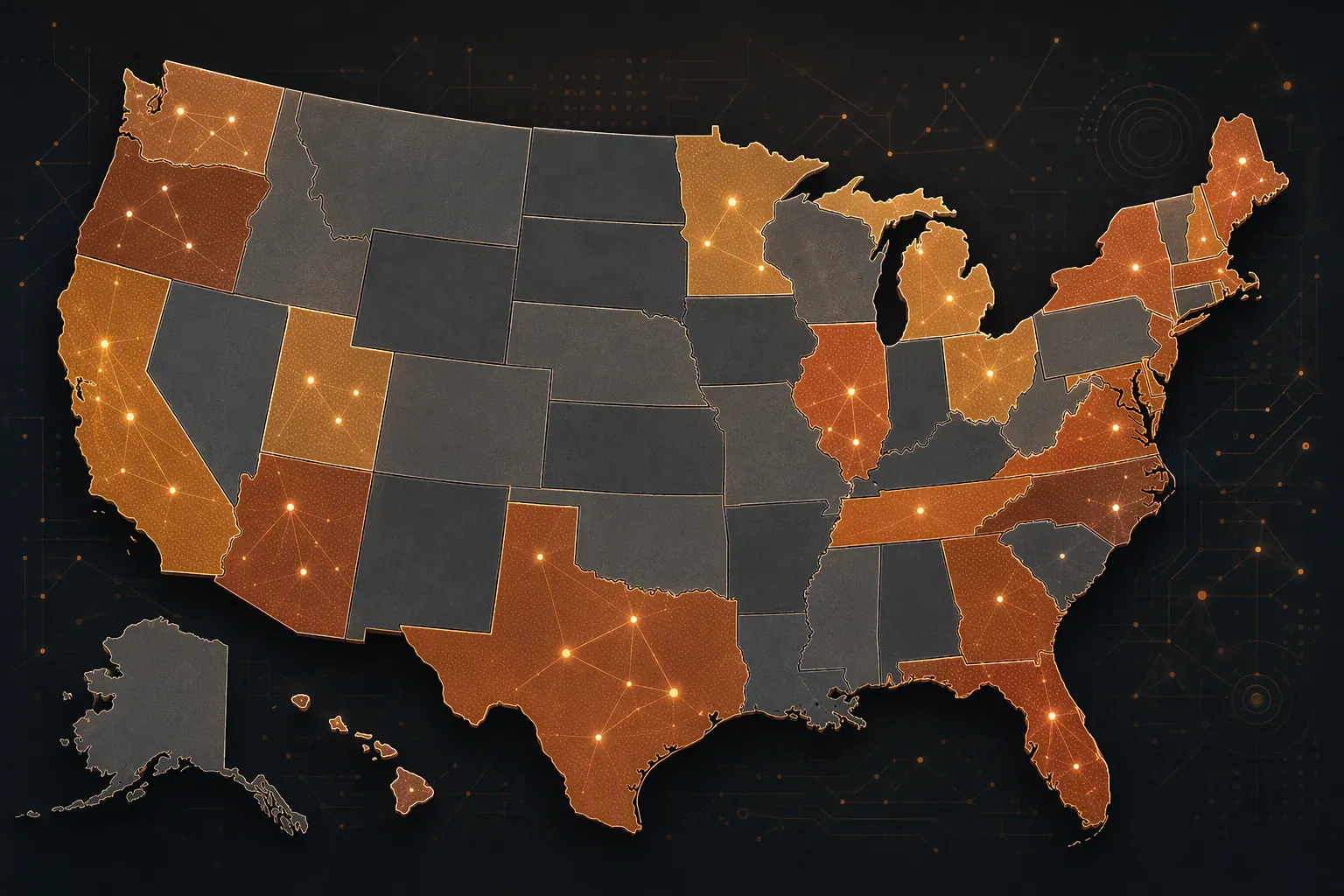
That cost is not theoretical anymore. States enacted 109 AI laws in the first half of 2026, according to TechPolicy.Press and the NYU Center on Technology Policy.[3] That figure is not an official federal count, and it should not be treated as one. It is still useful as a directional compliance signal: state legislatures are not waiting for Congress to finish designing a national AI framework.
For legal AI users, the number matters less as a headline than as a budgeting fact. A law-firm risk manager does not need all 109 measures to apply to a single tool before the patchwork becomes real. One state obligation affecting automated decision disclosures, consumer-facing AI use, attorney supervision, procurement representations, or litigation workflows can force a review of vendor contracts and internal controls. The compliance floor is set by the rule that can bind the organization, not by the rule that would be cleaner if Congress passed it.
That is also why state-law preemption should be separated from general deregulation rhetoric. A president can direct agencies, set enforcement priorities, and convene litigation strategy. The Trump administration’s AI Litigation Task Force and related pressure for state-law limits are important signals, as discussed in Why the Trump AI Action Plan Won’t Simplify Law Firm Compliance. But an executive preference for preemption is not itself preemption. The constitutional problem with trying to erase state AI laws by executive order is the point of Ron DeSantis Says an Executive Order Cannot Preempt State AI Laws. The durable route still runs through Congress.
Reconciliation Already Had Its Test
The obvious workaround is reconciliation: avoid the filibuster by attaching AI preemption to a budget vehicle. That path has already shown its limits. A 2025 attempt to include a state AI-law moratorium in reconciliation failed, and the Brennan Center’s AI legislation tracker treats that episode as part of the current federal AI legislative record.[4]
The reason matters. Reconciliation is not a magic container for any policy that lacks 60 votes. The Byrd Rule limits what can ride on that process by screening out provisions whose budget effects are merely incidental to the policy change. A state AI-law moratorium is mostly a federalism and regulatory-preemption provision. It may have economic consequences, but that does not make it a spending or tax measure in the way reconciliation requires.
That failed attempt is more useful than another speculative whip count because it shows the boundary of the shortcut. If the preemption coalition cannot eliminate the filibuster and cannot comfortably package a moratorium through reconciliation, the remaining path is ordinary legislation. Ordinary legislation brings the analysis back to 60 votes.
More Than 150 Bills Is Not the Same as One Enforceable Federal Standard
The 119th Congress has had more than 150 AI bills introduced, with none clearing the Senate’s 60-vote threshold, according to Brennan Center tracking.[4] That is a useful measure of activity, not a measure of enacted federal law. Legislative trackers are valuable, but only if they are read for status instead of volume.
| Federal AI Proposal Type | Compliance Significance | Current Senate Problem |
|---|---|---|
| Narrow conduct or sector bill | Could create targeted federal obligations if bipartisan text emerges | Still needs a viable coalition, but may avoid the state-preemption fight |
| Agency funding, procurement, or reporting measure | Could shape federal contractors and regulated entities | More plausible if tied to spending or administration and drafted narrowly |
| State-law moratorium or preemption bill | Would directly change the compliance floor by displacing state AI rules | Structurally blocked without 60 votes or a reconciliation path that survives Byrd Rule limits |
That table is the difference between monitoring Congress and overreacting to Congress. Legal departments should not ignore federal AI bills. They should stop treating every introduced federal bill as if it has the same probability of becoming enforceable. The closer a proposal gets to state-law override, the more directly it runs into the filibuster problem.
This is where Fetterman’s position is relevant even though AI is absent from his op-ed. His argument strengthens the expectation that the filibuster will remain available to block ordinary legislation. Thune’s reported confirmation of a large Republican pro-filibuster group points the same way from the other side of the aisle.[2] Together, they make federal AI preemption a poor baseline assumption for the 119th Congress.
What Legal-AI Buyers Should Treat as Live
The practical consequence is not that legal AI regulation is frozen. It is that the enforceable floor remains state-driven unless and until Congress can pass something narrower or the filibuster coalition breaks. For a legal-tech buyer, that changes the questions asked during procurement.
- Can the vendor identify which state AI obligations it has designed around, rather than simply claiming federal deregulation is coming?
- Does the contract allocate responsibility for notices, audit support, output review, model updates, and incident response if a state rule applies?
- Can the legal team map tool use by jurisdiction, client matter, data type, and user role?
- Does the firm have a supervision process for AI-assisted legal work that survives even if no federal AI statute passes?
Colorado is the useful example because it is not a hypothetical future federal standard. It is the kind of state-level obligation that remains live when federal preemption cannot move. The operational details are covered in Colorado’s AI Sunshine Act 2026: Legal AI Compliance Reset. For present purposes, the lesson is simpler: if a state rule applies to a tool, workflow, or client-facing use case, a stalled federal preemption bill does not suspend it.
This is mildly absurd from an administrative perspective. A firm can use one document-review system, one intake chatbot, or one research assistant across offices and still face different state expectations depending on the matter and user. Uniformity would be easier. But legal risk is not priced on what would be easier; it is priced on what can be enforced.
Vendor Claims Need a Procedural Discount
AI vendors have an understandable incentive to describe federal preemption as imminent. A national standard lowers sales friction. It lets a vendor present one compliance story to banks, hospitals, law firms, public agencies, and consumer platforms. The harder question is whether the vendor’s representation accounts for Senate procedure.
A useful procurement response is not to debate politics with the sales team. It is to ask for the assumption behind the roadmap. If the roadmap depends on Congress overriding state AI laws, the vendor should be able to identify the bill, the committee path, the Senate vote path, and the treatment of state-law preemption. If the answer is a general reference to the administration’s deregulatory posture, that is a signal, not a compliance plan.
The same discount belongs in law-firm risk briefings. Partners do not need a weekly catalogue of every federal AI proposal. They need to know whether a proposal changes obligations this quarter, whether it plausibly changes them during the 119th Congress, and whether state rules require action now. Broader market optimism about deregulation, including the signals discussed in Cathie Wood’s AI Stock Picks and the Deregulation Bet, may matter to investors. It does not by itself retire a state-law review checklist.
What Could Still Move
None of this means Congress is irrelevant to AI governance. It means the most sweeping form of federal uniformity is the least viable under the present Senate configuration. A narrower bill could still matter if it avoids state-law override, confines itself to federal procurement, addresses a discrete safety or national-security issue, or attracts a coalition large enough to overcome the ordinary threshold.
That distinction should shape monitoring. A compliance team can track federal AI bills in tiers: enacted law first, agency action second, bipartisan narrow bills third, broad preemption proposals last unless their vote path changes. The order is not about political preference. It is about enforceability.
The uncertainty is the durability of the coalition. The filibuster debate is moving quickly, and the 2026 midterms could change incentives. But as of Q3 2026, the available evidence points in one direction: Fetterman’s reversal, Thune’s reported count, and the failed reconciliation moratorium attempt all make state-law override a weak forecast.
For legal AI use, the bounded forecast is therefore straightforward. Unless the pro-filibuster coalition breaks, or Congress produces a narrow bipartisan AI bill that avoids preemption, state regulation remains the enforceable compliance floor through the foreseeable 119th Congress window.
References
- Why I changed my mind about the filibuster, The Washington Post, July 27, 2026
- John Fetterman: Eliminating the filibuster would be a mistake, Politico, July 27, 2026
- Where State AI Legislation Stands Half-Way Into 2026, TechPolicy.Press, July 6, 2026
- Artificial Intelligence Legislation Tracker, Brennan Center for Justice
Operationalizing workflow
No workflow has been explicitly linked to this obligation yet. See Workflows generally.
Illustrative cases
No illustrative case is currently tracked for this obligation. See Risk Digest for documented incidents generally.
← Back to RegulationReport a correction or tip
Spotted an outdated figure, a misstated fact, or a ruling this regulation entry should reflect? Public comments are disabled for this content given the professional cost of a misreported case outcome, penalty amount, or rule text — use the structured correction channel instead.
Report a correction or tip for this record →