
Fetterman's Filibuster Flip and Its Impact on Federal Law
- Authority
- United States Senate
- Rule type
- standing order
- Jurisdiction scope
- US federal
- Effective date
- Jan 1, 1975
- Source text
- Read primary rule text ↗
60-vote supermajority required to end debate on most Senate legislation
Sen. John Fetterman’s filibuster flip is not mainly interesting because a senator changed his mind. Senators do that, usually with less paperwork than the reversal deserves. The legally consequential part is that Fetterman moved from a 2022 pledge to eliminate the filibuster to a July 27, 2026 public defense of it, calling his earlier position “horribly wrong” and arguing that “history has vindicated” Sens. Kyrsten Sinema and Joe Manchin for refusing to abolish the rule. In his account, the filibuster became a “critical line of defense” against Trump-aligned legislation that otherwise might have moved through a Republican-controlled Washington by bare majority vote.[1]
That is the useful entry point for the legal impact analysis: not whether the reversal is embarrassing, but what it reveals about the operating conditions for federal law. A bill can have majority support, a favorable committee path, and an urgent policy theory, and still die because the Senate’s ordinary-legislation track usually requires more than a majority to end debate.

The Rule That Matters Before the Merits
The filibuster is not a clause in the Constitution. It is a Senate procedural practice, shaped by the chamber’s rules and precedents. The Senate’s own account traces the modern story through the disappearance of the “previous question” motion in 1806, the adoption of Rule XXII in 1917, and the later reduction of the cloture threshold to three-fifths of senators duly chosen and sworn in 1975.[2]
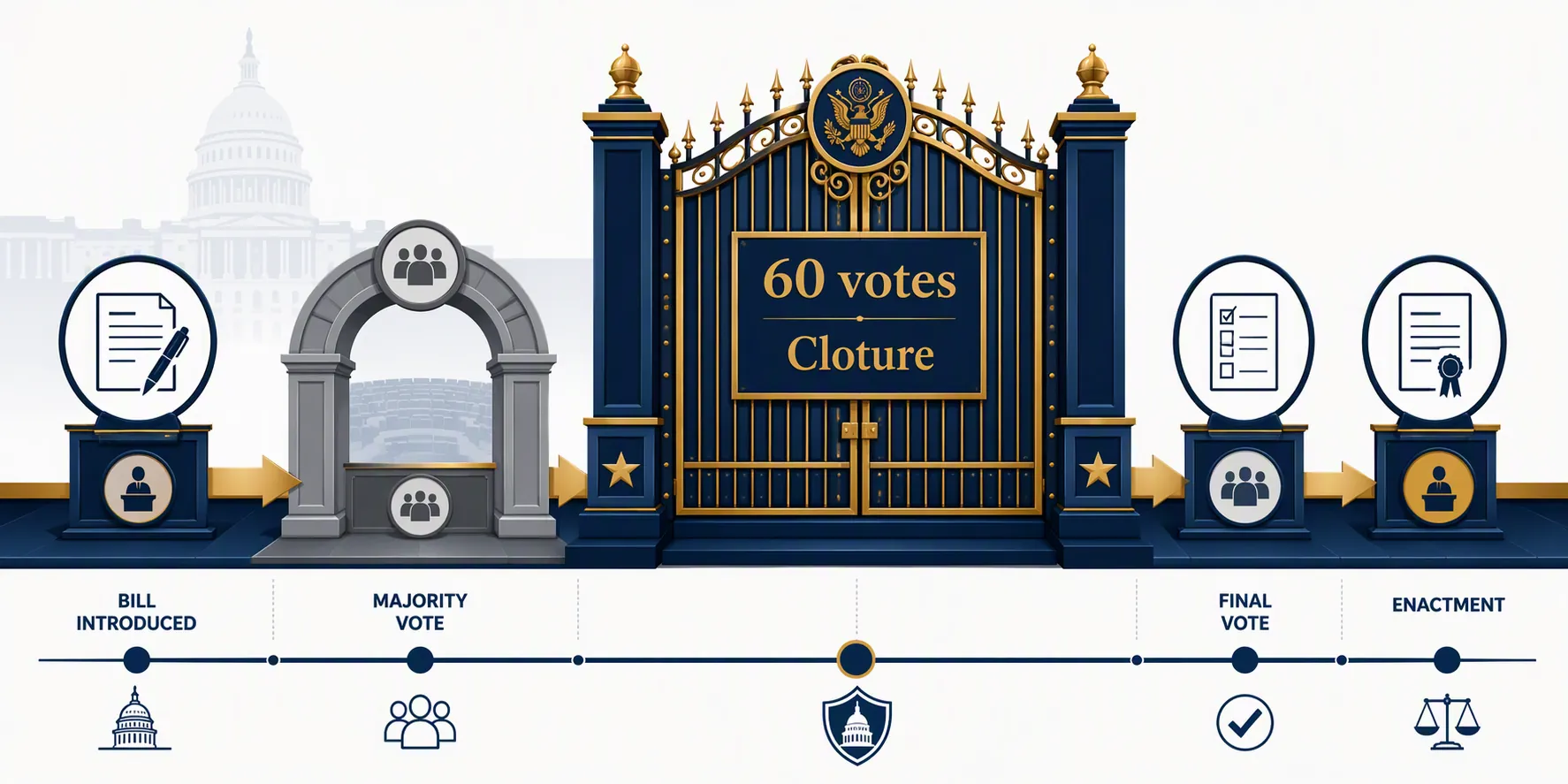
For most legislation, that means 60 votes if the Senate has its full membership. Cloture is the mechanism that ends debate. Without it, a determined minority can prevent the chamber from reaching final passage even when a simple majority supports the bill. The practical distinction is severe: the legal effect of a bill is zero until it survives the procedural path that allows it to become law.
This is why filibuster coverage that stops at moral description misses the instrument. The filibuster is not merely a tradition, a courtesy, or a cable-news synonym for obstruction. It is a gatekeeping rule that changes the probability of enactment for federal statutes. A privacy bill, an AI governance bill, a voting-rights bill, or a national labor standard can clear the House and still be functionally blocked if it cannot attract enough senators to invoke cloture.
| Senate route | Usual voting condition | Legal consequence |
|---|---|---|
| Ordinary substantive legislation | Typically needs 60 votes to invoke cloture | Majority support may be insufficient to reach final passage |
| Nominations after nuclear-option precedents | Can move by simple majority | Judicial and executive appointments follow a different procedural track |
| Certain budget reconciliation measures | Can move by simple majority if they fit the reconciliation rules | Tax, spending, and debt-limit provisions may avoid the ordinary 60-vote barrier |
| Measures covered by statutory or procedural exceptions | Depends on the specific exception | The threshold turns on classification, not just political support |
The current Senate does not use the filibuster as an occasional curiosity. Senate cloture data show 275 cloture motions filed in the 119th Congress through Q3 2026, already above the 252 motions recorded for the 113th Congress.[3] That comparison needs a filing-deadline caveat: the 119th Congress figure covers roughly 13 months, not a completed two-year Congress. It is still a useful signal that modern Senate business routinely moves through cloture fights rather than around them.
The longer trend is just as important. The Brennan Center, using Senate data, reports that more than half of all cloture votes since 1917 occurred in the 12 years preceding its analysis.[4] That does not prove that every cloture vote represents a full-strength filibuster in the old talking-marathon sense. It does show that the Senate’s workload now regularly runs through the architecture of cloture, deadlines, threatened obstruction, and negotiated floor time.
Exceptions Created a Two-Track Senate
The clean civics-book version says legislation needs 60 votes and majority rule applies elsewhere. The actual Senate is messier. Brookings has identified more than 160 exceptions to the 60-vote threshold created since 1969.[5] Those exceptions matter because they let certain questions bypass the ordinary cloture barrier while leaving most substantive regulatory bills exposed to it.
Nominations are the clearest example. Senate majorities have used the “nuclear option” to allow executive-branch and judicial nominees to advance by simple majority. Budget reconciliation is another major bypass, but only for provisions that fit reconciliation’s budgetary limits. That produces a two-track lawmaking environment: a president may staff agencies and courts with a majority, and Congress may move certain budget measures with a majority, while ordinary regulatory legislation still usually needs 60 votes to end debate.
For lawyers, that classification question is not academic. If a proposal can plausibly travel through reconciliation, the enactment analysis looks different. If it is ordinary regulatory legislation, the first procedural question is not whether 51 senators like it. It is whether 60 senators will vote to close debate, or whether enough senators are willing to create, invoke, or defend an exception.
Why Fetterman’s Reversal Lands Differently in 2026
Fetterman’s old position fit the post-2020 Democratic case for abolition: a Senate minority could block voting-rights legislation, abortion protections, labor priorities, and other federal statutes supported by a governing majority. His new position accepts the same procedural premise but changes the risk calculation. In 2026, he argues that the same 60-vote barrier prevented measures he opposes from becoming federal law.[1]
That is not a minor messaging adjustment. It is an admission that the filibuster’s value is assessed from behind a veil that senators rarely keep in place. A party that fears the next agenda often rediscovers the virtues of minority rights. A party that controls the next agenda often rediscovers the frustrations of obstruction. The rule itself has no policy preference. It only decides how large a coalition must be before ordinary legislation can move.
The reported Republican split over abolition makes that point sharper. Trump has pushed to terminate the filibuster, while Senate Republican leadership has said the votes are not there, with reports describing a substantial bloc of GOP senators opposed to elimination. That disagreement is not hard to understand. A majority can want immediate governing power and still contain senators who know they may need the same barrier after the next election.
This is why the reversal should not be filed only under hypocrisy. It is also a live demonstration of how procedure disciplines statutory ambition. The filibuster is procedural, historically contingent, and politically decisive. Each of those adjectives matters. It is procedural because the Constitution does not require it. It is historically contingent because Senate rules and precedents have repeatedly changed it. It is politically decisive because the fate of federal law often turns on whether the bill sits inside or outside the 60-vote channel.
The SAVE Act as the Concrete Case
Fetterman’s defense of the filibuster becomes most concrete around the SAVE Act. The bill would require documentary proof of citizenship to register to vote in federal elections and would impose voter-identification requirements at the polls. The Bipartisan Policy Center described the proposal as having passed the House while facing the Senate’s filibuster barrier.[6]
That example does more work than a general warning about “extreme legislation.” It identifies the precise procedural function Fetterman now praises: the House can pass a bill, a Senate majority can favor it, and the measure can still fail because it cannot reach cloture. From a voting-rights perspective, that barrier may be protective or anti-democratic depending on the bill and the observer. From a legal-process perspective, the sequence is simpler. The threshold controls whether a federal voting rule ever reaches the statute books.
The same structure frames Fetterman’s references to nationwide abortion restrictions and Project 2025-aligned provisions, though those examples should be handled with more caution unless a specific bill text and vote path are identified. As a procedural claim, the point is sound: ordinary legislation that cannot obtain cloture cannot become ordinary federal law. As a bill-specific claim, lawyers still need the introduced text, the committee posture, the floor vehicle, and the available exceptions before treating any single proposal as blocked for one reason only.
Representation Is Part of the Legal Risk Map
The filibuster also has a representational effect that legal readers should not ignore, even if it does not answer the reform question by itself. The Center for American Progress has calculated that the 21 least-populous states, enough to supply 42 senators and therefore more than enough to sustain a filibuster, represent approximately 11 percent of the U.S. population.[7]
That figure does not prove that small-state senators always vote together, and it should not be used as if it did. It does, however, describe the structural possibility embedded in the Senate: a relatively small share of the national population can be represented by enough senators to block cloture. When the subject is voting rights, national privacy, reproductive health, or platform regulation, that representational geometry becomes part of the enactment analysis.
What This Means for AI, Privacy, and Compliance Planning
Legal professionals tracking federal AI governance should take the Fetterman reversal as a reminder about process, not as a prediction engine. A federal AI bill may be carefully drafted, bipartisan in committee language, and responsive to obvious compliance gaps. If it is ordinary substantive legislation, it still faces the same Senate cloture problem as voting-rights or privacy legislation.
That includes proposals such as the Future of AI Innovation Act of 2026, which compliance teams may be watching for its potential effect on federal AI oversight. The filibuster alone cannot tell counsel whether such a bill will pass. It can tell counsel that majority support is not enough unless the bill fits an exception, moves as part of a different legislative vehicle, or attracts the votes needed to invoke cloture.
The working question is therefore procedural as much as substantive. When a draft federal framework appears, the first pass should not stop at definitions, covered entities, enforcement authority, preemption, effective dates, and penalties. It should also ask which Senate route the bill is likely to travel.
- If the bill is ordinary regulatory legislation, identify whether there is a plausible 60-vote coalition.
- If the bill is attached to a larger package, assess whether the vehicle changes the voting threshold or only the political pressure.
- If reconciliation is discussed, separate budgetary provisions from substantive regulatory commands.
- If an exception is claimed, verify the exception rather than assuming the Senate can use it for the whole bill.
- If the bill has majority support but no cloture path, treat implementation planning as contingent rather than imminent.
This is especially important for in-house legal departments and law-firm knowledge teams. They are often asked to translate introduced bills into client alerts, control inventories, product-roadmap risks, procurement standards, and board-level regulatory forecasts. A bill’s compliance burden may be real on paper and remote in legislative probability. The filibuster is one of the devices that separates those categories.
For a narrower compliance-risk treatment of the same problem, see After Fetterman, the Filibuster Remains a Regulatory Barrier. For the constitutional counterpoint around structural originalism and Senate design, see How Ben Sasse Built a Structural Originalist Case for the Filibuster.
Fetterman’s reversal matters because it reaffirms the rule’s present function. The filibuster remains a live procedural barrier to federal regulatory law. Anyone assessing AI governance, privacy, voting rights, or other national compliance regimes has to read the bill text and the Senate math together.
References
- Why I changed my mind about the filibuster, The Washington Post, July 27, 2026.
- About Filibusters and Cloture, United States Senate.
- Cloture Motions, United States Senate.
- The Filibuster, Explained, Brennan Center for Justice.
- What is the Senate filibuster, and what would it take to eliminate it?, Brookings.
- Five Things To Know About the SAVE Act, Bipartisan Policy Center.
- The Impact of the Filibuster on Federal Policymaking, Center for American Progress.
Operationalizing workflow
No workflow has been explicitly linked to this obligation yet. See Workflows generally.
Illustrative cases
No illustrative case is currently tracked for this obligation. See Risk Digest for documented incidents generally.
← Back to RegulationReport a correction or tip
Spotted an outdated figure, a misstated fact, or a ruling this regulation entry should reflect? Public comments are disabled for this content given the professional cost of a misreported case outcome, penalty amount, or rule text — use the structured correction channel instead.
Report a correction or tip for this record →