
Fetterman's Filibuster Reversal Reshapes the Legal Risk Calculus
- Authority
- U.S. Senate
- Rule type
- standing order
- Jurisdiction scope
- US federal
- Source text
- Read primary rule text ↗
Current as of July 28, 2026 (UTC): Senator John Fetterman’s Senate-posted op-ed changes a vote-count assumption, not Senate Rule XXII. This Regulation & Ethics analysis is for legislative-risk monitoring and client-advisory preparation; it is not legal advice. The operative materials are Fetterman’s own explanation, Senate.gov’s filibuster and cloture overview, CRS RL32684 on the “constitutional” or “nuclear” option, and reporting on Majority Leader John Thune’s statement that Republicans do not have the votes to terminate the filibuster. [1][2][3][4]
The practical correction is narrow but important: Fetterman’s filibuster position change does not itself alter the legal pathway for any bill. It does alter how legal practitioners should describe the probability of a future 51-vote Senate. A senator who once could be placed in a possible Democratic simple-majority column has publicly removed himself from that column. At the same time, his reversal gives Republican filibuster defenders a useful bipartisan exhibit when resisting President Trump’s pressure to abolish or carve through the rule.
The legal implication is a probability adjustment, not a rule change
Fetterman’s op-ed is not a Senate precedent, a standing order, or an amendment to Rule XXII. It is still a public commitment by a sitting senator on the precise question that matters for legislative tail-risk modeling: whether he would vote to eliminate the legislative filibuster. He says he changed his mind and now opposes eliminating it. In the same piece, he identifies the SAVE America Act, nationwide abortion restrictions, rollbacks of LGBT rights, and repeal of birthright citizenship as measures he believes could have passed in a simple-majority Senate. [1]
For regulated clients, those examples are not just campaign subjects. They are risk categories: election administration and voter-identification compliance, reproductive-health operations, employment and public-accommodation rules, family-status and citizenship-related administration, and downstream litigation exposure. The issue is not whether any one proposal would ultimately survive judicial review or administrative implementation. The first question is whether it can clear the Senate.
Under present practice, most major legislation still needs cloture before final passage can become realistic. Senate.gov describes cloture as the mechanism by which the Senate can end debate; for most questions, invoking cloture requires three-fifths of senators duly chosen and sworn, ordinarily 60 votes. [2] That is the threshold that keeps many high-impact statutory proposals in the “monitor closely, do not treat as imminent” category.
| Model assumption | Before Fetterman’s reversal | After the reversal |
|---|---|---|
| Democratic-led filibuster abolition or carve-out | Fetterman could be counted as at least a possible vote in some 51-vote scenarios. | He should be removed from that possible-vote column unless later first-party statements narrow or reverse his op-ed. |
| Republican attempt to end the filibuster under Trump pressure | Immediate risk depended on whether enough Republican institutionalists would hold. | Thune’s stated lack of votes remains the anchor, and Fetterman’s reversal gives Republican holdouts additional bipartisan cover. |
| Client advisory language | Some advisories could describe the filibuster as politically vulnerable from both parties. | Advisories should separate the still-available nuclear-option machinery from the currently missing majority coalition. |
Why the nuclear option matters even when Rule XXII stays on the page
The nuclear option is often described as “changing the rules by majority vote.” That shorthand is serviceable for headlines and dangerous for legal work. The point is more specific: a Senate majority can create or alter precedent about how an existing rule applies, without formally rewriting the rule text.
CRS RL32684, published in 2005, remains useful on the mechanics even though it should not be treated as a complete account of later nuclear-option episodes. It describes procedural pathways by which a Senate majority might overcome Rule XXII constraints, including a ruling that debate is dilatory, an opening-day majority-rules theory, and a constitutional point of order. CRS ties those pathways to earlier Senate episodes in 1957, 1969, and 1975. [3]
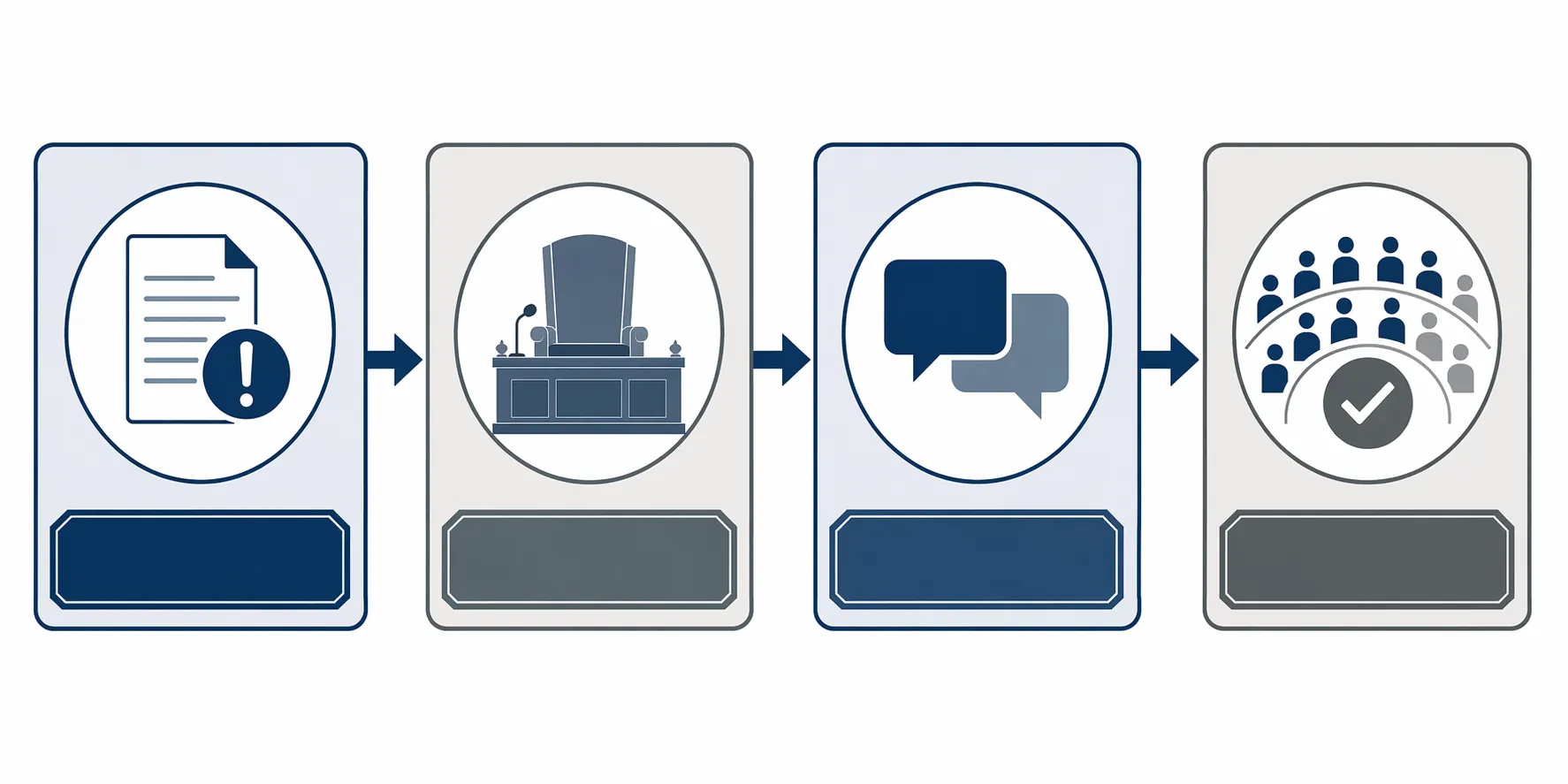
In practical terms, the sequence can be reduced to four steps. A senator raises a point of order asserting that a particular matter should be decided by majority vote or that further debate is not in order. The presiding officer rules on that point. A senator appeals the ruling. A majority then sustains or overturns the chair, establishing a precedent that governs future Senate practice.
That last step is why the device matters to counsel. The Senate may leave Rule XXII’s words formally intact while creating an exception that is functionally decisive for a class of measures. A compliance team reading only the standing rule can miss the live risk if it fails to track precedent. Conversely, a team reading only political commentary can overstate the risk if it assumes the mere existence of the device means the votes exist to use it.
The modern Senate is already exception-riddled. Brookings’ Molly Reynolds has counted more than 160 exceptions to the filibuster created since 1969. [5] The Brennan Center reports that more than half of all 2,500-plus cloture votes since 1917 occurred in just the last 12 years. [6] Those figures do not prove that full legislative abolition is imminent. They do show why “the filibuster still exists” is too blunt a sentence for a legal-risk memo.
The recent record also matters more than nostalgia about the Senate’s older norms. The nuclear-option page compiled with Senate source citations identifies three 2025 deployments: Congressional Review Act resolutions, the budget baseline for the OBBBA, and en bloc nominations. [7] Three uses in one year do not equal inevitable repeal of the legislative filibuster. They do make it hard to argue that the mechanism is theoretical.
The current arithmetic cuts against immediate abolition
The Senate’s present arithmetic is the reason Fetterman’s reversal matters. Republicans hold 53 seats, and Thune has publicly said his conference lacks the votes to end the filibuster despite Trump’s push. [4] If all Republicans supported a bill under the ordinary 60-vote cloture rule, they would still need seven additional votes. If instead Republicans tried to use the nuclear option to establish a majority-vote path, the relevant question would become how many Republicans refuse to go along.
That distinction should be explicit in client advisories. Seven votes is the ordinary cloture problem. A nuclear-option attempt is a majority-coalition problem. In a 53-seat Republican Senate, a small group of Republican defectors can be enough to stop a majority-precedent move if Democrats remain opposed. The exact parliamentary posture can matter, including whether a tie-breaking route is available, but the risk point is simpler: Thune is not describing a chamber where the votes are already banked.
Fetterman’s reversal therefore does not hand Democrats a new tool. It makes a future Democratic-led carve-out harder to model and makes it easier for Republican institutionalists to say that filibuster preservation is not merely partisan obstruction. A Republican senator resisting Trump can now point to a Democratic senator’s own warning that a 51-vote Senate could pass legislation Fetterman himself finds alarming. That is political cover, not law, but political cover is often what keeps the lawmaking machinery from being activated.
The result is a modest reduction in immediate Republican abolition risk, not a guarantee. Trump’s pressure could intensify, the issue vehicle could change, or a narrower carve-out could attract senators who would not support full repeal. The Senate has already shown that targeted exceptions are easier to sell than general abolition. That is why the advisory category should remain “low probability, high impact,” not “closed.”
Do not flatten Fetterman’s ambiguity
Fetterman’s op-ed is clearest on one point: he now opposes eliminating the legislative filibuster. It is less tidy on carve-outs. His criticism of Democratic “pearl-clutching” over Republican threats leaves room to argue that he might tolerate, or at least not reflexively oppose, a narrower government-funding exception. [1] That ambiguity matters because the Senate rarely erodes procedure in the abstract. It erodes procedure around a vehicle.
A full legislative-filibuster repeal, a voting-rights carve-out, a nominations precedent, a budget-process move, and a government-funding exception are different procedural events. They should not be assigned the same probability simply because they all involve majority pressure against extended debate. Fetterman’s reversal most clearly lowers the probability of a broad Democratic-led abolition effort. It does less work against a carefully framed exception that he has not squarely ruled out.
That is also why political labels are a poor substitute for first-party text. Whether Fetterman is becoming more moderate, more contrarian, or more unpredictable is less useful than the narrower proposition he has put into the record. For a risk memo, the sentence that matters is not a character assessment. It is whether he can be counted for a particular parliamentary move.
How to write the client-risk sentence now
The safer advisory language is procedural and conditional. Major statutory changes touching voting rules, abortion, LGBT rights, and birthright citizenship remain constrained by the legislative filibuster unless 60-vote cloture is available or a Senate majority creates a new exception. Fetterman’s reversal reduces the likelihood of a future Democratic simple-majority path and modestly reduces the immediate likelihood of a Trump-backed Republican abolition effort, given Thune’s public vote-count problem. [1][4]
That sentence avoids two common errors. It does not say the filibuster is safe; the nuclear-option architecture is tested, and the Senate has repeatedly narrowed filibuster practice through exceptions. It does not say the filibuster is dead; the current coalition for full legislative abolition is not visible on the record now available.
For monitoring purposes, the trigger list should be concrete: new first-party statements from Fetterman or other potential swing senators, Thune whip-count changes, a point of order tied to a specific bill or funding deadline, and any effort to frame a narrow exception as distinct from full abolition. Until one of those triggers appears, Fetterman’s reversal should be treated as a vote-count change with legal-risk consequences, not as a Senate rules event.
References
- OPINION: Why I changed my mind about the filibuster — Office of Senator John Fetterman.
- About Filibusters and Cloture — U.S. Senate.
- Changing Senate Rules: The 'Constitutional' or 'Nuclear' Option - CRS RL32684 — Congressional Research Service, 2005.
- Trump intensifies push for GOP senators to end filibuster — The Hill.
- The Filibuster Explained — Brookings.
- The Filibuster Explained — Brennan Center.
- Nuclear option — Wikipedia.
Operationalizing workflow
No workflow has been explicitly linked to this obligation yet. See Workflows generally.
Illustrative cases
No illustrative case is currently tracked for this obligation. See Risk Digest for documented incidents generally.
← Back to RegulationReport a correction or tip
Spotted an outdated figure, a misstated fact, or a ruling this regulation entry should reflect? Public comments are disabled for this content given the professional cost of a misreported case outcome, penalty amount, or rule text — use the structured correction channel instead.
Report a correction or tip for this record →