
Fidelity bitcoin ETF outflows put SEC duties to the test
- Authority
- U.S. Securities and Exchange Commission
- Rule type
- regulation
- Jurisdiction scope
- US federal
- Source text
- Read primary rule text ↗
Regulation & Ethics record. This article is for legal and compliance information only; it is not legal, investment, or trading advice. Last verified: July 31, 2026, 00:00 UTC.
The practical question behind the 2026 Fidelity bitcoin ETF outflows is narrow: did sustained FBTC-led outflows create a new SEC obligation for issuers, broker-dealers, or advisers? On the primary-source record available here, no. None of the SEC materials discussed below is an SEC response to the 2026 FBTC outflow episodes, and none makes an agency finding about those flows. The exercise is instead a duty map: existing SEC actions already identify the disclosures, mechanics, custody conditions, and recommendation standards that an outflow period would cause compliance staff to review.
Source discipline matters. The SEC actions are primary obligation sources. The 2026 flow figures are as-reported market data or analyst interpretation, not SEC data. That distinction is not cosmetic; it controls whether a compliance memo can say “the SEC requires” or only “this market event may test an existing requirement.”

What legally changed before the 2026 outflows
The starting point remains the SEC’s January 10, 2024 approval posture for spot bitcoin exchange-traded products. Chair Gary Gensler’s statement described the Commission’s action as limited to exchange rule filings for spot bitcoin ETP shares, noted that the Commission had previously disapproved more than 20 such filings, and distinguished bitcoin as a non-security commodity from many other crypto assets. The same statement also reminded intermediaries that broker-dealer recommendations of bitcoin ETP shares remain subject to Regulation Best Interest and adviser recommendations remain subject to the Advisers Act fiduciary duty.[1]
That point is easy to lose when outflow charts dominate the discussion. The approval did not convert bitcoin exposure into an obligation-free product class. It allowed listed trading of spot bitcoin ETP shares under a particular exchange-rule framework while leaving distribution conduct, disclosures, custody controls, and adviser obligations to be tested through the ordinary securities-law channels.
The more detailed outflow-relevant framework arrived later. Between July 2025 and March 2026, SEC staff and the Commission addressed crypto ETP disclosure, in-kind creation and redemption, broker-dealer custody treatment, and crypto-asset classification. Those materials did not wait for a single sponsor’s redemptions to spike; they already described the places where stress would matter.
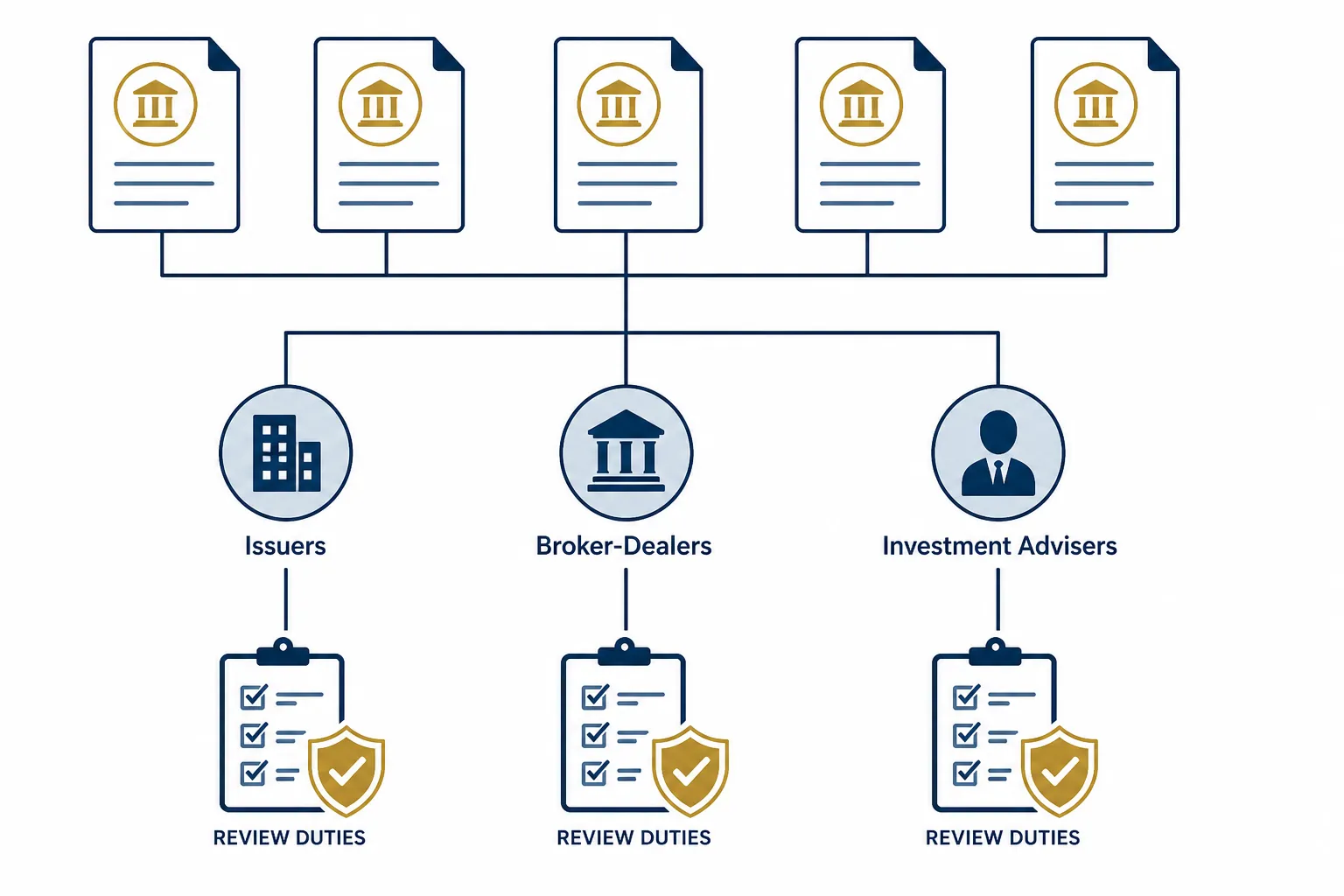
The SEC duty map counsel should start with
| Primary SEC source | Main actor | Outflow-relevant obligation or clarification | Compliance review during outflows |
|---|---|---|---|
| Jan. 10, 2024 spot-bitcoin approval statement | Broker-dealers, investment advisers, exchanges, product sponsors | Approval was limited; Reg BI and Advisers Act fiduciary duties still apply to recommendations of bitcoin ETP shares.[1] | Check whether recommendations, rollover discussions, model allocations, or hold/sell advice were reviewed under the same standards applied to other securities products. |
| Jul. 1, 2025 Division of Corporation Finance disclosure statement | Crypto ETP issuers and registrants | Disclosure should address fee competition, AP and counterparty risks, NAV methodology, creation/redemption mechanics, onchain versus offchain settlement, suspension terms, shareholder notice, and material plan-of-distribution changes.[2] | Check whether the registration statement and updates still describe how redemptions work under stressed flow, and whether a post-effective amendment is required. |
| Jul. 29, 2025 in-kind creation/redemption orders | Crypto ETP issuers, exchanges, authorized participants | The Commission permitted in-kind creations and redemptions for crypto ETPs, moving beyond the original cash-only regime.[3] | Check whether redemption disclosures, operational procedures, and AP agreements reflect the mechanics actually used. |
| Dec. 17, 2025 Trading and Markets custody statement | Broker-dealers holding crypto asset securities | The statement identified conditions for a broker-dealer to deem itself in physical possession or control of crypto asset securities under Rule 15c3-3(b)(1), including DLT assessment and private-key protection.[4] | Check custody treatment only where crypto asset securities, not merely bitcoin ETP shares held through ordinary securities custody channels, are in scope. |
| Mar. 17, 2026 SEC/CFTC classification interpretation | Market participants assessing federal securities-law coverage | The agencies clarified taxonomy and classification concepts; the release did not erase Securities Act, Exchange Act, Reg BI, or Advisers Act duties tied to ETP shares.[5] | Check whether anyone is using classification language to overstate deregulation of listed ETP shares or intermediary conduct. |
Issuer disclosures: the July 2025 Corp Fin statement carries most of the weight
For issuers, the Division of Corporation Finance’s July 1, 2025 statement is the first document to pull during an outflow review. It says crypto asset ETPs are not registered under the Investment Company Act of 1940, so the relevant disclosure obligations arise through Securities Act and Exchange Act registration and reporting, not the 1940 Act framework investors may associate with mutual funds or many ETFs.[2]
That distinction affects both drafting and supervision. A bitcoin ETP issuer cannot answer redemption stress by pointing vaguely to “ETF rules” if the product’s operative obligations are in its Securities Act registration statement, Exchange Act reporting, exchange listing requirements, and related disclosure controls. Counsel’s review starts with what the issuer said about the product it actually registered.
The statement’s risk-factor guidance is directly relevant to FBTC-led outflow scenarios because it calls for disclosure about competing products with lower fees and about authorized participant and counterparty risks.[2] Fee competition does not become a securities-law breach merely because assets move from one product to another. But if an issuer’s risk factors treat competing lower-fee products as theoretical when market flows show fee-sensitive switching pressure, disclosure counsel has a concrete item to test.
The same is true for authorized participants. In a redemption wave, the AP is not background plumbing. It is one of the named actors whose availability, concentration, conflicts, and operational capacity may determine whether creations and redemptions work as disclosed. Corp Fin’s statement makes those AP and counterparty risks part of the issuer-side disclosure set, so a compliance review should ask whether the issuer’s filings describe dependence on APs with enough specificity for the product’s actual redemption design.[2]
NAV methodology is another outflow pressure point. The July 2025 statement calls for disclosure about how NAV is calculated, including pricing sources and methodology.[2] Sustained redemptions do not by themselves prove NAV weakness. They do, however, increase the importance of documenting that calculation inputs, timing conventions, fair-value procedures where relevant, and any extraordinary pricing judgments match the registered methodology. The person signing off should be able to show the calculation path without relying on a market-commentary explanation after the fact.
Corp Fin also places creation and redemption mechanics where they belong: in plan-of-distribution disclosure. The statement identifies disclosure about creation and redemption mechanics, including whether settlement occurs onchain or offchain, and it addresses terms for suspending creations or redemptions and shareholder notification.[2] During a sustained outflow period, those provisions become operationally testable. Who can redeem? In what basket or cash form? Through which settlement path? Under what conditions may the issuer suspend or delay? What notice is given, and to whom?
The post-effective amendment point is particularly easy to underweight. Corp Fin stated that, for shelf registration statements on Form S-3 or Form F-3, material changes to plan-of-distribution information may require a post-effective amendment under Rule 415.[2] If an issuer changes how creation or redemption mechanics actually operate, the review cannot stop at a website FAQ, AP operations note, or trading-desk message. The question is whether the change is material plan-of-distribution information that must be brought back into the registration statement.
In-kind orders changed the mechanics of what an outflow redeems
On July 29, 2025, the SEC permitted in-kind creations and redemptions for crypto ETPs. The Commission’s release described the action as permitting authorized participants to create and redeem shares directly with the underlying crypto assets, rather than being limited to the earlier cash-only process.[3]
For outflow analysis, that change matters more than the headline suggests. A cash-only redemption process and an in-kind process allocate liquidity, execution, timing, custody movement, and tax or operational frictions differently. A market article may say “outflows” as if every dollar leaves through the same pipe. A compliance file should identify the actual pipe used by the product at the relevant time.
The practical issuer questions follow from that mechanics shift: whether offering documents describe the in-kind process; whether AP agreements and operational procedures are consistent with those documents; whether settlement is onchain or offchain as disclosed; whether any cash substitutions are permitted; and whether creation or redemption suspensions are governed by disclosed terms rather than ad hoc market-stress judgment. Those are not new duties created by an FBTC outflow streak. They are the consequences of the July 2025 approval framework being used in a heavier redemption environment.
Custody: do not stretch the Rule 15c3-3 statement beyond its actor and asset
The Division of Trading and Markets’ December 17, 2025 custody statement is narrower than many secondary summaries make it sound. It addresses conditions under which a broker-dealer may deem itself to have physical possession or control of crypto asset securities under Rule 15c3-3(b)(1). The conditions include, among other things, assessment of the relevant distributed ledger technology and controls for protecting private keys.[4]
That statement should not be turned into a blanket custody rule for every broker-dealer that customers trade bitcoin ETP shares through. Listed ETP shares held in ordinary securities accounts raise familiar customer-protection, books-and-records, and supervision questions. The December 2025 statement becomes more directly relevant where the broker-dealer itself is holding crypto asset securities in a manner that depends on private-key control and DLT access. The actor and the asset matter.
Where the statement does apply, outflows can put pressure on the evidence file. If redemption mechanics, AP activity, or related services require movement or control of crypto asset securities by a broker-dealer, the firm should be able to show how it assessed the DLT, how private keys are generated and protected, who can authorize transactions, what happens during a key compromise or fork event, and how those controls support the firm’s Rule 15c3-3 position. Market stress does not lower the documentation burden.
Classification guidance clarifies the perimeter; it does not retire product duties
The March 17, 2026 SEC/CFTC interpretation addressed classification and taxonomy for crypto assets, including the distinction between an asset itself and transactions or arrangements that may implicate the federal securities laws.[5] Chair Paul Atkins later framed the 2026 regulatory agenda around a view that most crypto assets are not themselves securities, while describing a broader effort to clarify the treatment of crypto market activity.[6]
That jurisdictional framing is important, but it is not a safe word that makes ETP-share obligations disappear. Spot bitcoin ETP shares are securities products offered and traded through regulated channels. Issuer registration disclosures, exchange listing conditions, broker-dealer recommendation standards, and adviser fiduciary obligations still have to be analyzed on their own terms. If a market note says classification guidance “changes the implications” of outflows, the next sentence should identify which duty changed. If it cannot, counsel should not treat the statement as an obligation update.
The 2026 FBTC-led outflow record, used as market context only
The reported outflow sequence is substantial enough to test the framework, even though it is not itself a regulatory source. MetaMask Alpha reported a 13-day streak of net outflows from May 15 through June 3, 2026, totaling about $4.4 billion, with FBTC showing $54.26 million of outflows on the final day of that streak. Because that source was served as an auto-translated secondary aggregator in the research record, the figure should be treated as market reporting to verify against stronger flow tables before it is used in a legal filing or board packet.[7]
TradingNEWS, published through Investing.com UK, described an approximately $3.4 billion weekly outflow in early June 2026 as a record weekly bleed for the category, and reported category AUM falling from about $104.29 billion on May 15 to about $82.83 billion on June 3. The same article attributed about 35% of outflows to GBTC while reporting that GBTC represented under 15% of category AUM, and characterized the episode as more cyclical than structural. Those fee-attribution and cycle-structure points are analyst interpretation, not SEC conclusions.[8]
Galaxy Research separately reported May 27, 2026 as a particularly severe outflow day, with bitcoin ETFs posting $723.5 million in net outflows.[9] CoinDesk then reported a July 2, 2026 reversal: $221.7 million of inflows into U.S. bitcoin ETFs, led by FBTC at $165.96 million, while noting year-to-date net outflows near $5.4 billion as of that date.[10]
Those figures are enough to ask disciplined questions. They are not enough to infer that an issuer’s disclosures were defective, that an AP failed, that a custodian mishandled keys, or that a broker-dealer made unsuitable recommendations. For those claims, the market record is a trigger for review, not the proof.
Where the outflow stress test points
Fee competition and product-comparison disclosures
The clean issuer-side question is not whether a lower-fee competitor caused FBTC outflows or category outflows. The better question is whether the issuer’s risk factors and product-comparison disclosures adequately describe fee competition as a material risk where lower-cost substitutes are available. Corp Fin put competing lower-fee products in the disclosure frame before the 2026 flows occurred.[2]
That does not validate every fee-attribution chart. The TradingNEWS/Investing.com UK point about GBTC’s fee profile and disproportionate outflows is useful as a lead for review, but it remains reported analysis.[8] A disclosure memo should separate three things: actual fee schedules, actual flow data from a reliable table, and any causal claim that fees drove redemptions. Only the first two are likely to be straightforward factual inputs.
NAV calculation under redemption pressure
NAV disclosure becomes more important when redemptions are sustained, particularly for a product whose underlying asset trades continuously and across venues. Corp Fin’s statement points issuers to NAV methodology disclosure, including pricing source and methodology.[2] A review should compare the disclosed methodology to the actual calculation records for the outflow dates, not just to a general pricing policy.
- Identify the pricing sources used for the relevant NAV calculations.
- Confirm whether the timing convention matched the disclosed methodology.
- Document any deviation, backup source, fair-value judgment, or extraordinary review.
- Tie redemption processing records to the NAV used for those transactions.
If the answer is “the market was volatile,” the file is not finished. Volatility explains why the calculation mattered; it does not show that the calculation followed the disclosed method.
Creation and redemption mechanics after the in-kind shift
The July 2025 in-kind orders make the mechanics review unavoidable. During the original cash-only phase, outflow commentary could usually treat redemption pressure as a cash creation/redemption problem. After the SEC permitted in-kind creations and redemptions, counsel has to ask which process the relevant product used, whether the product documents described it, and whether APs and custodians executed it as disclosed.[3]
That review should be dated. A statement about how the product handles redemptions in July 2026 may not answer how it handled them in May 2026 if procedures changed, AP arrangements changed, or cash substitutions were used. If the change touched material plan-of-distribution information, Corp Fin’s Rule 415 post-effective amendment point is the item to test.[2]
Authorized participant and counterparty functioning
Outflow periods expose whether AP risk disclosure is generic boilerplate or actually describes the product’s dependence on a small group of firms. Corp Fin specifically identified AP and counterparty risks as part of the crypto ETP disclosure set.[2] A compliance review should identify the APs active during the outflow dates, any AP concentration, whether any AP declined or delayed activity, and whether the issuer’s documents described the consequences of limited AP participation.
The review should also avoid importing facts from another sponsor’s product. A category-level outflow chart does not show that FBTC’s APs, GBTC’s APs, or IBIT’s APs behaved the same way. Product-level mechanics matter because the disclosure obligation is product-level.
Suspension terms and shareholder notification
Suspension language is often read only when something has already gone wrong. Corp Fin’s July 2025 statement made suspension terms and shareholder notification part of the expected disclosure around creation and redemption mechanics.[2] That means counsel should not wait for a suspension to ask whether the triggers are clear, whether notice recipients are identified, and whether the communications procedure is ready.
The FBTC-led streak did not, on the materials reviewed here, establish any suspension. The point is more modest: sustained outflows are the kind of condition under which suspension provisions stop being theoretical, so the provisions should be checked before anyone needs them.
Custody and private-key procedures, only where the custody statement applies
The December 2025 Trading and Markets statement gives broker-dealers a specific Rule 15c3-3 custody path for crypto asset securities, with conditions that include DLT assessment and private-key protection.[4] It does not turn every FBTC outflow into a private-key incident. A broker-dealer that only carries customer positions in listed ETP shares will usually analyze a different custody record from a broker-dealer directly controlling crypto asset securities.
Where the statement is in scope, the outflow period is a useful sample window. The firm should preserve transaction approvals, key-access logs, DLT monitoring records, incident escalations, and reconciliations that show control was maintained during heavier creation or redemption activity. If the product’s stress period never touched the firm’s crypto asset securities custody function, the memo should say that rather than stretch the source.
Broker-dealer and adviser conduct: recommendations do not get a crypto exception
Gensler’s January 2024 statement was explicit on the intermediary point: broker-dealers recommending bitcoin ETP shares are subject to Regulation Best Interest, and investment advisers recommending them are subject to the Advisers Act fiduciary duty.[1] That reminder matters more during outflow periods because customers and clients may be asking whether to buy the dip, hold a concentrated position, sell after losses, or rotate into a cheaper competing product.
For broker-dealers, the review is not “was FBTC down?” or “were outflows large?” It is whether the recommendation process captured the customer’s investment profile, costs, risks, alternatives, conflicts, and basis for the recommendation at the time it was made. If a representative recommended switching from one bitcoin ETP to another because of fees, the file should show the comparative cost analysis and any other material differences. If the recommendation was to hold despite sustained outflows, the file should show why that was in the customer’s best interest under the firm’s process.
For advisers, the same outflow facts feed a fiduciary review rather than a market-timing debate. Advisers should be able to explain why an allocation remained suitable for the client’s objectives, risk tolerance, liquidity needs, tax position, and portfolio construction; how the adviser evaluated competing products and fees; and how any conflicts were disclosed and managed. The Advisers Act question is not answered by saying that the SEC approved spot bitcoin ETPs in 2024. Approval to trade the product did not approve every later recommendation of it.
Model portfolios and platform lists deserve their own attention. A broker-dealer or adviser that placed bitcoin ETP shares into a model, kept a product on an approved list, or changed exposure during the May-June outflow window should be able to identify who reviewed the product, what flow and liquidity information they used, how costs were compared, and whether clients or representatives received updated guidance. The July 2 reversal reported by CoinDesk does not retroactively validate advice given during the outflow streak.[10]
How to write the Monday-morning compliance answer
A usable answer should begin with the negative premise: no SEC action reviewed here responds directly to FBTC’s 2026 outflows. Then it should map each asserted implication to a named source. If the issue is issuer disclosure, start with the July 1, 2025 Corp Fin statement. If the issue is redemption process, add the July 29, 2025 in-kind orders. If the issue is broker-dealer custody of crypto asset securities, use the December 17, 2025 Trading and Markets statement and confirm the asset and actor are actually in scope. If the issue is customer or client recommendations, return to Reg BI and the Advisers Act reminder in the January 2024 approval statement. If the issue is classification, use the March 2026 SEC/CFTC interpretation without allowing classification shorthand to swallow listed-product obligations.
- Do not cite market outflow reports as SEC findings.
- Do not treat category-level AUM movement as proof of a product-level disclosure failure.
- Do not convert analyst fee-attribution into causation unless stronger evidence supports it.
- Do not use “most crypto assets are not securities” language to bypass duties attached to ETP shares, broker-dealer recommendations, adviser conduct, or registered offering documents.
The better formulation is restrained: the 2025-26 SEC framework anticipated the stress points that the 2026 FBTC-led outflows exposed. The outflows test fee-risk disclosure, NAV calculation, creation and redemption mechanics, AP and counterparty dependence, suspension and notice terms, custody controls where applicable, and recommendation conduct. They do not, by themselves, announce a new SEC rule or finding.
That is where legal review should stop until the next primary source appears: identify the actor, identify the duty, identify the SEC text, and keep the market chart in its proper lane.
References
- Statement on the Approval of Spot Bitcoin Exchange-Traded Products, U.S. Securities and Exchange Commission, Jan. 10, 2024.
- Staff Statement on Disclosure for Crypto Asset Exchange-Traded Products, U.S. Securities and Exchange Commission Division of Corporation Finance, July 1, 2025.
- SEC Permits In-Kind Creations and Redemptions for Crypto ETPs, U.S. Securities and Exchange Commission, July 29, 2025.
- Statement on Custody of Crypto Asset Securities by Broker-Dealers, U.S. Securities and Exchange Commission Division of Trading and Markets, Dec. 17, 2025.
- SEC Clarifies Application of Federal Securities Laws to Crypto Assets, U.S. Securities and Exchange Commission, Mar. 17, 2026.
- Statement on 2026 Regulatory Agenda, U.S. Securities and Exchange Commission, July 7, 2026.
- Bitcoin ETF Outflows: 13-Day Streak Market Structure, MetaMask Alpha, June 5, 2026.
- Bitcoin's $3.4 Billion ETF Bleed Looks More Cyclical Than Structural, TradingNEWS via Investing.com UK, June 3, 2026.
- Weekly Top Stories 05/29/26: BTC ETF Outflows, Polymarket Insider Trading & Pope Encyclical Crypto, Galaxy Research, May 29, 2026.
- Finally, $221 Million Flow Into Bitcoin ETFs Ending a Painful 10-Day Outflow Streak, CoinDesk, July 3, 2026.
Operationalizing workflow
No workflow has been explicitly linked to this obligation yet. See Workflows generally.
Illustrative cases
No illustrative case is currently tracked for this obligation. See Risk Digest for documented incidents generally.
← Back to RegulationReport a correction or tip
Spotted an outdated figure, a misstated fact, or a ruling this regulation entry should reflect? Public comments are disabled for this content given the professional cost of a misreported case outcome, penalty amount, or rule text — use the structured correction channel instead.
Report a correction or tip for this record →