
Federal Appeals Court Vacates 2026 Immigration Detention Ruling
- Authority
- U.S. Court of Appeals for the Fifth Circuit
- Rule type
- standing order
- Jurisdiction scope
- US federal
- Effective date
- Jul 14, 2026
- Source text
- Read primary rule text ↗
Mandatory detention without bond hearing in Fifth Circuit
As of July 27, 2026, the Fifth Circuit’s July 2 panel decision in Sosnava Rodriguez v. Ortega is not binding law. The court granted rehearing en banc on July 10, the panel opinion was vacated on July 14, and the earlier February 2026 decision in Buenrostro-Mendez v. Bondi is back in force as controlling Fifth Circuit precedent. For current Fifth Circuit immigration-detention filings in Texas, Louisiana, and Mississippi, mandatory detention without a bond hearing remains the default, while the full court prepares to hear the case in September 2026.[1][2][3][4]
Last verified: July 27, 2026, UTC. This article is a procedural tracker and practice-risk analysis, not legal advice. Anyone filing in this window should verify the Fifth Circuit docket again before relying on any description of the posture.
The primary materials to keep open are the Sosnava Rodriguez panel opinion, the July 10 en banc order, the July 14 vacatur confirmation, and Buenrostro-Mendez. News coverage helps explain the stakes, but the filing question begins with those orders and opinions.
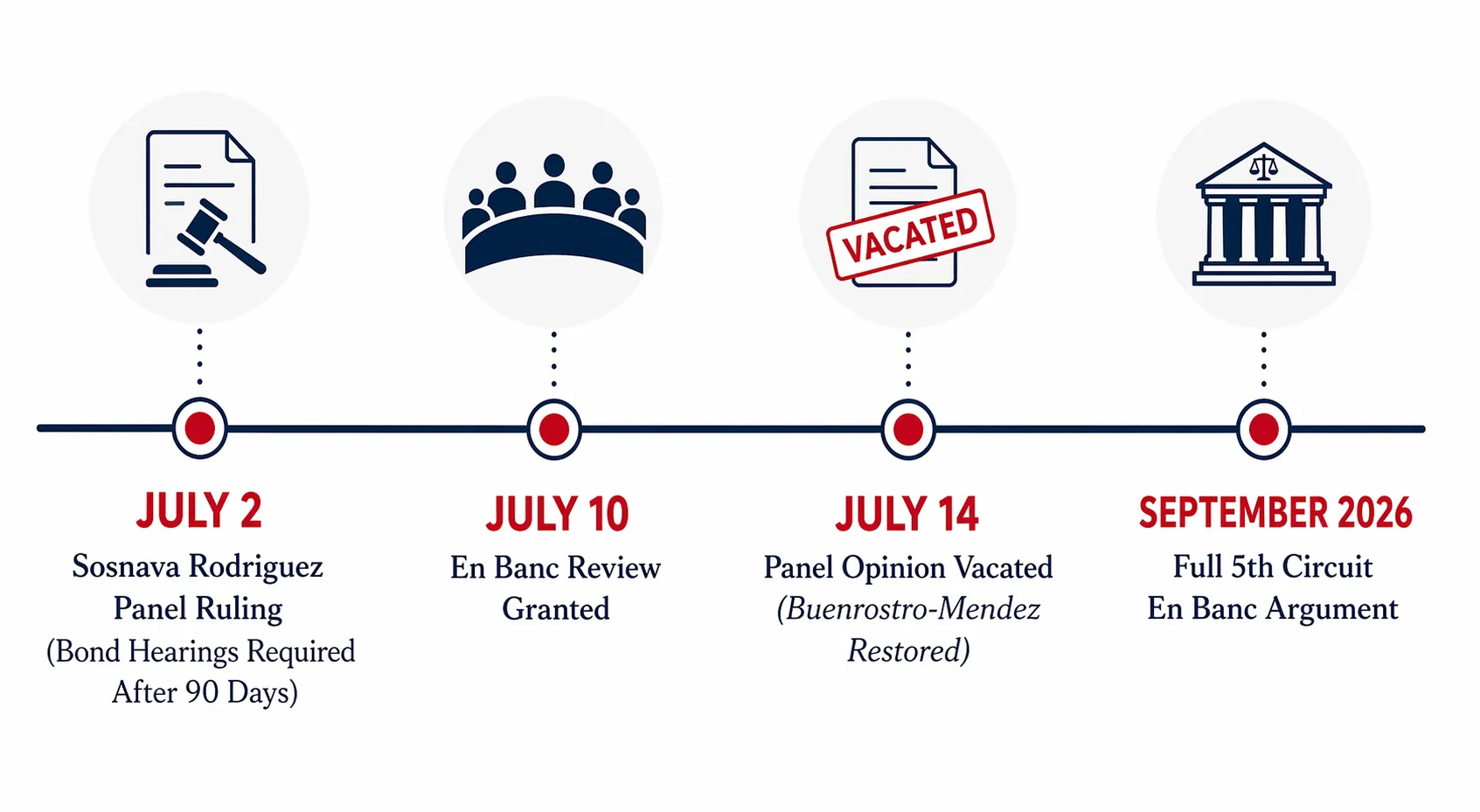
What changed between July 2 and July 14
On July 2, a Fifth Circuit panel held, 2-1, that ICE could not continue detaining covered individuals beyond 90 days without providing a bond hearing. For roughly eight days, that ruling appeared to give detained noncitizens in the Fifth Circuit a sharply different procedural argument: if detention passed the 90-day mark, counsel could point to a published circuit decision requiring a hearing rather than asking a district judge to extend constitutional doctrine on a case-by-case basis.[1]
That window closed quickly. On July 10, the Fifth Circuit granted en banc review, moving the case from the panel to the full court.[2] On July 14, the panel opinion was vacated.[3] Once vacated, the July 2 opinion no longer supplied a binding rule for district courts in the circuit. A lawyer can still read it, quote its reasoning, and preserve the argument it accepted. A lawyer should not describe it as controlling authority.
The consequence is not procedural housekeeping. It determines who remains detained while the lawyers fight about the scope of due process. With the panel opinion vacated, Buenrostro-Mendez again occupies the controlling position in the Fifth Circuit. That February 2026 published opinion upheld mandatory detention and is the decision district courts must treat as binding unless and until the en banc court changes the rule.[4]
| Date | Event | Practical effect |
|---|---|---|
| July 2, 2026 | Panel decision in Sosnava Rodriguez | Panel held that ICE could not detain covered individuals past 90 days without a bond hearing. |
| July 10, 2026 | En banc review granted | The case moved to the full Fifth Circuit. |
| July 14, 2026 | Panel opinion vacated | Sosnava Rodriguez ceased to be binding precedent. |
| September 2026 | Full en banc argument expected | The next load-bearing event for the circuit rule. |
Why a vacated opinion still matters, but not the way a live precedent matters
The distinction is not academic. In a district-court emergency filing, the difference between “the Fifth Circuit requires a bond hearing” and “a vacated Fifth Circuit panel opinion adopted this reasoning before rehearing en banc” is the difference between stating the law and overstating it.
A vacated panel opinion may still be useful as advocacy material. It shows that at least some members of the court found the bond-hearing argument legally serious. It can help counsel frame constitutional avoidance, due process, statutory structure, or administrability points. It may also help explain why a district judge should preserve the issue or why the government’s position is not beyond dispute.
But a vacated panel opinion cannot do the work of binding precedent. It does not require a district judge to order a hearing. It does not displace Buenrostro-Mendez. It does not create an enforceable circuit-wide right to a bond hearing after 90 days. If a motion filed today says otherwise, the government has an easy procedural answer before it reaches the merits.
This is especially important because the en banc court is not merely reconsidering a minor remedy. It will decide whether the Fifth Circuit stays with Buenrostro-Mendez or moves toward the bond-hearing approach accepted elsewhere. Reuters reported the en banc grant on July 10, and the full court is expected to hear argument in September 2026.[5] The court has 17 judges, 12 of whom were appointed by Republican presidents, a fact that matters for risk assessment but does not permit a confident prediction of the outcome.[5]
The people behind the posture
The case is not a docket abstraction. NIPNLG identifies the Sosnava Rodriguez petitioners as two Mexican citizens and one Honduran national, represented by the American Immigration Council.[6] Those details matter because immigration detention litigation often moves faster than the lives it controls: one week’s panel victory can become the next week’s vacated authority while the client remains in custody.
Practitioners using public resources from advocacy organizations should separate litigation support from controlling law. A case page can be useful for pleadings, party history, and coordination. It cannot revive a vacated panel decision. The same discipline applies in client counseling: the client should know that a favorable ruling existed, that it has been vacated, and that the en banc proceeding may change the rule again.
What practitioners can responsibly do during the en banc interim
The interim posture is unfavorable, not inert. Counsel in the Fifth Circuit can still seek bond hearings, but the theory should be drafted with the current hierarchy of authority in mind. Buenrostro-Mendez is binding. Sosnava Rodriguez is vacated. The en banc case is pending. District judges may react differently to that combination, particularly where detention has become prolonged, the record is sympathetic, or the government has conceded hearings in comparable cases.
- State the controlling rule first. If filing in Texas, Louisiana, or Mississippi, acknowledge that Buenrostro-Mendez currently controls.
- Use Sosnava Rodriguez carefully. Cite it, if at all, as vacated persuasive reasoning and as evidence of a live en banc dispute, not as binding law.
- Preserve constitutional and statutory arguments. The en banc court may accept, narrow, reject, or reframe the July 2 panel’s reasoning.
- Ask for alternative relief. If a court will not order release or a bond hearing outright, counsel may still seek expedited review, status reporting, or a record-preserving order.
- Verify local developments. District-level outcomes may move faster than published appellate doctrine during the rehearing window.
The government’s concession pattern deserves attention, but it has to be described accurately. The research record indicates that DOJ has conceded bond hearings in more than 200 cases nationwide rather than litigating them through decision.[5] That may give practitioners leverage in individual negotiations and may support an argument that a requested hearing is administrable. It is not precedent. It does not bind the next Assistant U.S. Attorney, the next district judge, or the en banc court.
That practical leverage can still matter. A detained client does not experience “nonprecedential” as meaningless if a concession results in a hearing. But a risk memorandum or emergency motion should not convert a recurring government choice into a rule of law. A concession is a litigation event. A published, non-vacated circuit opinion is law.
The national pressure on the Fifth Circuit
The Fifth Circuit is deciding this question against a crowded national habeas backdrop. Politico reported on July 9, 2026, that 464 judges had addressed related immigration habeas matters and that courts had issued more than 15,000 habeas rulings.[7] Those figures do not prove what the Fifth Circuit must do. They do show why the issue is unlikely to remain a local procedural quarrel.
The circuit comparison is important, but it should be used with care. The Second, Sixth, Tenth, and Eleventh Circuits have taken positions that contrast with the Fifth Circuit’s current mandatory-detention default. Al Jazeera’s April 29, 2026 coverage of the Sixth Circuit’s rejection of the policy illustrates that other appellate courts have been unwilling to give the government the same detention authority without bond-process safeguards.[8]
That does not mean the Fifth Circuit is already bound by a national majority. It is not. The Fourth, Ninth, and D.C. Circuits remain unresolved variables in this record, and their eventual rulings could affect the practical shape of any circuit split and the Supreme Court’s appetite for review. For present Fifth Circuit filings, the useful point is narrower: there is appellate support elsewhere for bond-hearing arguments, but it must be presented as persuasive authority outside the circuit unless and until the Fifth Circuit’s en banc court adopts it.
How the September argument should affect advice today
The September en banc argument is the next major event, not a reason to stop filing. For detained clients who have already passed the 90-day point, waiting may mean additional confinement under a rule that is actively being contested. For counsel, the harder task is to preserve the argument without promising relief that the current circuit rule does not provide.
A cautious advice note might say: the Fifth Circuit briefly issued a favorable panel decision requiring bond hearings after 90 days, but that decision has been vacated pending en banc review; the earlier Fifth Circuit decision upholding mandatory detention is currently binding; we can still seek a bond hearing and preserve objections, especially given favorable authority in other circuits and DOJ concessions in some cases, but success is uncertain and may depend on the district judge, the client’s facts, and developments in the en banc proceeding.
For law-firm risk managers and knowledge teams, the immediate task is version control. Any template that says Sosnava Rodriguez “requires” a bond hearing in the Fifth Circuit should be revised. Any template that ignores Sosnava Rodriguez entirely may also be incomplete, because the vacated opinion and pending en banc review remain relevant to preservation, negotiation, and client counseling.
For journalists, the headline discipline is similar. “Fifth Circuit requires bond hearings” was a July 2 snapshot. It is wrong as a July 27 status statement. The accurate formulation is less satisfying and more useful: the Fifth Circuit vacated a 2026 immigration detention ruling that would have required bond hearings after 90 days, restoring mandatory detention as the circuit default while the full court reviews the issue.
The filing posture on July 27
The operative posture is narrow enough to state plainly. Buenrostro-Mendez controls in the Fifth Circuit. Sosnava Rodriguez may shape arguments but no longer supplies binding relief. DOJ concessions may help in individual cases but do not create an enforceable right. The September en banc argument could change the rule, narrow it, or leave the prior precedent intact.
Until then, preserve the bond-hearing argument, cite favorable national developments carefully, distinguish concessions from precedent, and check the docket again before filing.
References
- Sosnava Rodriguez v. Ortega, No. 26-50183, United States Court of Appeals for the Fifth Circuit, July 2, 2026.
- En Banc Order, Sosnava Rodriguez v. Ortega, No. 26-50183, United States Court of Appeals for the Fifth Circuit, July 10, 2026.
- Vacatur Confirmation, Sosnava Rodriguez v. Ortega, No. 26-50183, United States Court of Appeals for the Fifth Circuit, July 14, 2026.
- Buenrostro-Mendez v. Bondi, No. 25-20496, United States Court of Appeals for the Fifth Circuit, February 2026.
- Reuters coverage of the en banc grant in Sosnava Rodriguez v. Ortega, Reuters, July 10, 2026.
- Sosnava Rodriguez v. Ortega case page, National Immigration Project of the National Lawyers Guild.
- Politico article documenting the 464-judge count and 15,000-plus habeas rulings, Politico, July 9, 2026.
- Al Jazeera coverage of the Sixth Circuit’s rejection of the immigration detention policy, Al Jazeera, April 29, 2026.
Operationalizing workflow
No workflow has been explicitly linked to this obligation yet. See Workflows generally.
Illustrative cases
No illustrative case is currently tracked for this obligation. See Risk Digest for documented incidents generally.
← Back to RegulationReport a correction or tip
Spotted an outdated figure, a misstated fact, or a ruling this regulation entry should reflect? Public comments are disabled for this content given the professional cost of a misreported case outcome, penalty amount, or rule text — use the structured correction channel instead.
Report a correction or tip for this record →