
Florida's 2026 Repeat Domestic Violence Penalty Map
- Authority
- Florida Legislature
- Rule type
- statute
- Jurisdiction scope
- US state (Florida)
- Effective date
- Jul 1, 2026
- Source text
- Read primary rule text ↗
Apply § 741.2801 one-degree reclassification and § 784.03(2) repeat-battery escalation, add § 741.283 jail minimums if applicable, and verify enrolled Ch. 2026-86 before filing.
| Record field | Current entry |
|---|---|
| Category | regulation-ethics |
| Jurisdiction | Florida |
| Effective date of 2026 repeat-DV change | July 1, 2026 |
| Last verified | August 2, 2026 |
| Working source note | 2025 statutory text is being read with Ch. 2026-86 / HB 277 materials pending official 2026 statute publication. New § 741.2801 language should be checked against the enrolled HB 277 chapter law before filing or relying on final statutory wording. |
Filed in the Regulation & Ethics record format: the practical question is what happens after July 1, 2026, when the new repeat-domestic-violence reclassification created by Ch. 2026-86 / HB 277 is read beside Florida’s existing repeat-battery felony rule. The chapter-law source and companion bill text are primary-source checkpoints, not substitutes for the official 2026 statute publication when it posts.[1][2]

The short penalty map: two repeat-DV mechanisms, not one
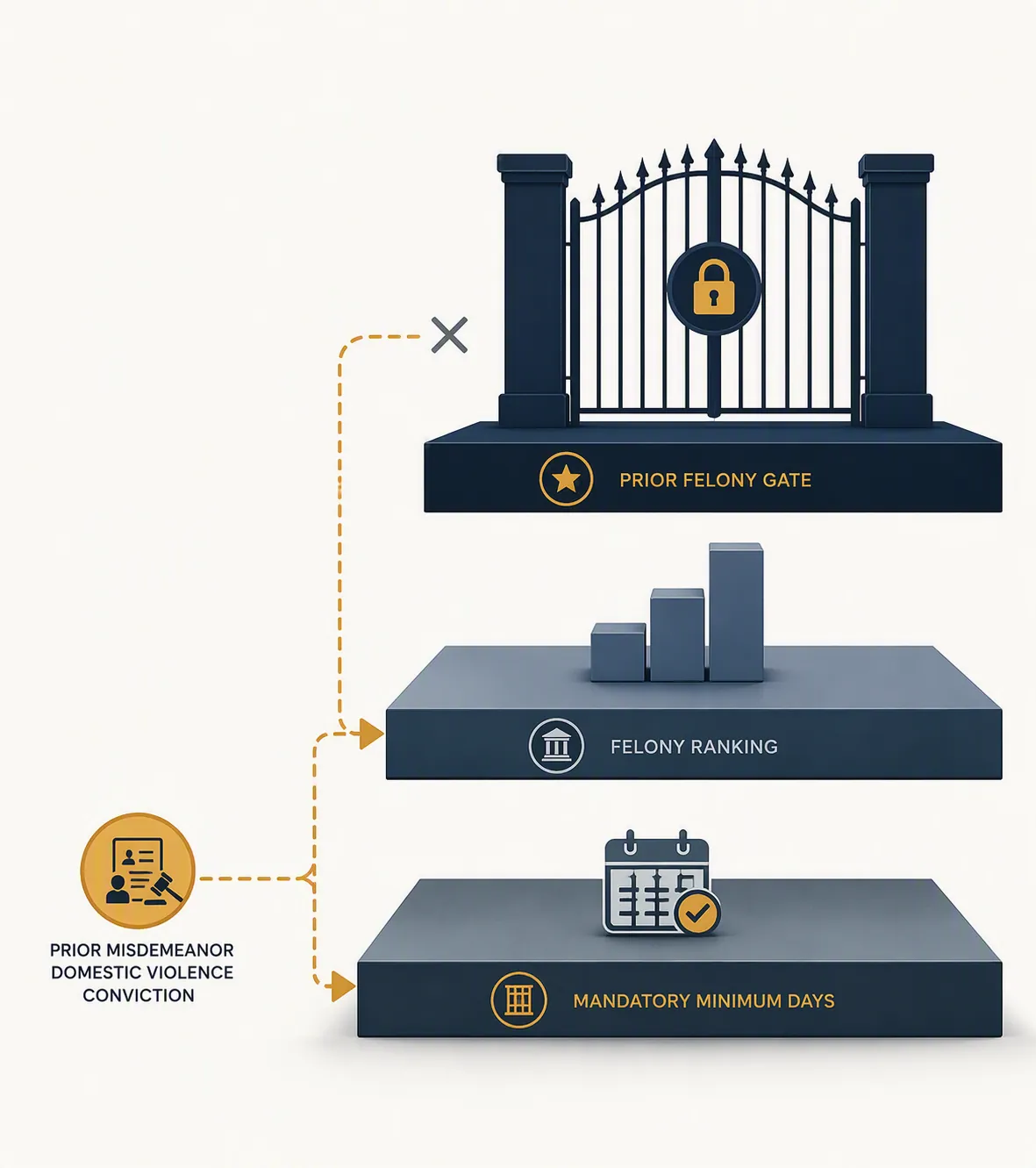
For a defendant with a prior domestic-violence conviction, the first charging screen after July 1, 2026 is not “misdemeanor or habitual offender.” It is whether the current charge fits § 784.03(2), the new § 741.2801, or both. Those statutes do different work.
| Question | § 784.03(2): repeat battery | New § 741.2801: repeat domestic violence |
|---|---|---|
| What current offense starts the analysis? | Battery under § 784.03. | A domestic-violence offense as defined by § 741.28. |
| What prior conviction matters? | One prior conviction for battery, aggravated battery, or felony battery. | One prior conviction for a domestic-violence offense. |
| Does withheld adjudication or a nolo plea count? | Yes. § 784.03(2) treats a qualifying determination of guilt as a conviction even if adjudication was withheld, and includes an accepted nolo contendere plea. | Yes. The new repeat-DV provision uses the same kind of conviction treatment for qualifying prior domestic-violence convictions. |
| What is the escalation? | The second or subsequent battery becomes a third-degree felony. | The current domestic-violence offense is reclassified one degree upward: second-degree misdemeanor to first-degree misdemeanor; first-degree misdemeanor to third-degree felony; third-degree felony to second-degree felony; second-degree felony to first-degree felony; first-degree felony to life felony. |
| What changes? | The battery charge itself becomes a third-degree felony when the statutory prior is present. | The statutory maximum changes through one-degree reclassification. Gain-time and Criminal Punishment Code ranking are computed without regard to the enhancement. |
| Most common trap | Assuming any prior domestic-violence conviction triggers § 784.03(2). It does not unless the prior is within the battery/aggravated-battery/felony-battery category. | Assuming the prior must be a felony. A prior misdemeanor domestic-violence conviction can trigger § 741.2801. |
The existing battery rule remains straightforward but narrow: if the defendant commits battery and has one prior conviction for battery, aggravated battery, or felony battery, § 784.03(2) makes the new battery a third-degree felony; the statute also defines conviction to include qualifying pleas and determinations of guilt even when adjudication is withheld.[3]
The 2026 change is broader by offense family. The companion CS/CS/SB 682 text for new § 741.2801 reclassifies a domestic-violence offense one degree upward when the defendant has a prior domestic-violence conviction, requires the prior-conviction fact to be found beyond a reasonable doubt, and states that gain-time and Criminal Punishment Code ranking are computed without regard to the enhancement.[2] The Florida Senate’s HB 277 summary describes the same repeat-DV reclassification structure and July 1, 2026 effective-date framework.[4]
Run the charge in this order
| Step | Charging or sentencing question | Why the order matters |
|---|---|---|
| 1 | Identify the current offense and whether it is a domestic-violence offense. | The new 2026 reclassification only starts if the current offense is within the domestic-violence category. |
| 2 | Identify the qualifying prior and its exact statutory character. | A prior misdemeanor DV conviction may matter under § 741.2801, while habitual-offender sentencing still requires prior felonies. |
| 3 | Test § 784.03(2) if the current charge is battery. | A battery with a qualifying prior battery-type conviction can already be a third-degree felony before the 2026 DV reclassification is considered. |
| 4 | Test new § 741.2801. | If the current offense is a DV offense and the defendant has a prior DV conviction, the offense moves one degree higher. |
| 5 | Add § 741.283 mandatory jail minimums where applicable. | These are jail floors for qualifying DV cases involving intentional bodily harm, not felony reclassification rules. |
| 6 | Only then consider § 775.084 and § 775.087. | Habitual-offender sentencing is prior-felony driven; 10-20-Life is weapon-triggered. |
That order keeps the two repeat-DV conversations from collapsing into one. A defendant with a prior misdemeanor domestic-violence battery may face a felony charge under the new repeat-DV reclassification, but that same prior misdemeanor does not satisfy the prior-felony requirement for habitual-offender treatment under § 775.084.[2][5]
Where § 784.03(2) and § 741.2801 overlap
The overlap is sharpest in the ordinary repeat domestic battery file. Suppose, hypothetically, the current arrest is for battery against a family or household member, and the prior judgment is also domestic-violence battery. The prosecutor does not have to choose between a “battery prior” lens and a “domestic-violence prior” lens too early. The current charge should be tested under both provisions.
Under § 784.03(2), the prior battery conviction can make the new battery a third-degree felony. Under new § 741.2801, the prior domestic-violence conviction can reclassify the domestic-violence offense one degree upward. If the starting point is a first-degree misdemeanor DV battery, § 741.2801 points to a third-degree felony; if § 784.03(2) independently makes the battery a third-degree felony, the 2026 reclassification question may then require closer attention to what the operative “current offense” is after the battery-specific enhancement is applied.[2][3]
That interaction is where tidy charts usually become unsafe. § 784.03(2) is not made obsolete by § 741.2801. It remains the battery-specific felony rule and can matter even when the prior conviction is not a domestic-violence prior. By contrast, § 741.2801 reaches the domestic-violence offense category and can be triggered by a prior misdemeanor DV conviction that would not be enough for habitual-offender sentencing.
The plea-advisement detail should be stated out loud: for both paths, the prior may count even if adjudication was withheld or the prior plea was nolo contendere. A summary that says only “prior conviction” without that qualification leaves out a consequence that can change the filing and plea conversation.[2][3]
The statutory maximum changes; the CPC ranking does not move with it
New § 741.2801 is a one-degree reclassification rule. It affects the statutory maximum by moving the offense to the next higher degree. But the companion bill text states that gain-time eligibility and Criminal Punishment Code ranking are computed without regard to the enhancement.[2]
That distinction matters most when the current DV offense begins as a first-degree misdemeanor. The 2026 reclassification can move it into third-degree-felony exposure, and the bill summary identifies that reclassified first-degree misdemeanor as ranked in level 1 of the Criminal Punishment Code.[4] The felony label and the CPC score are not the same question.
Mandatory jail floors under § 741.283
After the charging degree is mapped, § 741.283 supplies a separate jail-minimum screen. It applies when a person is adjudicated guilty of a crime of domestic violence and the person intentionally caused bodily harm to another person. Unless the court sentences the defendant to a nonsuspended state-prison sentence, the minimum jail terms are 10 days for a first offense, 15 days for a second offense, and 20 days for a third or subsequent offense.[6]
If the crime of domestic violence occurred in the presence of a child under 16 years old who is a family or household member of the victim or perpetrator, the jail floors increase to 15 days for a first offense, 20 days for a second offense, and 30 days for a third or subsequent offense, again unless a nonsuspended state-prison sentence is imposed.[6]
| § 741.283 condition | First offense | Second offense | Third or subsequent offense |
|---|---|---|---|
| DV adjudication with intentional bodily harm | 10 days | 15 days | 20 days |
| Same conduct in the presence of a child under 16 who is a family or household member of the victim or perpetrator | 15 days | 20 days | 30 days |
Those numbers are jail floors, not the whole sentencing range. They also do not answer whether the charge is a misdemeanor, a third-degree felony, or something higher after § 784.03(2) and § 741.2801 are applied.
Habitual offender and 10-20-Life are later layers
Section 775.084 does not become available merely because the case is a repeat domestic-violence case. The habitual felony offender and related designations depend on prior felony convictions and other statutory conditions. A single prior misdemeanor domestic-violence conviction can escalate a current DV charge under § 741.2801, but it does not by itself supply the prior felony needed for § 775.084 treatment.[5]
Section 775.087 is a different kind of enhancement. The familiar 10-20-Life framework is tied to firearm, destructive-device, and weapon use in specified felony settings; it is not a repeat-domestic-violence statute. A domestic-violence aggravated battery involving a firearm can bring the provisions into the same case, but the trigger is the weapon conduct, not the fact that the defendant has a prior DV conviction.[7]
The domestic-violence category still has to be proved from the record
The 2026 reclassification depends on the domestic-violence category, so the underlying definition matters. Section 741.28 defines domestic violence to include specified offenses such as assault, aggravated assault, battery, aggravated battery, sexual assault, sexual battery, stalking, aggravated stalking, kidnapping, and false imprisonment, as well as any criminal offense resulting in physical injury or death of one family or household member by another family or household member.[8]
The same section defines family or household member to include spouses, former spouses, persons related by blood or marriage, persons presently residing together as if a family or who have resided together in the past as if a family, and persons who are parents of a child in common, with the statutory residence limitation applying except for persons who have a child in common.[8]
The arrest context can explain why a repeat-DV issue appears quickly in the file. Florida’s warrantless-arrest statute allows arrest when the officer has probable cause to believe the person has committed an act of domestic violence or violated certain injunctions, even when the act was not committed in the officer’s presence.[9] That arrest authority does not itself establish the prior conviction or the penalty degree; it just explains why the charging review often begins before the record is tidy.
What changed in 2026, and what is still only a flag
HB 277 passed the Florida House 112-0 and the Senate 37-0, and the session page records approval by the Governor on May 21, 2026.[10] The operational change for this penalty map is the July 1, 2026 repeat-DV one-degree reclassification described in the chapter-law and Senate summary materials.[1][4]
The unsettled items should remain in a separate bucket. First, the enrolled Ch. 2026-86 text should be checked directly against the companion CS/CS/SB 682 language before final wording from new § 741.2801 is quoted in a pleading, memo, or client alert.[1][2] Second, the reported reduction of the § 741.31(4)(c) injunction-violation felony threshold from two prior convictions to one must be verified against the enrolled law and official 2026 statutes before being treated as operative text.[1][11]
Third, the House floor amendment numbers identified in the legislative materials—332751, 280643, and 827019—should not be treated as reflected in the companion CS/CS/SB 682 c2 text unless the enrolled HB 277 chapter law confirms the relevant wording.[1][2][10] Fourth, SB 436’s reported expansion of § 784.03(2) prior offenses, including a reported addition of resisting an officer with violence, remains reported but unverified on this record because no chapter number was located in the materials reviewed for this update.
No facial or as-applied challenge to new § 741.2801 was located in the sources reviewed as of August 2026. That is not a merits prediction. It is only a verification note for readers maintaining a 2026 obligations tracker.
Bounded answer for a July 2026 repeat-DV file
As of July 1, 2026, Florida repeat domestic violence penalties are not determined by one statute. Section 784.03(2) remains the repeat-battery felony rule. New § 741.2801 adds a one-degree reclassification for domestic-violence offenses with a prior domestic-violence conviction. Section 741.283 may add mandatory jail floors. Section 775.084 may layer on only when its prior-felony requirements are met, and § 775.087 is weapon-triggered rather than repeat-DV-triggered.
Use the map for issue-spotting, then verify the enrolled law and the official 2026 statutes before filing. Treat reported bill changes and companion-text differences as flags until primary text confirms them.
References
- Chapter 2026-86, Laws of Florida, Laws of Florida, 2026.
- CS/CS/SB 682 Bill Text: c2, Florida Senate, 2026.
- Section 784.03, Florida Statutes (2025), Online Sunshine.
- CS/CS/HB 277 — Domestic Violence, Florida Senate, 2026.
- Section 775.084, Florida Statutes (2025), Florida Senate.
- Section 741.283, Florida Statutes (2025), Online Sunshine.
- Section 775.087, Florida Statutes (2025), Florida Senate.
- Section 741.28, Florida Statutes (2025), Online Sunshine.
- Section 901.15, Florida Statutes (2025), Online Sunshine.
- HB 277: Domestic Violence, Florida Senate, 2026.
- Section 741.31, Florida Statutes (2025), Online Sunshine.
Operationalizing workflow
No workflow has been explicitly linked to this obligation yet. See Workflows generally.
Illustrative cases
No illustrative case is currently tracked for this obligation. See Risk Digest for documented incidents generally.
← Back to RegulationReport a correction or tip
Spotted an outdated figure, a misstated fact, or a ruling this regulation entry should reflect? Public comments are disabled for this content given the professional cost of a misreported case outcome, penalty amount, or rule text — use the structured correction channel instead.
Report a correction or tip for this record →