
Ford CEO Right-to-Repair Stance Creates Legal Risk
- Authority
- U.S. Congress
- Rule type
- statute
- Jurisdiction scope
- US federal
- Source text
- Read primary rule text ↗
Warranty coverage cannot be conditioned on use of authorized dealers unless service is free or FTC waiver obtained.
Jim Farley’s June 2026 right-to-repair comments matter less for their tone than for their sorting rule. As reported through secondary accounts of a Detroit Free Press interview, the Ford CEO drew a line between non-warranty DIY work and warranty work: owners repairing outside warranty were reportedly “fine,” but “not for warranty work.” Car and Driver’s account places the comments in the same week as a right-to-repair fight involving Ford, GM, Penske, Congress, and the White House.[1] That distinction is the legal sentence, not the headline.
The direct Detroit Free Press interview is being reached here through consistent secondary reporting rather than through a fully accessible primary transcript. That sourcing caveat matters. So does the legal scope: this is not legal advice, and a public statement is not the same thing as liability. But a public statement can become evidence of how a manufacturer wants customers, dealers, warranty administrators, and independent shops to understand the rules.
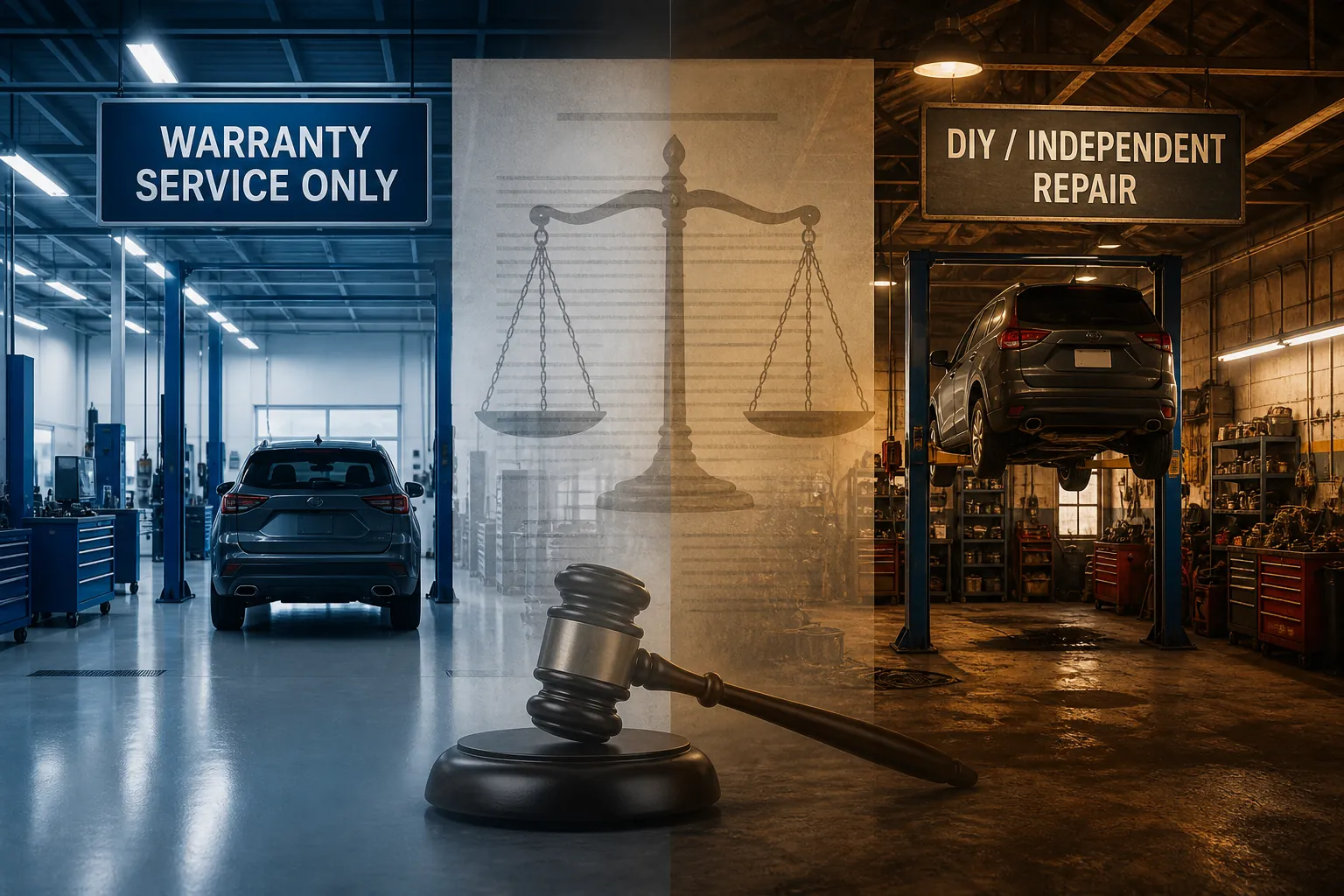
Ford’s safer version of the argument is easy to understand. Modern vehicles are software-mediated, safety-critical products. A bad repair can create warranty cost, product-liability exposure, emissions issues, cybersecurity concerns, and downstream blame-shifting. No serious analysis should pretend those concerns are imaginary. The problem is that warranty law already has a vocabulary for this fight, and it does not allow an automaker to convert every safety preference into an authorized-channel condition.
The Warranty Line Is Where the Legal Risk Starts
The core warranty-law issue is Magnuson-Moss Warranty Act § 102(c), which prohibits a warrantor from conditioning written warranty coverage on the consumer’s use of an article or service identified by brand, trade, or corporate name unless the article or service is provided without charge or the warrantor obtains an FTC waiver. Morgan Lewis’s 2026 refresher describes that basic right-to-repair rule as a federal limit on tying warranty coverage to authorized repair channels.[2]
That does not mean Ford must pay for damage caused by a bad independent repair. Magnuson-Moss does not require a manufacturer to honor a warranty claim for a defect actually caused by improper work, misuse, or nonconforming parts. The statutory risk is narrower and sharper: Ford cannot announce, administer, or imply a blanket warranty rule that owners must use dealers merely because the repair is warranty-adjacent.
Farley’s reported formulation gives a regulator or plaintiff a cleaner route than the usual consumer-confusion record. The sentence separates the world into two repair channels: outside warranty, DIY may be acceptable; inside warranty, the dealer channel is the approved path. If Ford’s actual warranty administration follows that same line, the statement becomes more than corporate messaging. It becomes a shorthand for a possible de facto tie.
The difference matters in discovery. A lawful warranty denial file usually asks a causation question: did the independent repair or part cause the claimed defect? A risky warranty policy asks a channel question: was the work performed by a dealer? The first is defensible. The second is where § 102(c) begins to bite.
This is also where public advertising can become relevant. Available reporting describes a national dealer-steering campaign in the same general right-to-repair context. Standing alone, advertising dealer service is ordinary commercial speech. Paired with executive language that treats warranty work as dealer-only, however, the campaign may help a claimant argue that Ford was not merely recommending dealers but shaping consumer behavior around a warranty consequence.
For related warranty-claim framing, the same Magnuson-Moss pressure point appears in prior Ford defect disputes, including Legal Options for Ford's Explorer Roof Rail Cover Recall. The recurring question is not whether Ford may contest causation. It may. The question is whether the company’s stated or practical rule skips causation and makes the repair channel do the work.
The 2014 MOU Does Not Cure a Federal Warranty Problem
Automakers often point to the 2014 national memorandum of understanding as proof that the vehicle repair market already has a working compromise. The problem is its legal status. The MOU is described in current law-firm coverage as non-binding and unenforceable, which makes it poor armor against a Magnuson-Moss theory.[2][3]
A non-binding MOU can help Ford tell a reasonableness story. It can show that automakers did not ignore repair access altogether, and it can explain why companies believed a voluntary framework was adequate for some diagnostic and service information. But it is not a statutory safe harbor. It does not authorize a warranty condition that federal law otherwise prohibits, and it does not prevent the FTC or a private plaintiff from asking how Ford actually communicated warranty consequences to owners.
That is why the current congressional maneuvering matters, but only to a point. The House committee advanced an amended REPAIR Act, H.R. 7389, by a 48-1 vote on May 21, 2026, after narrowing the bill.[4] Industry coverage and aftermarket materials describe the amended version as stripping out telematics-access provisions and leaning toward codifying the existing MOU framework rather than creating a broader data-access right.[4][5]
That timing gives Ford a motive context, not a defense. If Congress ultimately narrows repair-access obligations, Ford may gain statutory clarity in some areas. But a pending or narrowed bill does not suspend Magnuson-Moss. In Q3 2026, the warranty-tying rule remains the operative federal problem for a statement that appears to steer warranty work to dealers.
Economic Pressure Explains the Messaging; It Does Not Decide the Law
The economic backdrop is not subtle. Car and Driver, citing Cox Automotive data, reported that dealer service visit share fell from 33% to 29%, and that dealer service revenue declined 12% since 2018.[1] Those figures do not prove coordination, bad faith, or an unlawful tying policy. They do explain why dealer retention around service work has become commercially important.
They also explain why the public wording deserves scrutiny. When a manufacturer whose dealer channel is under pressure says warranty work should stay in that channel, the statement will not be read in isolation. It will be read next to dealer economics, lobbying activity, warranty-claim scripts, consumer-facing ads, and any internal documents describing lost service revenue.
The Oval Office meeting belongs in that category. Detroit Free Press reported that Ford, GM, and Penske met with President Trump on June 3, 2026, two weeks after the House committee vote on H.R. 7389.[6] That meeting does not make the reported warranty stance unlawful. It does, however, place the comments inside an active legislative and commercial campaign rather than a loose consumer-safety aside.
The Antitrust Theory Is Live, but Not Yet Won
The antitrust version of the claim is less direct than the Magnuson-Moss theory. It usually runs through the Kodak aftermarket doctrine: a company may face monopolization scrutiny where it has market power over a locked-in aftermarket, such as parts, service, or data access, even if the original equipment market is competitive. In the automotive setting, the unresolved question is whether control over vehicle-generated data, software tools, or telematics access can be pleaded as aftermarket power over repair.
That theory should not be oversold. The research record does not show that a federal court has already accepted a Kodak-style automotive data-access monopolization theory against an automaker. A plaintiff would still have to define the relevant aftermarket, show lock-in or information-cost problems, address safety and cybersecurity justifications, and connect Ford’s conduct to exclusion rather than ordinary product design or warranty administration.
Still, Ford’s reported warranty/non-warranty distinction helps plaintiffs tell a more coherent story. The warranty claim concerns repair-channel conditioning. The antitrust claim concerns control over the inputs needed to compete in repair after the vehicle is sold. If Ford publicly accepts non-warranty DIY in theory but limits the data, tools, or warranty-safe pathways that make independent repair commercially viable, the two arguments begin to reinforce each other.
Massachusetts is the caution sign for automakers. In 2025, the Alliance for Automotive Innovation’s lawsuit challenging the Massachusetts telematics right-to-repair law was dismissed, with the court rejecting automaker preemption arguments.[7] That result does not establish a federal antitrust violation. It does mean automakers cannot assume that safety, cybersecurity, or federal-preemption arguments will automatically defeat state repair-access regimes at the courthouse door.
Maine shows the other side of the same fragmented landscape. Its right-to-repair law became effective in January 2025, but the independent data-access entity required for implementation had not been established, leaving practical access questions unresolved.[7] For manufacturers, that fragmentation is burdensome. For plaintiffs, it supplies the argument that voluntary commitments and partial state statutes have not solved the telematics gap.
What Ford’s Lawyers Should Be Testing Now
The immediate legal audit is not complicated. Ford should be able to answer whether warranty personnel, dealer materials, owner communications, customer-service scripts, and advertising all preserve the same distinction that Magnuson-Moss requires: warranty coverage may be denied for damage caused by improper repair, but not merely because the owner used an independent shop, a non-OEM part, or a DIY method.
- Warranty denial files should identify causation, not just non-dealer repair history.
- Dealer-facing guidance should avoid language suggesting warranty work is categorically dealer-only.
- Consumer ads should distinguish a recommendation to use dealers from a condition of warranty coverage.
- Telematics and diagnostic-access policies should be reviewed separately from ordinary warranty administration.
- Safety rationales should be documented with specificity rather than used as a universal label.
The last point is not cosmetic. Safety is a real defense only when it is connected to the actual restriction. A company can say that certain repairs require calibration, trained technicians, secure software access, or validated procedures. That is different from saying warranty work belongs at dealers because DIY repair is unsafe. The broader the safety statement, the easier it is for a plaintiff to portray it as a post-sale market allocation dressed in product-risk language.
Other OEMs should read the episode the same way. The litigation risk is not created by having a dealer network, promoting dealer service, defending proprietary software, or opposing a broad right-to-repair bill. The risk grows when those positions are compressed into a public rule that consumers may hear as: your warranty is safe only if the dealer does the work.
A regulator would not need to prove that every Ford owner was misled by a CEO interview. A private plaintiff would not need to prove that public comments alone changed the repair market. The more practical use is evidentiary. The statement supplies theme language for a complaint, a demand letter, an FTC submission, or a deposition exhibit. It gives a claimant a clean sentence to place next to warranty denials and dealer-service economics.
Exposure, Not a Verdict
Farley’s reported comments do not guarantee an FTC action, a class claim, or an antitrust win. Ford has obvious defenses: safety, software integrity, warranty-cost control, voluntary repair-information commitments, and the absence of a settled federal automotive-data-access antitrust ruling. Those defenses matter.
They do not erase the exposure. Magnuson-Moss already limits warranty-channel tying. The 2014 MOU is non-binding, not a safe harbor. The narrowed REPAIR Act leaves telematics access contested. Massachusetts weakens the assumption that courts will reflexively accept automaker preemption arguments, while Maine shows that implementation gaps remain real.
The practical takeaway is narrow and durable: Ford may argue that some repairs should be performed by trained or authorized technicians for safety reasons, and it may deny warranty claims when bad repairs cause the defect. What it should not want is a record suggesting that warranty coverage itself depends on keeping repair work inside the dealer channel.
References
- Trump, Ford, GM, and the Right-to-Repair Battle, Car and Driver
- Navigating the Right to Repair Landscape in 2026: A Refresher on Basics and Best Practices, Morgan Lewis, June 2026
- Congress Considers Right-to-Repair Bill for Vehicle Owners, Sidley, March 2, 2026
- House committee advances amended REPAIR Act, CBT News
- Right to Repair Fact Sheet, CVSN
- Trump says Ford, GM want bill to restrict owners from fixing their own vehicles, Detroit Free Press, June 4, 2026
- Right to Repair in 2026: Where Laws, Courts and Automakers Stand, Autobody News
Operationalizing workflow
No workflow has been explicitly linked to this obligation yet. See Workflows generally.
Illustrative cases
No illustrative case is currently tracked for this obligation. See Risk Digest for documented incidents generally.
← Back to RegulationReport a correction or tip
Spotted an outdated figure, a misstated fact, or a ruling this regulation entry should reflect? Public comments are disabled for this content given the professional cost of a misreported case outcome, penalty amount, or rule text — use the structured correction channel instead.
Report a correction or tip for this record →