
What Are the Freedom Haulers CDL Eligibility Requirements?
- Authority
- Federal Motor Carrier Safety Administration (FMCSA)
- Rule type
- regulation
- Jurisdiction scope
- US federal
- Source text
- Read primary rule text ↗
Veteran must satisfy one of four FMCSA pathways: Military Skills Test Waiver, Even Exchange, GI Bill, or Skillbridge/OJT.
Current as of July 31, 2026, UTC. This Regulation & Ethics analysis is not legal advice. The short answer to “trump freedom haulers cdl program eligibility requirements” is that Freedom Haulers is not a standalone CDL entitlement. It is a federal branding and coordination initiative built around existing FMCSA, VA, and military-transition pathways. A veteran still has to qualify under the particular pathway being used, satisfy the state licensing agency, and give a carrier enough documentation to defend the hiring decision.
That distinction matters because the same applicant can look eligible in a press release and still fail at the DMV counter. One pathway waives only the road skills test. Another can waive both the knowledge and skills tests, but only in participating states and only for specified military occupational specialties. VA tuition coverage pays for approved training; it does not issue a CDL. Skillbridge and on-the-job training place the service member in a transition environment; they do not erase state licensing requirements.
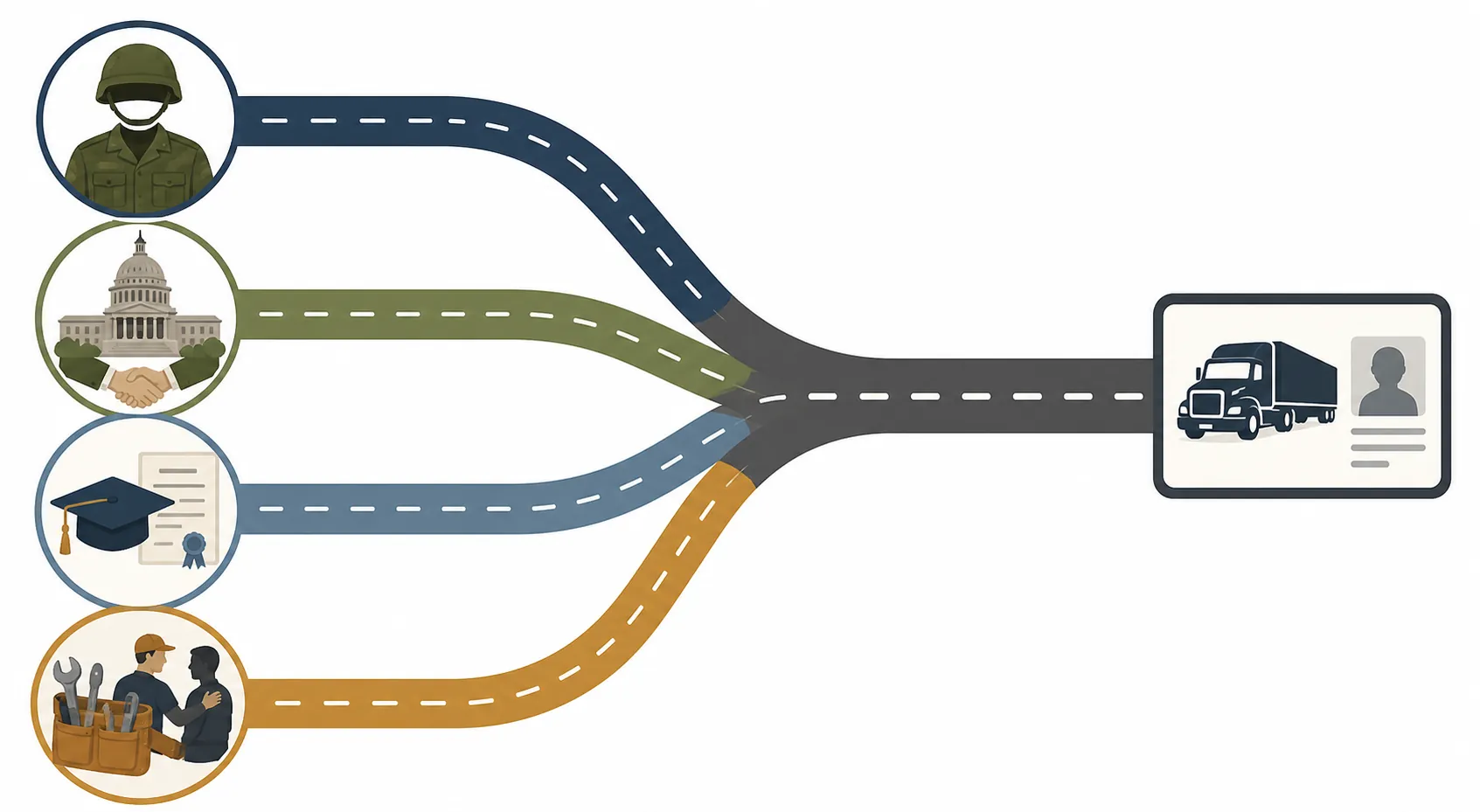
The Four Eligibility Gates Behind Freedom Haulers
The program is easiest to read as four gates, not one. The Military Skills Test Waiver is the familiar FMCSA route that lets a qualified service member or veteran skip the CDL skills test if military driving experience is documented. FMCSA says more than 40,000 service members and veterans have used that waiver since 2011, which is the first clue that the core mechanism is not new.[1]
| Pathway | What it can do | Core eligibility requirement | What remains outside the pathway |
|---|---|---|---|
| Military Skills Test Waiver | Waives the CDL skills test only | Two years of military heavy-vehicle experience, acceptable service documentation, commanding officer certification, and application within the expanded 24-month post-service window | Knowledge testing, state licensing review, medical qualification, class/endorsement limits, and carrier road-readiness verification |
| Even Exchange | Can waive both knowledge and skills tests | Qualifying MOS code in a participating state; 27 states participated as of July 2026, with 7 more committed | State participation, MOS fit, identity/residency documentation, and any non-waived endorsement or state requirement |
| GI Bill CDL training coverage | Can pay for approved CDL training | Generally requires 36 months of active service and enrollment in a VA-approved program | Licensing, testing, hiring, and state DMV acceptance |
| Skillbridge/OJT | Can place a transitioning service member into training or supervised work | Available during the final six months of active duty | CDL issuance, employer standards, insurance review, and state testing or waiver rules |
The only genuinely new eligibility element identified in the available materials is the temporary expansion of the post-service filing window for the Military Skills Test Waiver from 12 months to 24 months. That is an important access change for separating service members who miss the old window, but it is not a new statutory CDL category.
1. Military Skills Test Waiver: the road test is the only waived test
Under the Military Skills Test Waiver, the applicant must have operated a military vehicle comparable to the commercial motor vehicle class sought and must show at least two years of qualifying experience. The ordinary proof set includes military driving records or service records such as a DD-214, plus the FMCSA waiver form signed by a commanding officer or otherwise completed through the required certification process.[1][2]
The compliance point is narrow but decisive: this waiver does not waive the CDL knowledge test. A veteran who qualifies for the skills-test waiver still has to clear the knowledge-testing gate, satisfy state documentation rules, meet medical and qualification requirements, and obtain the license through the state driver licensing agency.[2]
The expanded 24-month window is therefore best understood as a filing-window expansion. It helps a former service member preserve the value of military driving experience for longer after separation. It does not tell the state to issue a license automatically, and it does not tell a carrier that the driver is ready for unsupervised dispatch.
2. Even Exchange: broader waiver, narrower availability
The Even Exchange program is more powerful on paper because it can waive both the knowledge test and the skills test. Its practical reach is narrower. As of July 2026, Even Exchange was available in 27 states, with 7 additional states committed: Indiana, Wyoming, Maryland, Louisiana, Arkansas, Florida, and Alabama.[3]
The applicant also needs a qualifying military occupational specialty code from the relevant branch. That MOS screen is not a ceremonial label. It is the administrative substitute for testing, and it is why a state examiner or compliance officer should ask which branch, which MOS, which license class, and which endorsements are actually covered before treating the applicant as test-exempt.[3]
Even Exchange is where state variation matters most. A veteran in a participating state may be able to avoid both tests if the MOS matches. A similarly situated veteran in a nonparticipating state may have to use the skills-test waiver route or test normally. Freedom Haulers does not appear, on the available record, to override that state-by-state participation map.
3. GI Bill coverage: payment support, not licensure
GI Bill coverage belongs in the eligibility discussion because many CDL candidates experience cost as the first gate. But it is a tuition pathway, not a licensing waiver. The materials identify the relevant eligibility baseline as 36 months of active service and enrollment in a VA-approved training program.[4]
For a carrier or state agency, that means a paid training seat is not the same thing as a CDL. The applicant still has to complete the training, satisfy the state licensing process, and meet whatever independent employer standards apply to the route, equipment, insurance profile, and commodities involved.
4. Skillbridge and OJT: transition access before separation
Skillbridge and on-the-job training address timing. They can place a service member into civilian training or supervised work during the final six months of active duty.[4] That can make the handoff from military service to trucking less abrupt, especially where an employer participates early and keeps documentation clean.
The legal effect should not be overstated. A Skillbridge placement does not itself waive a state CDL requirement, cure a missing MOS code, or prove post-training competence. It is a transition channel that may sit beside the waiver or Even Exchange analysis.
Why a Veteran CDL Initiative Arrived in the Middle of a Non-Domiciled CDL Fight
Freedom Haulers was announced on July 24, 2026, followed by a White House event on July 30, 2026.[4] The timing is not incidental. It came after FMCSA’s March 16, 2026 final rule on non-domiciled CDLs, which removed eligibility for several groups that had previously been part of the commercial-driver labor pool, including EAD holders, DACA recipients, asylum seekers, asylees, and refugees.[5]
Available sources estimate that the final rule removed about 200,000 drivers from the market.[5] That number should be read as a regulatory-labor estimate, not as proof that every affected driver had the same license class, route profile, safety record, or employer role. Still, it explains why a veteran-transition package was framed as an urgent supply-side response rather than as a routine awareness campaign.
The rule is also in active litigation. In Lujan v. FMCSA, the D.C. Circuit denied an emergency stay on May 6, 2026, and the case is proceeding on an expedited briefing schedule.[6] A stay denial is not a final merits ruling. For Q3 2026 eligibility planning, however, the practical point is that the rule remains operative unless and until the court or agency changes the legal landscape.

The DMV Counter Is Where Eligibility Becomes Real
A federal eligibility page can describe the waiver. The state driver licensing agency decides what the applicant must present, whether the waiver form is complete, whether the MOS or military vehicle comparison fits, and whether state law imposes additional processing requirements. That is why the Freedom Haulers analysis cannot stop at “veterans qualify.” Some veterans will qualify under one pathway, some under another, and some will need ordinary testing.
The non-domiciled CDL enforcement record shows how quickly state administration can become the controlling fact. DOT withheld $73.5 million from New York in April 2026 after CDL issuance audits showed a 53% noncompliance rate.[7] In California, a class action produced a state court order requiring the DMV to allow roughly 20,000 drivers to reapply, while the California DMV said FMCSA had directed a pause on non-domiciled issuance.[6][7]
Those state disputes concern non-domiciled CDLs, not veteran waivers as such. Their relevance is administrative. They show that CDL eligibility in 2026 is being tested through audits, funding pressure, state-court orders, federal instructions, and DMV-level pauses. A veteran pathway operating in that environment depends on documentation discipline, not just program messaging.
What Employers Should Verify Before Treating a Freedom Haulers Applicant as Road-Ready
Carrier compliance officers have a different problem from the applicant. The applicant wants to know whether a test can be waived or tuition covered. The carrier has to decide whether putting that driver behind the wheel is defensible after the paperwork clears.
- Identify the pathway: Military Skills Test Waiver, Even Exchange, GI Bill-funded training, Skillbridge/OJT, or ordinary state testing.
- Confirm the waiver scope: skills test only, both knowledge and skills tests, tuition support only, or supervised transition placement.
- Match military experience to the equipment: license class, vehicle type, endorsements, route expectations, and any hazardous-materials or passenger implications.
- Retain the proof file: DD-214 or military driving records, signed waiver form, MOS documentation, state CDL record, medical qualification, and training records.
- Do an independent road-readiness review: a state waiver reduces testing burden; it does not replace employer supervision, safety evaluation, or insurance review.
That last step is no longer just cautious human-resources practice. In May 2026, the Supreme Court unanimously held in Montgomery v. Caribe Transport II that brokers can face negligent-hiring suits under state law.[7] Available sources place that decision in the broader liability backdrop for transportation hiring. It does not say that a carrier is liable merely because it hires a waiver-CDL veteran. It does make sloppy reliance on a federal brand a poor substitute for a documented competence review.
English-Proficiency Enforcement Narrows the Same Labor Pool
The veteran initiative also sits beside a separate enforcement wave. FMCSA has removed more than 24,000 CDLs and continues to sideline about 2,000 drivers per month since June 2025 under English-proficiency rules, according to the cited compliance reporting.[7]
For Freedom Haulers eligibility, the English-proficiency figures do not create a veteran-specific gate. They matter because they compound the same driver-supply pressure that made veteran recruitment politically and operationally attractive. They also remind carriers that a CDL file is not complete if it ignores separate qualification rules that can remove a driver from service after licensing.
Safety Claims Are Context, Not the Eligibility Test
DOT materials and related coverage cite figures stating that veteran drivers have 42% fewer accidents and log 98% more miles than non-veteran drivers.[4][8] Those figures may help explain why veteran-transition policy appeals to regulators and carriers. The underlying study methodology was not independently verified in the reviewed materials, so the numbers should not be used as a substitute for applicant-level screening.
There is a defensible policy instinct behind the initiative: military heavy-vehicle experience can be relevant to civilian commercial driving, and a state should not force a qualified veteran to duplicate a road test merely because the experience occurred in uniform. The problem begins when that practical point is inflated into a universal hiring conclusion. A waiver says the state accepted a defined substitute for a defined test. It does not say the driver is matched to every fleet, route, load, or risk profile.
Employer Incentives Are Limited by the Lapsed WOTC
The Work Opportunity Tax Credit sometimes appears in veteran-hiring discussions, but it should not be treated as a current, settled Freedom Haulers benefit. Available sources state that the WOTC for veteran hiring lapsed on December 31, 2025 and had not been reauthorized as of the materials reviewed. That makes it, at most, a contingent incentive issue for employers rather than an eligibility requirement for a veteran applicant.
The Practical Eligibility Answer for Q3 2026
A veteran asking whether they qualify for Freedom Haulers in Q3 2026 should start with the pathway, not the program name. If they have two years of qualifying military heavy-vehicle experience and the necessary certification, the Military Skills Test Waiver may waive the road skills test within the expanded 24-month post-service window. If their MOS qualifies and their state participates in Even Exchange, both the knowledge and skills tests may be waived. If they need training funding, GI Bill coverage may help only if the program is VA-approved and the service requirement is met. If they are still within the final six months of active duty, Skillbridge or OJT may create a transition placement.
A carrier looking at the same applicant should ask a slightly different question: which legal requirement was actually satisfied, and what remains to be verified? The answer may include a state-issued CDL, but it should also include the waiver record, MOS documentation where relevant, medical qualification, training evidence, and an employer-level competence review.
Freedom Haulers may help eligible veterans move faster into CDL work. Its practical effect depends on state Even Exchange participation, careful documentation, carrier verification, and the unresolved D.C. Circuit litigation around the non-domiciled CDL rule that created much of the current urgency.
References
- Military Skills Test Waiver, Federal Motor Carrier Safety Administration.
- 49 CFR 383.77 - Substitute for driving skills tests for drivers with military CMV experience, Electronic Code of Federal Regulations.
- Even Exchange Program, Federal Motor Carrier Safety Administration.
- Freedom Haulers, U.S. Department of Transportation.
- Non-Domiciled CDL 2026 Final Rule FAQs, Federal Motor Carrier Safety Administration.
- Plaintiffs ask D.C. Circuit to expedite lawsuit over non-domiciled CDLs, Land Line Media.
- Commercial Driver's License Compliance Clash, Seyfarth Shaw LLP.
- Fox News article on Freedom Haulers veteran driver statistics, Fox News.
Operationalizing workflow
No workflow has been explicitly linked to this obligation yet. See Workflows generally.
Illustrative cases
No illustrative case is currently tracked for this obligation. See Risk Digest for documented incidents generally.
← Back to RegulationReport a correction or tip
Spotted an outdated figure, a misstated fact, or a ruling this regulation entry should reflect? Public comments are disabled for this content given the professional cost of a misreported case outcome, penalty amount, or rule text — use the structured correction channel instead.
Report a correction or tip for this record →