
Legal Risks of the US Gavi Funding Withdrawal
- Authority
- UN Committee on Economic, Social and Cultural Rights
- Rule type
- treaty
- Jurisdiction scope
- US federal
- Source text
- Read primary rule text ↗
Refrain from funding decisions that foreseeably impair extraterritorial right to health and life.
The legal question raised by the U.S. withdrawal from Gavi funding does not begin with a lawsuit. It begins with a funding act whose effects were sufficiently defined to be measured before the money was withdrawn.
Gavi entered its 2026-2030 replenishment cycle seeking $11.9 billion. At the June 2025 pledging summit, world leaders committed $9 billion, leaving a material gap against the target. The United States, meanwhile, withdrew a prior pledge of about $1.58 billion and is withholding $600 million in already appropriated FY2025 and FY2026 funds, according to KFF’s status analysis of U.S. support for Gavi and Gavi’s own account of the summit outcome.[1][2]

That funding frame matters because the projected health consequences are not abstract. Doctors Without Borders reported that the shortfall could leave 75 million children unvaccinated and lead to more than 1.2 million preventable deaths. Nature’s editorial board put the broader gap in the context of Gavi’s stated ambition to reach 500 million children and avert 8 million to 9 million deaths.[3][4]
Those figures do not, by themselves, answer whether the United States has enforceable legal liability. They do make it difficult to treat the withdrawal as a policy preference with no cognizable legal shadow. For counsel, the useful question is narrower: does the record support a colorable international human rights claim, and if so, what kind of consequence can realistically attach?
The Claim Is Stronger on Foreseeability Than on Forum
Amnesty International has taken the direct position that abrupt U.S. foreign-aid cuts “violate international human rights law.”[5] That is a serious legal characterization, not merely a campaign phrase, but it still has to be unpacked instrument by instrument. In practice, “violates international law” may mean treaty-body criticism, diplomatic censure, congressional oversight, reputational harm, or an argument in a non-U.S. forum. It does not automatically mean damages, an injunction, sanctions, or a justiciable claim in a domestic court.
The most plausible rights-based route runs through three familiar sources: Article 6 of the International Covenant on Civil and Political Rights, which protects the right to life; Article 12 of the International Covenant on Economic, Social and Cultural Rights, which protects the right to the highest attainable standard of health; and Article 24 of the Convention on the Rights of the Child, which addresses children’s right to health. The Physicians for Human Rights and Just Security analysis frames the cuts as a global human rights crisis and places those instruments at the center of the legal assessment.[6]
The evidentiary bridge is the hard part. A rights argument cannot rest only on the proposition that vaccines save lives. It must connect a state decision to a foreseeable deprivation abroad. The available research helps more than advocacy writing sometimes does: a BMJ Global Health study on Gavi transition settings, available through PMC, found that reduced Gavi support correlates with increased infant and under-5 mortality.[7] That finding does not prove that every dollar withheld from a replenishment cycle causes an identified child’s death. It does support the narrower and legally relevant point that reduced vaccine financing can be associated with measurable mortality increases in the affected population.
| Legal source | Why it matters | Main constraint |
|---|---|---|
| ICCPR Article 6 | Supports a right-to-life theory where foreseeable state action contributes to preventable mortality. | The United States has treaty reservations and enforcement remains limited. |
| ICESCR Article 12 | Provides the clearest right-to-health vocabulary, especially as interpreted through General Comment 14. | The United States signed but did not ratify the ICESCR. |
| CRC Article 24 | Centers children’s access to health measures, including preventive care. | The United States has not ratified the CRC. |
| Maastricht Principles | Articulate extraterritorial-obligations theory for foreseeable cross-border rights effects. | They are not a self-executing treaty or a direct domestic cause of action. |
ICCPR Article 6: A Colorable Right-to-Life Theory
Article 6 is the most direct route for a right-to-life argument because the projected consequence is mortality, not only degraded access to care. Where a government action foreseeably contributes to preventable deaths, the right-to-life frame is not strained. The question is whether the obligation reaches a funding withdrawal affecting children outside U.S. territory and whether any forum can give that conclusion binding effect.
Two limitations have to be kept in view. First, the United States has entered reservations, understandings, and declarations to the ICCPR, including a reservation concerning Article 6 and capital punishment. That reservation does not map neatly onto vaccine financing, but it signals the broader U.S. posture of limiting domestic legal effect. Second, even if a treaty body or legal commentator treats the withdrawal as inconsistent with Article 6, that conclusion is not the same as a U.S. court judgment.
For risk assessment, Article 6 is therefore best described as supporting a colorable legal claim, especially where the mortality projections are specific and the causal literature does not leave the issue entirely speculative. It is not, on the present record, a clear route to enforceable liability.
ICESCR Article 12 and General Comment 14: The Right-to-Health Argument With a Treaty-Posture Problem
The right-to-health argument is conceptually stronger under the ICESCR than under the ICCPR because Article 12 speaks in health terms. General Comment 14, issued by the Committee on Economic, Social and Cultural Rights, has long been used to interpret the content of that right, including access to preventive health measures and international cooperation. That framework fits a vaccine-financing withdrawal more naturally than a purely civil-and-political-rights instrument.
The difficulty is the United States’ treaty posture. The United States has signed but not ratified the ICESCR. Non-ratification does not make the treaty irrelevant to international legal argument; it does make a direct treaty-violation claim against the United States significantly weaker. General Comment 14 can inform soft-law, customary-law, and interpretive arguments, but it does not create a straightforward U.S. domestic cause of action.
This is where claim-strength labeling matters. A lawyer can say that the U.S. withdrawal is difficult to reconcile with the right-to-health framework used by U.N. bodies and human rights advocates. A lawyer should hesitate before saying that Article 12, standing alone, exposes the United States to an enforceable judgment. Those are different opinions, with different consequences for a client memorandum.
CRC Article 24: The Child-Rights Frame Is Morally Direct, Legally Indirect
Article 24 of the Convention on the Rights of the Child is the cleanest match to the population affected. The projected unvaccinated group is children. The threatened harm is preventable disease and death. The disrupted intervention is routine immunization. As a matter of rights vocabulary, the CRC is hard to avoid.
The same treaty-posture problem returns. The United States has not ratified the CRC. That does not erase the CRC’s relevance in diplomatic and international human rights analysis, especially when nearly universal ratification gives the instrument unusual normative weight. It does mean that a CRC theory is more likely to support condemnation, reporting, advocacy, or interpretive pressure than enforceable U.S. liability.
Extraterritorial Obligations Do the Most Work
The Maastricht Principles are the doctrinal hinge. They articulate an extraterritorial-obligations theory under which states should not take actions that foreseeably impair economic, social, and cultural rights outside their borders. In this setting, the argument is not that the United States directly administers the affected health systems. It is that a foreseeable withdrawal from a major vaccine-financing mechanism undermines access to immunization abroad in a way that human rights law should recognize.
That theory gains force from the funding record. Gavi’s replenishment target, the amount raised, the withdrawn U.S. pledge, and the withheld appropriated funds are not vague policy atmospherics. They are budgetary facts tied to a financing mechanism whose purpose is to expand immunization coverage.[1][2] The projected 75 million unvaccinated children and more than 1.2 million preventable deaths then supply the foreseeability element that an extraterritorial-obligations argument needs.[3]
The PMC article calling for enforceable commitments to global health makes the institutional point plainly: international health assistance can be framed as a rights obligation, but existing arrangements often lack the enforcement structure needed to make those commitments dependable.[8] That is not a technical footnote. It is the center of the risk analysis.
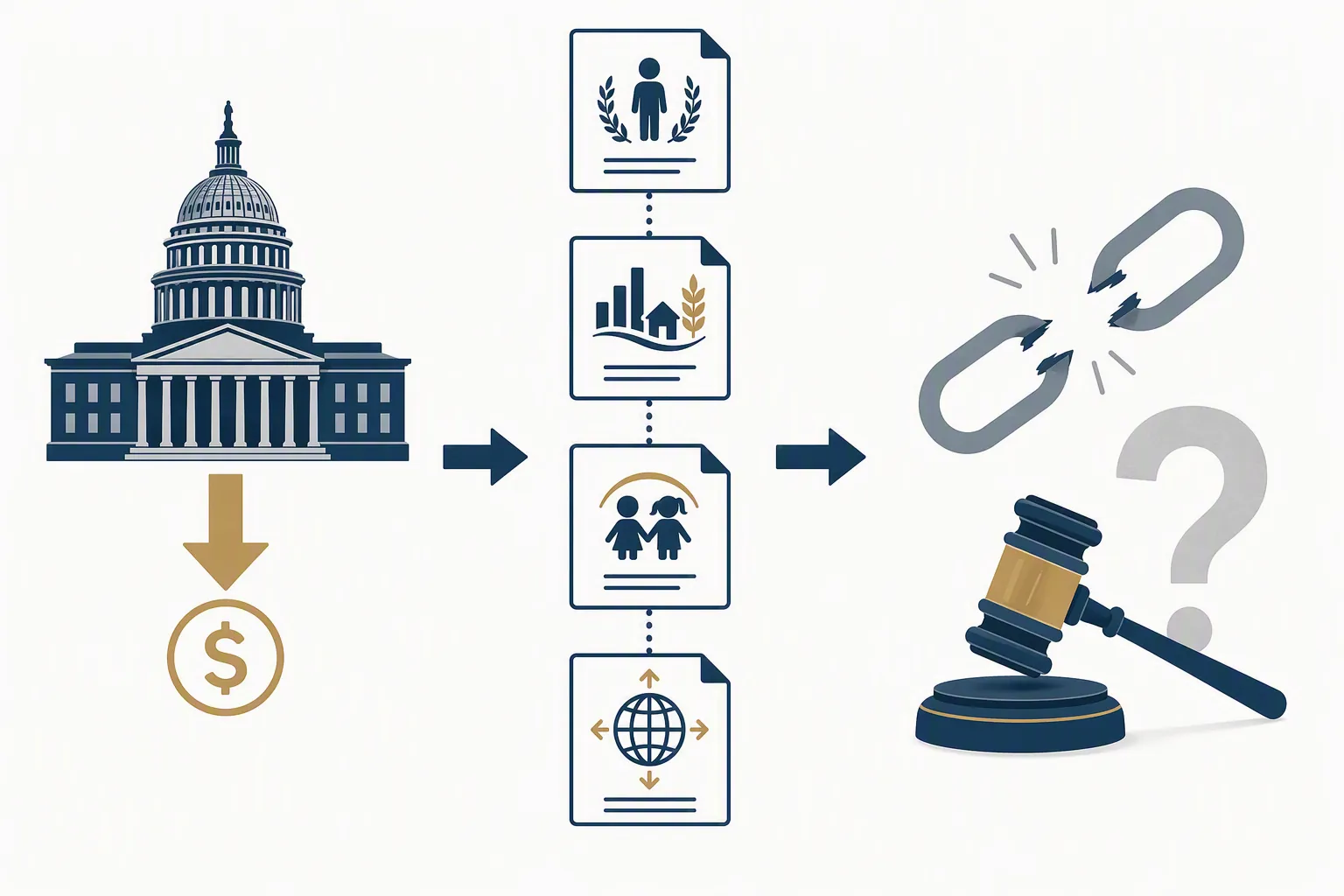
Reason-Giving Matters, But It Does Not Supply the Remedy
The stated rationale for the withdrawal also belongs in the legal file, though it should not consume the analysis. Forbes reported that Robert F. Kennedy Jr. announced the withdrawal of U.S. financial support from Gavi after criticizing vaccine safety and citing concerns associated with thimerosal.[9] The BMJ reported that the Trump administration would withhold Gavi funding until all vaccines containing mercury were removed, while noting that WHO evidence reviews did not support the premise that thimerosal in vaccines caused the asserted harms.[10]
That matters for reasonableness. A funding decision with grave projected health effects is easier to defend when it rests on a strong evidentiary basis. If the stated reason conflicts with the principal public-health evidence identified in the record, the decision becomes more vulnerable to legal and institutional criticism. It still does not create, by itself, a damages remedy.
The Biden-era pledge also matters, but for reliance and planning rather than partisan chronology. Gavi’s 2025-2028 expectations were shaped in part by the prior U.S. commitment of about $1.58 billion.[1][9] When a major donor withdraws after a financing architecture has been built around replenishment pledges, foreseeability is not limited to the abstract knowledge that vaccines are useful. It includes the foreseeable disruption of procurement, delivery planning, and immunization coverage.
What Exposure Actually Looks Like
No direct U.S. court orders or sanction rulings involving the Gavi withdrawal were identified in the materials reviewed. That absence should not be overread as legal innocence. It means the present matter is better classified as a Regulation & Ethics obligations analysis than as a case-specific litigation event.
The realistic exposure sits in four places. First, treaty bodies and U.N. procedures may treat the withdrawal as evidence of noncompliance with rights-based duties, even if their conclusions are not binding. Second, Congress and inspectors may scrutinize the withholding of already appropriated funds through domestic oversight channels. Third, other governments and international institutions may use the withdrawal as evidence that U.S. health commitments are unreliable. Fourth, affected communities and civil society groups may convert the legal theory into sustained reputational pressure.
Those consequences are not trivial. For some institutions, reputational and diplomatic findings can be more durable than a dismissed complaint. But they remain different from an enforceable judgment. The current legal architecture includes U.N. Human Rights Council procedures, treaty-body communications, and possible advisory routes, yet those channels have historically produced findings and pressure rather than compulsory remedies against the United States.
The Narrow Answer
The U.S. Gavi withdrawal creates a serious, source-supported human-rights risk. The funding act is defined; the shortfall is measurable; the projected number of unvaccinated children and preventable deaths is grave; and the causal literature makes foreseeability legally relevant. On that record, claims under the ICCPR, ICESCR, CRC, and Maastricht extraterritorial-obligations framework are colorable.
The stronger conclusion stops there. Because of U.S. treaty posture, reservations, non-ratification of key rights instruments, and the absence of a binding enforcement mechanism, the practical consequence is political, diplomatic, treaty-body, congressional, and reputational risk unless a forum can attach compulsory legal effect. That distinction is not a retreat from the mortality projections. It is the line between a serious legal claim and an enforceable legal remedy.
References
- The Trump Administration's Foreign Aid Review: Status of U.S. Support for Gavi, the Vaccine Alliance, KFF.
- World leaders recommit to immunisation amid global funding shortfall, Gavi.
- US makes deadly decision to withdraw funding for Gavi, Doctors Without Borders / MSF.
- Help save 2 million lives: close the vaccine funding gap, Nature.
- Amnesty International warns of devastating consequences as abrupt U.S. Foreign Aid cuts threaten human rights globally, Amnesty International, May 2025.
- U.S. Foreign Aid Cuts to Healthcare Trigger a Global Human Rights Crisis: How the World Must Respond, Just Security.
- Gavi transitions and increased infant and under-5 mortality, PMC / BMJ Global Health.
- US divestment in global health: disruption, uncertainty and response, PMC.
- RFK Jr. Withdraws U.S. Financial Support For Gavi Vaccine Alliance, Forbes, July 1, 2025.
- Trump to withhold Gavi funding until all vaccines with mercury removed, BMJ.
Operationalizing workflow
No workflow has been explicitly linked to this obligation yet. See Workflows generally.
Illustrative cases
No illustrative case is currently tracked for this obligation. See Risk Digest for documented incidents generally.
← Back to RegulationReport a correction or tip
Spotted an outdated figure, a misstated fact, or a ruling this regulation entry should reflect? Public comments are disabled for this content given the professional cost of a misreported case outcome, penalty amount, or rule text — use the structured correction channel instead.
Report a correction or tip for this record →