
What legally authorizes an international force in Gaza?
- Authority
- United Nations Security Council
- Rule type
- Security Council resolution
- Jurisdiction scope
- International (UN)
- Effective date
- Nov 17, 2025
- Source text
- Read primary rule text ↗
Verify Resolution 2803's official text, Charter grounding, party consent, and implementing agreements before relying on ISF authorization.
Record status and scope
Regulation & Ethics obligations record. Last verified: August 3, 2026, UTC. This is a legal-authorization map for an international force in a Gaza ceasefire, using the International Stabilization Force created under Security Council Resolution 2803 as the live case. It is not legal advice and does not assess military feasibility, ceasefire politics, or the merits of any peace plan.
Source-status note: the official Resolution 2803 PDF on the UN documents system and the Security Council press release were not available in the research set used for this record. Before publication in a client memorandum, filing, or government advice, check the official resolution text and press release if accessible. The Charter analysis below uses the UN Charter text for Chapter VII provisions, while Resolution 2803 details are drawn from UN News, France 24, and expert legal analyses; July 2026 implementation facts are drawn from Reuters and J Street reporting and should be refreshed before operational reliance.[1][2][3][4][5][6][7]

The authorization stack
The legal authorization for a Gaza ceasefire international force does not sit in one document. A Security Council mandate may authorize the mission, but counsel still has to test the Charter footing, territorial entry authority, consent from relevant parties, implementing agreements for each contingent, command arrangements, and reporting or withdrawal rules. If those layers do not line up, “UN-authorized” is an incomplete answer.
| Layer | Legal question | Current ISF position |
|---|---|---|
| Security Council mandate | What has the Council authorized, for how long, and with what powers? | Resolution 2803 reportedly authorizes the ISF and the Board of Peace through December 31, 2027 and uses “all necessary measures” language, but the official text should be verified against the PDF before reliance.[2][3][4] |
| Charter grounding | Is the Council acting under a Chapter VII enforcement theory, or under a more ambiguous peace-and-security frame? | The mandate has force-authorizing language, but expert analyses emphasize the absence of an explicit Chapter VII invocation and the use of a “regional peace” framing rather than a clean Article 39 formula.[1][4][5] |
| Consent | Whose permission lets foreign personnel enter and operate in Gaza? | Israel’s July 2026 approval is operationally important, but it does not settle the Palestinian consent question. The PA welcomed the resolution, while Hamas rejects foreign military presence.[2][3][6] |
| Implementing agreements | Which document gives a national contingent entry, status, command, discipline, weapons, detention, and withdrawal rules? | The July 2026 implementation record is state-by-state. Morocco reportedly signed the first formal participation agreement, and each national contingent requires separate Israeli approval.[6][7] |
| Oversight and administration | Who supervises the force, who reports to the Council, and how far does the governing structure reach? | The Board of Peace layer creates the sharpest institutional mismatch: the Council authorization is Gaza-specific and time-limited, while the charter analyses describe a more open-ended governance design.[4][12][13] |
Resolution 2803 gives the ISF real authority, but not a clean Charter label
Resolution 2803 was adopted on November 17, 2025 by a 13-0 Security Council vote, with China and Russia abstaining, according to UN News and France 24 reporting on the vote.[2][3] Those reports and subsequent legal analyses describe the resolution as authorizing an International Stabilization Force for Gaza, endorsing a Board of Peace, and setting the mandate through December 31, 2027.[2][3][4]
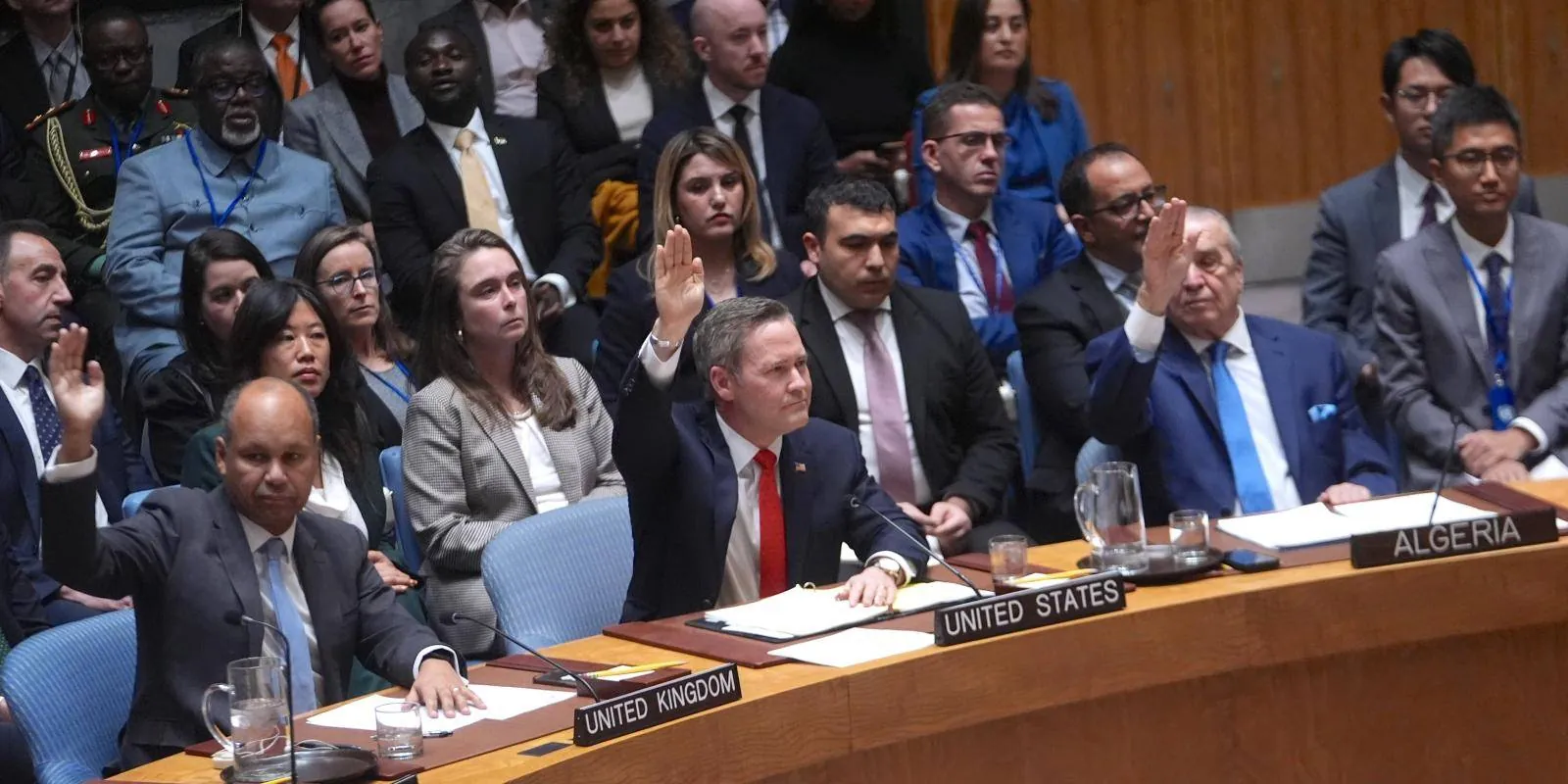
The operative language that matters most is the reported authorization to use “all necessary measures.” In Security Council practice, that phrase can do heavy work: it is the language readers look for when the Council intends to permit coercive action rather than only monitoring, liaison, or consent-based interposition. Resolution 2803 also reportedly requires the ISF to operate in close consultation and cooperation with Israel and Egypt, and ties Israeli withdrawal to demilitarization standards agreed among the IDF, the ISF, guarantors, and the United States.[4][5]
The difficulty is not that the Council did nothing. The difficulty is that the Council appears to have done something legally consequential while leaving the Chapter VII theory less explicit than lawyers usually prefer. Article 39 is the Charter provision under which the Council determines the existence of a threat to the peace, breach of the peace, or act of aggression; Article 42 is the provision under which it may authorize military measures if non-military measures are inadequate.[1] Expert analyses of Resolution 2803 identify two drafting features that weaken the enforcement theory: the apparent omission of an express Chapter VII invocation and the framing of the threat around “regional peace” and the security of neighboring states rather than a straightforward Article 39 determination of a threat to international peace and security.[4][5]
That does not make the mandate void. Security Council resolutions are interpreted from their text, context, object, and operative effects, not from a single label. But the missing label matters for advice. A state asked to contribute personnel needs to know whether the Council has clearly authorized enforcement powers, whether force may be used against non-consenting armed groups, and whether the mandate overrides objections that would otherwise be grounded in sovereignty, occupation law, or the absence of local consent.
Articles 24(2) and 25 sit behind that analysis even when they are not the provisions quoted in press coverage. Article 25 is the usual route by which members accept and carry out Security Council decisions; Article 24(2) is the reminder that the Council acts under the Charter, not outside it. Articles 2(1), 2(4), and 2(7) supply the sovereignty, non-use-of-force, and domestic-jurisdiction baseline that explains why consent and Chapter VII clarity matter. Legal commentary on the ISF therefore treats “all necessary measures” as important but not self-defining: the phrase must still fit within the Council’s Charter authority and within other applicable international law constraints.[4][5]
Security Council authorization is not the same thing as permission to enter
For a troop-contributing state, the next question is not whether diplomats used the word “authorization.” It is what document allows its personnel to cross into Gaza, carry weapons, receive orders, use force, detain or transfer persons if the mandate permits it, coordinate with Israeli and Egyptian authorities, and leave. A Council resolution may provide the international mandate. It usually does not, by itself, contain the entire status-of-forces and entry framework for every contingent.
The July 2026 implementation layer shows why that distinction matters. Reuters reported that Israel’s security cabinet approved the legal framework on July 26, 2026 for allowing an international force to enter areas of Gaza, with the planned force described as about 200 members from friendly countries such as Uganda and Morocco, and with each national contingent requiring separate Israeli approval.[6] J Street’s nine-month ceasefire assessment describes the contributor picture as moving: Morocco signed the first formal participation agreement on July 15, 2026; Indonesia suspended its previously expected 8,000-troop contribution after the U.S.-Israel-Iran conflict; and Albania, Kazakhstan, and Kosovo had committed troops.[7]
Israel’s consent is operationally indispensable in the reported framework because Israel controls the approval gate for national contingents. It is also legally important because Israel remains a central territorial and military actor for access, coordination, withdrawal sequencing, and security deconfliction. Commentary on Israel’s consent in other UN-force settings, including UNIFIL, is a useful warning against treating consent as a decorative formality; consent can shape the legal and practical limits of what a force may do on the ground.[8]
But Israeli approval is not a complete answer to Palestinian consent. The PA Foreign Ministry welcomed Resolution 2803, according to UN News coverage of the vote.[2] Hamas, by contrast, rejected any foreign military presence, according to France 24’s adoption report.[3] Those are not equivalent legal acts, and they do not cancel each other out neatly. The PA has international representational standing; Hamas has exercised de facto control and military presence in Gaza; Israel’s own role is analyzed through the law of occupation and effective control. A clean consent memo cannot be built by selecting only one of those facts.
Egypt is a different consent problem. Resolution 2803 reportedly requires close consultation and cooperation with Egypt as well as Israel.[4] That does not make Egypt the host state for Gaza, but it does make Egyptian coordination legally and logistically material where border access, monitoring, guarantees, or regional security arrangements are part of the force design.
Why the ISF strains the peacekeeping category
UN peacekeeping doctrine is a benchmark, not a magic label. The UN identifies three basic principles of peacekeeping: consent of the parties, impartiality, and non-use of force except in self-defense and defense of the mandate.[9] The ISF does not fit comfortably inside that traditional frame if its mandate includes proactive demilitarization, destruction of military infrastructure, and coercive measures against actors that have not consented.
That is the point at which the Charter question and the consent question merge. If the ISF is only a consent-based peacekeeping or stabilization presence, Hamas’s rejection and the uncertain Palestinian consent picture are legally significant constraints. If it is a peace-enforcement operation, the Council’s Chapter VII basis should be clear enough to support coercive action. Resolution 2803’s reported “all necessary measures” clause pushes toward enforcement; the missing explicit Chapter VII trigger pulls the advice back toward caution.[1][4][5]
The ISF should also not be confused with an occupation administration simply because it may operate in occupied or formerly occupied territory. Occupation law turns on effective control and the exercise of authority, not on the title attached to a force. If foreign contingents or the Board of Peace were to exercise governmental authority in Gaza, separate international humanitarian law questions would follow. For the occupation-law overlay and the effective-control test, see the companion record Does Israel’s Phased Withdrawal End Gaza’s Occupation?.
The July 19, 2024 ICJ advisory opinion on Israel’s presence and withdrawal obligations, and the October 2025 ICJ advisory opinion on humanitarian-relief facilitation, are therefore not background decoration. They are limits on what a Gaza force can be used to normalize. Carnegie and Law for Palestine critiques treat Resolution 2803 against that occupation-law backdrop, including the concern that a stabilization or governance mechanism could become a new legal wrapper for control rather than a route out of it.[10][11]
The Board of Peace creates a second mandate problem
The Board of Peace matters because it is not merely an administrative footnote to the ISF. Resolution 2803 reportedly authorizes both the ISF and the Board of Peace for the Gaza arrangement.[2][4] But analyses of the Board’s charter describe an institutional design that appears broader and more durable than a Gaza-specific, time-limited Security Council authorization: a territorially open-ended mission, lifetime chairmanship with unilateral powers, large membership-contribution expectations, and only six-monthly written reports to the Council rather than continuing UN operational oversight.[12][13]
That mismatch is not solved by saying the Council endorsed the plan. The legal question is narrower: which Board acts are actually covered by Resolution 2803, which acts rest on separate consent or participation instruments, and which acts would require a further Council decision? If the Board is supervising reconstruction coordination, donor interfaces, or civilian administration, the source of authority matters. If it is directing security operations, appointing local authorities, or conditioning withdrawal benchmarks, it matters more.
The Iraq contrast is useful only to the extent it clarifies the gap. Legal commentary often treats Resolution 1483 as an example of a Council instrument that engaged more directly with occupation administration and transformative governance powers. Resolution 2803, as described in the available analyses, does not supply that same clean template for Gaza.[4][11]
Documents counsel should ask for before relying on the mandate
A ministry or troop-contributing state should not stop at the press description of Resolution 2803. The minimum diligence file should include the instruments that allocate risk and authority at the point of deployment.
- The official Resolution 2803 PDF and Security Council press release, checked against the quoted “all necessary measures,” duration, reporting, consultation, and withdrawal language.
- The Israeli security-cabinet approval text or implementing decision, including the basis for approving or rejecting each national contingent.
- Each participation agreement, beginning with Morocco’s reported July 2026 agreement, and any annexes on status, privileges, immunities, discipline, weapons, communications, and withdrawal.
- Rules of engagement and any use-of-force directive distinguishing self-defense, defense of mandate, demilitarization operations, detention, transfer, and property destruction.
- Command-and-control instruments identifying whether orders flow through the ISF commander, contributing-state national command, the Board of Peace, guarantor states, or Israeli coordination channels.
- The written record of Palestinian positions: PA communications, Hamas statements, and any document purporting to bind local authorities or communities affected by ISF operations.
- Egypt coordination documents, especially for border access, deconfliction, monitoring, and any role as guarantor.
- Reporting and review mechanisms: who reports to the Council, how often, what incidents must be reported, and who can suspend or terminate a contingent’s participation.
Legal status as of August 3, 2026
The ISF’s authority is real. The Security Council acted; the reported mandate contains coercive language; Israel approved an entry framework in July 2026; and at least one state-level participation agreement had reportedly been signed. Those are not merely political endorsements.[2][3][6][7]
The authority is also incomplete. The weakest Charter layer is the reported absence of an explicit Chapter VII trigger despite “all necessary measures” language. The weakest consent layer is the unresolved Palestinian picture: PA welcome, Hamas rejection, and contested effective control cannot be treated as a single consent position. Until the official text and implementing agreements close those gaps, the safest legal description is qualified: Resolution 2803 authorizes an ISF for Gaza, but the force’s coercive powers, territorial entry rights, and governance relationship remain dependent on contested Charter interpretation, Israeli approval, state-by-state agreements, and unresolved Palestinian consent.
References
- UN Charter: Chapter VII — United Nations
- UN News backgrounder on the vote — UN News
- UN approves US plan authorizing international stabilization force in Gaza — France 24 — November 17, 2025
- Resolution 2803 and the International Stabilization Force — Just Security
- UNSC Resolution on Gaza: Concerns — Just Security
- Israeli security cabinet approves letting international force enter Gaza areas — Reuters — July 26, 2026
- Nine months in: Assessing the status of the Gaza ceasefire — J Street
- Israel’s Consent, UNIFIL, and the Charter — Lieber Institute
- Principles of peacekeeping — UN Peacekeeping
- Rule by Law over rule of law — Carnegie Endowment
- Policy Brief: The Gaza Peace Plan & the UNSC Draft Resolution as a New Form of Occupation Contravening International Law — Law for Palestine
- The status of the Board of Peace for Gaza in international law — Diplo
- International Law and the Trump Board of Peace Charter — Arab Center Washington DC
Operationalizing workflow
No workflow has been explicitly linked to this obligation yet. See Workflows generally.
Illustrative cases
No illustrative case is currently tracked for this obligation. See Risk Digest for documented incidents generally.
← Back to RegulationReport a correction or tip
Spotted an outdated figure, a misstated fact, or a ruling this regulation entry should reflect? Public comments are disabled for this content given the professional cost of a misreported case outcome, penalty amount, or rule text — use the structured correction channel instead.
Report a correction or tip for this record →