
Are the 2028 Generic Drug Tariffs Enforceable?
- Effective date
- Apr 2, 2026
The first legal problem with the announced generic drug tariffs is not the rate. It is the missing instrument. As of July 24, 2026, the public record contains a July 21–22 Truth Social announcement describing 100% tariffs on imported generic drugs beginning in 2028 and 200% tariffs in 2029, but not a Federal Register notice, proclamation, regulation, or other operative document that a customs broker could apply at entry. The hard legal baseline still appears to be the April 2, 2026 Section 232 pharmaceutical proclamation, and that document expressly excluded generic pharmaceuticals and their ingredients while directing a one-year reassessment ending April 2, 2027.[1]
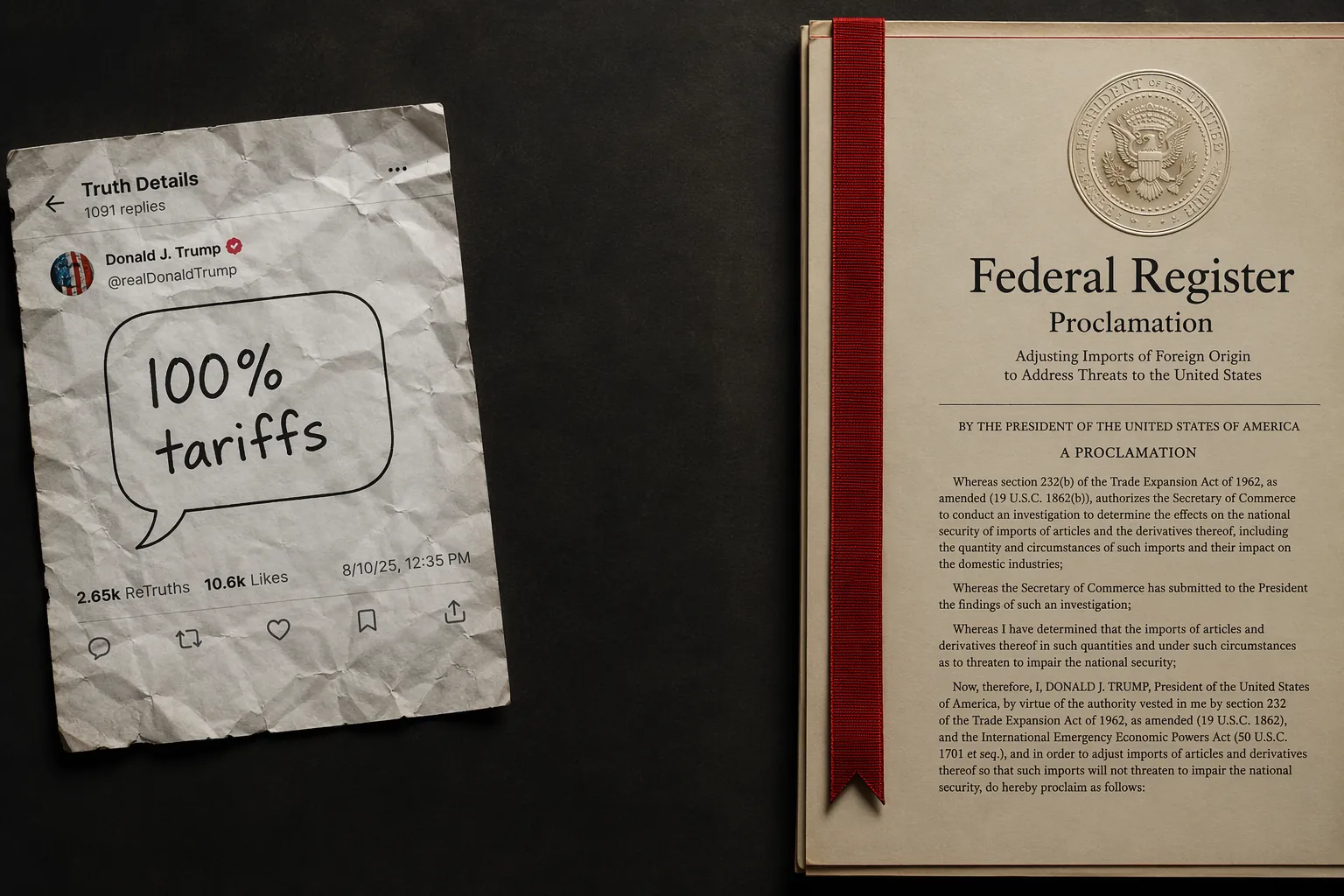
That mismatch matters before anyone reaches the familiar arguments about drug prices, shortages, or reshoring. A tariff can be plausible policy and still not yet be an enforceable legal obligation. A procurement team may have to renegotiate supply commitments because counterparties are alarmed by the announcement. An importer may have to model exposure. A generic manufacturer may have to revisit active pharmaceutical ingredient sourcing. None of that makes the announced rates self-executing.
The practical question is narrower: what document, under what statutory authority, would make the 2028 generic drug tariffs legally operative? Until that question is answered, the legal analysis is a verification exercise, not a rate prediction.
The April Proclamation Is the Baseline, Not a Footnote
Section 232 is not a casual label. It is a trade statute with a procedure, findings, presidential action, implementation mechanics, and litigation consequences. The April 2, 2026 proclamation is therefore doing more work than a news-cycle reference to “pharmaceutical tariffs” might suggest. It adjusted imports of pharmaceuticals and pharmaceutical ingredients under Section 232, but it carved out generic pharmaceuticals and their ingredients and required reassessment within one year.[1]
For counsel, that exclusion is not a drafting curiosity. It means the existing proclamation does not appear, on its face, to impose the announced generic drug tariffs. If a party wants to treat the July announcement as legally binding today, it has to identify the bridge from an exclusion in April to inclusion in 2028. A social-media statement is not that bridge.
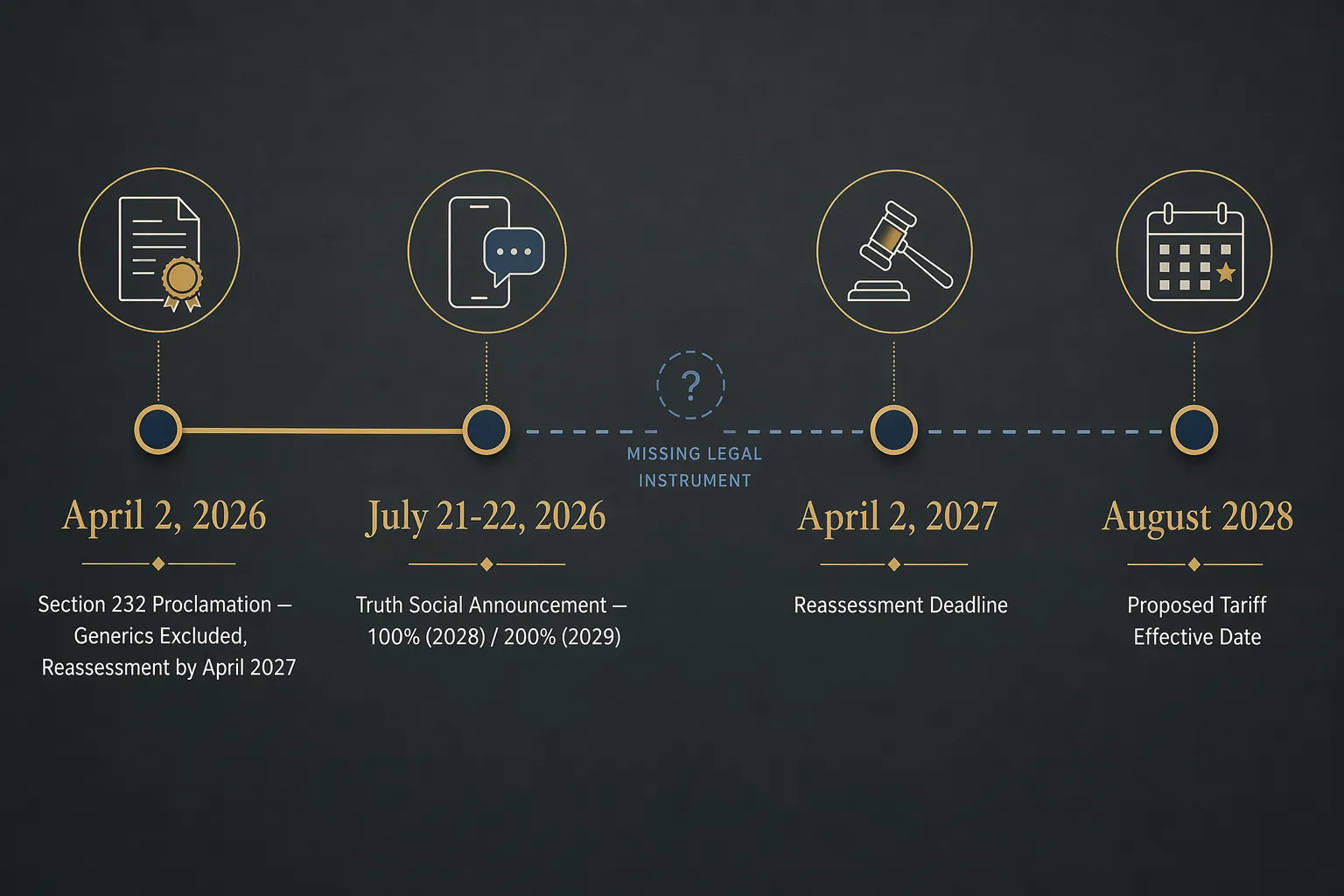
The reassessment clause also limits how far one can responsibly extrapolate. It does not guarantee that generics remain excluded forever. It does not prevent the administration from developing a new record or issuing a later action. But it does establish a procedural marker: April 2, 2027. Any later generic-specific tariff action should be checked against that reassessment framework, including whether the government is relying on the promised reassessment, a new Section 232 investigation or finding, or some separate source of authority.[1]
That is why the August 2028 effective date cannot be analyzed in isolation. The legal sequence currently runs this way: generics excluded on April 2, 2026; informal generic tariff announcement on July 21–22, 2026; reassessment deadline on April 2, 2027; proposed tariff start in August 2028. The missing item is the operative instrument connecting the second event to the fourth.
Three Possible Legal Routes, Three Different Vulnerabilities
The administration could try to reach the announced result through at least three pathways. They should not be collapsed into one generalized “tariff authority” bucket, because each creates a different review problem and a different set of documents to request.
| Possible route | What counsel would need to verify | Primary vulnerability |
|---|---|---|
| New or revised Section 232 action | Whether generics are newly included through a valid finding, proclamation, reassessment, or implementing notice | Whether the action is procedurally traceable from the April 2026 exclusion and supported by the required national-security record |
| IEEPA-based action | Whether the government invokes emergency economic powers despite the Supreme Court’s 2026 reciprocal-tariff ruling | Whether the action runs into the same statutory limits that affected earlier reciprocal tariffs |
| Separate executive action | What statute or delegated authority is actually cited once the instrument is published | Whether the asserted authority reaches generic drug imports at the announced rates and timetable |
The first route is the most obvious because the April pharmaceutical action already used Section 232. It is also the route that demands the most careful reading, precisely because the existing document cuts against the July announcement rather than implementing it.
If the Route Is Section 232, the Generic Exclusion Has to Be Overcome
A future Section 232 instrument could change the analysis. The administration might publish a reassessment concluding that generic pharmaceutical imports threaten national security, issue a revised proclamation, direct Customs and Border Protection to collect duties on specified products, and define coverage by tariff classification, product type, ingredient status, country of origin, or some combination of those features. If that happens, the analysis moves from “there is no instrument” to “does this instrument lawfully do what it says?”
The current record does not permit that second question to be answered cleanly. The April proclamation’s generic exclusion means one cannot simply cite the existing Section 232 action as though it already covers the announced 2028 tariffs. The government would need to show where generics enter the operative text, when the rate attaches, which goods are covered, and how the action relates to the one-year reassessment the proclamation itself required.[1]
That may sound formalistic until a shipment is on the water. At entry, someone has to classify the product, determine origin, apply the duty rate, and decide whether to protest or reserve rights. Contract teams have to decide whether tariff clauses are triggered by announcement, enactment, collection, or final adjudication. Regulatory teams have to know whether a proposed sourcing change is merely prudent planning or a response to an enforceable trade measure. Those are document-dependent judgments.
Law-firm alerts have accordingly focused importers on monitoring the Section 232 process, product scope, country-of-origin questions, and implementation details rather than treating the pharmaceutical tariff landscape as fully settled.[2][3] That is the right emphasis. The most important legal fact is still not the announced percentage. It is whether a later Section 232 document validly reverses or supplements the April exclusion.
If the Route Is IEEPA, the Supreme Court Problem Returns
An International Emergency Economic Powers Act route would present a different problem. The analysis should be restrained: do not assume that every tariff labeled emergency-based fails, and do not assume that a loss in the reciprocal-tariff litigation disables every future import measure. The question is whether the new action relies on the same type of authority the Supreme Court rejected in Learning Resources, Inc. v. Trump.
For readers tracking that issue, Lex Machina Review’s internal analysis of which Canada tariffs survive after the IEEPA ruling is the better place to verify the holding before applying it here. The generic-drug question should not be answered from half-remembered summaries of the reciprocal-tariff cases. If a future generic tariff instrument invokes IEEPA, counsel would need to compare the actual text of that instrument against the Supreme Court’s ruling and any limiting language in the decision.
That comparison would be litigation-sensitive. A party challenging an IEEPA-based generic tariff would likely focus on statutory authority, the fit between the declared emergency and the tariff remedy, and whether the government is attempting to accomplish through emergency powers what the Court has already refused to allow in the reciprocal-tariff context. But without an IEEPA instrument, those remain conditional arguments, not present defects in an enforceable rule.
If the Route Is Something Else, the Authority Cannot Be Assumed
The third possibility is a separate executive action invoking a different statute or a combination of authorities. That route deserves less speculation because there is no instrument to read. The useful point is negative: counsel should not assign legal risk as though the authority were already known. A memorandum saying “tariffs announced” is not the same as a memorandum identifying statutory authority, effective date, covered tariff lines, exemptions, implementation agency, and challenge route.
This is also where automated or generic legal research can go wrong. A system that fills the gap by assuming Section 232, IEEPA, or a familiar trade statute may produce a fluent memo and still fail the only test that matters: whether the cited authority is the one the government actually used. The broader problem is not unique to pharmaceuticals; it is the same verification failure discussed in Lex Machina Review’s article on AI tools for Trump tariff legal analysis.
Section 232 May Be Stronger Than IEEPA, but That Does Not Supply the Missing Step
There is a fair counterweight to the vulnerability analysis. Atul Pandey of Khaitan & Co. was quoted after the July announcement as noting that the earlier reciprocal tariffs were struck down by the Supreme Court, while the latest tariffs claim a “stronger statutory foundation” under Section 232; he also cautioned that a successful court challenge may “delay or reshape the policy” rather than end it outright.[4]
That assessment is important because it resists an easy but sloppy conclusion: that the Supreme Court’s reciprocal-tariff ruling automatically defeats any later pharmaceutical tariff. It does not. Section 232 has its own statutory architecture, and courts may treat a properly developed Section 232 action differently from a challenged IEEPA tariff. A national-security trade measure supported by the right findings and implemented through the right documents is a different legal object from a social-media announcement or an emergency-power tariff that exceeds statutory limits.
But the counterweight does not solve the April problem. A stronger statutory platform still requires a valid procedural bridge. If the government relies on Section 232, counsel still has to locate the finding or reassessment that brings generics into scope after their express exclusion. If it relies on IEEPA, counsel still has to test the instrument against the Supreme Court’s tariff ruling. If it relies on another authority, counsel still has to identify that authority before assigning obligations.
Country of Origin Turns the Announcement Into a Contract Problem
The legal uncertainty does not make the business consequences imaginary. Generic-drug supply contracts often run ahead of legal clarity, and counterparties do not wait for a clean Federal Register citation before asking who will absorb a possible duty. The right response is not to pretend the announced tariffs are enforceable. It is to map where exposure would attach if an enforceable instrument later appears.
Brookings’ pharmaceutical tariff analysis is useful here because it ties tariff exposure to country-of-origin rules rather than to a broad story about “foreign drugs.” For single-API drugs, Brookings explains that the API source can determine tariff liability, meaning exposure may attach even where final dosage form finishing occurs elsewhere.[5] That distinction is the difference between a vague supply-chain worry and a concrete diligence request.
A counsel-led review should therefore ask for the API source, the manufacturing and finishing locations, the declared origin theory, the tariff classification, and the contract language allocating changes in duty. The answer may vary by product. A generic finished in one country may not escape exposure if the relevant origin rule points back to an API made in another. Conversely, a company should not assume that every foreign processing step produces the same tariff result.
Brookings also discusses the thin margins and supply-chain structure that make generic-drug tariffs difficult to absorb.[5] Those facts matter legally because they affect renegotiation pressure, force majeure arguments, commercial impracticability theories, and the credibility of reshoring plans. They do not prove that the announced tariffs are invalid. They explain why legally uncertain tariffs can still move behavior before they are enforceable.
Onshoring Is Not Just a Tariff Question
The policy premise behind pharmaceutical tariffs is often stated as if higher import costs straightforwardly induce domestic production. That may be the goal, but the legal and regulatory path is slower. Moving generic-drug manufacturing or API sourcing can implicate FDA submissions, facility qualification, supplier qualification, quality agreements, inspection timing, and customer approvals. A tariff proclamation cannot by itself create inspected capacity.
Lachman Consultants warned after the July announcement that FDA inspection capacity is already strained, a point that matters if tariff policy pushes companies toward new or shifted manufacturing arrangements.[6] This is not a reason to ignore tariff risk. It is a reason to be careful when a contract counterparty treats relocation as an immediate substitute for duty exposure.
For legal teams, the onshoring question should be sequenced. First identify whether there is an enforceable tariff instrument. Then identify covered products and origin exposure. Only then evaluate whether a sourcing or manufacturing change is feasible under trade, FDA, quality, and commercial obligations. Reversing that order can turn a political announcement into unnecessary regulatory churn.
What Can Be Verified Now
As of July 24, 2026, the announced 2028 generic drug tariffs are a serious planning risk, not a settled legal obligation. That is not a comforting answer, but it is the answer the documents support. The April Section 232 proclamation excluded generics and created a reassessment window ending April 2, 2027; the July announcement supplied rates and timing, but not an enforceable instrument.[1]
Before signing off on contract language, customs treatment, supply relocation, reserves, or litigation posture, counsel should be able to answer a short set of document-based questions:
- What is the operative authority: Section 232, IEEPA, or another statute?
- Where is the formal instrument: proclamation, Federal Register notice, regulation, agency instruction, or other legally operative document?
- Does the instrument expressly include generic pharmaceuticals and generic pharmaceutical ingredients after the April 2026 exclusion?
- How does the timing fit with the April 2, 2027 reassessment deadline and the announced August 2028 effective date?
- Which products, tariff classifications, countries of origin, API sources, and exemptions are covered?
- Which challenge route applies, and how does the pathway interact with the Supreme Court’s reciprocal-tariff ruling and Section 232 procedure?
Those questions do not eliminate commercial risk. They keep legal advice tied to something more durable than an announcement. A 100% or 200% tariff would be large enough to alter sourcing, pricing, and contract allocation across the generic-drug sector. But until the government publishes the legal instrument that imposes it, the enforceability analysis begins and ends with the same missing page.
References
- Adjusting Imports of Pharmaceuticals and Pharmaceutical Ingredients Into the United States, White House, April 2026.
- Section 232 Pharmaceutical Tariffs: What Importers Need to Know, McDermott Will & Emery.
- Executive Order Imposing Section 232 Tariffs on Pharmaceuticals and Pharmaceutical Ingredients, Foley Hoag, April 2026.
- Economic Times pharma article, Economic Times, July 22, 2026.
- Pharmaceutical tariffs: How they play out, Brookings, March 2025.
- Tariffs on Generics: The Law of Unintended Consequences Is Lurking Nearby, Lachman Consultants, July 23, 2026.
Operationalizing workflow
No workflow has been explicitly linked to this obligation yet. See Workflows generally.
Illustrative cases
No illustrative case is currently tracked for this obligation. See Risk Digest for documented incidents generally.
← Back to RegulationReport a correction or tip
Spotted an outdated figure, a misstated fact, or a ruling this regulation entry should reflect? Public comments are disabled for this content given the professional cost of a misreported case outcome, penalty amount, or rule text — use the structured correction channel instead.
Report a correction or tip for this record →