
Has Georgia's Gas Tax Suspension Expired?
- Authority
- Georgia Department of Revenue
- Rule type
- regulation
- Jurisdiction scope
- US state - Georgia
- Effective date
- Jun 3, 2026
- Source text
- Read primary rule text ↗
Distributors and IFTA carriers must treat the motor fuel excise tax as reinstated on June 3, 2026, and follow DOR post-suspension return, refund-claim, and IFTA reporting guidance.
Regulation & Ethics obligations tracker. This record is general legal and tax information, not legal, tax, accounting, or carrier-compliance advice. Legal-background review: Mara Ellison, J.D., Georgia state-law editor. Last verified: August 2, 2026, 16:00 UTC. For comparison with this site’s current-law tracker format, see the AI literacy obligations tracker.
| Current status question | Answer as of August 2, 2026 |
|---|---|
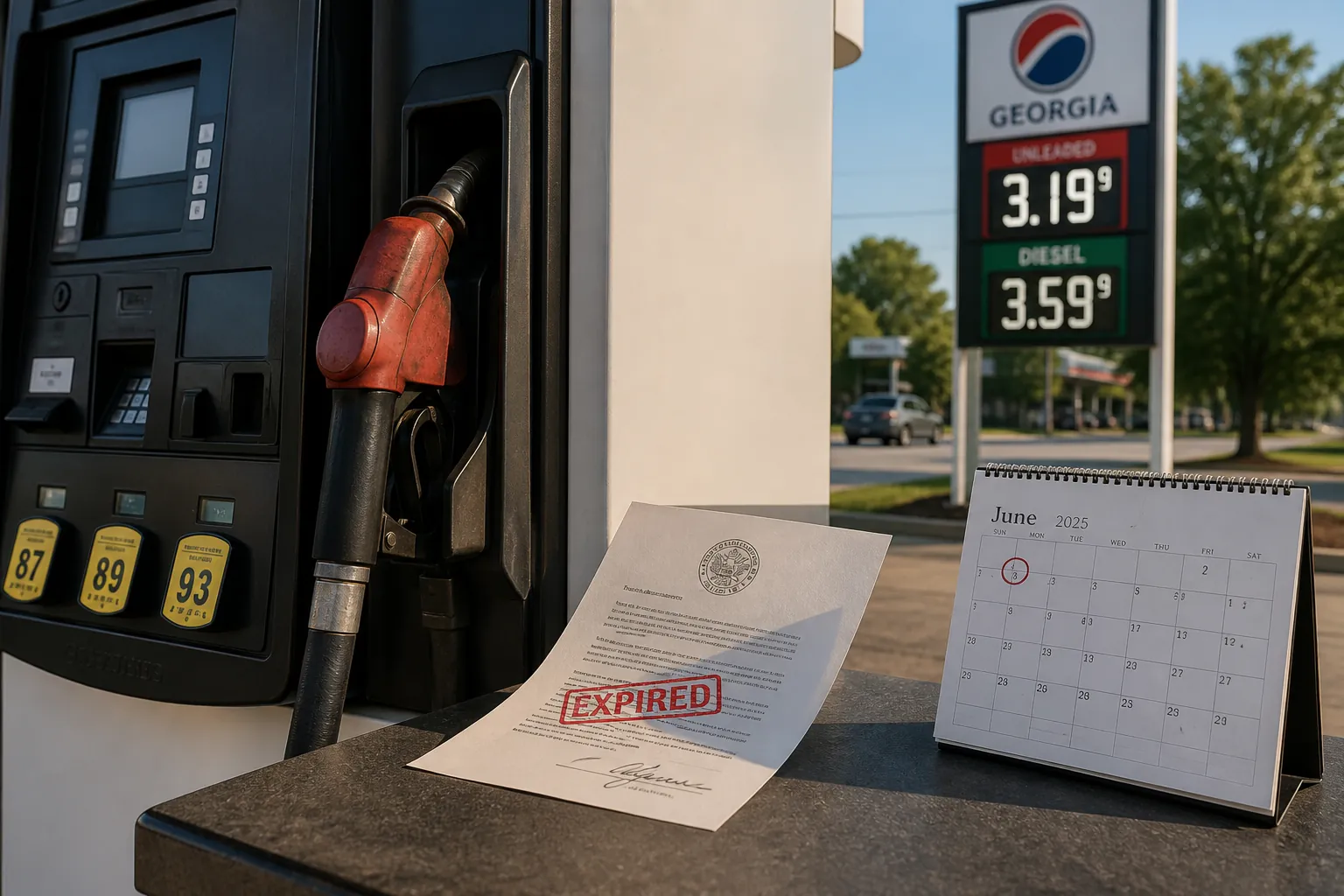
| Is Georgia’s 2026 gas tax suspension still active? | No. The 2026 suspension has expired. Georgia’s motor fuel excise tax resumed June 3, 2026. [1][2] |
| What are the reinstated state excise tax rates? | 33.3 cents per gallon for gasoline and 37.3 cents per gallon for diesel. [1][2] |
| Was the final legal endpoint June 2 or June 3? | The executive-order suspension ran through 11:59 PM June 2; the tax returned on June 3. [1] |
| Has a new suspension been announced? | No further suspension is in effect or announced in the cited current-law materials as of this verification date. [1] |
The short answer is therefore not “extended,” “pending,” or “through June 3” in the loose press-release sense. The operative answer is that the state motor fuel excise tax is back in force for taxable activity on and after June 3, 2026, and affected filers are now in the post-suspension reporting posture described by the Georgia Department of Revenue. [1][2]
The legal timeline has two parts, and the handoff matters
Georgia’s 2026 suspension did not operate as one open-ended holiday. It came in two legal phases: first, a statutory suspension tied to HB 1199; second, a short executive-order extension that bridged the period from May 20 through June 2.
| Phase | Legal instrument | Effective window | What happened after it ended |
|---|---|---|---|
| 1 | HB 1199 statutory suspension | 11:00 AM March 20, 2026, through 11:59 PM May 19, 2026 | The statutory suspension ended; the executive order began immediately after. [1][3] |
| 2 | Executive Order 05.15.26.02 | 12:01 AM May 20, 2026, through 11:59 PM June 2, 2026 | The motor fuel excise tax resumed June 3, 2026. [1][4] |
HB 1199 was signed March 20, 2026. The Department of Revenue’s suspension materials identify the statutory suspension period as beginning at 11:00 AM on March 20 and ending at 11:59 PM on May 19. That is the first period a distributor or reporter has to separate from the later executive-order period. [1][3]
Executive Order 05.15.26.02 then took over at 12:01 AM on May 20 and ran through 11:59 PM on June 2. The order was signed May 15 under the title “Declaring a State of Emergency due to Acute Consumer Price Shock,” and it extended the suspension for the additional period after the statutory window closed. [4][5]
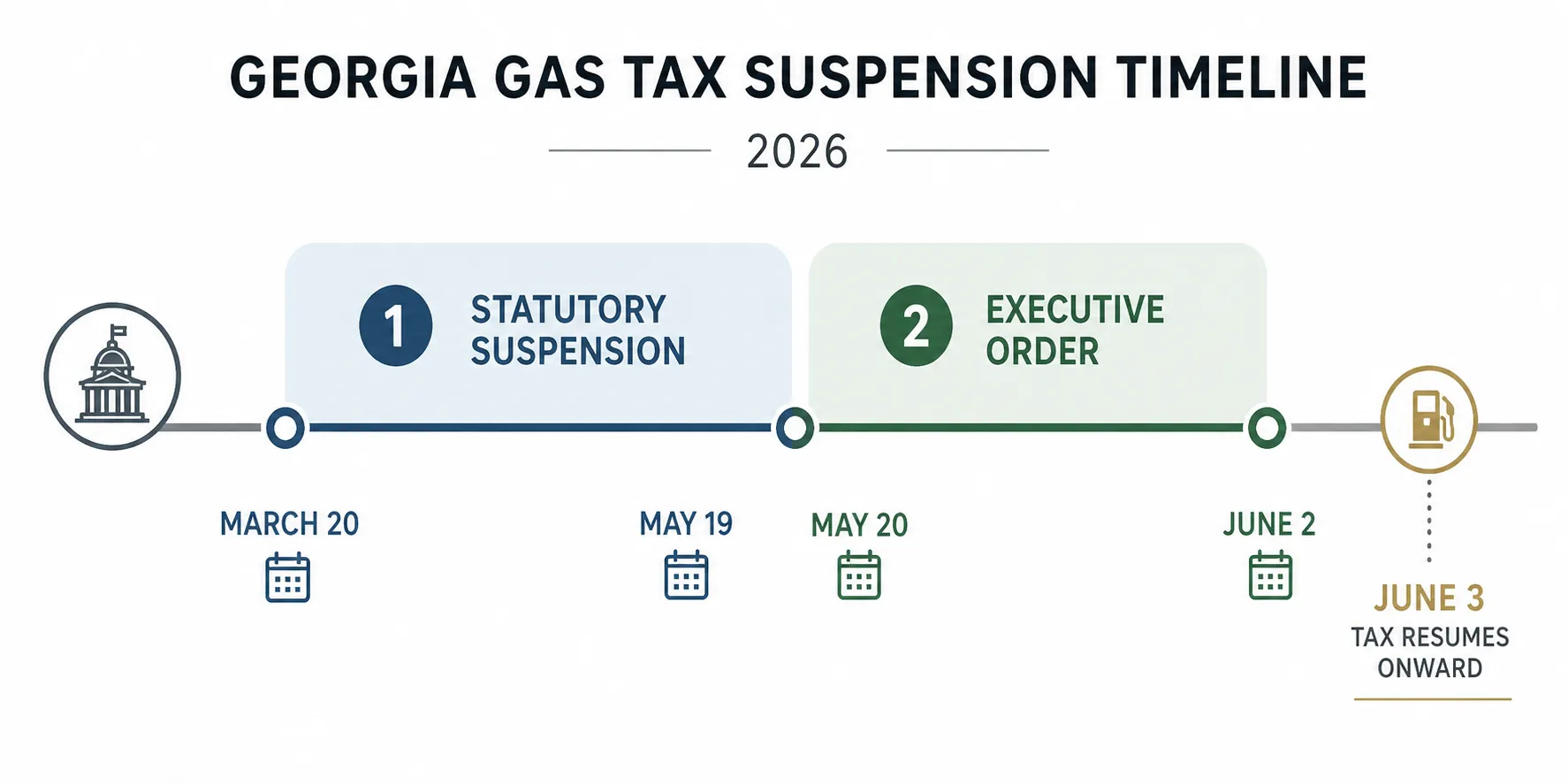
The point that deserves care is the endpoint. The Governor’s May 15 release described the extension as running “through June 3,” but the Department of Revenue’s current suspension FAQ states the executive-order period ended at 11:59 PM June 2 and that the tax resumed June 3. For return and remittance purposes, the Department of Revenue and the operative order control the mechanics: June 3 is the return date, not another full suspended-tax day. [1][4][5]
The executive order was later ratified by House Resolution 3EX during Georgia’s June 17–23, 2026 special session. That ratification matters to the record of authority for the May 20–June 2 extension; it does not create a new suspension after June 2. [6]
What tax came back on June 3
The reinstated tax is Georgia’s state motor fuel excise tax. The current rates stated in the Department of Revenue suspension materials are 33.3 cents per gallon for gasoline and 37.3 cents per gallon for diesel. Those are the figures that matter for current-law status after the suspension, not the broader phrase “gas tax holiday.” [1][2]
The suspension was also narrower than many public summaries make it sound. DOR’s materials identify the suspended taxes as the state excise tax under O.C.G.A. § 48-9-3 and the locomotive fuel tax under O.C.G.A. § 48-8-30. Prepaid local sales tax and other local taxes were not suspended. Jet fuel and dyed diesel were also outside the suspension. [1][2]
That distinction is not a technical footnote for anyone filing returns. If a tax was never suspended, it did not become payable again on June 3; it remained payable throughout. If a fuel type was excluded, the suspension did not apply to it in the first place. The useful shorthand for drivers may be “the gas tax came back,” but the filing shorthand has to be more exact.
Distributor obligations are now post-suspension obligations
For fuel distributors, the active question is no longer how to handle an ongoing suspension. DOR’s bulletin MFT-2026-01 gives the post-suspension posture: no remittance of the suspended state motor fuel excise tax was required for the suspension period, but distributors still have return and reporting tasks, including Motor Fuel Distributor Return treatment and refund-claim procedures through the Georgia Tax Center where applicable. [2]
- Separate gallons and activity that fall inside the March 20–May 19 statutory suspension window from activity inside the May 20–June 2 executive-order window and from activity on or after June 3.
- Do not treat June 3 as a suspended-tax day. DOR identifies June 3, 2026, as the date the state motor fuel excise tax resumed. [1]
- Use DOR’s Motor Fuel Distributor Return instructions rather than a news summary when determining how suspended-period activity is reported. [2]
- Use the Georgia Tax Center refund route where DOR’s guidance makes a refund claim available. [2]
- Keep excluded taxes and excluded fuels out of the suspension bucket: prepaid local sales tax, other local taxes, jet fuel, and dyed diesel were not suspended. [1][2]
None of that requires treating this article as a compliance manual. The practical point is simpler: once the suspension ended, filing accuracy depends on using DOR’s implementation documents for the suspended period and ordinary excise-tax treatment for taxable activity after June 2.
IFTA carriers should not read the expiration as a blank exemption
International Fuel Tax Agreement carriers have a separate reporting problem: they may have Georgia travel and fuel activity that overlaps the suspension windows, followed by ordinary taxed activity after June 2. DOR’s FAQ includes IFTA guidance for the 2026 suspension, and carriers should apply that guidance to the relevant reporting periods rather than assume that Georgia miles or fuel purchases are simply ignored because a state excise tax was temporarily suspended. [1]
For IFTA purposes, the status statement is narrow. Georgia’s suspended state excise tax period ended before June 3; the state excise tax resumed June 3; and carrier reporting should be checked against DOR’s IFTA instructions for the affected quarters. That is a reporting instruction problem, not an ongoing-holiday problem. [1]
Why some public accounts sounded different
Public-facing summaries of tax holidays often compress the legal endpoint into a consumer-facing date. In this instance, that compression produced a real ambiguity: “through June 3” appeared in the Governor’s May 15 announcement, while DOR’s FAQ states the suspension expired at 11:59 PM June 2 and the tax returned June 3. DOR’s FAQ is the better source for the filing answer. [1][5]
News coverage on June 3 captured the lived effect at the pump. WABE described the reinstatement as raising prices by 33 cents per gallon, and CBS News Atlanta reported that Governor Brian Kemp was not extending the suspension set to expire Tuesday night. That reporting is useful for understanding what drivers saw, but it does not change the legal endpoint or the return date. [8][7]
The Governor’s office and state leaders also framed the suspension as consumer relief. Speaker Jon Burns was quoted in the Governor’s March 20 release with an estimate of roughly $400 million in savings for Georgians. That is a public estimate attributed to state leadership; it is not the source to use for deciding whether a June return should include resumed excise-tax treatment. [3]
Current-law answer
As of August 2, 2026, Georgia’s 2026 gas tax suspension has expired. The state motor fuel excise tax resumed June 3, 2026, at 33.3 cents per gallon for gasoline and 37.3 cents per gallon for diesel. The legal suspension consisted of the HB 1199 period from 11:00 AM March 20 through 11:59 PM May 19 and the Executive Order 05.15.26.02 period from 12:01 AM May 20 through 11:59 PM June 2. [1][2][3][4]
No additional suspension is in effect or announced in the cited current-law record. Distributors and IFTA carriers should treat the matter as a completed suspension with remaining reporting, return, and refund-claim consequences under DOR guidance, not as an active motor-fuel-tax holiday. [1][2]
References
- 2026 Suspension of Georgia Motor Fuel Taxes FAQs — Georgia Department of Revenue
- MFT-2026-01 Suspension of Georgia Motor Fuel Taxes — Georgia Department of Revenue
- Gov. Kemp Signs Major Tax Relief Bills for Hardworking Georgians — Office of the Governor of Georgia, March 20, 2026
- 2026 Executive Orders — Office of the Governor of Georgia
- Gov. Kemp Suspends Gas Tax for Two Additional Weeks — Office of the Governor of Georgia, May 15, 2026
- General Assembly Concludes Special Session — Georgia Municipal Association
- Gov. Kemp not extending Georgia's gas tax suspension set to expire Tuesday night — CBS News Atlanta
- Georgia's gas tax suspension lifts, raising prices by 33 cents per gallon — WABE, June 3, 2026
Operationalizing workflow
No workflow has been explicitly linked to this obligation yet. See Workflows generally.
Illustrative cases
No illustrative case is currently tracked for this obligation. See Risk Digest for documented incidents generally.
← Back to RegulationReport a correction or tip
Spotted an outdated figure, a misstated fact, or a ruling this regulation entry should reflect? Public comments are disabled for this content given the professional cost of a misreported case outcome, penalty amount, or rule text — use the structured correction channel instead.
Report a correction or tip for this record →