
Germany's 2025 Conscription Law and the Hidden Exit Rule
- Authority
- German Federal Ministry of Defence
- Rule type
- statute
- Jurisdiction scope
- Germany
- Effective date
- Jan 1, 2026
- Source text
- Read primary rule text ↗
Men aged 17–45 residing in Germany must obtain Bundeswehr approval before leaving for over 3 months; currently suspended by ministerial directive.
As of Q3 2026, the awkward answer to Germany’s 2025 military-service exit rule is this: the long-stay exit-permission rule exists in the amended Conscription Act, but its routine operation is suspended. That is not the same as repeal. For mobility files, the distinction matters because a suspended statutory obligation can return faster than a repealed one, and because the first months of 2026 produced a compliance problem that no later public instruction has clearly cured.
| Issue | Current Position |
|---|---|
| Statutory authority | Section 3(2) of the amended Wehrpflichtgesetz, changed by the 2025 military service modernization legislation. |
| Effective date | The amended rule entered into force on January 1, 2026. |
| Covered population | German males aged 17-45 who are resident in Germany, including dual nationals and recognized conscientious objectors, based on the available reporting and analysis. |
| Trigger | Leaving Germany for more than three months. |
| Approval authority | Bundeswehr Career Center. |
| Current enforcement posture | Suspended by Defense Minister Boris Pistorius through an April 7, 2026 ministerial directive; the statutory text remains in force. |
| Practical risk | Not an ordinary active approval process in Q3 2026, but a conditional compliance item that should remain on mobility and immigration risk registers. |
The provision sits inside a wider military-service modernization package. The federal government described the draft as part of an effort to adapt the Bundeswehr’s personnel system, with registration and preparedness measures tied to Germany’s security environment.[1] The exit rule, however, is narrower than the political argument over manpower. It concerns a particular act: a covered German male resident leaving the country for more than three months without prior Bundeswehr approval.
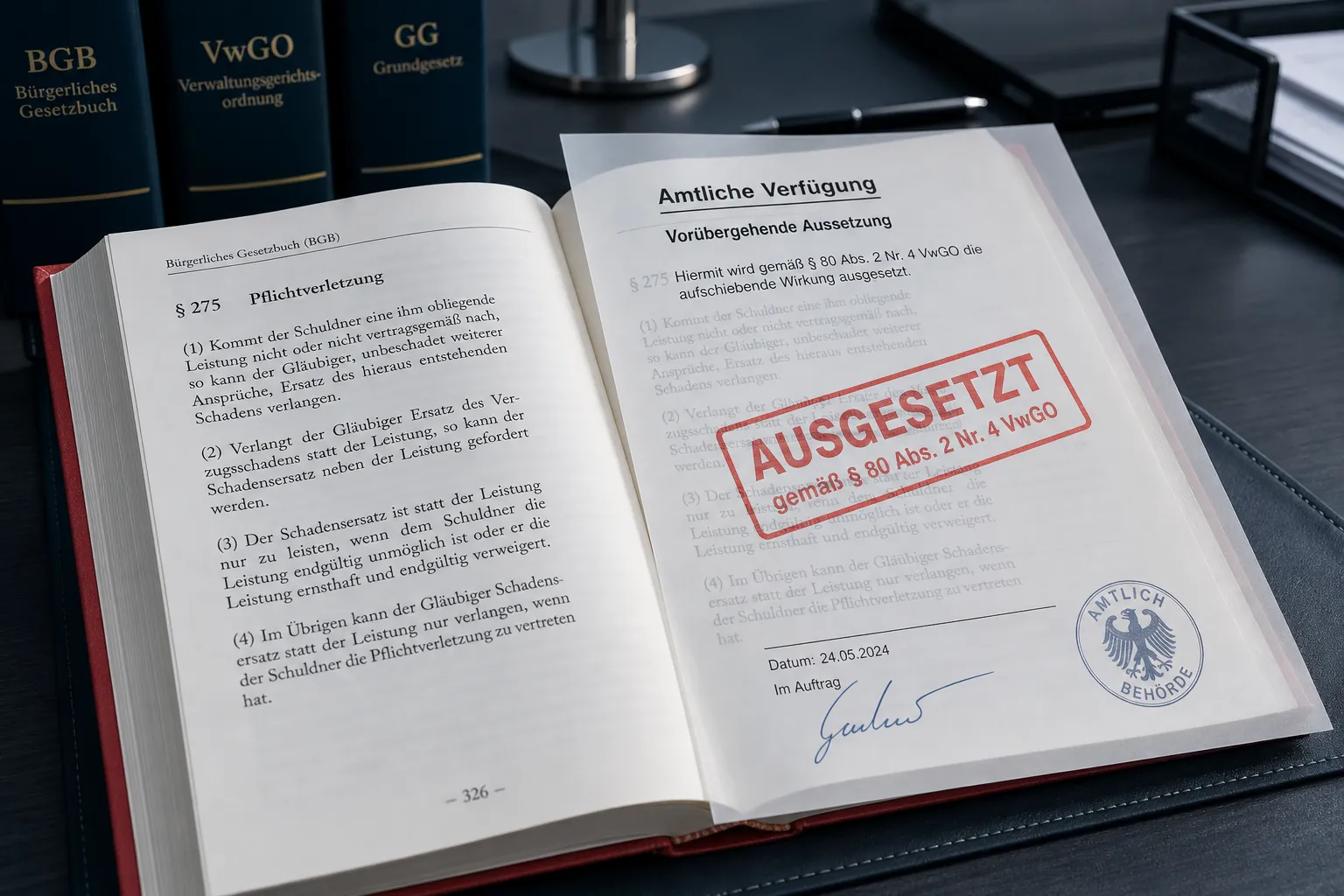
The Clause That Outlived Its Suspension
Before the 2025 amendment, the relevant travel restriction belonged to an emergency architecture. It applied in connection with a declared state of tension or defense under Articles 80a and 115a of the Basic Law. The modernization law moved the approval requirement into ordinary statutory operation, so that it was no longer confined to the emergency setting described in the prior framework.[2][3]
That is the legally interesting change. Germany did not merely revive a public debate about conscription. It placed a peacetime restriction on extended departure into the statutory text, then suspended the administrative operation of that restriction several months later. A compliance file should not flatten those two moves into one conclusion.
The reported scope is broad: German males aged 17 to 45 who reside in Germany, including dual nationals and recognized conscientious objectors.[2][3] Reporting has noted that approximately one in six German men born in 2008 hold a second passport, which is relevant because dual nationality does not appear to remove a covered person from the rule.[2] That statistic should not be used as a proxy for the number of people facing an actual permission problem. The live operational question is much smaller: who crossed, or plans to cross, the more-than-three-month threshold while resident in Germany.
Permanent expatriates who had already relocated abroad before the law took effect appear to fall outside the core case described in the available materials.[3] The harder edge cases are not resolved by the sources: a German citizen registered in Germany but spending long periods abroad, a dual national with a secondary residence, or an employee whose assignment straddles the effective date. Those are not good places for confident general advice.
The Short Timeline Matters More Than the Headline
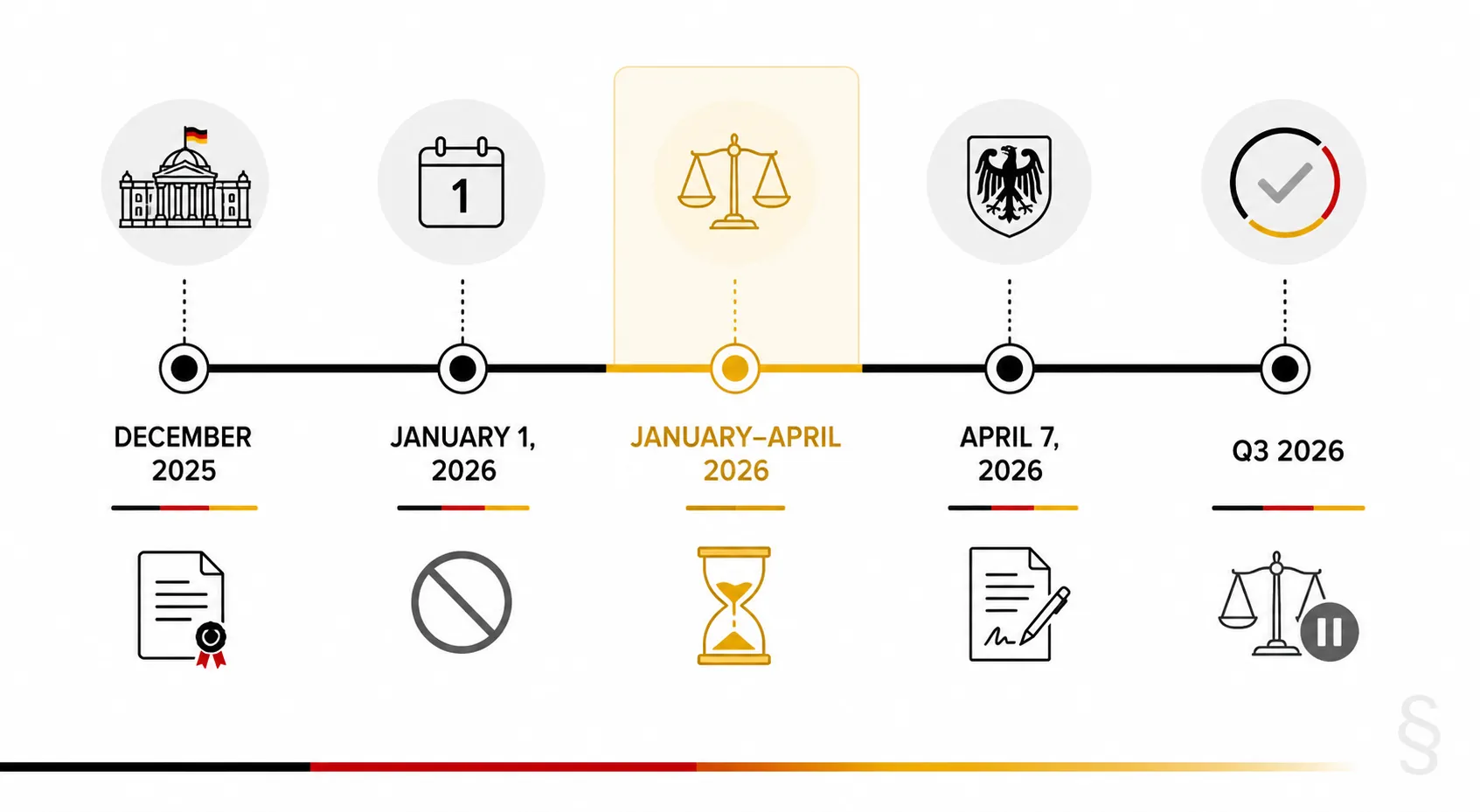
The dates are doing most of the legal work.
- December 2025: the military service modernization legislation was enacted, amending Section 3(2) of the Conscription Act.
- January 1, 2026: the amended provision entered into force.
- January-April 2026: no implementing regulations, application form, or published procedure was available for the extended-departure approval process.
- April 7, 2026: Defense Minister Boris Pistorius suspended the travel-notification and approval requirement by ministerial directive.
- Q3 2026: the ministerial suspension remains the reported enforcement posture, while the statutory authority remains in force.
The BBC reported the April 7 suspension and the absence of a developed administrative route for affected men seeking approval for long stays abroad.[2] IMI Daily likewise described the lack of implementing regulations, application forms, and Defense Ministry guidance, and reported that the ministry was still developing exception regulations as of April 2026.[3]
This leaves an inelegant but important sequence. For roughly the first quarter of 2026, the obligation was in force on paper. The people who most needed a process were not people making symbolic constitutional arguments. They were students, employees, dual nationals, and assignees with departures longer than three months. If they tried to comply, there was no published form to file. If they did not file, the literal rule gave them no clean safe harbor.
There are no reported enforcement actions in the materials for that January-April period. That absence matters and should be stated plainly. It does not, however, convert the period into a non-event. Compliance departments are often asked later whether a risk was checked, not whether prosecutors or agencies made an example of the first affected cohort.
Repeal, Suspension, and Reactivation Are Different Legal Conditions
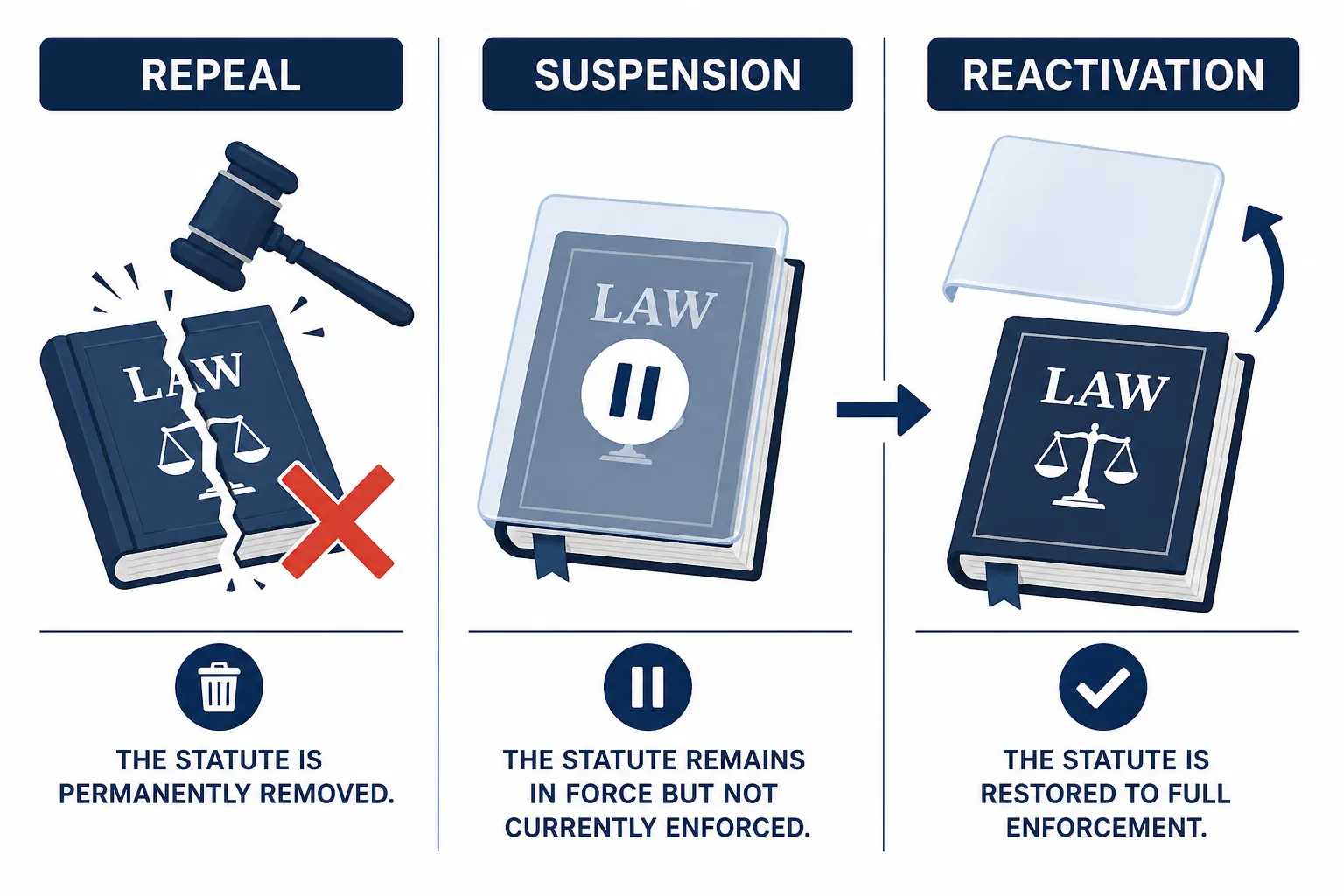
A repeal removes the obligation from the statutory structure. A suspension pauses its practical operation. Reactivation lifts the pause. The April 7 action belongs in the second category, not the first.[2][3]
That is why “suspended” is a useful word for a press release and a troublesome word for advice. It tells the affected person not to expect an ordinary approval process today. It does not tell the lawyer that the rule has disappeared. Because the suspension was ministerial rather than legislative, the available materials support the narrower conclusion that the requirement could be reactivated without new legislation.[3]
| Condition | What It Would Mean for the Exit Rule | Q3 2026 Status |
|---|---|---|
| Repeal | Parliament removes or replaces the statutory obligation. | Not shown by the available materials. |
| Suspension | The executive pauses operation of the approval requirement while the statutory authority remains. | This is the reported current posture. |
| Reactivation | The ministry lifts the suspension and begins operating the approval requirement under the existing statute. | Possible under the reported structure, but not reported as having occurred. |
For advice, the immediate consequence is modest but real. A lawyer should not tell a German-resident covered man in July 2026 that he must obtain Bundeswehr approval before an ordinary six-month work assignment if the ministerial suspension remains in place. The same lawyer should be cautious about saying the issue is closed, especially where the assignment may run for months and the government could change the enforcement posture during the assignment.
The question is not whether every covered person is at high risk. The better question is whether the file should record that a statutory travel-approval rule exists, that it is currently suspended, and that the assignment should be rechecked if the Defense Ministry issues implementing guidance or reverses the suspension.
The January-April Gap Is the Part Employers Cannot Neatly File Away
The most uncomfortable fact pattern is not a future departure after the suspension. It is a departure that began after January 1, 2026 and before April 7, 2026, where the employee was a German male resident aged 17 to 45 and the assignment exceeded three months.
The sources describe a rule in force, but no practical means to comply. No implementing regulations. No application form. No published procedure. No clear exception process.[2][3] That is a regulatory design problem before it is an employee behavior problem. A person cannot meaningfully be expected to select the right form, route the request to the right office, and satisfy the right evidentiary standard if none of those items has been published.
Still, corporate records do not improve when the file is silent. If an employer sent a covered employee abroad for a six-month assignment in February 2026, the prudent record is not a dramatic admission of illegality. It is a dated note: the statute had entered into force; no application mechanism was publicly available; the ministry later suspended the requirement; no enforcement action is known from the available materials; and the file should be revisited if the government issues retroactive guidance or a curative measure.
That note may never be needed. But if a later immigration, defense, audit, or ethics question asks whether the company assessed the rule, “the requirement was suspended in April” will not answer what happened in February.
Files Worth Reviewing
- German male employees aged 17-45 who were resident in Germany on or after January 1, 2026.
- Assignments, secondments, remote-work approvals, study leaves, or transfers outside Germany lasting more than three months.
- Departures initiated between January 1 and April 7, 2026.
- Dual nationals who may have been treated internally as only foreign nationals for mobility-screening purposes.
- Conscientious objectors who may have been incorrectly excluded from screening because the business viewed the rule as only a military-service availability issue.
The review should stay disciplined. The available sources do not quantify how many covered men actually left Germany for more than three months during the gap. They also do not show penalties being imposed. Inflating the affected population may create attention, but it does not create better advice.
Scope Questions That Remain Unsettled
The statute’s reported core is clear enough for triage, but not clear enough for every residence scenario. “Resident in Germany” does the work. The materials do not resolve how the rule applies to a German citizen with a foreign home and a German registration address, a dual national who spends most of the year outside Germany, or a person whose departure began before entry into force but crossed the three-month mark afterward.
Nor should counsel assume that conscientious-objector status removes the person from the approval rule. Available analysis states that recognized conscientious objectors are included within the exit-permission obligation.[3] That inclusion is easy to miss because conscientious objection is often discussed as an exemption from armed service, not from administrative availability controls.
Dual nationality deserves the same caution. A second passport may change an employee’s travel convenience, consular options, or family-law planning. It does not, on the available materials, remove a German male resident from the amended Section 3(2) framework.[2][3]
The Constitutional Issue Is Real, but Not Yet Decided
A peacetime approval requirement for leaving the country longer than three months naturally presses against Basic Law protections for freedom of movement and personal liberty. The reported legal concern centers on Articles 11 and 2, especially because the revised rule is no longer limited to a declared state of tension or defense.[3]
That is not the same as saying the provision is unconstitutional. The research materials do not identify a filed constitutional challenge as of mid-2026, and they do not provide a judicial ruling. The responsible posture is to flag the tension, not to advise as though a court has already resolved it.
The comparison with Sweden and Norway sharpens the point without settling it. Available analysis describes those systems as notification-based rather than permission-based: the individual informs the state, rather than seeking approval to leave.[3] Germany’s amended model is therefore more restrictive among the comparable examples discussed in the sources, but comparative discomfort is not a legal holding.
What Counsel Should Track in Q3 2026
The practical work is not complicated, but it has to be dated. Immigration counsel and mobility teams should separate present operations from statutory existence. Presently, the approval process should not be treated as routinely enforceable if the April 7 suspension remains the current directive. Statutorily, the provision should remain visible because no repeal has been identified in the available materials.
- Keep the rule in risk registers as suspended, not eliminated.
- Screen long-term departures for the narrow trigger: German male resident, age 17-45, more than three months outside Germany.
- Preserve a separate note for January 1-April 7, 2026 departures because that period combined statutory effectiveness with missing implementation machinery.
- Monitor Defense Ministry guidance, Bundeswehr Career Center procedures, exception regulations, and any legislative repeal or amendment.
- Avoid treating dual nationals or conscientious objectors as categorically outside the rule unless later official guidance says so.
The cleanest advice is conditional. Counsel should not advise as if the exit-permission obligation is currently enforceable in routine cases under an active application process. Counsel also should not delete it from the compliance map. The statute survives the suspension, and the January-April 2026 gap has not been affirmatively extinguished.
References
Operationalizing workflow
No workflow has been explicitly linked to this obligation yet. See Workflows generally.
Illustrative cases
No illustrative case is currently tracked for this obligation. See Risk Digest for documented incidents generally.
← Back to RegulationReport a correction or tip
Spotted an outdated figure, a misstated fact, or a ruling this regulation entry should reflect? Public comments are disabled for this content given the professional cost of a misreported case outcome, penalty amount, or rule text — use the structured correction channel instead.
Report a correction or tip for this record →