
Gordie Howe Bridge toll deal creates legal uncertainty for shippers
- Authority
- Gordie Howe International Bridge Authority
- Rule type
- regulation
- Jurisdiction scope
- US federal
- Source text
- Read primary rule text ↗
Bridge authority must obtain U.S. consent for toll changes exceeding 10% or outside regional averages.
The first legal fact most shippers will touch is not the cable-stayed span over the Detroit River. It is the toll line in a freight quote. For the Gordie Howe International Bridge, the listed opening toll is $5.75 USD / $8.00 CAD for passenger vehicles and $8.75 USD per axle for commercial vehicles; the bridge authority also lists a Breakaway discount program of 25% for eligible frequent users. Those figures can be put into a lane model now. The harder question is how stable that model remains once the new U.S.-Canada revenue-sharing and toll-consent framework is layered over the original crossing agreement. [1][2]
Jurisdiction, date, and source status
This article treats the toll arrangement as a cross-border regulatory and contracting issue, not as legal advice. It is current to July 28, 2026. The relevant legal setting spans Canada, Michigan, and the United States, but the immediate commercial users are practical: carriers, brokers, shippers, customs-adjacent service providers, and counsel who must decide how to draft price-adjustment language for Windsor-Detroit traffic.
The official Gordie Howe International Bridge toll-rate page is the source used here for the listed tolls. The official project site also lists a Proposed Agreement in Principle page, but as accessed for this article its full text did not load; the 2026 agreement terms below therefore rely on published reporting by Global News and CP24/CTV that quoted or described the agreement text. That caveat matters because the dispute is not about whether tolls exist. It is about which legal instrument controls future toll governance. [1][3][4][5]

The current toll cost is straightforward enough to model
For a passenger vehicle, the published opening price is $5.75 USD or $8.00 CAD. For a commercial vehicle, the published price is $8.75 USD per axle. The rate card also identifies a Breakaway program with a 25% discount, which may matter for carriers with repeat crossings, depending on eligibility and use pattern. [1][2]
| User category | Published opening toll | Commercial significance |
|---|---|---|
| Passenger vehicle | $5.75 USD / $8.00 CAD | Useful for retail and employee travel budgeting; less central to freight contracts. |
| Commercial vehicle | $8.75 USD per axle | Direct input for carrier bids, customer fuel-and-toll pass-through clauses, and route comparisons. |
| Frequent users | Breakaway discount program listed at 25% | May lower realized toll cost for eligible users, but does not answer who controls future rate changes. |
That last distinction is the point. A discount program can change the amount a particular carrier pays. It does not remove the need to know whether toll increases, toll reductions, or negotiated rate structures are controlled by the bridge authority alone, by Canada under the original crossing economics, or by a later U.S. consent mechanism.
The 2026 deal adds a U.S. toll-governance layer
The July 2026 agreement in principle reportedly gives the United States 50% of net bridge and crossing-related revenues for the first 15 fiscal years. The U.S. share is to flow through an Economic Development Fund defined to benefit “the United States and trade between Canada and the United States.” Reporting on the agreement text did not identify a Canadian governance role in that fund. [4][5][6]
The same reported agreement gives the United States veto rights over certain toll changes. The U.S. can veto toll increases of more than 10% in a fiscal year when the resulting rate would exceed the average of comparable regional crossings. It can also block toll reductions below that average. A 30-day consent-or-deem process applies. [4][5]
For commercial users, those phrases are not decorative. “Comparable regional crossings” can become the benchmark for whether a rate is permissible. A 10% fiscal-year threshold can become the difference between a routine adjustment and a consent event. A deemed-consent mechanism can become the timing rule around which a carrier decides whether to hold a bid open, reserve capacity, or reopen a customer price.
The arrangement also changes the incentives around reductions. A bridge operator lowering tolls below regional averages might help stimulate traffic or respond to competitive pressure, but under the reported framework that decision is not simply a local pricing move. It may be a revenue-affecting action subject to U.S. objection.
The unresolved conflict is with the 2012 Crossing Agreement
The original 2012 Crossing Agreement has been described as giving Canada priority to recoup the full $6.4 billion CAD construction cost before profit-sharing with Michigan. That was the commercial premise: Canada financed the bridge, and Canada would recover its construction outlay before the state participated in profits. CP24’s context reporting says the 2012 agreement is preserved, but the 2026 side arrangement functionally overlays it. [5]
The 2026 agreement-in-principle points in a different economic direction. Instead of Canada-first recoupment, it reportedly starts a 50% U.S. share of net bridge and crossing-related revenues during the first 15 fiscal years. Global News reported that the published agreement text did not mention Canada’s $6.4 billion CAD construction debt or interest costs in the revenue-sharing formula. [4][5]
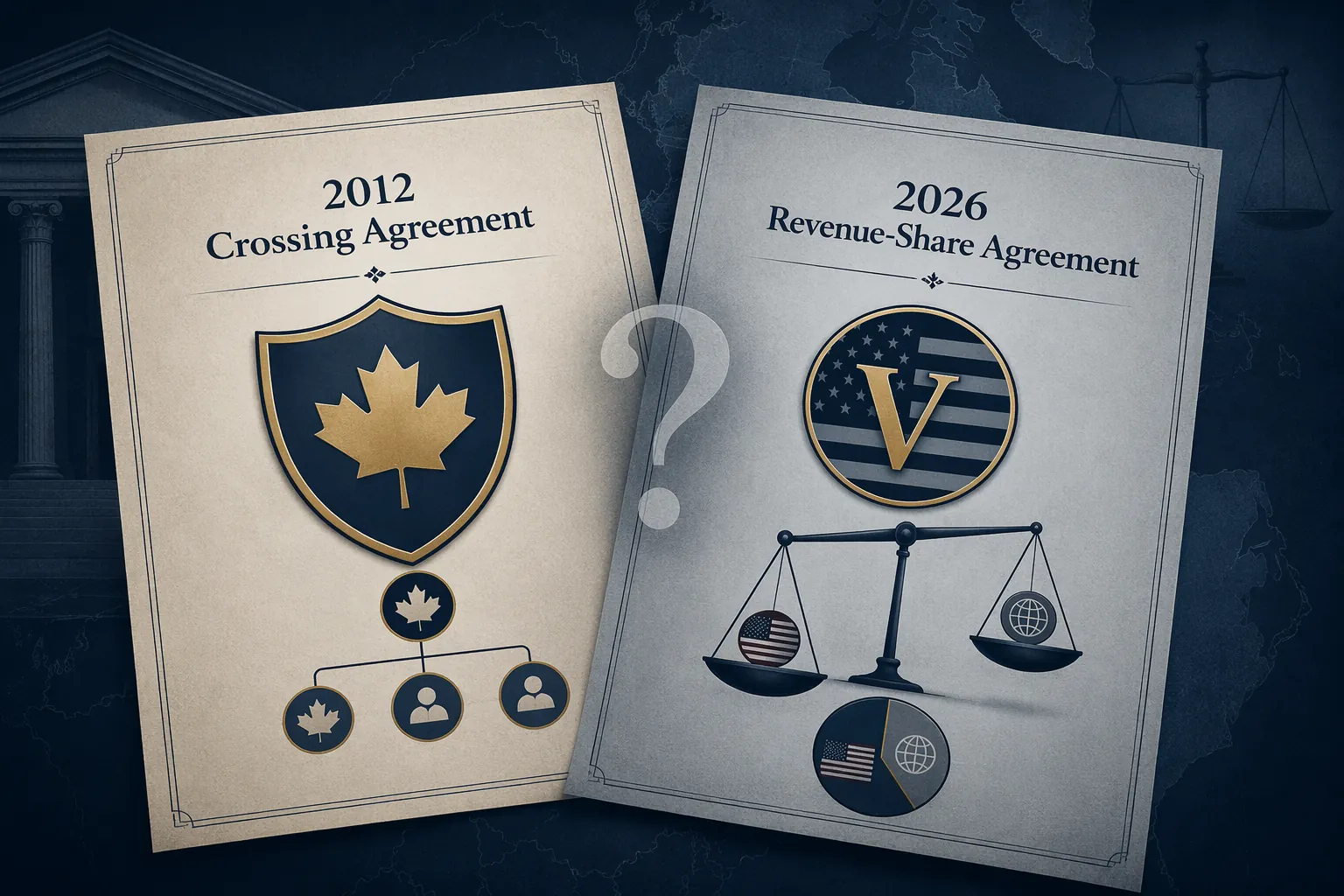
That is the legal hinge. If the 2012 instrument controls, Canada’s debt-priority economics remain central. If the 2026 instrument controls, U.S. revenue participation begins immediately and the U.S. also gains a meaningful say over certain rate changes. If both are said to coexist, the unanswered question is how to resolve a conflict between Canada-priority recoupment and immediate U.S. revenue sharing.
Nothing in the available reporting identifies a formal amendment that cleanly subordinates the 2012 Crossing Agreement to the 2026 arrangement or rewrites the earlier recoupment priority. The safer description, on the public record available as of July 28, 2026, is that the 2026 deal creates an additional governance framework whose priority over the original agreement has not been publicly resolved.
Why an “agreement in principle” still matters to pricing
The phrase “agreement in principle” can sound softer than a final implementing instrument. In a toll contract, however, even a published framework can change commercial expectations. A carrier preparing annual customer negotiations does not wait for litigation over treaty hierarchy before deciding whether to include a toll-escalation clause. A shipper assessing competing Windsor-Detroit routes needs to know whether the bridge’s future tolls are governed by a debt-recovery model, a regional-comparability model, or both.
The uncertainty is not that users cannot calculate today’s charge. They can. The uncertainty is whether future increases and reductions will be reviewed under a predictable single-instrument regime or under overlapping commitments with different economic purposes.
Carney’s statements create a reliance problem, not a separate toll rule
Prime Minister Mark Carney reportedly stated that toll sharing would not occur until Canada’s construction debt was repaid. Global News then compared those statements with the published agreement text and reported that the text provides for a 50% U.S. share during the first 15 fiscal years, without the debt-priority clause Carney described. As of July 28, 2026, the public record reviewed here did not identify a published explanation from the Prime Minister’s Office reconciling that discrepancy. [4]
The legal significance is narrower than a political credibility fight. Public statements may affect expectations, but the rate-setting risk for users comes from the written mechanism: revenue sharing, comparable-crossing benchmarks, U.S. veto rights, and the absence of a publicly clear amendment path between the 2012 and 2026 instruments.
The Economic Development Fund gives the United States a continuing revenue interest
The Economic Development Fund is not just an accounting destination. If 50% of net bridge and crossing-related revenues are routed to a U.S.-controlled fund for 15 fiscal years, the United States has an ongoing fiscal interest in the level and timing of toll receipts. That interest helps explain why the agreement pairs revenue sharing with a consent right over changes that move the toll away from regional averages. [4][5][6]
The accountability question follows from the structure. The fund is described as benefiting “the United States and trade between Canada and the United States,” but the available reporting does not specify a Canadian governance role. For Canadian-funded infrastructure, that omission matters if future toll decisions are challenged as inconsistent with the 2012 Canada-recoupment premise. [4][5]
The political backdrop is also part of the record, though not the controlling legal issue. The agreement was announced after U.S. senators pressed Canada to share toll revenues commensurate with Canada’s benefit from the crossing. That pressure helps explain the deal’s direction; it does not answer how the new terms relate to the earlier crossing agreement. [5][6]
Existing bridge litigation shows why toll rights are not theoretical
The Windsor-Detroit corridor already has active legal friction around bridge economics. CBC reported that a legal challenge involving tolls and compensation at the Ambassador Bridge will head to trial. That case is not a ruling on the 2026 Gordie Howe agreement, and it should not be treated as a precedent for the new revenue-sharing mechanism. It does, however, show that toll rights, compensation, and competitive effects around this corridor are already litigable subjects rather than abstract policy concerns. [7]
For counsel drafting transportation terms, the lesson is modest: do not assume a bridge toll is merely a posted public fee. Around this crossing, the fee sits inside financing commitments, cross-border revenue claims, regional price comparisons, and private competitive disputes.
What commercial users can treat as settled, and what they cannot
- Settled enough for current modeling: the listed opening tolls are $5.75 USD / $8.00 CAD for passenger vehicles and $8.75 USD per axle for commercial vehicles, with a 25% Breakaway discount program identified for eligible frequent users.
- Settled enough for governance tracking: the reported 2026 framework gives the United States a 50% share of net bridge and crossing-related revenues for the first 15 fiscal years and consent rights over certain toll increases and reductions.
- Not settled on the public record: whether the 2026 agreement formally amends, supersedes, or merely coexists with the 2012 Crossing Agreement’s Canada-recoupment-first structure.
- Not settled for contract drafting: how “comparable regional crossings” will be selected, how disputes over that benchmark will be handled, and whether a challenged toll adjustment would be delayed, revised, or allowed to proceed pending intergovernmental resolution.
That is enough uncertainty to affect toll pass-through clauses, bid validity periods, annual customer pricing, and risk allocation between carriers and shippers. A carrier can quote the current rate card. It should be more careful about promising that future Gordie Howe Bridge toll changes will follow a simple public-tariff path.
The practical legal implication is therefore restrained but real: commercial users can calculate the Gordie Howe Bridge toll cost now, but they cannot yet treat future toll-rate governance as settled. The 2026 U.S. veto and revenue-share framework functionally overlays the original Canada-priority crossing agreement, without a publicly clear amendment resolving which instrument controls if their economics collide.
References
- Toll Rates | Gordie Howe International Bridge — Gordie Howe International Bridge.
- It's going to cost $8 for passenger vehicles to cross the Gordie Howe bridge when it opens — CBC News.
- Proposed Agreement in Principle — Gordie Howe International Bridge — Gordie Howe International Bridge.
- Gordie Howe bridge revenue-sharing agreement appears to contradict Carney — Global News, July 22, 2026.
- Gordie Howe Bridge deal: Details revealed — CP24/CTV News, July 22, 2026.
- How will Gordie Howe Bridge profit-share deal work between Canada and the US? — Global News.
- Legal challenge over tolls, compensation at the Ambassador Bridge will head to trial — CBC News.
Operationalizing workflow
No workflow has been explicitly linked to this obligation yet. See Workflows generally.
Illustrative cases
No illustrative case is currently tracked for this obligation. See Risk Digest for documented incidents generally.
← Back to RegulationReport a correction or tip
Spotted an outdated figure, a misstated fact, or a ruling this regulation entry should reflect? Public comments are disabled for this content given the professional cost of a misreported case outcome, penalty amount, or rule text — use the structured correction channel instead.
Report a correction or tip for this record →