
How the Grant Thornton–CBIZ merger's antitrust review works
- Authority
- FTC/DOJ
- Rule type
- statute
- Jurisdiction scope
- US federal
- Effective date
- Feb 17, 2026
- Source text
- Read primary rule text ↗
Mandatory HSR filing and initial 30-day waiting period before closing
There is no useful debate over whether the Grant Thornton–CBIZ merger triggers US premerger review. The 2026 Hart-Scott-Rodino size-of-transaction threshold is $133.9 million, effective Feb. 17, 2026; the announced CBIZ transaction carries an enterprise value of approximately $5 billion.[1][2] That makes the Grant Thornton CBIZ merger antitrust review a mandatory HSR exercise, not a discretionary agency curiosity.
The open items are narrower and more practical. As of Aug. 2, 2026, the public materials reviewed here do not confirm that an HSR filing has been made, which agency has clearance, or whether staff has identified issues requiring a deeper investigation. Those are docket facts to re-check before treating any expected closing date as an antitrust timetable.
| Deal-team question | Known answer as of Aug. 2, 2026 | Why it matters |
|---|---|---|
| Is HSR review required? | Yes. The $5 billion disclosed enterprise value exceeds the $133.9 million 2026 HSR size-of-transaction threshold.[1][2] | The parties cannot close until the HSR waiting period has expired or been terminated, assuming no other closing condition blocks the deal. |
| Has an HSR filing been publicly confirmed? | Not in the public materials reviewed here. | The statutory waiting period normally does not start until the filing is made. |
| Which agency is reviewing? | Not publicly confirmed in the materials reviewed here. | Only one agency receives clearance to investigate the transaction in depth.[3] |
| What is the ordinary initial clock? | The FTC describes an initial 30-day waiting period for most reportable transactions.[3] | A routine path can fit the parties’ Q4 2026 expected closing window; a Second Request can change that. |
| What is the key delay risk? | A Second Request, which extends the waiting period until substantial compliance and then another 30 days.[3] | That is the procedural step most likely to push the deal away from an ordinary Q4 closing timetable. |
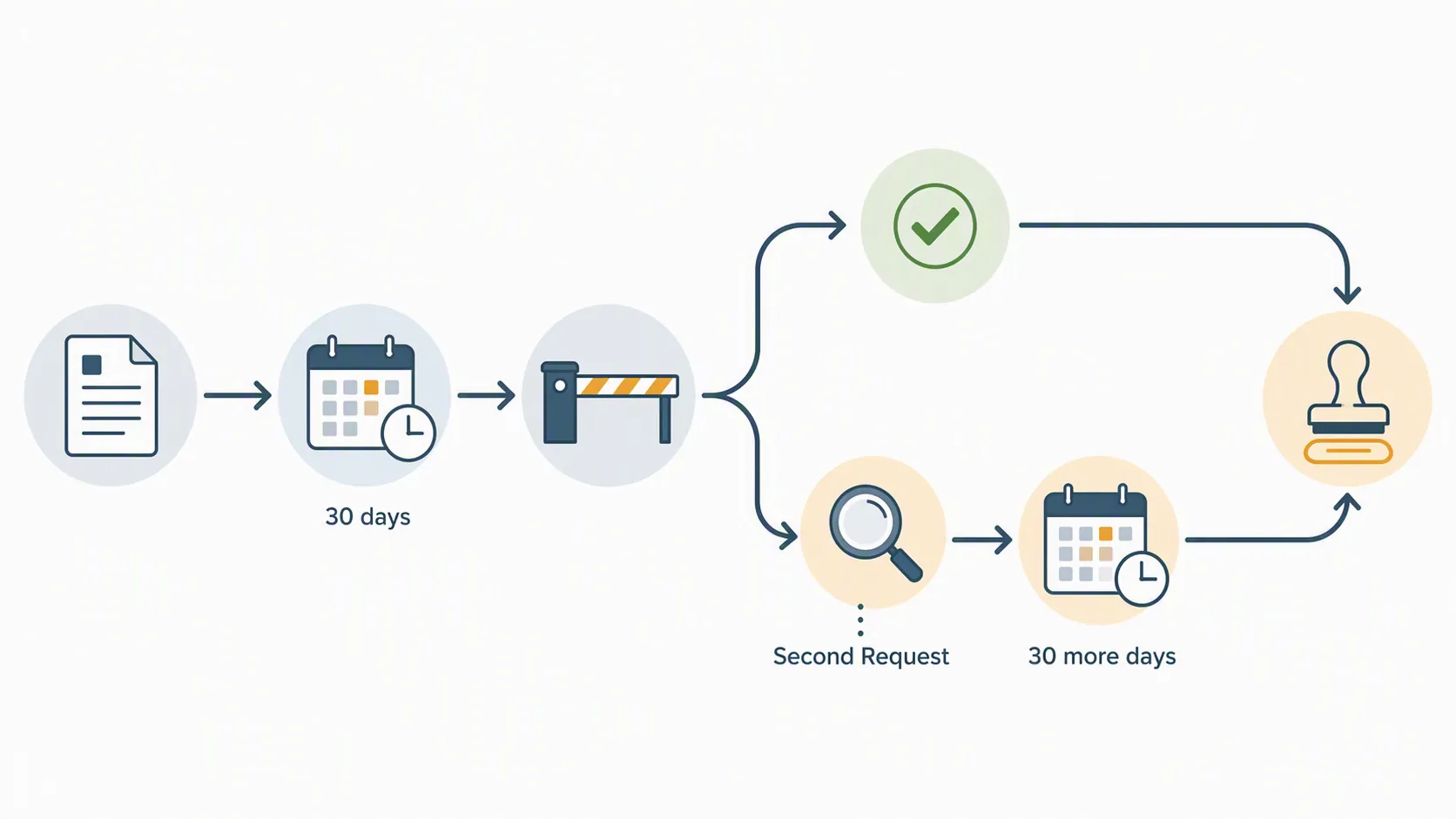
The HSR clock starts with notification, not the press release
The merger announcement and merger agreement tell readers why the deal is reportable. They do not, by themselves, start the HSR waiting period. Under the FTC’s description of the premerger process, parties to a reportable transaction submit notification, the agencies determine which one will review the deal, and the parties observe an initial waiting period before closing unless the waiting period is terminated earlier or expires by its own terms.[3]
For this transaction, the first file-control point is therefore simple: confirm the filing date. If the parties filed soon after signing, the ordinary initial period could still be compatible with the announced expectation of a Q4 2026 close. If the filing is delayed, withdrawn and refiled, or followed by a Second Request, the public closing expectation becomes less useful than the agreement’s outside date.
Agency assignment is the next missing fact. The FTC and DOJ do not both run full parallel merger investigations. The transaction is cleared to one agency, and that agency decides whether to let the waiting period expire, terminate it, negotiate a fix, or issue a Second Request.[3] Until clearance is public or otherwise confirmed, outside observers should avoid writing as though a particular agency has already taken ownership of the matter.
What the initial 30 days can and cannot tell you
The initial waiting period is not a merits ruling. It is a screening period. The agencies can review the filing, ask preliminary questions, speak with customers or competitors, and decide whether the transaction deserves more investigation. For most reportable transactions, the FTC describes the initial waiting period as 30 days.[3]
In the Grant Thornton–CBIZ deal, an ordinary expiration would mean the HSR condition has been satisfied unless a timing agreement, another legal restraint, or a separate closing condition remains in the way. It would not mean the agencies certified that every market theory is harmless. It would mean they did not use HSR to keep the parties from closing at that point.
That distinction matters because the merger agreement itself makes HSR expiration or termination a closing condition. The agreement also conditions closing on the absence of a prohibitive governmental law or order, CBIZ shareholder approval by a majority of outstanding shares, and no Company material adverse effect.[2] HSR is one gate, not the only gate.
The Second Request is the real delay scenario
If the reviewing agency needs more information, it can issue a Second Request. That is the important procedural breakpoint. The FTC describes the effect plainly: issuance of a Second Request extends the waiting period until the parties have substantially complied with the request, after which an additional 30-day waiting period runs.[3]
A Second Request would not mean the merger has been challenged. It would mean the agency is not willing to clear the transaction on the initial record. In a professional-services combination, that deeper record could include client overlaps, service-line segmentation, local or industry-specific competition, partner and employee movement, attest-practice structure, and how the planned separation of CBIZ’s Benefits and Insurance Services affects the horizontal overlap actually being acquired.[2]
The practical consequence is schedule risk. The initial 30 days is a defined period; substantial compliance is not. A Second Request creates a document, data, custodian, privilege, and negotiation exercise before the final 30-day post-compliance clock even begins. That is why the July 28, 2027 outside date matters more than the headline Q4 2026 closing expectation once a deeper review becomes plausible.[2]
The merger agreement prices friction without predicting defeat
The agreement’s risk allocation is more informative than the transaction announcement’s strategic language. CBIZ agreed to a $107.5 million company termination fee, reduced to $49.6 million in specified go-shop or excluded-party scenarios. The parent termination fee is $198.4 million and is backed by a limited guarantee from Grant Thornton Advisors. The agreement also sets an outside date of July 28, 2027.[2]
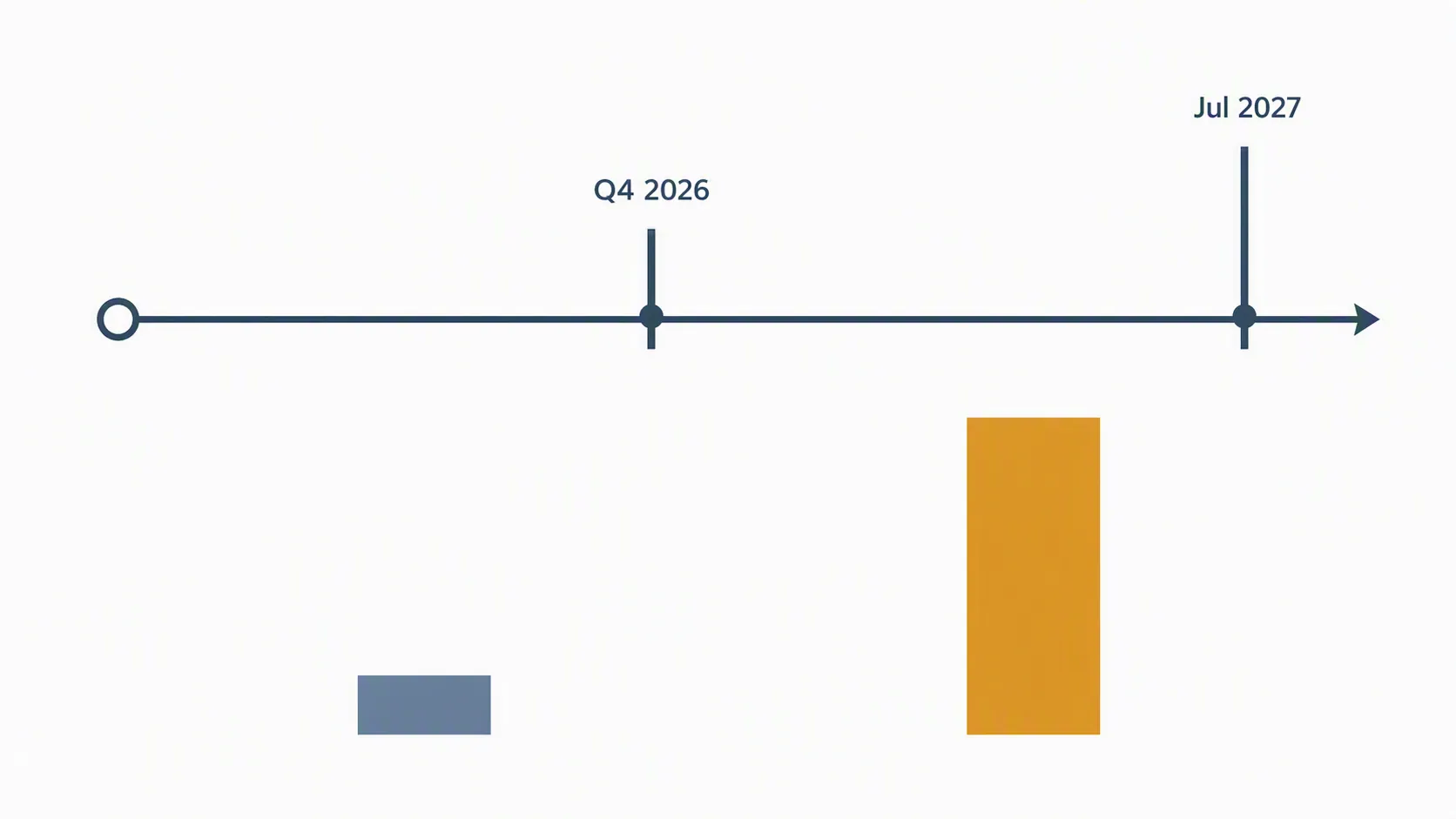
Those terms do not prove clearance. They do show the parties planned for a path in which closing is expected but not assumed to be frictionless. If the antitrust route were treated as impossible, a one-year outside date and parent-side reverse termination fee would not cure the problem. If the parties treated HSR as purely clerical, the July 2027 backstop and asymmetric parent fee would be less notable.
| Agreement term | Disclosed term | Regulatory reading |
|---|---|---|
| HSR closing condition | Expiration or termination of the HSR waiting period is a condition to closing.[2] | The parties built the statutory waiting period directly into the closing mechanics. |
| No prohibitive order condition | Closing is conditioned on no governmental law or order prohibiting the merger.[2] | Even HSR expiration would not solve a separate injunction or blocking order. |
| Expected closing | The companies expect closing in Q4 2026.[2] | That is compatible with a routine HSR path, but it is not a guarantee. |
| Outside date | July 28, 2027.[2] | The agreement leaves room for a longer review process than an ordinary 30-day wait. |
| Company termination fee | $107.5 million, reduced to $49.6 million in specified go-shop or excluded-party scenarios.[2] | CBIZ-side deal protection is present, but the go-shop period preserves a short market check. |
| Parent termination fee | $198.4 million, backed by a limited guarantee from Grant Thornton Advisors.[2] | The larger parent-side fee is the more direct sign of buyer-side execution risk allocation. |
| Go-shop deadline | Aug. 27, 2026.[2] | Alternative bids have a short defined window; that period runs separately from HSR timing. |
The asymmetry is doing work. The larger parent termination fee is the cleaner signal that buyer-side failure, including regulatory execution failure if covered by the agreement’s termination provisions, has been priced more heavily than a standard seller-side break. The limited guarantee matters because it identifies a source of payment support, while also preserving the contractual cap structure described in the agreement.[2]
Why “smaller than the Big Four” is not the end of the analysis
The Big Four comparison is useful, but only to a point. Ideagen Audit Analytics data reported by Accounting Today in April 2026 showed the Big Four holding 51% of SEC registrant audits: Deloitte at 926 audits, or 15%; EY at 799, or 13%; PwC at 744, or 12%; and KPMG at 639, or 11%. The top 10 auditors held 65%, while 219 other firms covered the remaining 35%.[4]
That context cuts against the easy version of a challenge narrative: a combined Grant Thornton–CBIZ platform would remain far below Big Four scale in SEC audit share. But antitrust review does not have to define the market as all professional services, all accounting firms, or all SEC audits. The narrower questions are the ones that can consume agency time.
The agencies may look at middle-market accounting, tax, and advisory services where the firms overlap; client segments that treat the Big Four as too expensive, conflicted, or mismatched; attest-related structures under the alternative practice model; and labor markets for CPA talent, especially attest professionals. The planned separation of CBIZ’s Benefits and Insurance Services into a standalone New Mountain-backed entity narrows part of the horizontal business overlap, but it does not answer every professional-services or labor-market question.[2]
The recent consolidation backdrop also matters because agencies can ask whether a transaction fits a broader trend toward concentration, not just whether it creates a dominant firm in one national market. Accounting Today reported that CBIZ CPAs, after combining with Marcum in 2024, and Baker Tilly, after merging with Moss Adams in 2025, both entered the top 10 in 2025.[4] That is not an antitrust violation by itself. It is the kind of industry pattern staff can use to decide what to ask for in the first review period.
The enforcement climate supports caution, not melodrama
The agencies have been active enough that a large reportable transaction should not be treated as rubber-stamped. In the FY2025 HSR Annual Report, the FTC reported 2,006 transactions and said approximately 31.8% were valued above $1 billion. The FTC and DOJ brought 18 merger enforcement actions; the FTC’s eight actions included three litigations, three consent orders, and two abandoned transactions.[5]
Those figures are environment data, not a prediction for this deal. A $5 billion professional-services transaction is large enough to be sorted carefully. The available concentration data also leave room for a clearance path, especially if the agencies do not find narrow market shares, customer substitution evidence, labor-market concerns, or attest-structure issues that justify a remedy or challenge.
What to monitor from here
- HSR filing confirmation: the waiting period normally depends on actual notification, not the announcement date.
- Agency clearance: the reviewing agency matters because it controls staff process, investigation scope, and remedy negotiations.
- Initial waiting-period outcome: expiration or early termination would satisfy the HSR condition, subject to other closing conditions.
- Second Request issuance: this is the main procedural event that could push timing away from a routine Q4 2026 close.
- Remedy signals: divestitures, conduct commitments, staffing restrictions, or attest-practice changes would indicate that review found a narrower concern rather than a broad professional-services block.
- Calendar pressure: the relevant long stop is July 28, 2027, not just the announced Q4 2026 expectation.[2]
Until those points are public, the cleanest statement is the most limited one: the Grant Thornton–CBIZ merger is automatically HSR-reportable; the unresolved antitrust questions are agency assignment, depth of investigation, whether a Second Request issues, whether any targeted fix is required, and whether the path remains compatible with Q4 2026 or moves closer to the July 2027 outside date.
References
- Current HSR thresholds; Federal Trade Commission; link
- Current Report on Form 8-K; CBIZ, Inc.; July 28, 2026; link
- Premerger Notification and the Merger Review Process; Federal Trade Commission; link
- Audit Analytics data on SEC registrant audits; Accounting Today; April 2026; link
- FTC and DOJ Issue FY 2025 Hart-Scott-Rodino Annual Report; Federal Trade Commission; July 2, 2026; link
Operationalizing workflow
No workflow has been explicitly linked to this obligation yet. See Workflows generally.
Illustrative cases
No illustrative case is currently tracked for this obligation. See Risk Digest for documented incidents generally.
← Back to RegulationReport a correction or tip
Spotted an outdated figure, a misstated fact, or a ruling this regulation entry should reflect? Public comments are disabled for this content given the professional cost of a misreported case outcome, penalty amount, or rule text — use the structured correction channel instead.
Report a correction or tip for this record →