
How the H-1B Pause Bill Would Affect Legal Employers
- Authority
- U.S. House of Representatives
- Rule type
- proposed legislation
- Jurisdiction scope
- US federal
- Source text
- Read primary rule text ↗
As of July 30, 2026, H.R. 8443 — the End H-1B Visa Abuse Act of 2026 — is a real bill, not enacted law. It was introduced on April 22, 2026, referred to the House Judiciary Committee, has eight Republican cosponsors, has no Senate companion, and has no Congressional Budget Office score in the available record.[1] For legal employers, that procedural posture matters as much as the bill text. The full H-1B visa pause bill is unlikely to become law as written, but several of its provisions are concrete enough to affect planning assumptions before Congress takes another formal step.
The useful question is not whether every lateral offer, technical hire, or immigration filing should be frozen. It should not. The useful question is which parts of the bill would change employer behavior if they reappeared in narrower legislation, agency action, or a larger immigration package. That is where the legal analysis becomes more than a headline check.

What the bill would actually change
H.R. 8443 is often described as a three-year H-1B pause bill. That label is accurate but incomplete. The pause applies to new H-1B issuances; it does not, by itself, cancel every existing H-1B approval. The harder compliance problem is that the bill also includes provisions that would disrupt existing H-1B workers by restricting adjustment of status and requiring departure for certain status changes, according to practitioner analysis of the bill text.[2]
That distinction is not academic. A law firm hiring an AI systems engineer, an e-discovery vendor recruiting machine-learning talent, a hospital counsel’s office advising a teaching system, and a university-affiliated research center would not face the same operational question. Some would lose future hiring channels. Others would have to revisit current employees’ green-card strategy, travel risk, or work-continuity planning.
| Provision | Immediate compliance question |
|---|---|
| Three-year pause on new H-1B issuances | Can the employer continue a hiring plan that depends on a new H-1B petition or cap filing? |
| $200,000 wage floor | Does the role still qualify economically, especially if it is entry-level, academic, healthcare, research, or cost-sensitive technical work? |
| OPT elimination | Does the employer lose the post-graduation bridge commonly used before H-1B sponsorship? |
| Third-party staffing ban | Can a consulting, managed-services, legal-tech, or vendor-placement model continue if the worker is assigned away from the petitioning employer? |
| Removal of cap exemptions | Do universities, teaching hospitals, and nonprofit research organizations lose access to a hiring channel they previously treated as structurally available? |
| Adjustment-of-status prohibition and mandatory departure provisions | Do existing H-1B employees need consular processing abroad or face work-interruption risk during status changes? |
The three-year pause is only the first constraint
A three-year pause on new H-1B issuances would first hit recruiting calendars. Employers that rely on early identification of international graduates, cap-subject H-1B filings, or lateral movement from other employers would need to separate candidates into two groups: people who already have a durable work-authorized path and people whose plan depends on a new H-1B issuance during the pause window.
For legal employers, the most obvious exposure is not traditional associate hiring. It is the technical layer around legal services: litigation analytics, document automation, cybersecurity, data engineering, AI model evaluation, contract lifecycle systems, and e-discovery operations. Those teams often sit inside law firms, alternative legal service providers, legal-tech vendors, or corporate legal departments. If a hiring plan assumes access to new H-1B filings, the bill would turn that assumption into a contingency item.
Existing H-1B employees would not be untouched. Practitioner analysis from PSBP Law identifies two provisions that reach beyond the new-issuance pause: a prohibition on adjustment of status and a mandatory-departure requirement for status changes.[2] Those provisions would move the bill from a hiring restriction into a retention and business-continuity problem.
The $200,000 wage floor would rewrite eligibility math
The proposed $200,000 minimum wage floor is the provision most likely to change internal screening before any bill becomes law. RN Law Group’s analysis describes the floor as above the 75th percentile of current H-1B wages and warns that it would price out many entry-level positions, healthcare roles, and university research positions.[3]
For an employer, that means the immigration question would no longer start with whether the role is a specialty occupation or whether the candidate has the right degree. It would start with whether the compensation package clears a statutory number that many legitimate roles do not reach. A research informatics role at a university hospital, a junior machine-learning engineer supporting legal analytics, or a data scientist on a compliance-monitoring product may be strategically important while still falling below that floor.
The wage floor also changes who inside the organization must sign off. Immigration counsel can explain eligibility. Compensation, finance, and the business sponsor would have to decide whether the role can be repriced. If it cannot, the candidate pipeline narrows even if the employer remains willing to sponsor.
OPT elimination would remove the graduate hiring bridge
The bill’s proposed elimination of Optional Practical Training is less dramatic in statutory language than a three-year H-1B pause, but it may be more disruptive to early-career hiring. OPT often functions as the bridge between graduation and a later work-visa strategy. Removing it would compress recruiting decisions into a smaller set of immediately available work-authorization categories.
For law firms and legal-tech companies, the affected jobs are not limited to lawyers. Product counsel teams, litigation-data groups, AI governance teams, and legal operations departments increasingly recruit people with technical graduate training. If the OPT bridge disappears, employers lose a period in which they can evaluate a candidate’s fit, file future petitions, and align staffing with client demand.
This is also where offer-letter timing becomes a risk-control document rather than a formality. A conditional start date, immigration-contingency language, and backup staffing plan may matter more than a general statement that employment is subject to work authorization.
A third-party staffing ban would reach vendor and placement models
The proposed third-party staffing restriction is easy to underestimate if the reader thinks only about direct law-firm employment. Many legal employers depend on vendors that place technical workers into client environments: managed review platforms, cybersecurity providers, AI implementation consultants, data-hosting vendors, and compliance-software teams. A ban on third-party placement would not merely affect the staffing company; it would affect the client waiting for the staffed function.
The compliance burden would likely appear first in contracting. Procurement teams would ask vendors whether services depend on H-1B workers assigned to third-party sites. Information-security teams would want to know whether a substitute delivery model changes data access. Legal operations would need to decide whether a delayed implementation affects discovery deadlines, regulatory reporting, or client commitments.
That is why this provision has independent significance even if the full bill stalls. It targets a business model that has long been politically visible in H-1B debates, and it can be detached from the three-year pause more easily than some of the bill’s broader architecture.
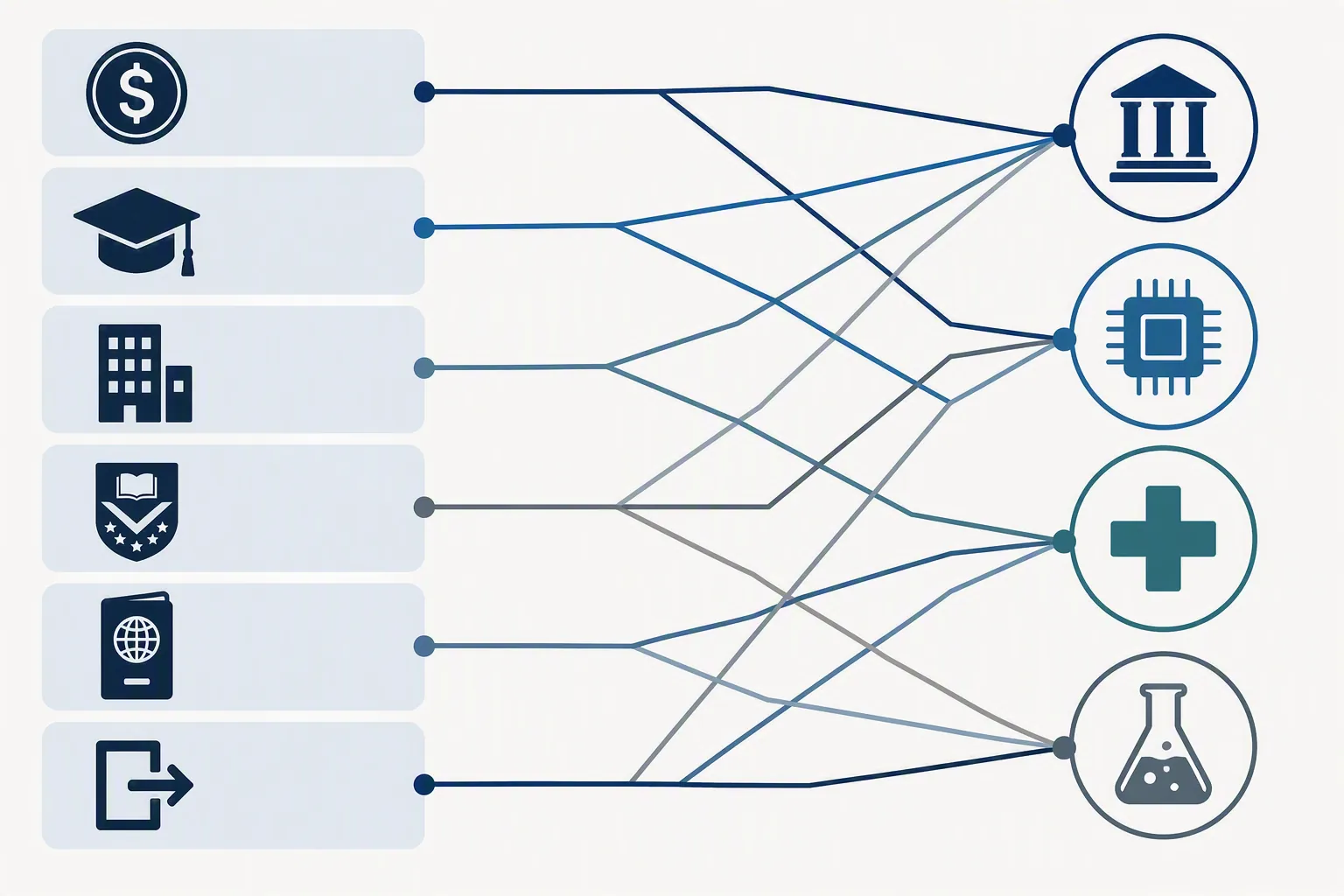
Cap-exemption removal would pull universities and teaching hospitals into the same bottleneck
Current H-1B planning often treats universities, teaching hospitals, and nonprofit research organizations differently from cap-subject private employers. H.R. 8443 would remove that distinction. The AAMC has warned more broadly that hospitals and health systems depend on H-1B visa-sponsored physicians, which is why cap-exemption changes matter beyond the technology sector.[4]
For legal employers, the connection is indirect but real. Academic medical centers and research institutions are clients, counterparties, and sometimes partners in AI, health-data, compliance, and research-commercialization projects. If their physician, researcher, or technical workforce planning changes, counsel may see the issue through affiliation agreements, grant obligations, clinical coverage questions, data-use projects, or delayed technology deployments.
The same point applies to legal-tech development. AI tools used in litigation analytics, contract review, and regulatory compliance do not emerge only from law-firm innovation committees. They draw from university research, nonprofit labs, hospital data environments, and technical teams that may rely on immigration pathways. A cap-exemption change would therefore be part of the talent-risk map for legal technology, even though it is not an AI regulation provision.
Adjustment-of-status restrictions would affect current employees, not just future hires
The adjustment-of-status provision is the part of the bill most likely to be missed in a quick reading. A hiring pause tells employers to look forward. An adjustment restriction tells them to open current employee files.
Manifest Law’s analysis highlights the severe consequences for India- and China-born workers facing decade-plus employment-based green-card backlogs if H-1B workers could no longer adjust status inside the United States.[5] The practical result would be more reliance on consular processing abroad, with the attendant risk of travel disruption, appointment delays, administrative processing, family interruption, and work-continuity gaps.
For an in-house legal department, this is not just an immigration-benefits question. It can affect succession planning, matter staffing, access to sensitive systems, client notification obligations, and the timing of promotions. If an employee in a long green-card backlog must leave the United States to complete a process that previously could proceed domestically, the employer needs a coverage plan before the departure becomes operationally urgent.
The bill’s passage odds are low, but that is not the end of the analysis
The procedural record does not support treating H.R. 8443 as imminent law. It has no Senate companion, no CBO score, limited Republican cosponsorship, and no evident bipartisan coalition in the materials reviewed as of July 30, 2026.[1] Several immigration practitioners have assessed passage of the full bill as very unlikely or practically zero, citing the midterm election calendar, the lack of a Senate companion, and expected opposition from affected industries.[2][3][5]
That practitioner consensus is useful, but it should be labeled for what it is: professional judgment, not a formal probability model. The absence of a Senate companion is a serious signal. So is the absence of a CBO score. So is the breadth of disruption across technology, healthcare, higher education, and research. None of those facts makes the bill impossible; together, they make enactment in current form an imprudent baseline assumption.
Independent economic work also counsels against treating the bill as a narrow immigration filing issue. The Federal Reserve Bank of Richmond’s Economic Brief No. 25-39 provides non-advocacy analysis of H-1B program changes as labor-market policy, which is the right frame for employer impact: these rules affect where firms can find specialized labor, how they price roles, and how quickly they can fill technical needs.[6]
Which provisions deserve monitoring even if H.R. 8443 stalls
The full bill’s weakness does not make every provision weak. Some provisions are portable. A wage floor can be proposed as a narrower reform. OPT limits can be pursued through student-visa or employment-authorization policy. A third-party staffing restriction can be framed as an anti-outsourcing measure. Cap-exemption limits can be inserted into a broader workforce package. Adjustment-of-status constraints can surface in green-card reform negotiations.

For legal-risk planning, the provisions fall into different monitoring buckets:
- Wage floor: review roles where sponsorship is expected but compensation is materially below $200,000, especially technical, research, healthcare-adjacent, and early-career positions.
- OPT elimination: identify hiring programs that assume a post-graduation work period before H-1B sponsorship.
- Third-party staffing ban: ask critical vendors whether service delivery depends on H-1B workers placed at client sites or assigned to client-controlled projects.
- Cap-exemption removal: flag university, teaching-hospital, and nonprofit research relationships where talent disruptions could affect legal, clinical, research, or technology obligations.
- Adjustment and departure provisions: identify current H-1B employees in long green-card backlogs whose work continuity could be affected by a forced consular-processing model.
The right internal response is proportionate. A company does not need to cancel a hire because a House bill has been introduced. It may need to add a legislative-risk note to a hiring memo, revise escalation criteria for sponsored roles, or ask immigration counsel for a file-level review of employees whose green-card strategy depends on adjustment of status.
Planning posture for legal employers
The safest planning posture is neither alarm nor dismissal. Treat H.R. 8443 as a low-probability bill with higher-probability components. That means no blanket hiring freeze, no casual assurance that “it will never pass,” and no client advisory that implies the bill is already law.
For offer letters and staffing approvals, the near-term control is documentation. If a role depends on H-1B, OPT, cap exemption, or a third-party placement model, the file should say so. If an existing employee is in an employment-based green-card backlog, the file should show whether adjustment of status is part of the strategy. If a vendor’s performance depends on sponsored technical workers, the contract owner should know whether a regulatory change would delay delivery.
This article is editorial legal-risk analysis, not legal advice. The triggers for revisiting the assessment are concrete: a Senate companion bill, House Judiciary movement, a CBO score, incorporation of these provisions into a larger immigration package, or executive action targeting the same wage, OPT, staffing, cap-exemption, adjustment, or departure issues.
References
- End H-1B Visa Abuse Act of 2026 — Congressman Eli Crane — April 22, 2026 — link
- A Bill, Not a Law: A Practitioner’s Analysis of the End H-1B Visa Abuse Act of 2026 — PSBP Law — link
- The End H-1B Visa Abuse Act: A Political Attack Disguised as Reform — RN Law Group — link
- Hospitals and health systems depend on H-1B visa-sponsored physicians. So what happens now? — AAMC — link
- Proposed H-1B Visas Pause — Manifest Law — April 28, 2026 — link
- Economic Brief No. 25-39 — Federal Reserve Bank of Richmond — link
Operationalizing workflow
No workflow has been explicitly linked to this obligation yet. See Workflows generally.
Illustrative cases
No illustrative case is currently tracked for this obligation. See Risk Digest for documented incidents generally.
← Back to RegulationReport a correction or tip
Spotted an outdated figure, a misstated fact, or a ruling this regulation entry should reflect? Public comments are disabled for this content given the professional cost of a misreported case outcome, penalty amount, or rule text — use the structured correction channel instead.
Report a correction or tip for this record →