
What the Three H-1B Visa Ban Challenges Mean for Employers
- Authority
- Presidential Proclamation
- Rule type
- executive order
- Jurisdiction scope
- US federal
- Effective date
- Sep 19, 2025
- Source text
- Read primary rule text ↗
Pay $100,000 entry-condition fee for covered H-1B workers
Current status record — last verified July 30, 2026
As of July 30, 2026, employers should treat the $100,000 H-1B entry-condition fee as blocked nationally, not as finally invalidated. USCIS updated its H-1B FAQ on July 28, 2026, after the latest appellate development, and that agency guidance is the first operational source to check before travel, consular-processing, or petition-planning decisions are made. [1]
The underlying action was not a categorical H-1B suspension. The September 19, 2025 presidential proclamation imposed a $100,000 payment as an entry condition for certain H-1B workers under Immigration and Nationality Act § 212(f). [2] The current block remains in place because the First Circuit denied the government’s stay motion on July 24, 2026; Fragomen reported that the government may still seek emergency Supreme Court relief. [3]
| Record field | Current entry |
|---|---|
| Policy label | $100,000 H-1B entry-condition fee |
| Common shorthand | Often called an “H-1B visa ban,” but that shorthand overstates the mechanism |
| Issuing authority asserted | Presidential proclamation invoking INA § 212(f) [2] |
| Proclamation date | September 19, 2025 [2] |
| Current enforcement status | Blocked nationally after the First Circuit denied a stay on July 24, 2026 [3] |
| Immediate operational requirement | Do not treat the $100,000 fee as currently enforceable unless USCIS guidance or a court order changes |
| Unstable point | The government may seek emergency Supreme Court relief, and a separate D.C. Circuit appeal could uphold the fee [3] |
| Cases to monitor | Chamber of Commerce v. DHS; State of California v. Mullin; Global Nurse Force v. DHS |
Why “visa ban” is the wrong operating term
For employers tracking the H-1B visa ban legal challenges and implications from 2025, the first correction matters: there is no live categorical ban on H-1B visas in this record. The dispute is over whether the president may condition entry on a $100,000 payment for covered H-1B workers. That distinction changes the compliance question. A ban analysis asks whether a class may enter at all. This litigation asks whether the government may collect or require a large payment as the condition of entry.
That also means an employer headline reading “blocked” or “upheld” is incomplete unless it says which court acted. A D.D.C. ruling upheld the fee. A D. Mass. ruling invalidated it. The First Circuit has refused to pause that invalidation. The D.C. Circuit has not yet issued its merits decision. A Northern District of California healthcare case remains pending. Those are not interchangeable procedural facts.
The three active challenges
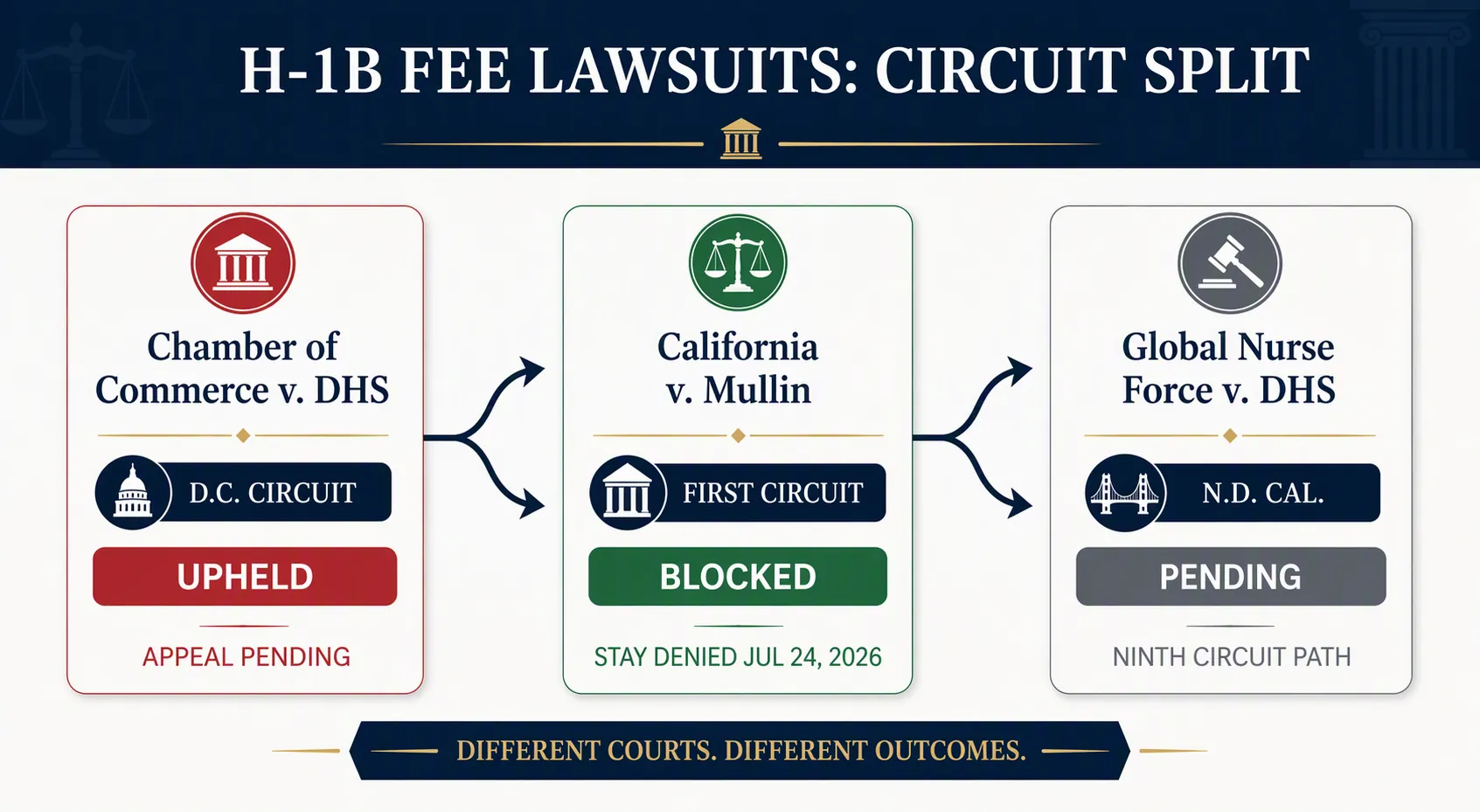
The current map is a three-case record. Chamber of Commerce v. DHS is the pro-fee ruling now before the D.C. Circuit. State of California v. Mullin is the anti-fee ruling that currently supplies nationwide relief after the First Circuit stay denial. Global Nurse Force v. DHS is the pending healthcare-specific case that could create a Ninth Circuit path and a separate Administrative Procedure Act route.
Chamber of Commerce v. DHS — the D.D.C. ruling that upheld the fee
| Field | Record |
|---|---|
| Court | U.S. District Court for the District of Columbia; appeal pending in the D.C. Circuit |
| Case number | No. 1:25-cv-02677-RC |
| Plaintiffs | U.S. Chamber of Commerce, American Association of Universities, American Council on Education, and 29 other associations [4] |
| District-court result | Fee upheld on December 23, 2025 [5] |
| Core theory from plaintiffs | The proclamation overrides specific INA provisions and exceeds § 212(f) authority |
| Appeal posture | D.C. Circuit heard oral argument in March 2026; practitioners cited by Bloomberg Law expected a merits decision in a 6–18 month window [6] |
| Employer consequence | If the D.C. Circuit affirms, this becomes the strongest appellate path for reinstating the fee |
The Chamber case is the reason the current block should not be read as a final answer. The association plaintiffs attacked the proclamation as an executive workaround to the INA’s existing H-1B framework. The D.D.C. decision rejected that challenge and treated § 212(f), as interpreted through Trump v. Hawaii, as giving the president “extraordinarily broad discretion” over entry restrictions. [5]
Higher-education employers have a direct stake in that posture because the plaintiff group includes major education associations, and CUPA-HR described the ruling as a federal-court decision upholding the H-1B visa fee proclamation from the higher-education employer perspective. [7] Universities that stopped at the words “fee blocked” would miss the competing record: one district court has already accepted the government’s § 212(f) argument.
The D.C. Circuit appeal is therefore not background noise. Bloomberg Law described the resulting legal whiplash as a preparation problem for employers, with the appeal already argued and a merits decision expected by practitioners in a 6–18 month window. [6] That estimate is not a deadline, and it is not a guarantee of Supreme Court timing. It is enough, however, to keep the case on any H-1B travel and sponsorship risk calendar.
State of California v. Mullin — the ruling currently blocking enforcement
| Field | Record |
|---|---|
| Court | U.S. District Court for the District of Massachusetts; stay proceedings in the First Circuit |
| Case number | No. 1:25-cv-12255 |
| Plaintiffs | 20-state coalition led by California |
| District-court result | Fee struck down on June 8, 2026 [8] |
| Core theory | The $100,000 charge is, in substance, a tax lacking congressional delegation |
| Stay posture | First Circuit denied the government’s stay motion on July 24, 2026 [3] |
| Employer consequence | This is the operative reason the fee is blocked nationally today |
California is the current operating case. On June 8, 2026, the District of Massachusetts struck down the fee, and AP reported the ruling as a defeat for the administration’s H-1B fee requirement. [8] The court’s reasoning did not simply disagree with the D.D.C. court on the breadth of § 212(f). It treated the $100,000 charge as a tax problem.
CDF Labor Law’s employer-side analysis described the district court’s conclusion that the fee was unlawful and emphasized the tax-power framing. [9] In that frame, the dispositive issue is not whether entry may be restricted under § 212(f), but whether the executive branch may impose a six-figure charge without congressional authorization. That is a different legal question from the one that carried the government in the D.D.C. ruling.
The appellate posture is what makes California immediately important. The First Circuit denied the government’s stay motion on July 24, 2026, leaving the district-court order in place and the fee blocked nationally. [3] Ogletree Deakins likewise described the government’s appeal strategy after the ruling striking down the $100,000 requirement. [10]
The practical result is temporary relief with a short fuse. Employers do not have a current payment obligation under the blocked fee, but that status could change if the government obtains emergency relief from the Supreme Court or if later appellate rulings alter the injunction’s effect. A hiring plan that assumes the fee is gone for the 2026–2027 cycle is making a merits prediction, not reading the current docket.
Global Nurse Force v. DHS — the pending healthcare and APA track
| Field | Record |
|---|---|
| Court | U.S. District Court for the Northern District of California |
| Case number | No. 3:25-cv-07721 |
| Plaintiffs | Healthcare staffing agency and individual physician plaintiffs |
| Current status | Pending before Judge Chen; no merits ruling yet |
| Core theory | Healthcare-specific harm plus an Administrative Procedure Act theory |
| Potential appellate path | Ninth Circuit, if the case produces an appealable ruling |
| Employer consequence | Hospitals, physician employers, and healthcare staffing companies should not assume the association and state-coalition cases capture all sector-specific harms |
Global Nurse Force is still pending, so it should not be treated as a third merits ruling. Its value in the record is different: it preserves a healthcare-specific version of the challenge and an APA route that does not depend entirely on the constitutional tax question.
The healthcare allegations matter because some employers are not just moving one H-1B worker through a standard petition-and-entry sequence. Hospitals and staffing agencies may be managing physician placement in underserved areas, J-1 waiver transitions, and timing-sensitive coverage needs. Holland & Knight’s early analysis of national-interest exceptions and the $100,000 fee identified healthcare-specific effects as a distinct concern under the proclamation. [11]
The APA theory is also worth keeping separate. If a court invalidates the fee on notice-and-comment or administrative-process grounds, that ruling would not necessarily answer the same question as California’s tax-power ruling or Chamber’s § 212(f) ruling. The remedy could be narrower, the reasoning could travel differently on appeal, and healthcare employers could receive a more tailored form of relief.
Where the circuit conflict now sits
The operational whiplash comes from the difference between two already-issued district-court rulings. Chamber upheld the fee under a deferential § 212(f) analysis. California struck it down as an unauthorized tax. The First Circuit’s refusal to stay California means the anti-fee ruling controls enforcement today; the pending D.C. Circuit appeal means the pro-fee theory remains alive.
| Case | Current legal signal | Circuit path | What could change for employers |
|---|---|---|---|
| Chamber of Commerce v. DHS | Fee upheld at district-court level | D.C. Circuit | A D.C. Circuit affirmance would strengthen the government’s case for reinstatement |
| State of California v. Mullin | Fee struck down; stay denied | First Circuit | This ruling supplies the current national block |
| Global Nurse Force v. DHS | No merits ruling yet | Potential Ninth Circuit path | Could add healthcare-specific or APA-based relief |
That conflict makes Supreme Court review a serious risk judgment, particularly if the D.C. Circuit validates the fee while the First Circuit path continues to block it. It does not make the timing certain. Emergency relief could arrive quickly if sought and granted; merits review could move on a different schedule. The useful point for compliance planning is not to guess a date, but to recognize which docket events would change the answer.
What employers can and cannot safely infer today
A blocked fee does not create a durable safe harbor for every H-1B decision made during the injunction period. It means the government should not enforce the $100,000 entry-condition fee while the current order remains effective. Employers still need to manage ordinary H-1B filing rules, consular timing, travel risk, and internal approvals without assuming the fee litigation has ended.
- For new sponsorship planning: model the case both ways. One version assumes the fee remains blocked; the other assumes emergency relief or an appellate ruling reinstates it before the worker’s entry event.
- For travel planning: check the USCIS FAQ and any agency implementation notice before the worker departs or returns. The enforcement question is tied to entry, so timing matters.
- For universities: keep Chamber on the watch list because higher-education associations are part of that plaintiff group and the D.C. Circuit ruling could affect cap-exempt and research-employer planning.
- For hospitals and healthcare staffing companies: keep Global Nurse Force separate in the risk register because its healthcare allegations and APA theory may not rise or fall with the same reasoning as Chamber or California.
- For legal and finance teams: do not book the $100,000 charge as a current payable obligation, but do decide who has authority to approve or halt affected travel if the block is lifted quickly.
Adjacent H-1B policy tracks that are not this litigation
Two other H-1B policy streams can confuse the record if they are folded into the fee cases. The Biden H-1B Modernization Rule, finalized on January 17, 2025, addressed issues such as lottery registration, review criteria, and cap-exempt definitions. It is not the source of the $100,000 entry-condition fee.
The Grassley-Durbin H-1B and L-1 Visa Reform Act of 2025, S. 2928, is also separate. If enacted, legislation could change the H-1B framework through Congress and could affect the practical value of the pending litigation. Until then, it belongs in a legislative tracker, not in the enforcement-status field for the proclamation fee.
Monitoring posture as of July 30, 2026
The clean status entry is short: the $100,000 H-1B fee is blocked nationally today because the First Circuit denied a stay, but the block is not a final merits resolution. The next material events are an emergency Supreme Court application, any further First Circuit action, the D.C. Circuit merits decision in Chamber, and any ruling in Global Nurse Force.
- Check USCIS guidance before relying on the blocked status for travel or entry planning.
- Track the First Circuit and any Supreme Court emergency docket activity tied to California v. Mullin.
- Track the D.C. Circuit merits decision in Chamber of Commerce v. DHS.
- Track Global Nurse Force v. DHS for healthcare-specific relief or an APA ruling.
- Reverify the record if any court acts after July 30, 2026. This article is an information record, not legal advice.
References
- H-1B FAQ — USCIS, July 28, 2026
- Restriction on Entry of Certain Nonimmigrant Workers — The White House, September 19, 2025
- United States: Federal Appeals Court Declines to Stay Lower Court Order Vacating $100,000 H-1B Fee — Fragomen, July 24, 2026
- Chamber of Commerce v. DHS — U.S. Chamber of Commerce
- Trump’s $100K H-1B Visa Fee May Be Here to Stay — Lawfare
- H-1B Visa Fee’s Legal Whiplash Demands Employers’ Preparation — Bloomberg Law
- Federal Court Upholds H-1B Visa Fee Proclamation — CUPA-HR
- Judge strikes down Trump’s $100,000 fee for H-1B visas — AP News, June 8, 2026
- US District Court Rules $100,000 H-1B Fee Is Unlawful — CDF Labor Law LLP
- Trump Administration Appeals Ruling Striking Down $100,000 H-1B Fee Requirement — Ogletree Deakins
- A Look at National Interest Exceptions and the $100,000 H-1B Fee — Holland & Knight, September 2025
Operationalizing workflow
No workflow has been explicitly linked to this obligation yet. See Workflows generally.
Illustrative cases
No illustrative case is currently tracked for this obligation. See Risk Digest for documented incidents generally.
← Back to RegulationReport a correction or tip
Spotted an outdated figure, a misstated fact, or a ruling this regulation entry should reflect? Public comments are disabled for this content given the professional cost of a misreported case outcome, penalty amount, or rule text — use the structured correction channel instead.
Report a correction or tip for this record →