
Haiti TPS Expires: What Employers Must Do Now
- Authority
- USCIS
- Rule type
- regulation
- Jurisdiction scope
- US Federal
- Effective date
- Jul 24, 2026
- Source text
- Read primary rule text ↗
Employers must reverify work authorization using Form I-9 Supplement B; cannot rely on expired Haiti TPS EADs after July 24, 2026.
As of July 24, 2026, employers should treat Haiti TPS work authorization as an immediate Form I-9 problem, not a wait-and-see immigration-policy issue. USCIS SAVE guidance identifies July 24, 2026 as the employment-authorized-through date for Haiti TPS-based EADs, including cards with prior expiration dates running from July 22, 2017 through February 3, 2026.[1] After that date, the expired Haiti TPS EAD is not acceptable evidence of current work authorization.
The employer’s available compliance path is narrow: identify affected employees, reverify work authorization using Form I-9 Supplement B, accept any valid document or document combination the employee chooses to present, and preserve a record that explains why the reverification occurred. If the employee cannot present acceptable unexpired documentation, the I-9 file cannot be made compliant by sympathy, a manager note, or continued reliance on the old TPS card.
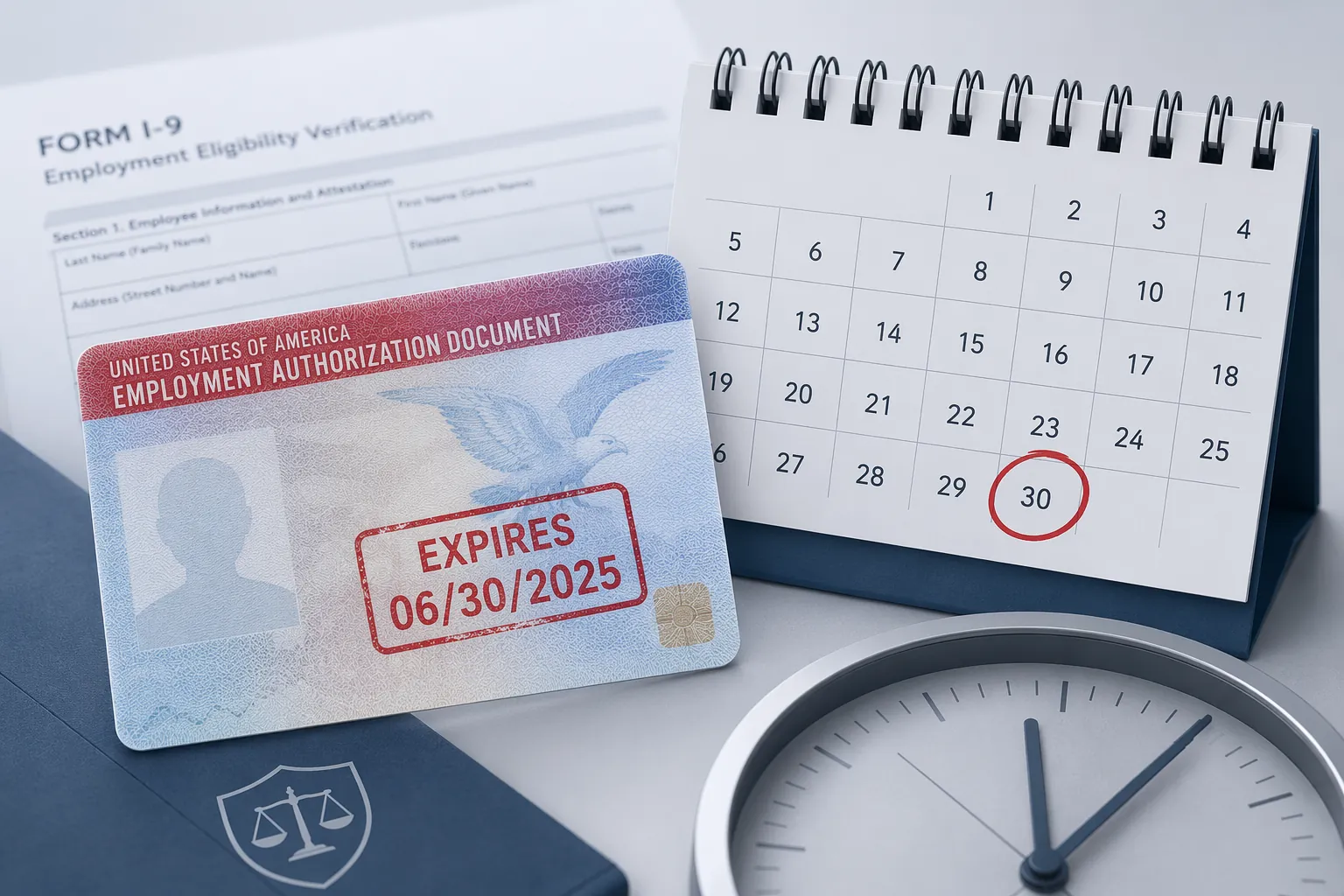
This article is a compliance workflow for employers and legal operations teams. It is not legal advice for any individual employee, and it does not resolve immigration eligibility questions outside the I-9 and E-Verify record.
What Is Fixed Today
The reason employers can no longer rely on prior court-preserved validity is the Supreme Court’s June 25, 2026 decision in Mullin v. Doe. In a 6-3 ruling, the Court held that INA § 244(b)(5)(A) strips federal courts of jurisdiction to review non-constitutional TPS termination claims, ending the stay that had preserved EAD validity after Judge Reyes’s February 2, 2026 order in Miot v. Trump.[2]
For the person maintaining I-9 files, the litigation history matters only to the extent it explains the cutover. USCIS SAVE then set July 24, 2026 as the single EAD expiration date for Haiti TPS-based EADs covered by the prior extensions.[1] That creates one operational deadline across a group of employees whose cards may show different printed expiration dates.
One point remains worth marking rather than smoothing over: the district-court implementation mechanics in Miot may still produce additional procedural detail, and USCIS may issue supplemental instructions after July 24. Employers still need a defensible record today. Later clarification may affect how a file is annotated, but it does not make an expired TPS EAD acceptable after the cutover date.
The Reverification Workflow
The safest way to manage the deadline is to run it as a controlled reverification project, not as a set of one-off HR conversations. The file should show who was reviewed, why the employee was included in the review, what document expired, what the employee was asked to provide, what was presented, and what action followed.
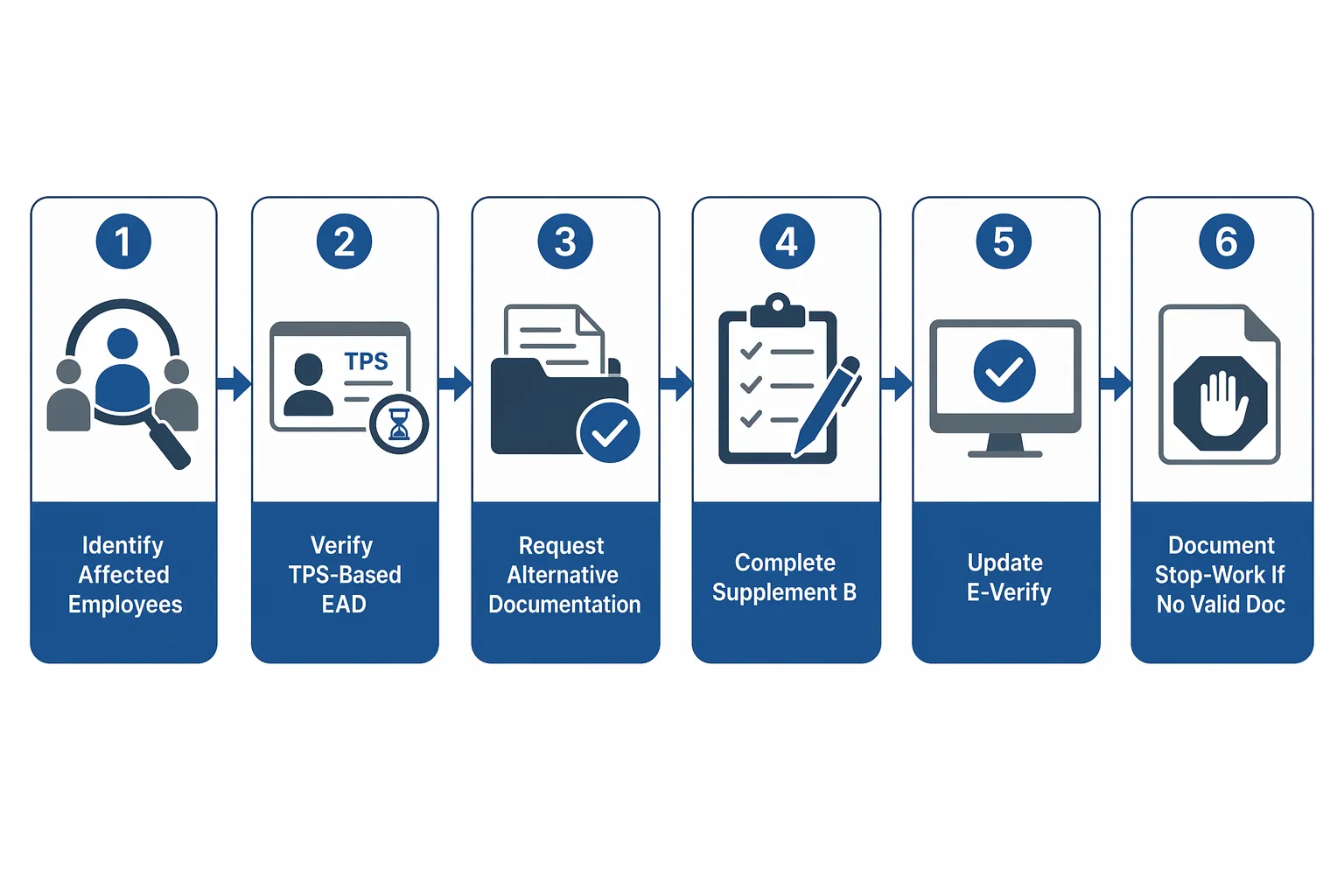
| Step | Employer action | Record to preserve |
|---|---|---|
| 1 | Identify employees whose I-9 records rely on Haiti TPS-based EADs expiring July 24, 2026. | Roster or query results showing the population reviewed. |
| 2 | Confirm that the document is TPS-based rather than another unexpired source of employment authorization. | Copy or I-9 document data already retained under the employer’s normal I-9 practice. |
| 3 | Notify the employee that reverification is required and that the employee may choose which acceptable document to present. | Neutral notice template and date sent. |
| 4 | Complete Supplement B if the employee presents acceptable unexpired documentation. | Supplement B entry, document title, issuing authority, document number, expiration date if any, and employer signature/date. |
| 5 | Update E-Verify records where the employer participates in E-Verify. | E-Verify case update or tracking note, including the July 24, 2026 expiration date where applicable. |
| 6 | If no acceptable document is presented, document the stop-work consequence and the basis for it. | Manager/legal approval note and payroll or scheduling action record. |
1. Identify the affected I-9 records
Start with the I-9 system, not with supervisors’ memory. Search for EADs tied to Haiti TPS and for expiration dates that were previously extended by TPS guidance. USCIS SAVE identifies July 24, 2026 as the controlling expiration date for Haiti TPS-based EADs, even where the card’s original expiration date is much older.[1]
The review should distinguish a Haiti TPS-based EAD from any other document the employee may have used or later provided. A person may have TPS and also possess another form of work authorization. The employer’s I-9 obligation turns on the document being relied upon for employment authorization, not on a broad label in the HRIS.
2. Ask for documentation without choosing the document for the employee
Once the expiring TPS-based EAD is identified, the employer should notify the employee that reverification is required. The notice should not tell the employee to produce a particular replacement document. Form I-9 rules allow the employee to choose among acceptable documents, including an acceptable List A document or an acceptable List B and List C combination. Law-firm guidance addressing the Haiti TPS cutover identifies examples such as another List A document or a List B plus List C combination, while also warning that many Haiti TPS beneficiaries may not have an alternative document available.[3][4]
A clean notice is usually short: the prior EAD can no longer be accepted after July 24, 2026; reverification is required; the employee may present any acceptable unexpired document or combination from the Form I-9 Lists of Acceptable Documents; and failure to present valid documentation affects continued employment eligibility. Avoid adding informal promises such as “we can keep you active until USCIS says more.” That kind of language is exactly what becomes hard to defend later.
3. Complete Supplement B when acceptable documentation is presented
If the employee presents acceptable unexpired documentation, complete Supplement B of Form I-9 within the usual reverification framework. Record the document title, issuing authority, document number, and expiration date if the document has one. The employer representative should sign and date the reverification entry.
Do not enter the expired Haiti TPS EAD as the reverification document. The expired card is the reason for reverification; it is not the proof that solves the reverification. If the employer retains document copies as part of its consistent I-9 practice, retain the new document copy in the same manner. If the employer does not retain copies, preserve enough system metadata and internal notes to show that the reverification was timely and tied to the July 24 cutover.
4. Update E-Verify where applicable
Employers enrolled in E-Verify have a second record to manage. Greenberg Traurig’s July 2026 employer guidance states that E-Verify employers should enter July 24, 2026 as the expiration date and monitor for tentative nonconfirmations.[5] That does not replace Supplement B. It is a related system obligation that should match the I-9 file rather than drift into a separate, unexplained data point.
For audit purposes, the E-Verify note and the I-9 note should tell the same story: the employee’s Haiti TPS-based EAD expired under the July 24, 2026 USCIS SAVE cutover; reverification was requested; the employee either presented acceptable documentation or did not; and the employer acted accordingly.
The Annotation Problem USCIS Has Not Fully Solved
The uncomfortable part is not the basic rule. It is the annotation. Seyfarth Shaw flagged that USCIS guidance left key implementation questions unanswered, including the absence of standardized language for the Form I-9 “Additional Information” field and complications for electronic I-9 vendors that are not built for narrative court-order entries.[3]
That gap matters because an auditor does not just ask whether the employer eventually reached the right conclusion. The auditor looks at the record as it existed when the decision was made. If an electronic I-9 platform only allows a short dropdown label, or if the HRIS auto-populates a stale EAD date, the employer can end up with a file that technically contains the right document but fails to explain the July 24 reverification trigger.
Until USCIS supplies standardized language, employers should preserve source-linked rationale rather than inventing a confident-sounding legal conclusion. A defensible internal note can identify the USCIS SAVE alert date, the July 24, 2026 employment-authorized-through date, the employee’s prior Haiti TPS-based EAD, and the date reverification was completed or attempted. If the system has no adequate field, preserve a contemporaneous memo or attachment under the employer’s normal I-9 retention controls.
The note should be factual. It should not speculate about the employee’s immigration status beyond the work-authorization document presented. It should not say the employer “terminated TPS” or “revoked authorization.” The employer is documenting that a previously relied-upon EAD could no longer be accepted and that Form I-9 reverification was required.
When the Employee Has No Alternative Document
Some employees will not be able to present another acceptable document. That is not a documentation inconvenience; it is the point where the employer’s I-9 obligation and the employment decision collide. The employer should not complete Supplement B with the expired TPS EAD, should not backdate reverification, and should not leave the employee active on the theory that another extension may arrive.
The compliance consequence is stop-work unless and until the employee presents valid work-authorization documentation. The personnel file should show that the employer gave the employee the opportunity to present any acceptable Form I-9 documentation, did not specify which document to provide, reviewed what was presented, and made the employment action because no acceptable unexpired documentation was available.
This is also where managers need a script. “Can we keep them on payroll while legal looks at it?” is not an I-9 position. If legal is reviewing a document, document the review. If there is no document to review, the payroll or scheduling decision should not be left to a supervisor’s informal judgment.
Penalty Exposure Is Practical, Not Theoretical
INA § 274A penalties for knowingly continuing to employ unauthorized workers range from $2,332 to $23,317 per worker, as adjusted for inflation.[6] Fisher Phillips has also warned that good-faith reliance on an expired EAD is not a defense.[6] The employer needs evidence that it stopped relying on the expired TPS EAD when the July 24 cutover arrived.
E-Verify and federal-contract risk sit alongside the I-9 issue. The research materials support the existence of those risks, but not a prediction that any particular employer will be investigated or lose a contract because of one Haiti TPS reverification file. The correct operational posture is to keep the I-9, E-Verify, payroll, and contract-compliance records aligned before anyone has to reconstruct the decision under pressure.
Program Risk Beyond Haiti
Haiti is the live queue today, but it should not be treated as a one-country anomaly inside the compliance program. Morgan Lewis identified the Mullin posture as affecting all 13 terminated TPS designations and named countries including Myanmar, Ethiopia, Somalia, South Sudan, and Yemen as part of the broader employer-risk landscape.[7]
That point should lead to a systems check, not a second policy debate. Employers should review whether their I-9 platform can generate TPS-based EAD reports by country, expiration date, and document category; whether the system can preserve narrative annotations; and whether HR, legal, and payroll share the same stop-work protocol when an employee cannot present valid documentation.
Readers who need the legislative-status context can pair this workflow with Senate Stalls Haiti TPS Extension as Work Permits Expire. The employer file, however, should remain narrower: July 24 is the reverification date; the record should cite the source for that date; Supplement B should be completed only with acceptable unexpired documentation; and any unresolved USCIS annotation gap should be documented as a gap, not hidden inside a vague HR note.
References
- Update on Termination of Temporary Protected Status for Haiti, Release July 10, 2026, USCIS SAVE, July 10, 2026
- Mullin v. Doe, Supreme Court of the United States, June 25, 2026
- Ask Not for Whom the Bell Tolls: Haiti TPS Litigation and USCIS I-9 Guidance Signal Broader Employer Risk and Unanswered Questions, Seyfarth Shaw, February 17, 2026
- SCOTUS Rules TPS Terminations Are Final: An Employer’s Guide, Klasko Immigration, June 26, 2026
- Preparing for the End of Haiti TPS: Employer Compliance Considerations, Greenberg Traurig, July 2026
- Supreme Court Backs Trump Administration’s Termination of TPS Protections for Haiti and Syria, Fisher Phillips, June 26, 2026
- Federal Court Stay of Haiti TPS Termination Remains in Effect; Case Now Before the US Supreme Court, Morgan Lewis, March 19, 2026
Operationalizing workflow
No workflow has been explicitly linked to this obligation yet. See Workflows generally.
Illustrative cases
No illustrative case is currently tracked for this obligation. See Risk Digest for documented incidents generally.
← Back to RegulationReport a correction or tip
Spotted an outdated figure, a misstated fact, or a ruling this regulation entry should reflect? Public comments are disabled for this content given the professional cost of a misreported case outcome, penalty amount, or rule text — use the structured correction channel instead.
Report a correction or tip for this record →