
Hallucinogen Legal Status in the United States, Mid-2026
- Authority
- U.S. Drug Enforcement Administration (DEA)
- Rule type
- statute
- Jurisdiction scope
- US federal
- Source text
- Read primary rule text ↗
All classic psychedelics remain federally prohibited under Schedule I of the Controlled Substances Act; state programs do not override federal law.
For purposes of this article, “hallucinogen” means psychedelic or psychedelic-adjacent controlled substances—psilocybin, LSD, DMT, MDMA, ibogaine, mescaline, 5-MeO-DMT, and related compounds—not AI hallucination. The status described here is current to the cited mid-2026 sources, with the most recent state-program source updated July 14, 2026. It is an informational legal-status reference, not legal advice.
The short answer for “hallucinogen legal status United States 2026” is still federal Schedule I for classic psychedelics. As of Q3 2026, psilocybin, LSD, DMT, MDMA, ibogaine, mescaline, and 5-MeO-DMT remain federally prohibited under the Controlled Substances Act’s Schedule I framework, subject to narrow exceptions such as certain religious-use protections and research authorization pathways. Ketamine sits in a different legal category: it is Schedule III, and esketamine has an FDA-approved product pathway through Spravato. That difference matters before any state map is opened.[1]

State law has nevertheless moved. Oregon and Colorado now operate state-authorized therapeutic programs. Several other states have signed or enacted medical, pilot, or launch-stage models. Others have research-only carve-outs, trigger laws tied to future federal approval, or local decriminalization policies. None of those categories is interchangeable with federal legalization, and none should be read as a general permission slip for possession, prescribing, transport, advertising, investment, professional services, or workplace handling.
Start with the federal floor
A state therapeutic statute can change state enforcement risk, create a licensing system, and define who may provide services under state law. It does not repeal the Controlled Substances Act. For classic psychedelics, that means federal exposure remains part of the file even in a state that has built an operational program.
The federal classification also affects adjacent work. A lawyer reviewing a lease, a bank relationship, an insurance policy, a physician-employment agreement, a professional-license issue, a clinical-trial contract, a marketing plan, or a diligence memo is not only asking whether the client can point to a state statute. The relevant question is what conduct the client is undertaking, who is authorized under state law to do it, whether the substance remains federally controlled, and whether any federal agency action has actually changed legal status.
City decriminalization deserves the same discipline. Local deprioritization policies may lower the likelihood of municipal enforcement for specified possession or use conduct, but they do not create a state licensing regime, do not authorize commercial therapy, and do not bind federal authorities. Wikipedia’s decriminalization overview places psilocybin decriminalization activity in roughly 30 cities across more than 15 states, but that is decriminalization context, not legal access.[2]
Executive Order 14401 did not reschedule psychedelics
Executive Order 14401, issued April 18, 2026, is important because it tells federal agencies to move faster around psychedelic-related review. It directs FDA prioritization and calls for DEA parallel review in specified circumstances. It should not be described as legalization, rescheduling, or a federal authorization for ordinary clinical use of psilocybin, MDMA, DMT, ibogaine, or other Schedule I psychedelics.[3]
The limit is statutory. Scheduling authority remains with DEA and HHS under 21 U.S.C. 811. The President may set policy direction for executive agencies, but an executive order cannot itself move a drug from Schedule I to another schedule or approve a new drug application. Harvard Petrie-Flom’s Q&A on the order makes that distinction directly: EO 14401 can push agencies to prioritize and coordinate; it cannot compel DEA rescheduling outside the statutory process.[4]
That distinction is not academic. A company may tell investors that an FDA pathway is accelerating. A state may draft a trigger law keyed to future federal approval. A hospital may prepare a pilot. None of those steps changes today’s Schedule I status unless and until the relevant federal approvals and scheduling actions occur.
A four-tier state map is useful only if the tiers are kept separate
Mind Medicine Law’s Psychedelic Legal Status Map, last reviewed June 21, 2026, is a workable backbone because it separates operational programs from launch-stage medical models, research-only carve-outs and trigger laws, and states with no significant reform. The categories are not permanent labels; they are a mid-2026 risk frame.[5]
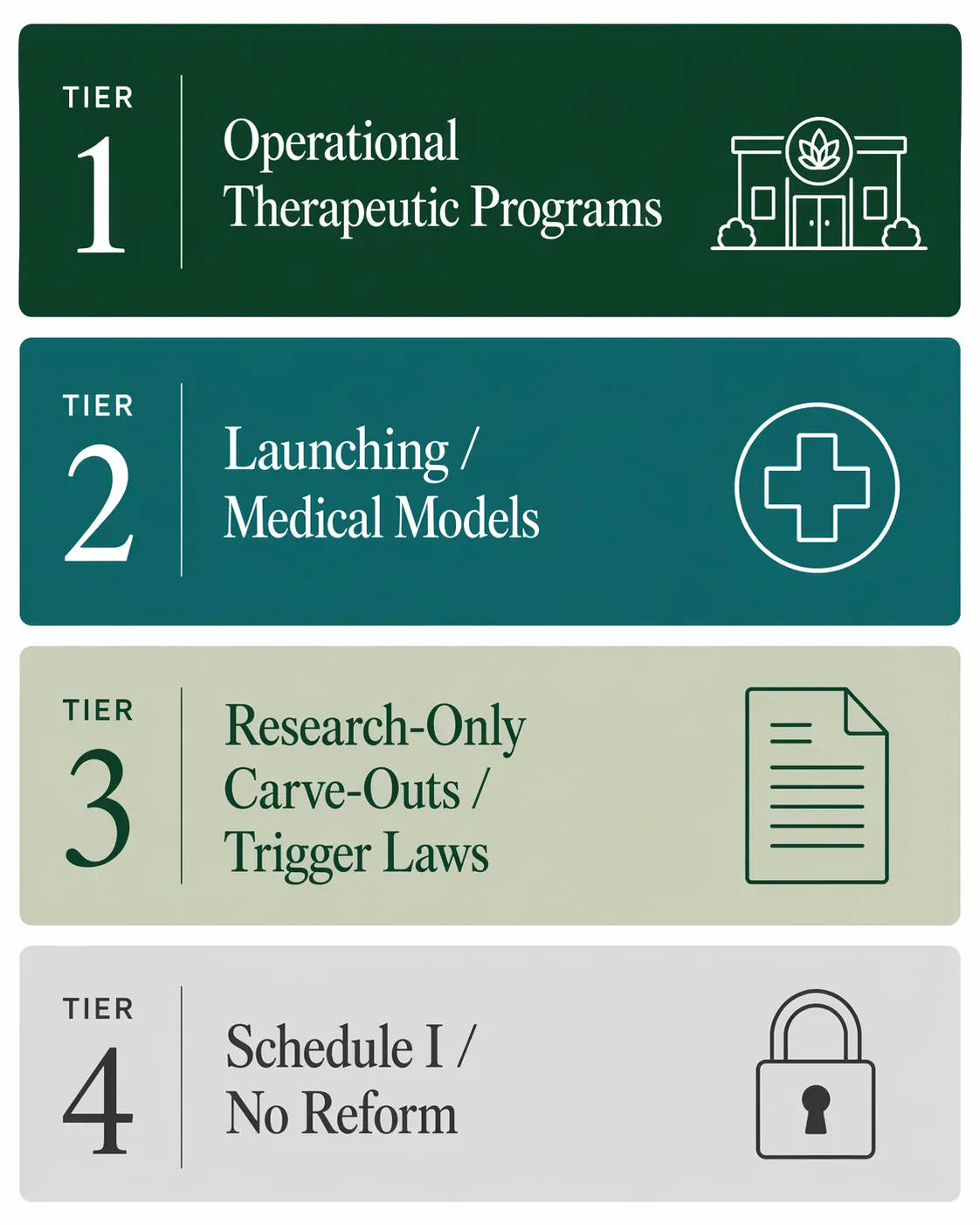
| Tier | Mid-2026 status | Practical legal meaning |
|---|---|---|
| Operational therapeutic programs | Oregon and Colorado | State-authorized service or healing-center activity exists, but federal Schedule I risk remains. |
| Launching or medical-model states | New Mexico, New Jersey, South Dakota, Connecticut | Signed, enacted, or developing programs require close attention to launch dates, eligible settings, and implementing rules. |
| Research-only carve-outs and trigger laws | Virginia, Texas, Arizona, and others | Research permission or future-trigger planning is not current general therapeutic access. |
| Unchanged prohibition states | Approximately 25 states under the Mind Medicine Law framework | Schedule I treatment remains the dominant practical answer absent a narrower exception. |
Oregon and Colorado: operational programs, not federal safe harbors
Oregon and Colorado are the states where the legal analysis most often becomes concrete. They are not merely debating psychedelics or funding studies; they have moved into state-authorized therapeutic infrastructure. That changes the diligence questions. Counsel can review license categories, premises rules, facilitator or healing-center requirements, advertising claims, service contracts, insurance exclusions, employment screening, and local land-use constraints. It does not remove the need to mark the federal Schedule I overlay.
Oregon’s psilocybin services program shows why operational status is not the same as commercial stability. Psychedelic Beacon’s July 14, 2026 update, citing Oregon Health Authority dashboard data, reported 23 active service centers, more than 16,000 clients served, session costs ranging from $1,000 to $5,000, and 12 of 35 centers closed. Those figures should be verified against primary Oregon Health Authority materials in any formal diligence file, but they are enough to flag the basic business-continuity issue: state authorization does not guarantee a durable market.[6]
For a lawyer advising an Oregon operator, investor, landlord, lender, therapist, or professional-services vendor, the relevant risk is layered. The client may be acting inside a state program while still touching a federally controlled substance. The service-center model may rely on licensed personnel, constrained premises, state-specific intake and administration rules, and consumer-facing materials that cannot be treated like ordinary wellness advertising. If the center closes, the consequences are not only financial; client records, refunds, employee obligations, lease covenants, pending sessions, and professional complaints can follow.
Colorado’s program raises similar federal-state questions, but its 2026 developments also widen the substance-specific analysis. Psychedelic Beacon reported 34 licensed healing centers in Colorado and noted that HB26-1325, an ibogaine pilot, was signed June 4, 2026, with an effective date of August 12, 2026.[6] A Colorado memo that treats “psychedelics” as one block will miss the point. Ibogaine carries its own clinical and legal concerns, and a pilot effective on a future date is not the same as a currently operating, generally available treatment pathway.
The Colorado ibogaine pilot is therefore a good example of how not to overread reform. A signed bill matters. An effective date matters. Implementing rules, eligible institutions, patient criteria, liability allocation, insurance treatment, emergency protocols, and federal scheduling all matter before anyone can say what a provider, sponsor, or investor can safely do.
Launching medical models require date-stamped advice
The second tier is easier to overstate because the headline often says a state has “legalized” or “approved” something. For legal work, the better category is launch-stage medical or pilot authority. New Mexico, New Jersey, South Dakota, and Connecticut are the states to watch in this tier as of mid-2026, but they should not be treated as interchangeable with Oregon or Colorado.
New Mexico is targeting a late-2026 launch. New Jersey has a $6 million hospital pilot signed January 21, 2026. South Dakota passed a measure March 10, 2026. Connecticut SB 191 was signed June 4, 2026. These are meaningful state developments, but the practical advice depends on what is live, what is pending implementation, and which actors are actually authorized to participate.[6]
A hospital pilot, for example, creates a different risk profile from an open service-center model. It may concentrate activity inside institutional review, credentialing, adverse-event reporting, procurement controls, and board oversight. A statewide therapeutic-services program raises broader questions about private operators, facilitators, real estate, franchising, marketing, local approvals, and consumer protection. A signed law awaiting launch sits in a third posture: useful for planning, not enough for present-day conduct unless the statute and implementing rules already authorize it.
That is where date-stamping becomes a professional habit. A June 2026 diligence memo should not be recycled in October without checking effective dates, agency rules, licensing portals, enforcement statements, and local restrictions. In this field, “the state passed a law” is usually the first sentence of the analysis, not the conclusion.
Research carve-outs and trigger laws do less than clients may hope
Research-only and trigger-law states belong in the legal-status map, but they should be handled briskly in client advice. They can justify monitoring, grant strategy, institutional planning, or contingent investment terms. They do not provide current general access to psychedelic therapy.
Virginia’s HB 1347/SB 379 trigger law was signed April 13, 2026. Kansas HB 2218 was pending in the materials reviewed. Texas has a more than $50 million ibogaine research program, and Arizona has a $5 million psilocybin research program.[6] These developments matter for universities, hospitals, public-private research partners, funders, and companies positioning themselves for later approvals. They are poor support for a present-tense claim that commercial psychedelic treatment is legal in those states.
Trigger laws are especially easy to misstate. If a law activates only after FDA approval, DEA scheduling action, or another defined federal event, the operative legal question is whether the trigger has occurred. As of Q3 2026, for classic psychedelics, the answer remains no.
COMP360 is a regulatory watch item, not a current status change
COMPASS Pathways’ COMP360 psilocybin program is one of the reasons state trigger laws are receiving attention. The company has reported two positive Phase 3 trials—COMP005 in June 2025 and COMP006 in February 2026—and positive 26-week durability data announced July 7, 2026. It has targeted a rolling NDA submission in Q4 2026.[7]
The federal review context is also moving. FDA issued final guidance, “Psychedelic Drugs: Considerations for Clinical Investigations,” on July 13, 2026. The American Hospital Association reported related federal activity, including a July 13, 2026 HHS-VA memorandum of understanding and a scheduled FDA public hearing on September 14, 2026.[8]
None of that is approval. COMPASS has represented that state trigger laws could cover about 90% of the U.S. population if COMP360 is approved and the relevant triggers activate; that figure should be treated as a corporate disclosure, not an independently verified legal census.[7] It is useful for scenario planning and not much more. A client acting today still needs current federal status, current state authority, and current implementing rules.
Public opinion and historical projections are context, not authority
Public opinion data can explain why legislatures are paying attention, but it does not answer who may possess, administer, prescribe, invest in, transport, insure, or advertise psychedelic services. RAND’s 2025 Psychedelics Survey, published February 24, 2026, reported that 23% of U.S. adults supported legal psilocybin use and compared that level of support to cannabis support in the mid-1990s.[9] That is an attitudes measure, not a behavior measure and not a legal authorization.
The same caution applies to historical models. A 2023 JAMA Psychiatry article by Siegel and coauthors analyzed the 2019–2022 legislative wave and modeled a cannabis-analogy projection under which a majority of states could legalize psychedelics between 2033 and 2037.[10] The data cutoff was September 2022, and the projection is not a present legal rule. It is useful background for long-range monitoring, not a basis for signing off on current operations.
The practical rule for 2026 files
For any 2026 matter involving classic psychedelics, begin with federal Schedule I. Then identify the state tier: operational therapeutic program, launch-stage medical or pilot model, research-only or trigger-law jurisdiction, local decriminalization policy, or unchanged prohibition state. Separate current operating authority from pending legislation, research permission, future federal-approval triggers, and local enforcement deprioritization.
After that, check the details that decide the file: effective dates, licensing status, eligible substances, authorized personnel, permitted locations, patient or participant criteria, advertising limits, professional-license exposure, insurance exclusions, employment consequences, local restrictions, and federal enforcement overlay. Until federal scheduling actually changes, hallucinogen legal status in the United States remains jurisdiction-specific, substance-specific, and date-sensitive.
References
- Legal status of psychedelic drugs in the United States, Wikipedia.
- Psilocybin decriminalization in the United States, Wikipedia.
- Executive Order 14401, The White House, April 18, 2026.
- Q&A with I. Glenn Cohen and Mason Marks on Executive Order 14401, Harvard Petrie-Flom Center, April 18, 2026.
- Psychedelic Legal Status Map, Mind Medicine Law, last reviewed June 21, 2026.
- Psilocybin Therapy Legal States 2026, Psychedelic Beacon, updated July 14, 2026.
- COMPASS Pathways Q1 2026 earnings disclosure and COMP360 program updates, COMPASS Pathways, 2026.
- FDA fast-tracking and CNPV news item, American Hospital Association, April 24, 2026.
- RAND 2025 Psychedelics Survey, RAND Corporation, February 24, 2026.
- Psychedelic Drug Legislative Reform and Legalization in the United States, JAMA Psychiatry, 2023.
Operationalizing workflow
No workflow has been explicitly linked to this obligation yet. See Workflows generally.
Illustrative cases
No illustrative case is currently tracked for this obligation. See Risk Digest for documented incidents generally.
← Back to RegulationReport a correction or tip
Spotted an outdated figure, a misstated fact, or a ruling this regulation entry should reflect? Public comments are disabled for this content given the professional cost of a misreported case outcome, penalty amount, or rule text — use the structured correction channel instead.
Report a correction or tip for this record →