
Hochul AI campaign ads expose legal gaps in New York's AI ad laws
- Authority
- New York State Legislature
- Rule type
- statute
- Jurisdiction scope
- US state
- Effective date
- Jan 1, 2024
- Source text
- Read primary rule text ↗
Disclose AI-generated deceptive media in election communications
The most useful fact in the Hochul AI campaign ad dispute is not that a 2026 New York gubernatorial campaign used synthetic media. It is the placement problem: after questions from the press, Bruce Blakeman’s campaign added a “Made with AI” tag on X, while the reported disclosure did not appear inside the video itself.[1] For New York counsel, that sequence matters because Election Law §14-106 regulates the communication, not the later explanation of it.
As of Q3 2026, the record is still thin in the places that would matter in a filing, platform review, station clearance, or demand letter: no reported New York Board of Elections guidance, no court ruling on the parody exception, and no reported enforcement action under the relevant AI political-ad laws. That does not make the risk theoretical. It means the lawyer asked to approve the next ad has to separate enacted duties from proposed fixes, and penalty exposure from political noise.
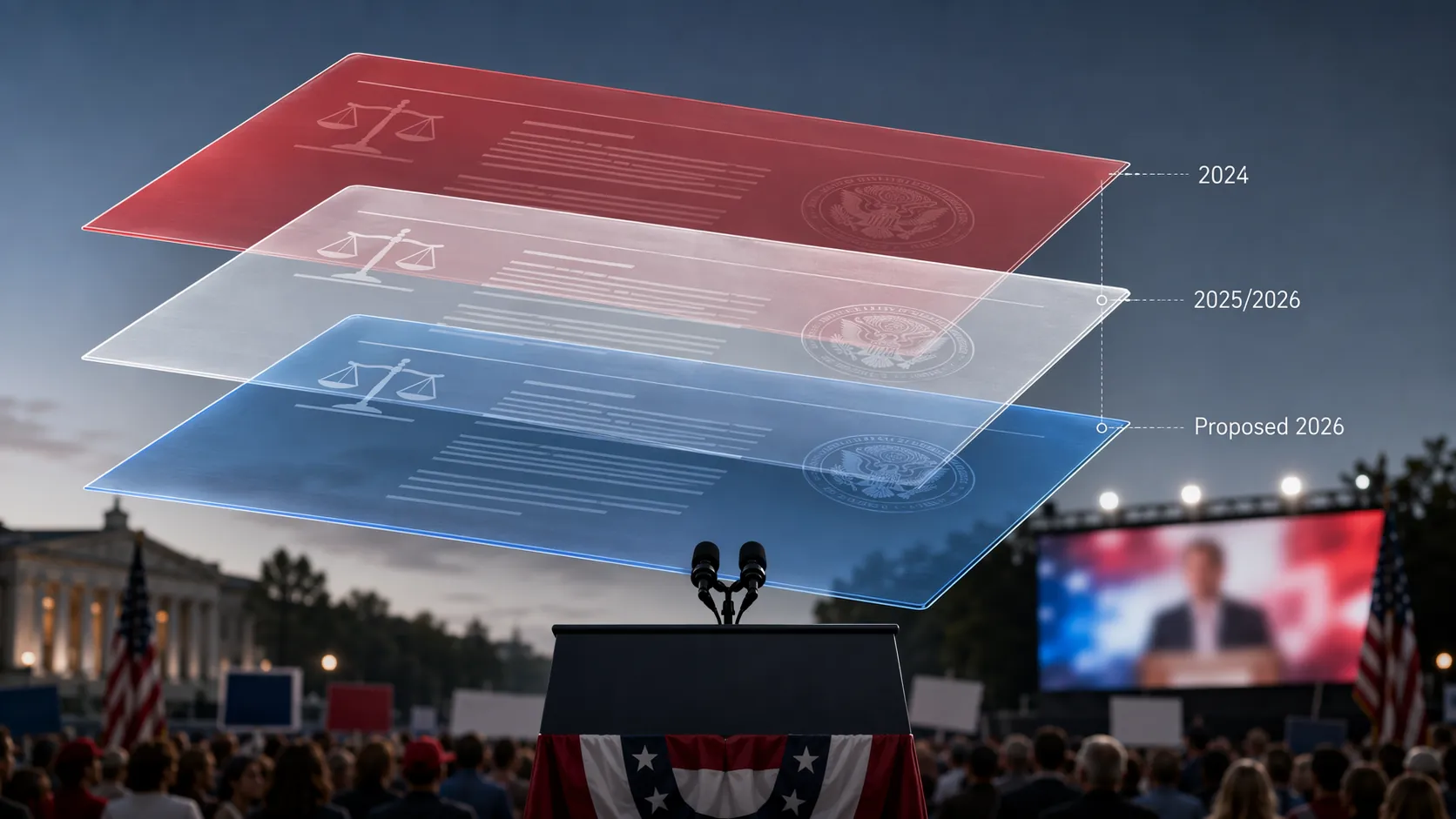
| Regulatory layer | Status as of Q3 2026 | What it reaches on paper | Penalty or remedy stated in available materials | Blakeman ad issue |
|---|---|---|---|---|
| Election Law §14-106 deceptive-media disclosure rule | Enacted; effective in 2024 | Materially deceptive media in election communications, with a parody or satire exception | $1,000 civil penalty | May South Park-style video tests whether cartoon parody avoids disclosure; July attack ad raises a cleaner disclosure-placement issue |
| Synthetic Performers Disclosure Law | Enacted in December 2025; effective June 2026 | Advertising using a synthetic performer, though available analysis describes a commercial orientation | $1,000 civil penalty for a first violation and $5,000 for later violations | July attack ad may look closer to an ordinary ad placement, but whether political attack ads fall within the law remains uncertain |
| Proposed 90-day candidate-image ban | Proposed by Governor Kathy Hochul in January 2026; unenacted as of Q3 2026 | AI-generated candidate imagery within 90 days of an election | Private right of action under the proposal | Would be a future blackout model, not an operative rule governing the May or July ads |
| Federal preemption pressure | Executive-branch pressure after December 2025 order; no reported filed challenge as of July 2026 | Potential challenges to state AI laws | No New York campaign-ad penalty by itself | Affects caution in advice, not current New York compliance wording |
The Disclosure Problem Starts With Where the Label Appeared
A social-platform label added after inquiry is not the same legal act as a disclosure placed in the communication. ABC7 reported in July 2026 that the Blakeman campaign defended its AI-generated ads and that a “Made with AI” tag appeared on X after media inquiry, not in the video itself.[1] If that is the compliance record, it is an awkward one: the campaign’s public cure is temporally late and physically outside the communication the statute is concerned with.
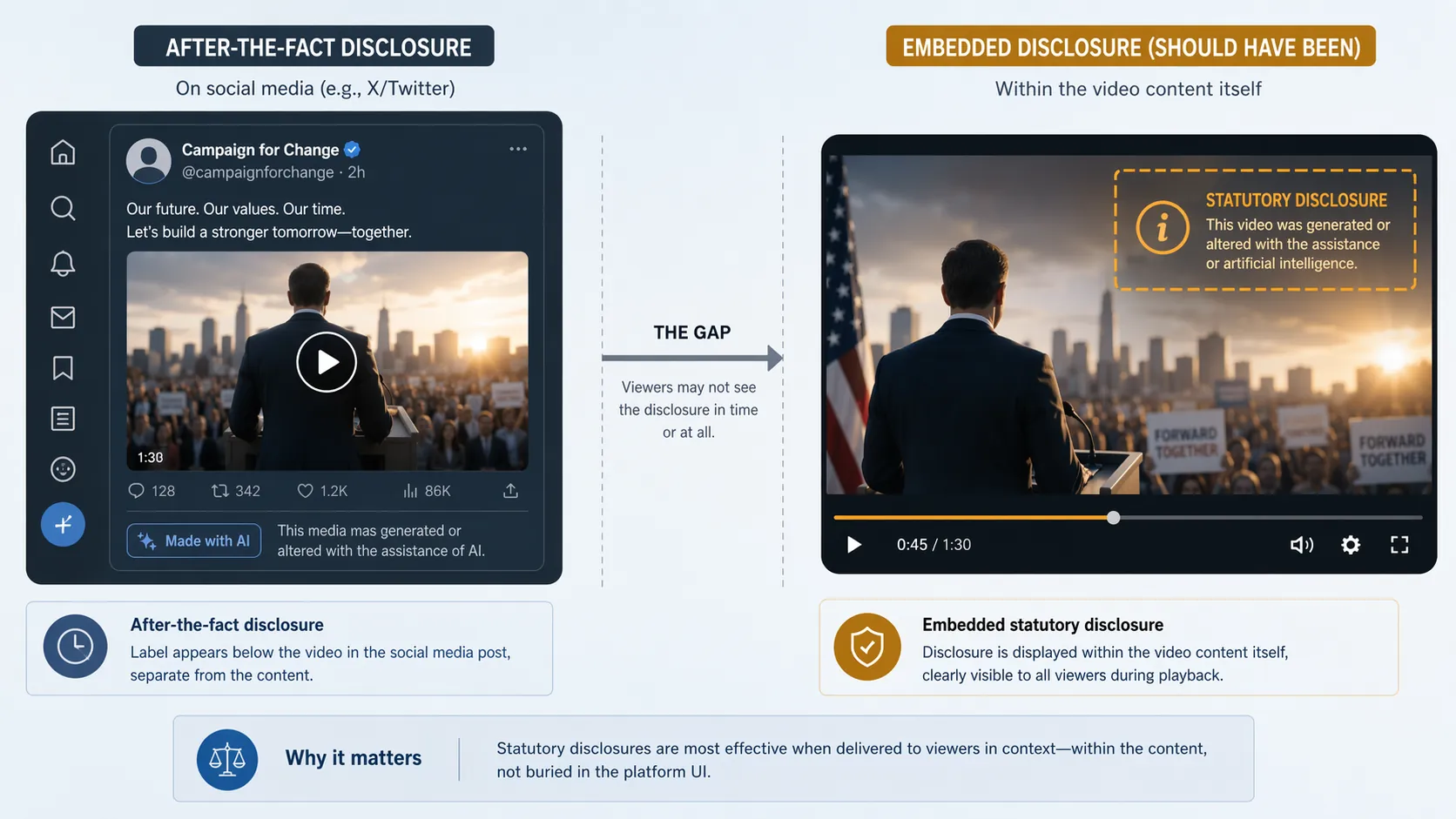
That distinction can feel fussy until a campaign is inside an ad deadline. A platform may apply or display its own AI label. A consultant may add a caption. A spokesperson may explain the joke to a reporter. None of those necessarily answers the narrower Election Law question: did the regulated communication itself carry the required disclosure at the time it was disseminated?
The practical consequence is that the lawyer reviewing the next cut should not treat post-publication labeling as a safe substitute. It may help the equities. It may reduce confusion. It may make a later enforcement decision less attractive. But on the available record, it does not erase the placement question that the Blakeman ads put in front of New York election counsel.
The May Parody Video Is the Harder §14-106 Test
The May 2026 video matters because it does not present the easiest version of a deceptive-media case. It used a South Park-style cartoon format, which gives a campaign an obvious parody argument. But election attorney Sarah Steiner told City & State New York that the audio would mislead the average viewer despite the cartoon presentation, putting pressure directly on the statute’s parody and satire exception.[2]
That is where the legal uncertainty sits. A cartoon visual can signal joke, exaggeration, or commentary. Synthetic audio can do something else at the same time: make a viewer think a candidate actually said words she did not say. If a court eventually has to read §14-106 against that kind of ad, the question may not be whether the whole piece is funny or crude. It may be whether the allegedly deceptive portion would cause an average viewer to misattribute a statement.
The available materials do not support saying that New York has already resolved that question. They support the opposite: the May video is a live example of a parody-coded synthetic ad that could still draw a disclosure argument. With no reported court interpretation of the parody defense and no reported Board of Elections guidance as of July 2026, counsel cannot honestly call the exception settled.
| Ad | Most relevant issue | Campaign argument likely available | Counterargument | Penalty exposure described in available materials |
|---|---|---|---|---|
| May 2026 South Park-style parody video | Whether synthetic audio in a cartoon parody still required an in-communication deceptive-media disclosure | The format was obvious parody or satire | The audio could mislead the average viewer about what Hochul said | $1,000 civil penalty under §14-106 if the disclosure rule applies |
| July 2026 “Criminals, Cronies, and Illegal Immigrants for Hochul” attack ad | Whether a later X label, rather than an in-video disclosure, satisfies the disclosure obligation | The AI use was publicly identified after inquiry and on the platform | The statute requires disclosure in the communication, and the cure was not contemporaneous on the reported facts | $1,000 civil penalty under §14-106; possible but uncertain Synthetic Performers exposure |
The $1,000 civil penalty is not large by modern statewide-campaign standards, but that is not the only reason campaigns care. A late-stage ad dispute can force edits, takedown requests, platform escalation, broadcaster review, emergency correspondence, and sworn factual positions that no one wanted to create over a social video. Small statutory penalties can still produce expensive operational problems.
The July Attack Ad Has Less Parody Cover
The July 2026 “Criminals, Cronies, and Illegal Immigrants for Hochul” ad presents a different posture. It may still use exaggeration and attack-ad convention, but it is less cleanly described as a cartoon parody test. That shifts attention away from whether the viewer understood a joke and toward the more mechanical question: where was the AI disclosure, and when was it there?
On the reported facts, the disclosure appeared only after media inquiry and only on X.[1] For clearance purposes, that is not a comforting fact pattern. It invites an agency or opposing counsel to say the campaign treated disclosure as a public-relations add-on rather than as a condition of dissemination. It also leaves open what happened on any other placement, repost, embedded version, downloaded copy, or paid distribution path not covered by the X tag.
The analysis should still stay narrow. The materials do not establish that New York authorities found a violation, issued a penalty, or ordered removal. They establish a compliance gap that would be hard to ignore in advice: if §14-106 applies, the safer placement is in the ad itself before it runs, not in a later platform-side notation.
The Synthetic Performers Law Adds Penalties, but Not Certainty
New York’s Synthetic Performers Disclosure Law adds a second enacted layer, but it does not map neatly onto campaign speech. Analyses by Skadden and Crowell & Moring describe the law as regulating advertising that uses synthetic performers, with civil penalties of $1,000 for a first violation and $5,000 for subsequent violations, and with the law effective in June 2026 after enactment in December 2025.[3][4]
That timing makes the July ad more interesting than the May video under this layer. The May video preceded the June 2026 effective date described in the available analyses. The July ad came after it. If the statute reaches the ad, the later spot is the cleaner temporal candidate for exposure.
The harder issue is scope. The available legal analyses frame the statute around advertising and synthetic performers, but also indicate a commercial orientation.[3][4] A political attack ad is plainly an ad in ordinary speech; it is not plainly a commercial advertisement in the way a product endorsement or brand campaign is. That gap is not wordplay. It affects who has to disclose, what creative must carry, and whether a campaign or media buyer faces the $1,000-to-$5,000 penalty structure.
Until an agency, court, or enforcement record says more, the Synthetic Performers law is best treated as a possible additional review item for post-June 2026 political creative, not as a settled political-ad rule. Counsel can flag it. Counsel should not overstate it.
Hochul’s 90-Day Ban Is a Proposal, Not a Governing Rule
Governor Hochul’s January 2026 proposal would have moved beyond disclosure by banning AI-generated candidate images within 90 days of an election and creating a private right of action.[5] That is a significant model for future disputes because it targets timing and candidate likeness directly, two points that disclosure statutes often leave to later argument.
But an unenacted bill does not govern a campaign ad. As of Q3 2026, the proposed 90-day blackout should not be cited as an operative obligation for the Blakeman ads. It belongs in a risk memo as a legislative signal and a possible future exposure path, not as the rule that decides whether the May or July videos were lawful.
The proposal also shows why disclosure-only regimes are under pressure. If lawmakers think an in-ad label is insufficient close to Election Day, they may try to regulate the use of synthetic candidate imagery itself. Whether that approach survives drafting, passage, enforcement, and constitutional challenge is a separate question; the current point is simpler. The blackout has not yet arrived.
Federal Preemption Is Background Pressure, Not a New York Defense Yet
The federal overlay should be handled with the same restraint. Analyses by Gibson Dunn and Sidley described President Trump’s December 2025 executive order as directing federal attention toward preemption challenges to state AI laws.[6][7] That matters because state AI regulation now sits under a visible federal shadow.
It does not, on the available record, eliminate New York’s enacted campaign-disclosure rule or the Synthetic Performers law. No filed challenge to these New York campaign-ad applications is identified in the supplied materials as of July 2026. The practical advice is therefore not to ignore state law, but to preserve the issue and avoid unnecessary concessions about statutory coverage where coverage is uncertain.
What Counsel Can Say in Q3 2026
For a New York campaign, PAC, media company, or agency, the defensible advice is a matrix rather than a verdict. The May parody video raises the unresolved §14-106 question: when synthetic audio is paired with cartoon parody, does the parody exception defeat the in-communication disclosure requirement? The July attack ad raises the cleaner placement question: does a later “Made with AI” tag on X cure the absence of a disclosure inside the video? The available record gives no reported enforcement answer to either.
- Treat §14-106 as the primary operative rule for New York election communications using deceptive synthetic media.
- Place any required AI disclosure inside the communication before dissemination, rather than relying on a later platform label.
- Do not assume parody resolves the issue when synthetic audio could be understood as an actual candidate statement.
- Review post-June 2026 ads for possible Synthetic Performers exposure, while noting the unsettled political-ad scope.
- Track Hochul’s 90-day blackout proposal as a future-risk item, not as current law.
- Preserve federal preemption arguments without treating them as a present exemption from New York compliance.
That is an unsatisfying answer for anyone looking for a clean campaign-season rule. It is, however, the record New York has built by Q3 2026: overlapping AI political-ad rules on paper, a real statewide-race test in the Blakeman-Hochul exchange, and still no Board of Elections guidance, no parody ruling, no reported enforcement action, uncertain commercial-ad scope, an unenacted blackout proposal, and federal preemption pressure that has not yet become a case deciding these ads.
References
- Nassau County Executive Bruce Blakeman defends use of AI-generated campaign ads; Gov. Hochul calls it lying, ABC7 NY, July 2026
- Hochul said what? Blakeman AI video may have violated election law, City & State NY, May 2026
- Two Newly Enacted New York Laws Will Regulate Use of AI-Generated Content in Advertising, Skadden, January 2026
- Synthetic Performers, Real Consequences: Implications of Trailblazing New York AI Ad Law, Crowell & Moring
- NY Gov. Hochul wants to ban AI images in political campaigns, Gothamist, January 2026
- President Trump’s Latest Executive Order on AI Seeks To Preempt State Laws, Gibson Dunn, December 2025
- Unpacking the December 11, 2025 Executive Order, Sidley, December 2025
Operationalizing workflow
No workflow has been explicitly linked to this obligation yet. See Workflows generally.
Illustrative cases
No illustrative case is currently tracked for this obligation. See Risk Digest for documented incidents generally.
← Back to RegulationReport a correction or tip
Spotted an outdated figure, a misstated fact, or a ruling this regulation entry should reflect? Public comments are disabled for this content given the professional cost of a misreported case outcome, penalty amount, or rule text — use the structured correction channel instead.
Report a correction or tip for this record →