
A House Majority Can Impeach Trump — but Not Remove Him
- Authority
- U.S. Constitution
- Rule type
- constitutional provision
- Jurisdiction scope
- US federal
- Source text
- Read primary rule text ↗
House impeachment requires a simple majority; removal requires a two-thirds Senate conviction.
When 2026 coverage says a Democratic House majority could “impeach Trump,” the verb needs careful handling. A majority in the House could approve articles of impeachment. It could not convict or remove the president. Those are separate Senate actions, and conviction requires two-thirds of senators—67 if all 100 senators vote.[1]

The 2021 vote shows where House power ends
Donald Trump’s second impeachment provides a direct example of the two chambers performing different constitutional functions. On January 13, 2021, the House approved one article of impeachment, for incitement of insurrection, by a recorded vote of 232–197, with four members not voting.[2]
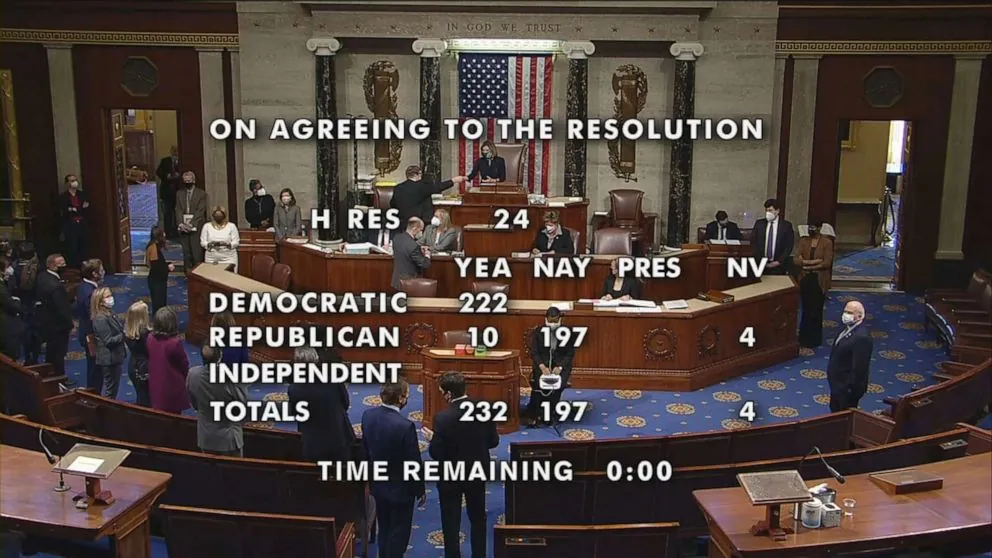
That vote completed the House’s decision to impeach. It did not remove Trump, impose a Senate judgment, or allow the House to substitute its vote for the Senate’s. The approved article became the charge considered in a separate Senate trial.
The supplied secondary account reports that 57 senators voted guilty, leaving the result 10 votes short of the required 67 and producing an acquittal.[2] A cataloged Senate roll-call page did not include a usable passage in the research materials, so the full two-sided Senate tally is not independently verified here. The relevant point is narrower: the guilty votes did not reach the two-thirds threshold.
| Stage | Chamber | Required action | What the action accomplishes |
|---|---|---|---|
| Impeachment | House | Simple-majority approval of one or more articles | Approves charges and allows them to proceed to the Senate |
| Trial and conviction | Senate | Two-thirds vote to convict | Supplies the judgment required for removal |
What a Democratic House majority could actually do
If Democrats obtained a House majority after the November 3, 2026 election, that result would enable them to organize and advance House business once the new Congress took office. On impeachment, the decisive authority would be the ability to bring articles before the chamber and pass them with a simple majority.
An article of impeachment states the alleged grounds on which the House seeks to charge an officeholder. The House may approve one article and reject another; the process does not require every proposed allegation to travel together. Once an article passes, the House has impeached the president on that article and can transmit the matter for Senate proceedings.
The threshold description used here rests partly on a secondary summary of the constitutional process rather than the primary text of Article I, which was not included in the supplied materials.[1] It supports the basic division of labor—a House majority brings charges, while two-thirds of the Senate is needed to convict—but should not be treated as a substitute for the Constitution or the chambers’ governing procedural authorities.
A member can use privileged procedure to force House action
The next question is not simply whether a party’s leaders want an impeachment vote. House procedure gives individual members a route for bringing an impeachment resolution before the chamber as a question of privilege. A procedural primer identifies Representative Al Green’s H.Res. 646 and H.Res. 705 during the 115th Congress as examples of impeachment resolutions raised through that mechanism.[3]
This means leadership cannot indefinitely prevent every form of floor action merely by declining to schedule an ordinary resolution. A member may invoke the privileged route and require the House to confront the matter.[3] That does not guarantee adoption of the articles. The chamber can act procedurally—including by voting to dispose of the resolution—rather than approving impeachment on its merits.
The distinction is important in political headlines. “Forcing a vote” may mean forcing members to take a recorded position on how the resolution will be handled. It does not necessarily mean that the only available vote is a final yes-or-no decision on impeachment itself. Nor does privileged status predetermine whether a majority will support the resolution.
The supplied procedural source is an expert primer, not the text of a House rule or a Congressional Record entry.[3] It verifies the existence and prior use of the route, but the available materials do not support broader claims that every procedural dispute would be resolved in a particular way.
The Senate threshold remains outside the House’s control
After the House approves an article, the central authority shifts to the Senate. House members may have initiated the case and approved the charge, but they cannot lower the Senate threshold or supply the votes needed there. Even a unanimous House impeachment vote would not amount to a Senate conviction.
A Democratic House majority could initiate and advance articles of impeachment, and privileged procedure could be used to force the House to act on an impeachment resolution. If an article won a simple majority, Trump would be impeached on that charge. Removal would still require a separate Senate conviction at the two-thirds threshold—67 of 100 senators—and a House majority cannot provide those Senate votes.
References
- U.S. Senate votes on presidential impeachment convictions 1868–2021, Statista.
- Second impeachment of Donald Trump, Wikipedia.
- A Primer on Impeachment Procedures in the House, Legislative Procedure, April 8, 2019.
Operationalizing workflow
No workflow has been explicitly linked to this obligation yet. See Workflows generally.
Illustrative cases
No illustrative case is currently tracked for this obligation. See Risk Digest for documented incidents generally.
← Back to RegulationReport a correction or tip
Spotted an outdated figure, a misstated fact, or a ruling this regulation entry should reflect? Public comments are disabled for this content given the professional cost of a misreported case outcome, penalty amount, or rule text — use the structured correction channel instead.
Report a correction or tip for this record →